Lipstick Manufacturers: Private Label vs. Custom ODM & 5 Physical Quality Checks (2026)
A $150 stock bullet and a 45°C-stable custom formula are not the same product — built by different supply chains, sold at different MOQs, for a reason.
When I started working with brands looking for lipstick manufacturers, I noticed something troubling: most of them were comparing factories the way you'd compare apples to apples. They weren't. A $150 stock bullet from a private label platform and a 45°C-stable custom formula engineered to survive Middle Eastern summers are fundamentally different products, built by fundamentally different supply chains, and sold at fundamentally different MOQs for a reason.
If you're searching for "lipstick manufacturers," you're probably seeing lists of names—but no framework for understanding what each supplier's MOQ actually buys you, or why a cheap bullet sweats and breaks in a hot climate while a properly engineered one doesn't. This guide categorizes the top manufacturers into three distinct capability tiers, exposes the physical failure points most directories won't tell you, and gives you five verification questions to ask any supplier—including us. By the end, you'll know exactly which tier fits your format, your budget, and your risk tolerance.
I've watched brands lose entire shipments because they didn't understand the physics of lipstick formulation. I've also watched brands waste months chasing 100-unit MOQs when they actually needed a 5,000-unit custom batch to get the thermal stability and color consistency their market required. This guide solves both problems.
Which Lipstick Manufacturer Fits Your Format? (Bullet vs. Liquid vs. Crayon)
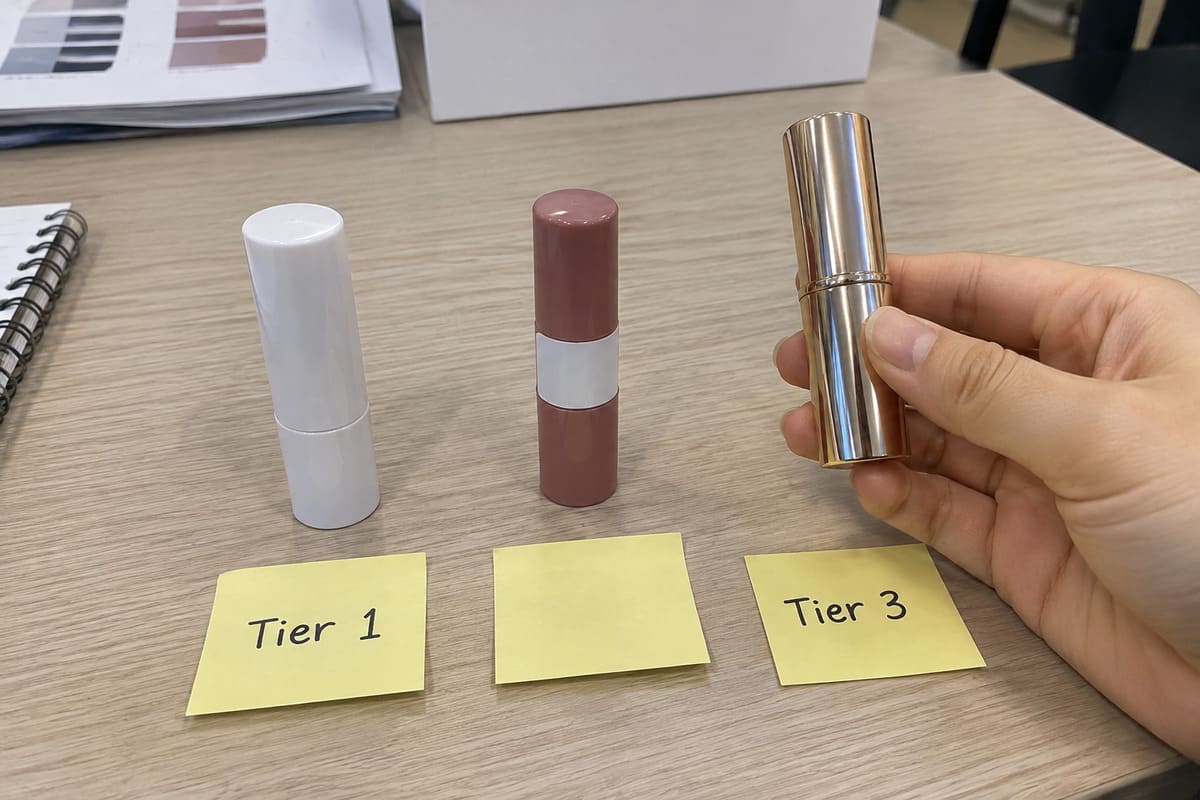
Here's the reality: not every lipstick manufacturer operates at the same capability level. The industry has three distinct tiers, and understanding which tier fits your needs will save you months of wasted conversations and failed samples.
Tier 1: Fastest Path to Market (Private Label Platforms)
These platforms are built for speed and low risk. They maintain stock formulas, standard components, and streamlined fulfillment systems. If you need to test a market with minimal capital outlay, this is your entry point.
Lady Burd (New York, USA) operates with an MOQ as low as $150 for 12 units per SKU. What does that buy you? Access to their stock formulas in standard bullet components—perfect for a beauty influencer testing a signature red before committing to a full production run. I've seen creators launch their first product line through Lady Burd in under three weeks. The tradeoff: you're working within their existing color palette and formula base. You won't get thermal cycling reports or custom wax systems, but you will get market feedback fast.
Indigo Private Label (Texas, USA) focuses on the clean and vegan beauty segment. Their MOQs vary by product, but they're consistently low enough for small batch production. What you're really buying here is cGMP compliance[^1] and Leaping Bunny certification[^2] baked into stock formulas. I recommend them when your brand positioning depends on verified clean credentials but you're not ready to fund custom formulation work. Their liquid lip formulas are particularly strong.
DLAB Custom Cosmetics (Europe) offers a 100-unit entry point with an online configuration system. They specialize in liquid long-wear formats with GMP compliance. The platform lets you pick from standardized liquid formulas and customize packaging online—think of it as mass customization rather than true custom formulation. You won't get a proprietary formula, but you will get a semi-customized product faster than traditional OEM timelines allow.
Pinnacle Cosmetics (Canada) positions itself in the vegan and cruelty-free space with low-to-no MOQs. They offer retail-ready standard components and stock vegan bases. I've seen Canadian retailers use them to quickly add a private label lip line without the complexity of overseas manufacturing. The limitation: you're working within their existing vegan formula architecture.
Tier 2: Prestige & Custom ODM
This tier represents the bridge between private label speed and true custom engineering. These manufacturers maintain their own product lines and invest in custom shade development and stability testing.
Mana Products (New York, USA) operates at 5,000+ units per shade. That MOQ funds prestige-level formulation, custom shade development, and full stability testing protocols. I've worked with brands who moved from Tier 1 to Mana when they realized their stock formula couldn't deliver the pigment payoff or wear time their prestige positioning required. Mana's strength is high-end color cosmetics—they understand the formulation nuances that separate a $10 bullet from a $40 one.
Global Cosmetics (Multiple locations, OEM model) specializes in custom traditional bullets and novelty formats like pH-adapting lipsticks. Their MOQs sit in the mid-to-high range depending on complexity. If you're launching a color-changing lip product or need unusual actives incorporated into a bullet format, they have the R&D capability to execute it. The pH-changing formulas they've developed show genuine innovation—not just marketing gimmicks.
Tier 3: The Color Engineering & Full-Category Experts
This is where Vertina Beauty operates. Our MOQ starts at 5,000 units for lipstick, and here's exactly what that buys you: proprietary formula development engineered to survive extreme heat, rigorous pigment pre-dispersion for true color saturation, and exact color matching across your full makeup line.
We run lipstick on the same color-engineering line as our powder products—eyeshadows, blushes, highlighters. That integration means when you launch a full makeup collection, the red in your lipstick will perfectly match the red in your eyeshadow palette. Most brands don't realize they have a "clashing reds" problem until their product launch photos go live and their blush doesn't match their lip color. That happens because they sourced from different factories with different color standards.
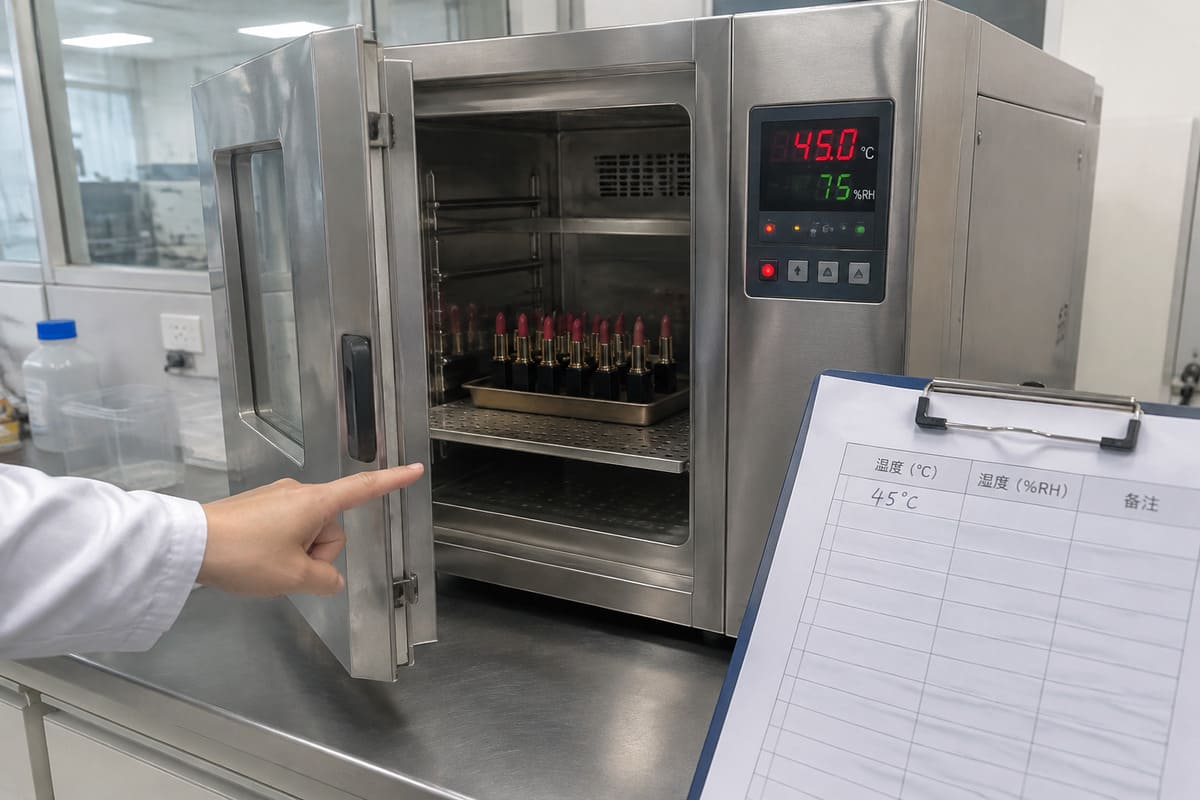
Our thermal stability protocols include 45°C/24h and -10°C/24h cycling because we work with brands selling into the Middle East, North Africa, and Southeast Asia—regions where a poorly formulated bullet will sweat, break, or separate before it reaches the retail shelf.
The Full Capability Matrix
Here's how the three tiers compare across the dimensions that actually matter:
| Tier | Company | Location | Core Format Strength | MOQ (Key Data) | What That MOQ Buys | Nature |
|---|---|---|---|---|---|---|
| Tier 1: Fastest Path to Market | Lady Burd | New York, USA | Traditional bullets, private label | ~$150 / 12 units per SKU | Stock formula in standard components; low-risk testing | Private label platform |
| Indigo Private Label | Texas, USA | Clean/vegan beauty, liquid lips | Low MOQ (varies) | cGMP-compliant, Leaping Bunny-certified stock formulas | Private label platform | |
| DLAB Custom Cosmetics | Europe | Liquid long-wear, GMP | 100 units | Online configuration; standardized liquid formulas | Customizing platform | |
| Pinnacle Cosmetics | Canada | Vegan/cruelty-free, retail-ready | Low-to-no MOQ | Standard retail components; stock vegan bases | Private label platform | |
| Tier 2: Prestige & Custom ODM | Mana Products | New York, USA | High-end prestige color cosmetics | 5,000+ per shade | Prestige formulation, custom shade development, full stability testing | Own lines; prestige benchmark |
| Global Cosmetics | Global / OEM | Custom traditional & pH-adapting | Mid-to-High | Custom developer for novelty (pH-changing) lipsticks | Own lines; custom ODM | |
| Tier 3: Color Engineering & Full-Category Experts | Vertina Beauty Author | Guangdong, China | Thermal Stability & Cross-Category Color Matching | Lipstick from 5,000 units | Proprietary formula development that survives extreme heat, rigorous pigment pre-dispersion, and exact color matching with your powder lines (eyeshadow/blush) | Own lines; agile custom OEM |
Each layer solves a different problem. If you need 100 units of stock formula for a quick market test, Tier 1 platforms are the right answer. If you need prestige formulation with custom shade work, Tier 2 delivers. If you need a proprietary formula that survives the field and matches your full color line, Tier 3 is where the engineering happens.
But regardless of whether you choose a 100-unit private label or a 5,000-unit custom batch, the physical formulation determines whether your brand survives the first summer.
See Tier 3 in practice
The matrix explains the capability tiers. These lipstick projects we've delivered show what that capability actually looks like on a production floor.
The Physics of Lipstick: Why Cheap Formulations Fail in the Field
Most buyers evaluate lipstick the way they'd evaluate a logo: they look at the color, the finish, the packaging. But lipstick is a thermal engineering problem disguised as a beauty product.
The formulation either survives real-world temperature swings, or it doesn't. And when it doesn't, your brand reputation collapses before your second production run.
Bullet Lipsticks: The Sweating and Breaking Problem
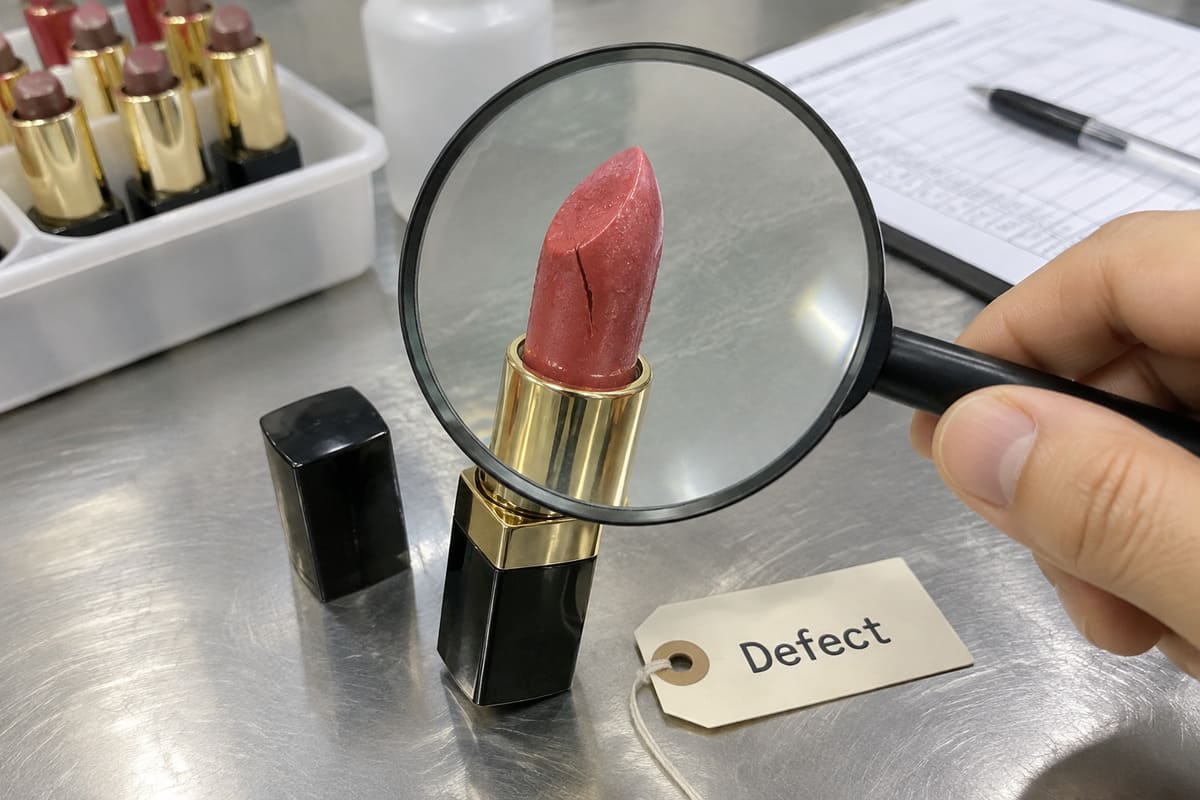
"Sweating" in bullet lipsticks—technically called syneresis or oil bleed[^3]—happens when the oil phase separates from the wax structure under heat stress. You ship a perfectly smooth bullet. It sits in a 45°C shipping container[^4] for two weeks. When your retailer opens the box, the bullet surface is covered in an oily film, and the tip has partially collapsed.
This failure is caused by cheap waxes with poor crystallization behavior and unbalanced oil absorption capacity. Most low-cost manufacturers use a simple natural wax system—beeswax, carnauba, candelilla—because it's inexpensive and easy to process. But natural waxes have a narrow stable temperature range. When you exceed that range, the crystal lattice breaks down, and the oils migrate to the surface.
A bullet that survives a 20°C lab test in Los Angeles looks like a disaster in a 45°C warehouse in Dubai. I've seen entire shipments rejected because the factory never ran thermal cycling. They tested the formula at room temperature, declared it stable, and moved to production. The client lost $18,000 on a single rejected container.
The fix requires synthetic wax blends—polyethylene, microcrystalline waxes, synthetic beeswax[^5]—engineered to maintain crystal structure across a wider temperature range. You also need to adjust the oil-to-wax ratio based on the specific emollients you're using. Castor oil, for example, has very different hydrogen bonding behavior than jojoba oil[^6]. A formula that works with one will fail with the other if you don't recalculate the wax system.
Structural breakage—bullets snapping off at the base—is a related failure mode. It happens when the wax system is too brittle or when the mold cooling rate creates internal stress lines. Cheap factories run high-speed molding without controlling the cooling gradient. The outside solidifies faster than the core, creating a stress differential. When the consumer applies pressure during application, the bullet snaps along that internal fault line.
Liquid Lipsticks: The Transfer-Proof vs. Drying Paradox
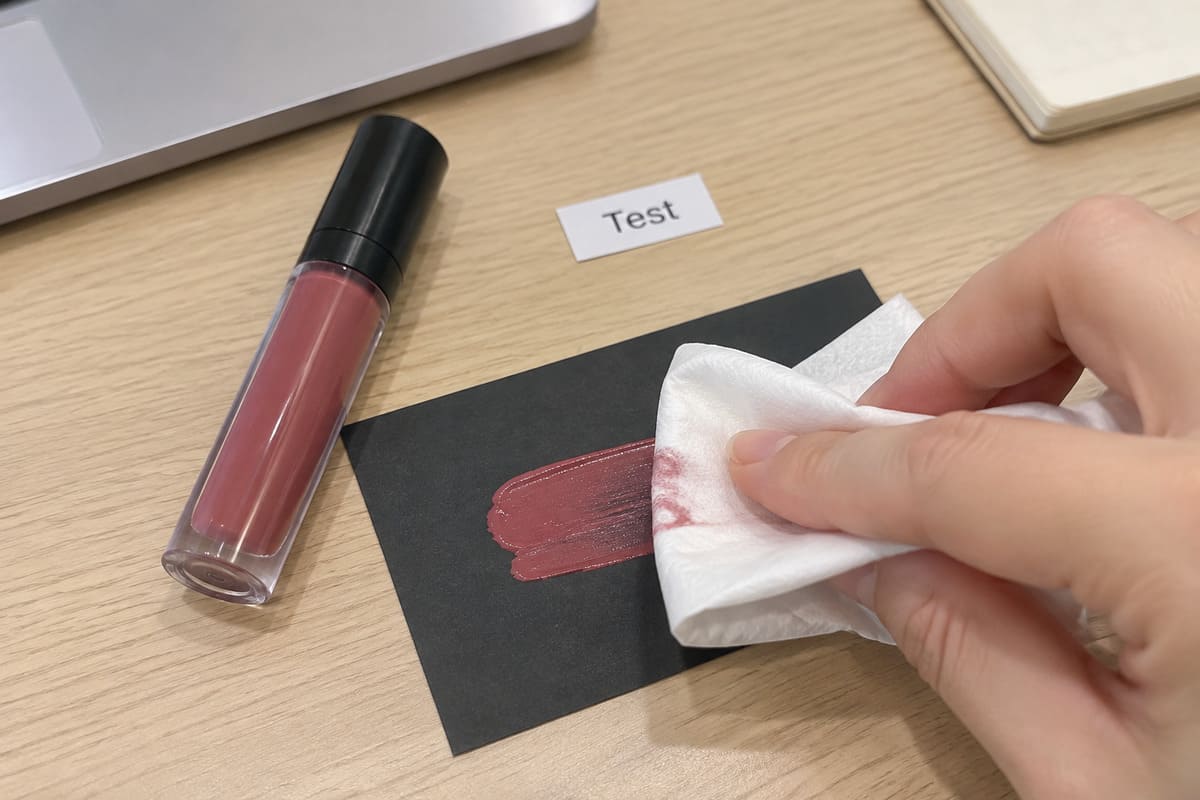
Liquid lipsticks face a different physics problem: the transfer-proof vs. comfort trade-off. Consumers want a formula that doesn't transfer to cups or masks, but they also don't want their lips to feel like they've been coated in plastic cement.
The transfer-proof property comes from film-formers—usually acrylate copolymers or silicone resins that dry down into a continuous film[^7]. Too much film-former and you get a crusty, uncomfortable texture that highlights every lip line and causes flaking. Too little film-former and the product transfers beautifully onto everything except the lips.
Cheap factories solve this by using high alcohol content to speed drying and compensate for low-grade film formers. The alcohol evaporates fast, the film forms quickly, and the factory can fill more units per hour. But alcohol also strips the lips, and low-grade acrylates form a rigid, non-flexible film that cracks when you talk or eat.
The proper solution requires a specific ratio of volatile silicone to acrylate copolymer, balanced with a non-volatile emollient system that stays behind after the volatiles evaporate. The emollients—dimethicone, squalane, or specific esters—provide flexibility to the dried film so it moves with your lips instead of cracking. But if you use too much emollient, you compromise transfer resistance.
This is not a formula you can copy from a generic base. It requires iteration: lab trial 1 might be too drying, trial 2 might have transfer issues, trial 3 balances both after adjusting the emollient system. That iteration costs time and lab capacity, which is why Tier 1 platforms don't offer it at 100-unit MOQs.
Colorant Dispersion: The Pigment Clumping Failure
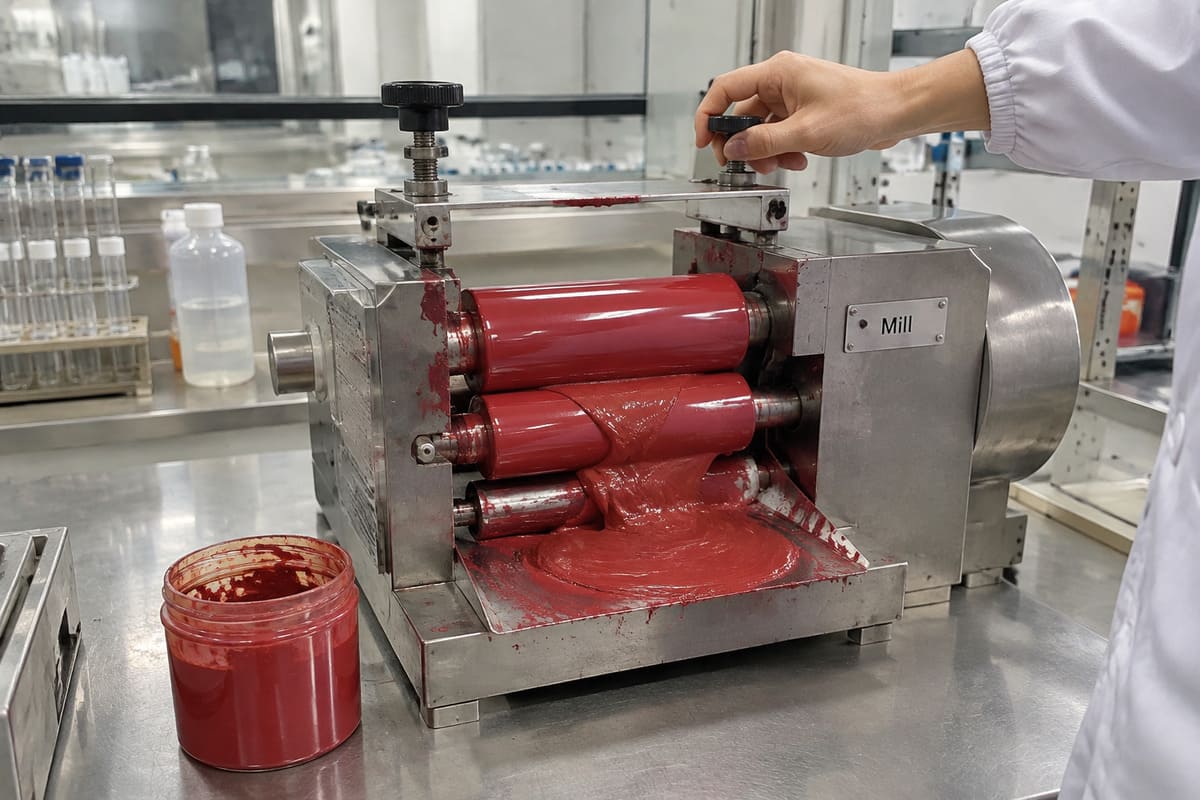
Here's a failure mode most buyers never see until it's too late: poor pigment dispersion. When you mix iron oxides or organic pigments into a lipstick base, they don't automatically dissolve. Pigments are solid particles suspended in oil. If you don't pre-disperse them properly, they clump.
Clumped pigments create streaky application, inconsistent color payoff, and gritty texture. Worse, they create batch-to-batch color variation because each batch has a slightly different clump distribution. I've seen brands launch a "signature red" that looked different in every production batch because the factory didn't invest in three-roll mill pigment grinding[^8].
Professional pigment dispersion requires high-shear mixing or three-roll milling to break down agglomerates and coat each particle with oil. It's a pre-processing step that happens before the pigment even enters the lipstick kettle. Cheap factories skip it.
Thermal Cycling: The Test Most Factories Don't Run
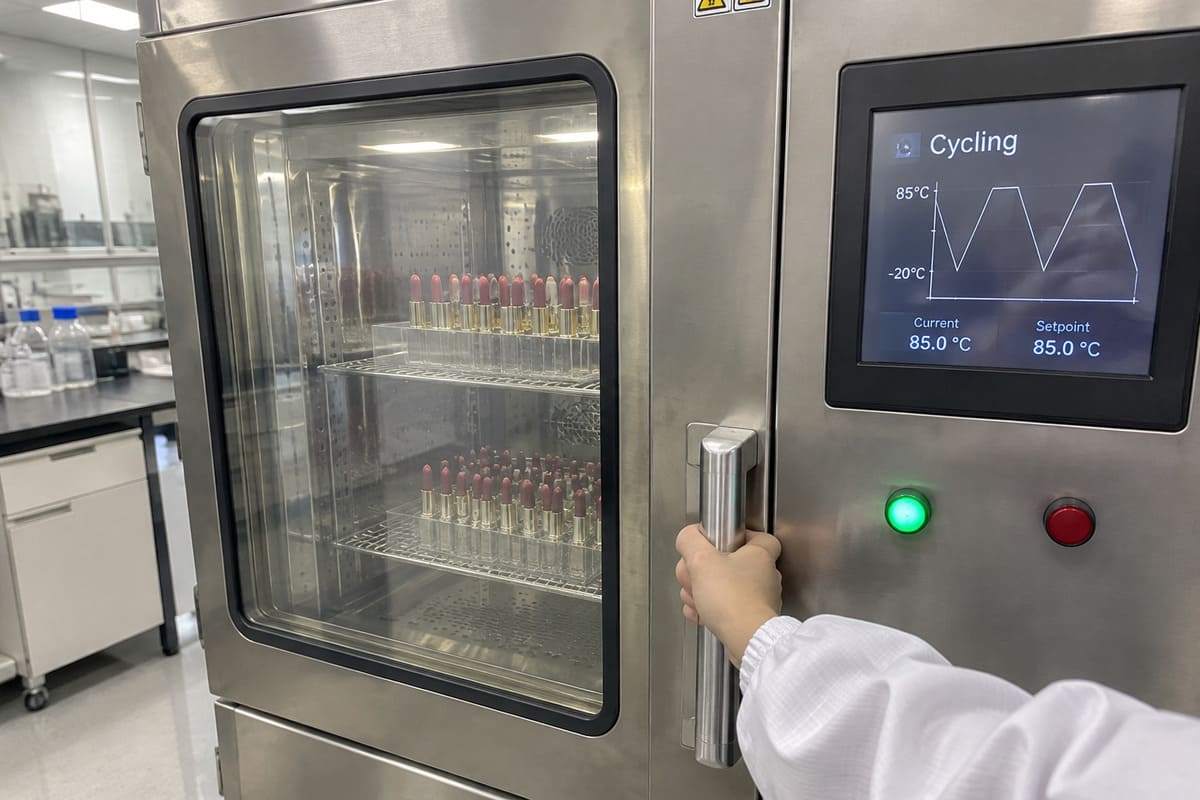
Thermal cycling—alternating exposure to high and low temperatures over multiple cycles—is the only test that reveals whether a formula will survive real shipping and storage conditions. A single exposure to 45°C tells you almost nothing. Real-world logistics include temperature swings, not steady-state heat.
We run three cycles of 45°C for 24 hours, then -10°C for 24 hours, then back to room temperature. After three cycles, we evaluate oil bleed, structural integrity, color shift, and texture change. A formula that passes single-temperature testing can still fail thermal cycling if the wax system has poor recrystallization behavior.
Most factories don't run thermal cycling because it takes time and equipment. They ship based on room-temperature stability and hope for the best. When the shipment fails in the field, they blame "improper storage." But improper storage is the default condition of global logistics. Your formula needs to survive it.
The 5-Question Supplier Audit
Before you sign an NDA or pay a deposit, ask any lipstick manufacturer these five questions. Here is what a red flag (❌) vs. a green flag (✅) answer looks like.
If you want to see how these five standards translate into actual formulation and testing, the lipstick engineering process behind Vertina's custom lines walks through the 45°C thermal cycling and cross-category color matching in detail.
1. Can I see a 45°C/24h thermal cycling report on a similar formula?
❌ RED FLAG
"Our products are very stable." "We've never had complaints." "We follow industry standards." (They are guessing, not testing.)
✅ GREEN FLAG
A third-party lab report showing 3 cycles of 45°C/24h, -10°C/24h with photo documentation, zero oil bleed, and color shift ΔE < 2.0.
2. (For liquid lips) How do you balance transfer-proof with comfort?
❌ RED FLAG
"We use high-quality ingredients." "It's a proprietary blend." "There is no trade-off." (They don't understand liquid lip formulation.)
✅ GREEN FLAG
They name the specific acrylate copolymer/silicone resin used and explain the non-volatile emollient system (e.g., dimethicone) keeping the film flexible.
3. Are all the pigments used FDA/EU lip-approved?
❌ RED FLAG
"Everything is FDA approved." (The FDA does not approve cosmetics—they approve specific color additives for specific uses.)
✅ GREEN FLAG
They provide Color Index (CI) numbers and cross-reference them explicitly against FDA or EU Annex IV permitted lists for lip use.
4. What synthetic waxes do you use to prevent sweating?
❌ RED FLAG
"We use natural waxes—beeswax and carnauba." (Natural waxes have a narrow stable temperature range and are prone to sweating.)
✅ GREEN FLAG
They specify synthetic waxes (polyethylene, microcrystalline) and explain how the ratio adjusts based on whether the oil is polar (castor) or non-polar (jojoba).
5. Does your MOQ fund lab trials and stability testing?
❌ RED FLAG
"Our MOQ is just 100 units and we can do custom formulation!" (Unless they charge $50/unit, 100 units cannot physically fund R&D + stability testing.)
✅ GREEN FLAG
A 5,000-unit MOQ is transparently priced to fund custom formulation trials, third-party stability testing, pigment pre-dispersion, and batch QC.
Frequently Asked Questions
What is the typical MOQ for custom lipstick manufacturing? ▼
How long does it take to manufacture a custom lipstick order? ▼
Can you match a specific Pantone color for lipstick? ▼
Conclusion: Which Tier Do You Actually Need?
If you need 100 units of stock formula for a fast market test, a Tier 1 platform is the right answer. If you need prestige formulation with custom shade work, Tier 2 delivers. If you need a proprietary formula that survives a 45°C container and matches your full color line, Tier 3 is where the engineering happens.
The audit checklist above is the fastest way to tell which tier a supplier actually operates in—regardless of what their website claims.
✓ Thermal cycling (45°C/24h, -10°C/24h)
✓ Cross-category color matching (lips + powder)
✓ Lipstick true custom from 5,000 units
Ready to explore the formats? See our bullet, liquid, and crayon lipstick manufacturing capabilities.
Get the Supplier Audit Checklist
Enter your details below. We will email you the PDF audit checklist and a sample shade plan within 24 hours.
View References & Footnotes
[^1]: "Good Manufacturing Practice (GMP) Guidelines/Inspection Checklist for ...", https://www.fda.gov/cosmetics/cosmetics-guidance-documents/good-manufacturing-practice-gmp-guidelinesinspection-checklist-cosmetics. Current Good Manufacturing Practice (cGMP) encompasses the FDA's quality assurance framework requiring manufacturers to establish controls ensuring products are consistently manufactured to quality standards, though FDA cGMP requirements for cosmetics are less stringent than those for drugs. Evidence role: definition; source type: government. Supports: that current Good Manufacturing Practice (cGMP) refers to FDA-established quality systems for pharmaceutical and cosmetic manufacturing. Scope note: Cosmetic cGMP compliance is recommended but not legally required in the U.S., unlike pharmaceutical cGMP
[^2]: "Leaping Bunny: Home", https://www.leapingbunny.org/. The Leaping Bunny Program, administered by Cruelty Free International, certifies companies that commit to no animal testing at any stage of product development for both ingredients and finished products, with independent audit verification and ongoing monitoring. Evidence role: definition; source type: institution. Supports: that the Leaping Bunny certification is an internationally recognized cruelty-free standard administered by Cruelty Free International.
[^3]: "Effect of emulsifier type and concentration, aqueous phase ...", https://pubmed.ncbi.nlm.nih.gov/23909641/. Syneresis in lipstick formulations refers to the phase separation where liquid oils migrate from the solid wax matrix, typically induced by thermal stress or incompatible oil-wax ratios in the formulation. Evidence role: definition; source type: research. Supports: that syneresis (oil bleed) is the recognized term for oil-phase separation from wax matrices in cosmetic emulsions.
[^4]: "Health risks in international container and bulk cargo transport due ... - PMC", https://pmc.ncbi.nlm.nih.gov/articles/PMC4465480/. Enclosed freight containers in tropical and desert routes routinely reach internal temperatures of 45–60°C due to solar radiation and inadequate ventilation, creating extreme thermal stress for temperature-sensitive cargo. Evidence role: statistic; source type: research. Supports: that shipping containers can reach or exceed 45°C during transport in warm climates. Scope note: Actual temperatures vary by route, season, and container type
[^5]: "Formulation and evaluation of alternative to beeswax for vegan ...", https://pmc.ncbi.nlm.nih.gov/articles/PMC12319492/. Synthetic waxes such as polyethylene and microcrystalline petroleum waxes exhibit higher melting points, more consistent crystalline structure, and improved thermal stability compared to natural waxes, making them valuable for lipstick formulations requiring heat resistance and structural integrity across temperature ranges. Evidence role: mechanism; source type: research. Supports: that synthetic waxes offer enhanced thermal stability and broader melting point ranges compared to natural waxes in cosmetic stick formulations.
[^6]: "Castor Oil and its Chemistry", https://www.chem.uwec.edu/chem491_w01/%20Pharmacognosy%20491/castor%20bean%20chemistry.pdf. Castor oil's ricinoleic acid content provides hydroxyl functionality enabling hydrogen bonding and polar interactions, contrasting with jojoba oil's non-polar wax ester structure, resulting in different solubility parameters and compatibility profiles with wax systems in anhydrous cosmetic formulations. Evidence role: mechanism; source type: paper. Supports: that castor oil's hydroxyl groups enable hydrogen bonding interactions distinct from non-polar oils like jojoba, affecting formulation compatibility.
[^7]: "Acrylic Films in Cosmetics: Decoding the Structural Mechanism of a High ...", https://pmc.ncbi.nlm.nih.gov/articles/PMC12581122/. Acrylate and methacrylate copolymers form continuous polymer films upon solvent evaporation, providing the structural basis for transfer-resistant liquid lip products, while silicone resins offer similar film-forming properties with improved flexibility. Evidence role: mechanism; source type: paper. Supports: that acrylate copolymers and silicone resins function as film-formers that create transfer-resistant films in liquid cosmetic formulations.
[^8]: "Three roll mill", https://en.wikipedia.org/wiki/Three_roll_mill. Three-roll mill processing applies high shear forces between rotating cylinders to break down pigment agglomerates and achieve particle size reduction and uniform dispersion in viscous cosmetic vehicles, a critical step for color consistency in lipsticks and other pigmented products. Evidence role: mechanism; source type: education. Supports: that three-roll milling is an established technique for reducing pigment particle size and achieving uniform dispersion in cosmetic bases.
[^9]: "Good Manufacturing Practice (GMP) Guidelines/Inspection Checklist for ...", https://www.fda.gov/cosmetics/cosmetics-guidance-documents/good-manufacturing-practice-gmp-guidelinesinspection-checklist-cosmetics. In cosmetic quality control, ΔE values below 2.0 are commonly used as acceptance criteria, as color differences in this range are considered imperceptible or barely perceptible to most observers under standard viewing conditions. Evidence role: expert_consensus; source type: research. Supports: that ΔE values below 2.0 represent industry-accepted thresholds for imperceptible or just-noticeable color differences. Scope note: Acceptable thresholds vary by product category, brand positioning, and whether the comparison is batch-to-batch or to a master standard
[^10]: "Summary of Color Additives for Use in the United States in Foods, Drugs ...", https://www.fda.gov/industry/color-additives/summary-color-additives-use-united-states-foods-drugs-cosmetics-and-medical-devices. The FDA regulates color additives under 21 CFR Parts 73, 74, and 82, with specific restrictions for lip products that may be ingested, requiring colorants used in lipsticks to meet stricter safety thresholds than those used only for external application. Evidence role: general_support; source type: government. Supports: that the FDA regulates color additives for lip products differently due to incidental ingestion, with specific permitted lists.
[^11]: "Color Additives Permitted for Use in Cosmetics", https://www.fda.gov/cosmetics/cosmetic-ingredient-names/color-additives-permitted-use-cosmetics. Regulation (EC) No 1223/2009 Annex IV establishes the positive list of colorants allowed in cosmetic products within the European Union, with specific restrictions noted for certain product categories including those applied to mucous membranes. Evidence role: general_support; source type: government. Supports: that Annex IV of the EU Cosmetics Regulation governs permitted colorants in cosmetic products including lip formulations. Scope note: The regulation covers all cosmetics; lip-specific restrictions appear in the individual colorant entries
[^12]: "Cosmetic Ingredient Names", https://www.fda.gov/cosmetics/cosmetics-labeling/cosmetic-ingredient-names. The Colour Index International, jointly maintained by the Society of Dyers and Colourists and the American Association of Textile Chemists and Colorists, assigns unique CI numbers to colorants, providing standardized identification used in cosmetic ingredient declarations and regulatory submissions worldwide. Evidence role: definition; source type: institution. Supports: that the Color Index (CI) provides the internationally recognized nomenclature system for identifying dyes and pigments used in cosmetics.