Top Cosmetic Manufacturers for Beginners [2026 Guide]
Don't let low MOQ traps ruin your first launch. Discover the tiered path to building a real brand, from risk-free testing to true custom formulation.
Finding the right cosmetic manufacturers for beginners feels impossible when every factory promises the lowest minimums and the fastest shipping. You have savings on the line. You are terrified of ordering 500 units that sit in a closet forever. That fear pushes most first-timers toward the cheapest option, and that choice quietly sets up the failure they dread. I want to help you avoid it.
The best cosmetic manufacturers for beginners are not the ones with the lowest minimum order. They are the ones that keep you compliant and let you build a real brand later. Start by testing the market with ready-stock or safe private label products, then move to true custom formulation once demand is proven. That tiered path protects your budget and your brand.
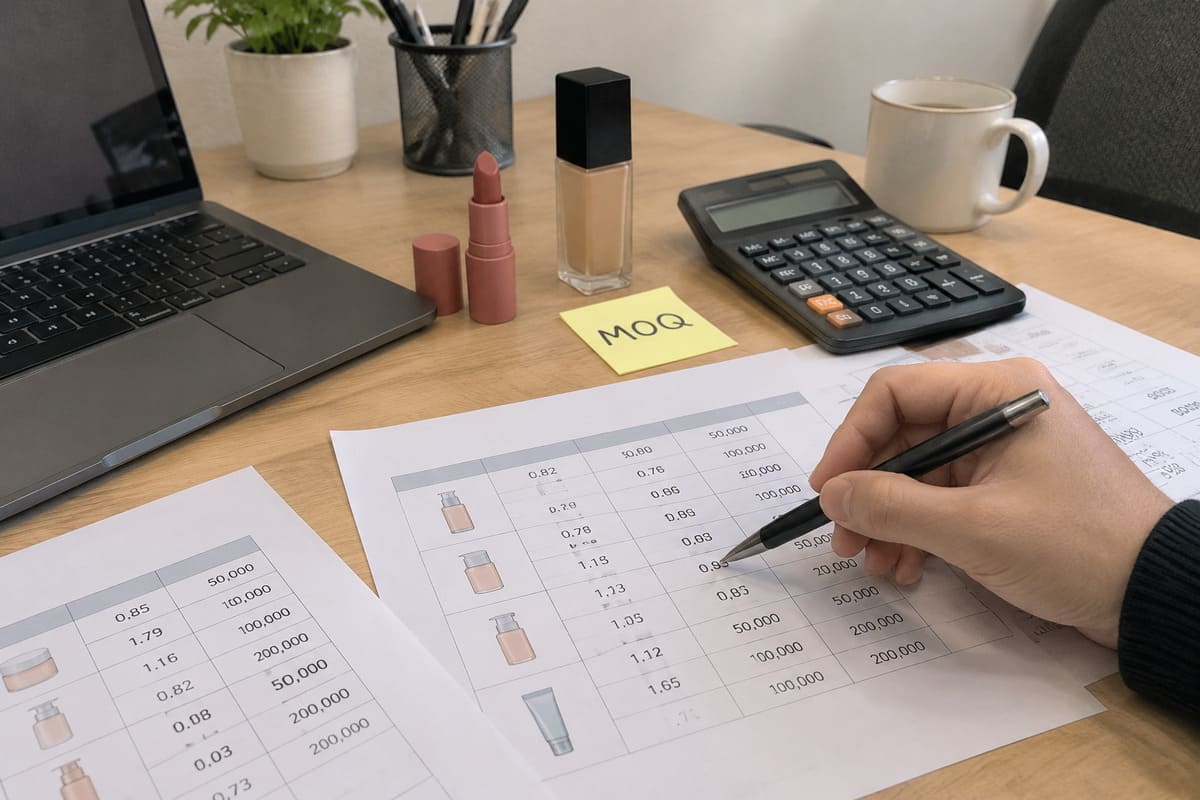
Most guides just hand you a list and wish you luck. I want to do more than that. Below I rank ten real factories, explain white label versus private label, hand you an outreach email template, and walk through the compliance mistakes that get listings banned. Keep scrolling, because the order you do these things in matters more than the list itself.
The 2026 Top 10 Cosmetic Manufacturers for Beginners (Ranked)
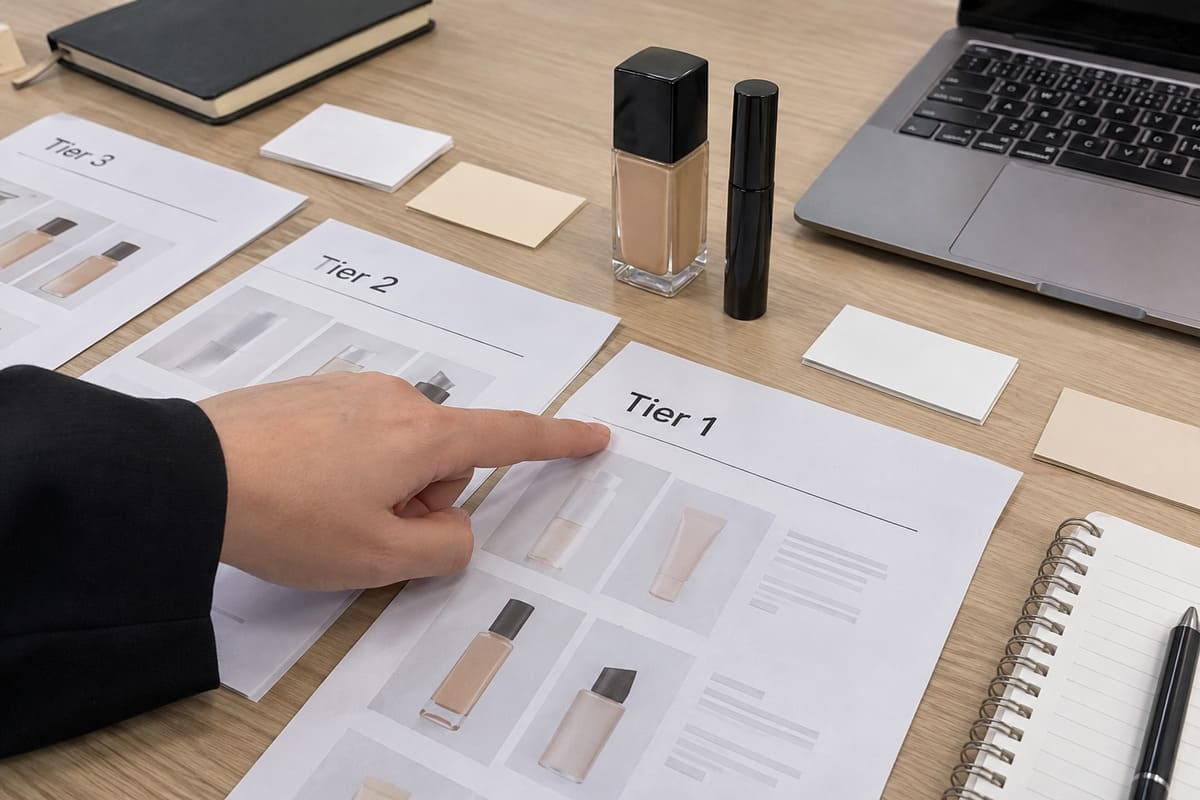
You searched for a list, so here it is first. I grouped these ten cosmetic manufacturers for beginners into three tiers, because a factory that is perfect for a $500 test is the wrong choice for a brand you plan to scale. The tier tells you the job each factory does best.
The ten manufacturers below fall into three tiers: Tier 1 for ultra-low MOQ testing, Tier 2 for agile small-batch private label, and Tier 3 for true custom formulation. Tier 1 gets you to market fastest with zero exclusivity. Tier 3 builds brand equity. Match the tier to your current stage, not your dreams.
Tier 1: Ultra-Low MOQ & Dropshipping (For Testing Only)
| Manufacturer | Location | Best For | MOQ Reality |
|---|---|---|---|
| Blanka | Canada | Dropship & white label testing | 1 unit; zero exclusivity |
| ViaGlamour | Canada | Shopify sellers, vegan lines | Very low; dropship, stock formulas |
| Indigo Private Label | USA | First-time founders | No minimum; stock formulas only |
| Lady Burd | USA | Fast market tests | ~$150 stock order; public molds |
Tier 1 factories are genuinely useful for one job: confirming whether anyone will click "buy." You print your logo on an existing product and sell it this week. The trade-off is that your product is identical to dozens of other new brands using the same stock formula and public mold.
Tier 2: Agile Mid-Sized Factories (For Small-Batch Private Label)
| Manufacturer | Location | Best For | MOQ Reality |
|---|---|---|---|
| Dynamic Blending | USA | Skincare & haircare | Low MOQ private label |
| Columbia Cosmetics | USA | Color cosmetics & skincare | Moderate, flexible |
| Cosmetic Solutions | USA | Natural & organic skincare | Moderate; formula tweaks |
| Radical Cosmetics | USA | Color cosmetics, family-owned | Moderate |
| Pinnacle Cosmetics | Canada | Makeup & skincare | Moderate |
Tier 2 factories let you adjust a stock formula, pick a shade range, and choose better packaging. You get more differentiation than Tier 1, at a higher minimum and a longer lead time.
Tier 3: True Customization
| Manufacturer | Location | Best For | MOQ Reality |
|---|---|---|---|
| Vertina Beauty | China / Global | Exclusive custom formulation, cosmetics makeup | 2,000 pcs powder / 5,000 pcs skincare; full FDA/MoCRA support; ready-stock lines for testing |
I run Vertina, so I will be plain about where we sit. We are the true customization tier. We are not the right first stop if your only goal is 50 logo-printed units this month. We are where you go when you have proven demand and want shades that belong only to you. More on that path later.
White Label vs. Private Label: What Should Beginners Choose?
You keep seeing both terms, and factories use them loosely, so you end up confused about what you are actually buying. That confusion costs money, because white label and private label carry very different risks and minimums. Let me separate them cleanly.
White label means you buy an existing stock product and print your logo on it. It is fast, cheap, and carries zero exclusivity. Private label means you customize a stock formula, shade, or packaging to make it more your own. It costs more and requires higher minimums, but the product feels less generic. Choose white label to test, private label to differentiate.
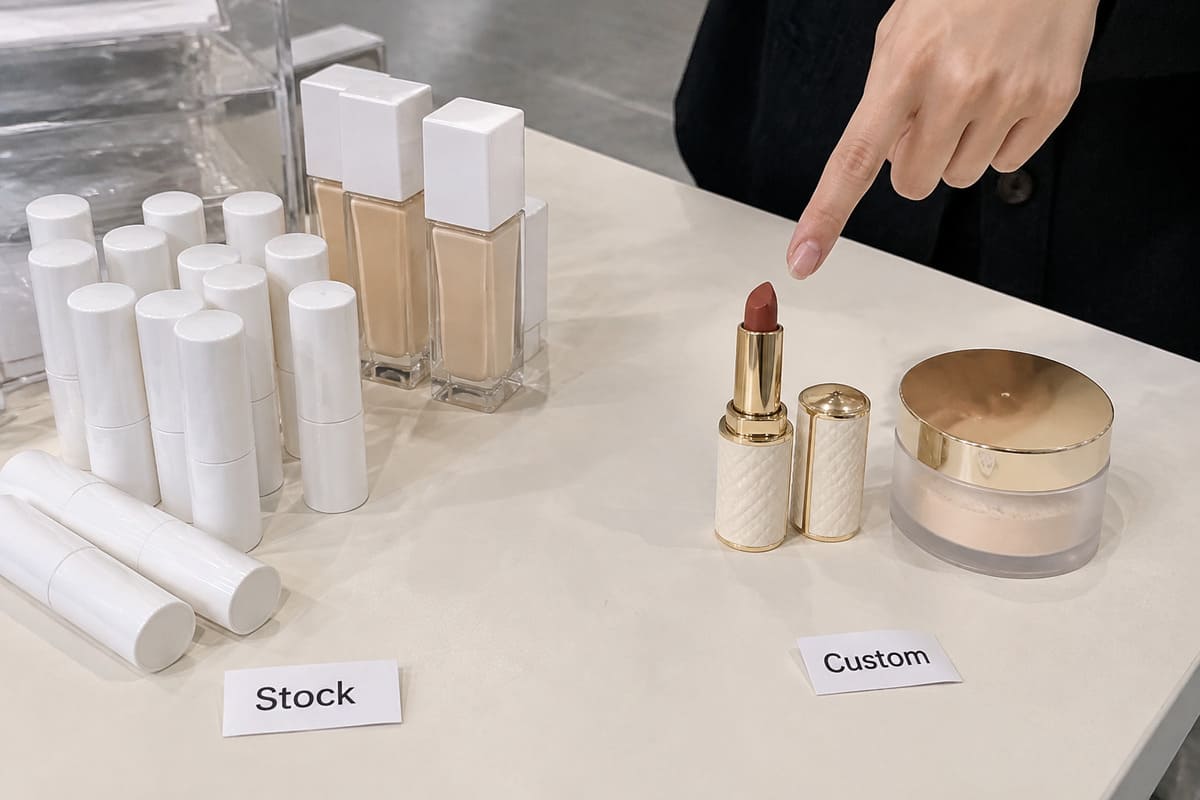
Here is how I explain it to founders who message me for the first time. The two models answer different questions. White label answers "will anyone buy this?" Private label answers "can I stand out a little?" Neither answers "can I own a unique product?" Only true custom formulation does that.
| Factor | White Label | Private Label |
|---|---|---|
| What you get | Stock product + your logo | Modified stock formula/shade/packaging |
| Typical MOQ | 1–100 units | 500–3,000 units |
| Exclusivity | None | Partial |
| Lead time | Days | 3–6 weeks |
| Best for | Market validation | Early differentiation |
| Main risk | Identical competitors | Still shares a base formula |
A simple budget rule. If you have under $1,000 and have never sold a cosmetic before, start white label. Prove the concept. If you have early traction and $3,000 to $8,000, private label gives you a cleaner identity while you grow. Do not borrow money to jump straight to custom formulation. Earn your way there with real sales data. I have watched founders skip validation, order 3,000 units of a shade they loved, and discover their customers wanted something else entirely.
One caution worth repeating: treat every "organic," "vegan," or "clean" claim a factory makes as a document you must verify, not a promise you can resell. Ask for the supporting paperwork and, for any health or safety claim, get a qualified regulatory professional to review it for your specific market.
How to Contact Factories & Test Samples (With a Free Email Template)
You found some factories, and now the blank email sits there. You do not know what to ask, so you send a vague "please send info" message and get a vague reply or none at all. A weak first email filters you straight into the ignore pile. A sharp one gets you a catalog and a quote the same day.
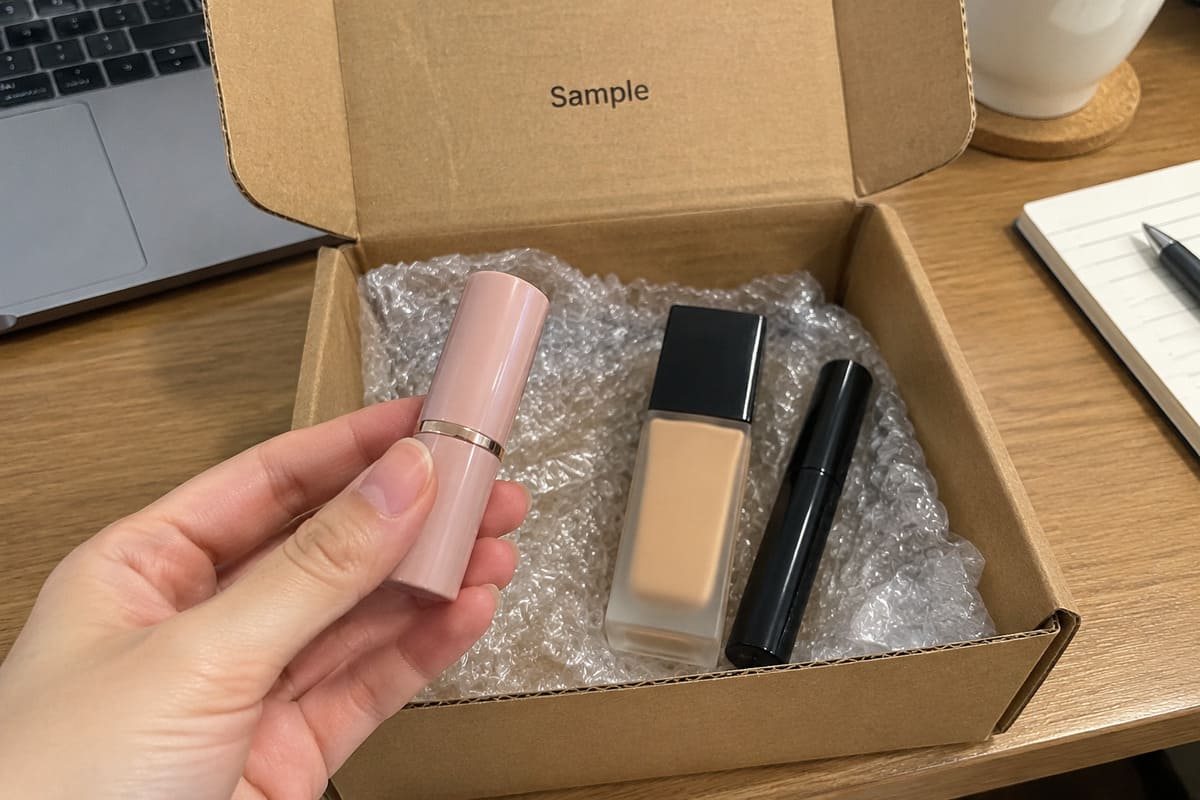
To contact a cosmetic factory effectively, send one clear email that states your product, target market, estimated first order, and three specific requests: a product catalog, the real MOQ and unit price, and a paid sample. Factories that reply within 24–48 hours with specifics are worth pursuing. Vague or slow replies predict vague and slow production.
Copy this template and fill in the brackets.
Subject: Private Label Inquiry — [Eyeshadow Palette] for [US / EU] Market
Hello [Factory Name] team,
I am launching a [color cosmetics] brand targeting [market]. I am evaluating suppliers for an initial order of roughly [500] units, with repeat orders if the product performs.
Could you please send me:
1. Your current product catalog with stock options.
2. Your MOQ and unit price at [500] and [2,000] units.
3. A paid sample of [product], shipped to [country].
I also need to confirm you can support [MoCRA / EU] compliance for my market. Please share what documentation you provide.
Thank you,
[Your name, brand, website]
What to check when the sample arrives
- Texture and payoff. Powder should not fly off or crumble. Swatch it. A good powder shows strong color in one or two passes.
- Color consistency. Order the same shade twice if you can. Batch-to-batch color drift will haunt you when customers compare units.
- Packaging quality. Open and close the compact fifty times. Cheap hinges break in transit and generate returns.
- Smell and settling. A chemical smell or product that has separated signals a weak formula or old stock.
How to judge the factory itself
| Signal | Good sign | Warning sign |
|---|---|---|
| Reply speed | Within 24–48 hours | Days of silence |
| Answers | Specific MOQ, price, lead time | "It depends," no numbers |
| Compliance | Offers documentation, asks your market | Dismisses the question |
| Samples | Willing to send paid samples | Refuses or stalls |
I treat the sample stage as an interview for both sides. How a factory communicates before you pay predicts exactly how it communicates when a shipment is late.
The Hidden "Beginner Trap": Why Ultra-Low MOQ Factories Cost You More
Here is the part nobody selling you a 50-unit minimum wants to say out loud. The ultra-low MOQ that feels so safe is often the most expensive mistake a beginner makes. You think you are reducing risk. You are actually buying a product that cannot win.
Ultra-low MOQ factories rely on stock formulas and public molds, which means your "new brand" is physically identical to dozens of others. When products are identical, the only lever left is price, so you get dragged into an Amazon price war you cannot win. The cheap entry fee leads to an expensive, slow failure. Low MOQ is a testing tool, not a brand strategy.
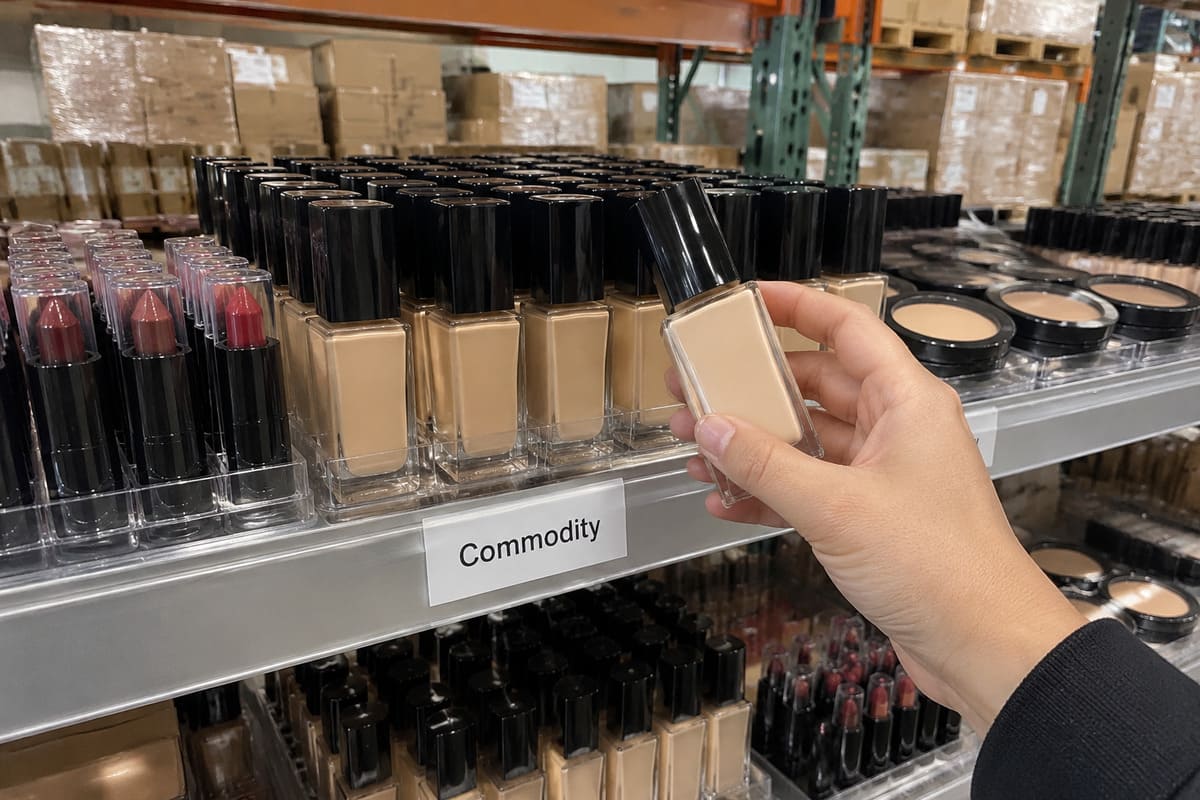
Think through the math. A public-mold compact with a stock pressed powder is available to anyone with a logo file. Twenty other beginners order the same compact. You all list on the same marketplace. Buyers see twenty near-identical palettes, and the only thing they can compare is the price. So someone drops their price by a dollar, then someone else undercuts that, and your margin evaporates.
- No exclusivity means no reason for a customer to choose you over a cheaper copy.
- Stock formulas cannot be improved, so you cannot compete on quality either.
- Shared molds make your packaging look like everyone else's on the shelf.
The deeper problem is sunk cost. You spend your first budget on inventory that was never going to differentiate you, and when it does not sell, you have no money left to try a real product. Over 60% of new beauty brands fail within their first 18 months, and the two biggest causes I see are inventory mismanagement and compliance failures. Both are downstream of starting with the wrong product for the wrong reason.
To be fair, Tier 1 factories are not scams. They do exactly what they promise, and for a one-week market test they are the right tool. The trap is treating a testing tool as a brand-building strategy. Use it to learn, then move on before you pour your real money in.
The Beginner's Compliance Checklist: 3 Things That Get You Banned
You are focused on shades and packaging, which is natural, but the thing that actually kills first launches is boring paperwork. Marketplaces and customs do not care how pretty your palette is. A missing symbol or a bad barcode gets your listing suspended before a single sale. I have watched it happen, and the founder never saw it coming.
Three compliance failures get beginner cosmetic listings banned most often: a barcode printed without the required quiet zone so scanners cannot read it, a US product missing the MoCRA Responsible Person name and address, and an EU product missing the PAO (period-after-opening) symbol. A real manufacturer should flag these before production, not after your listing is pulled.
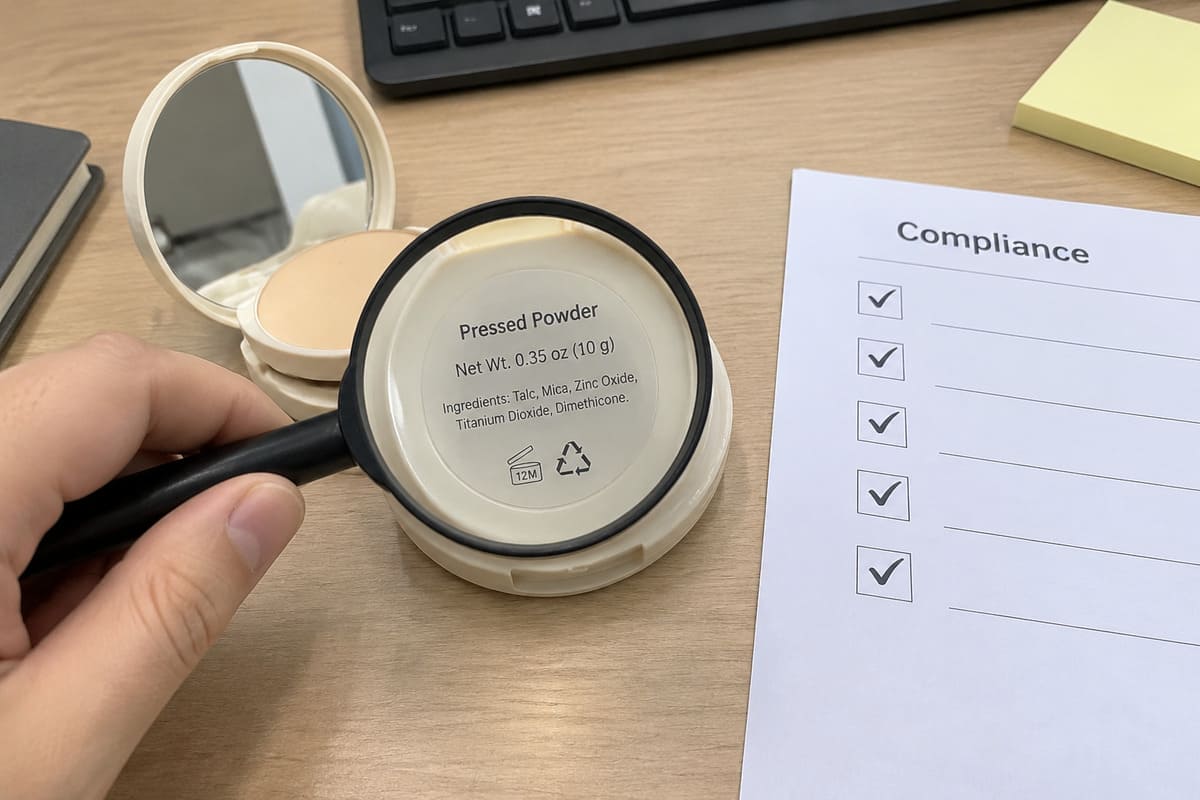
| # | Requirement | Market | What happens if you skip it |
|---|---|---|---|
| 1 | Barcode quiet zone | Global retail | Scanners fail; retailers reject it |
| 2 | Responsible Person under MoCRA | United States | Non-compliant; listing and import risk |
| 3 | PAO symbol (e.g., 12M open-jar icon) | European Union | Non-compliant label; EU removal |
A few plain-language notes so these are not just jargon:
- Quiet zone is the blank margin on each side of a barcode. Designers often crop it to fit artwork. Without it, no scanner reads the code.
- MoCRA Responsible Person is the company or individual, with a US address, accountable for the product. It must appear so regulators know who to contact.
- PAO symbol tells EU buyers how many months the product stays safe after opening. It is mandatory on EU packaging.
I want to be clear about my role here. I am describing the categories of rules I see trip beginners up, not giving you legal clearance for your specific product. Before you print final artwork, have a qualified regulatory professional review your label. A good factory acts as a gatekeeper and raises these points early. If a supplier shrugs off your compliance question, treat that as the answer. For the barcode details, see our Vertina Barcode Guide.
The Vertina Path: From Risk-Free Testing to True Customization
By now you can see the pattern. Beginners need to test cheaply, then graduate to something they can own. The problem is that most factories only sell you one or the other, leaving a painful gap in the middle where brands fall apart. I built our offer specifically to bridge that gap.
The Vertina path has two stages. If your budget is small, start with our Ready-Stock Branded Line to validate your market with compliant, properly packaged product, no production wait. When your demand is proven, move to true custom formulation starting at 2,000 pieces for powder makeup, with full FDA/MoCRA compliance support. The 2,000-piece threshold is where brand equity begins.
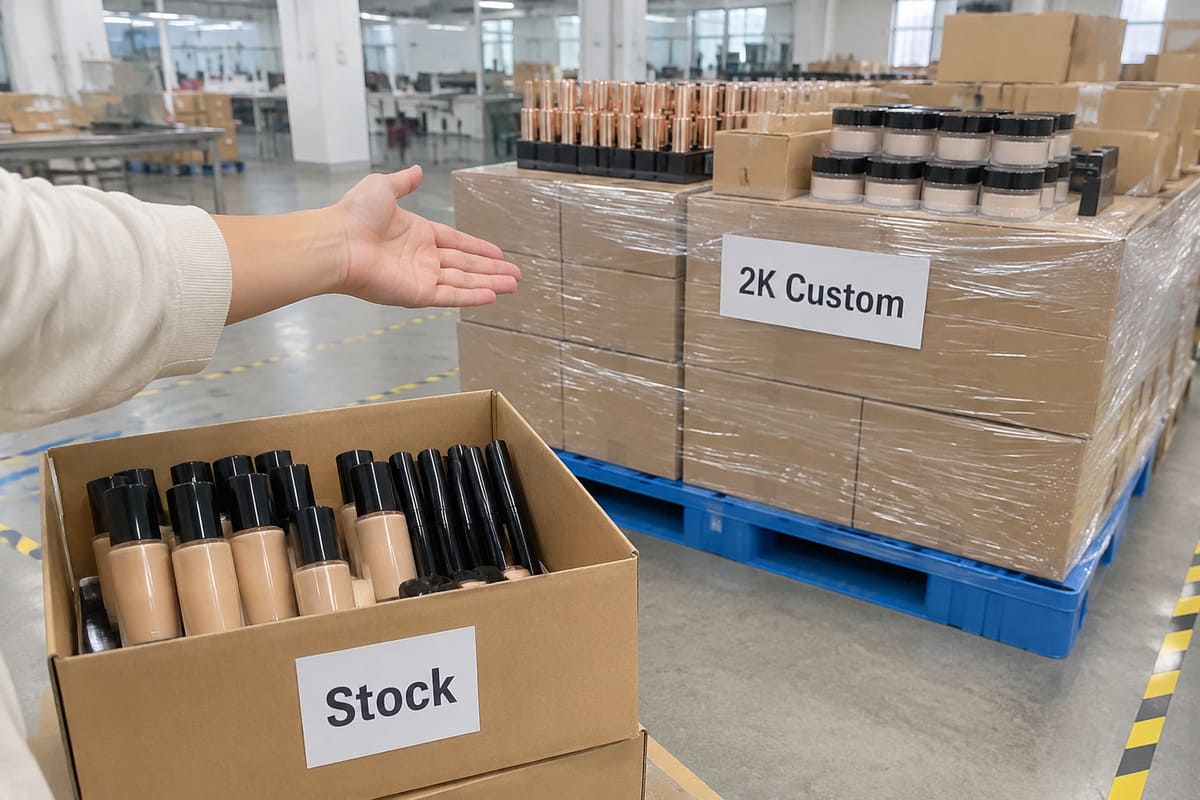
Let me tell you about a founder I worked with, because it maps the whole path.
A first-time founder in Europe bought a 200-unit stock eyeshadow palette from a cheap manufacturer to "test the market." The palette shipped with no PAO symbol, and the barcode had no proper quiet zone. Her Amazon listing was suspended almost immediately. She had spent her first budget and had nothing to sell.She came to us to recover. We moved her onto our Ready-Stock Branded Line, which already carries compliant labeling and packaging, so she was selling again within days instead of waiting on a new production run. Once her sales data proved which style actually moved, she placed a 2,000-piece custom powder order with shades that are now hers alone.
| Stage | Product | MOQ | Compliance | Goal |
|---|---|---|---|---|
| 1. Test | Ready-Stock Branded Line | Low | Pre-built | Validate demand fast |
| 2. Build | True Custom Formulation (powder) | 2,000 pcs | Full FDA/MoCRA support | Own exclusive product |
I know 2,000 pieces sounds large when you are staring at competitors advertising 50. So I will reframe it. Below that volume, you cannot run a genuinely custom formula, because the lab and fill costs do not work. The 2,000-piece powder threshold is not a wall built to keep you out. It is the point where a factory can make something that belongs only to you. That is where a brand stops being a logo on someone else's product and starts being an asset.
Frequently Asked Questions
What is the best MOQ for a beginner cosmetic brand? ▼
Do I need certifications to sell cosmetics online? ▼
Are ultra-low MOQ cosmetic manufacturers worth it? ▼
Why did my cosmetic listing get suspended on Amazon? ▼
How much does custom cosmetic formulation cost for a beginner? ▼
Conclusion: Your First Step to a Real Brand
If you remember one thing from this guide to cosmetic manufacturers for beginners, make it this: low MOQ is for testing, and true customization is for building. Use Tier 1 factories to learn whether your idea sells. Keep your compliance clean so a missing symbol never sinks your launch. Then graduate to a 2,000-piece custom order when the data says you are ready, because that is where a real, ownable brand actually begins.
Ready for your next step? Grab our Beginner's Due Diligence Checklist, or chat with me on WhatsApp and tell me your market and first-order plan. I will tell you honestly which tier fits you today.
✓ Risk-Free Testing Options
✓ Honest MOQ (2,000 pcs)
✓ Full FDA & MoCRA Support
Get Your Beginner's Checklist
Enter your details below. We will email you the PDF checklist and a sample shade plan within 24 hours.
View References & Footnotes
[^1]: "White-label product", https://en.wikipedia.org/wiki/White-label_product. General reference sources define a white-label product as goods manufactured by one company and sold under another company's brand without modification.
[^2]: "Private label", https://en.wikipedia.org/wiki/Private_label. Reference sources define private-label products as goods made by a contract manufacturer and marketed under a retailer's brand, often with some specification control by the retailer.
[^3]: "Professional Makeup Manufacturer: Factory vs. Distributor - Vertina ...", https://vertinabeauty.com/professional-makeup-manufacturer-factory-vs-distributor/. Cosmetic formulation literature relates pressed-powder properties, including color payoff and resistance to crumbling, to binder selection and pressing parameters.
[^4]: "How Can I Create My Own Makeup Brand? (A Brutally Honest ...", https://vertinabeauty.com/how-can-i-create-my-own-makeup-brand-a-brutally-honest-roadmap-to-avoid-the-5-minute-trap/. Economic literature on product differentiation and price competition holds that firms selling near-identical goods face intense price-based competition that erodes profit margins.
[^5]: "Establishment Age and Survival Data", https://www.bls.gov/bdm/bdmage.htm. Bureau of Labor Statistics Business Employment Dynamics data document survival rates for new establishments, showing a substantial fraction close within the first two years of operation.
[^6]: "Why Small Businesses Fail: Key Findings from the Wall ...", https://luskin.ucla.edu/news/why-small-businesses-fail-key-findings-from-the-wall-street-journal/. Studies and surveys on business failure identify cash-flow and inventory-related problems among the most common contributing factors for small firms.
[^7]: "General Specifications Change Notification (GSCN)", https://www.gs1.org/docs/barcodes/GSCN_20-323_Clafiry_Add-on.pdf. GS1 general specifications define the quiet zone as the minimum clear space required on either side of a barcode and state that insufficient quiet zones impair or prevent scanning.
[^8]: "Cosmetics & U.S. Law", https://www.fda.gov/cosmetics/cosmetics-laws-regulations/cosmetics-us-law. FDA guidance on the Modernization of Cosmetics Regulation Act of 2022 describes the Responsible Person concept and the associated facility registration and product listing obligations for cosmetic products in US commerce.
[^9]: "Regulation (EC) No 1223/2009 of the European Parliament ...", https://health.ec.europa.eu/system/files/2016-11/cosmetic_1223_2009_regulation_en_0.pdf. Regulation (EC) No 1223/2009 of the European Parliament and of the Council specifies cosmetic product labelling requirements, including the period after opening during which the product remains safe for use.
[^10]: "FDA Authority Over Cosmetics: How Cosmetics Are Not ...", https://www.fda.gov/cosmetics/cosmetics-laws-regulations/fda-authority-over-cosmetics-how-cosmetics-are-not-fda-approved-are-fda-regulated. FDA resources describe the agency's regulatory framework for cosmetics and the expanded requirements introduced by the Modernization of Cosmetics Regulation Act of 2022.
[^11]: "Registration & Listing of Cosmetic Product Facilities and ...", https://www.fda.gov/cosmetics/registration-listing-cosmetic-product-facilities-and-products. FDA materials implementing the Modernization of Cosmetics Regulation Act set out Responsible Person obligations including registration, product listing, and labeling of contact information.