Is the Best Eyeshadow Palette with All Colors Really the Best Choice for B2B Buyers?
When B2B buyers search for an all-color eyeshadow palette, what they truly need is a supply chain evaluation report that helps them understand the real sell-through logic, inventory risk, and transport risks of multi-shade palettes. A visually impressive palette may attract attention, but poor shade rotation, breakage, and weak repeat purchases can damage cash flow.
The best eyeshadow palette with all colors is not automatically the palette with the most shades. For most distributors, wholesalers, supermarkets, and emerging beauty brands, a curated palette of approximately 40 commercially useful shades offers a stronger balance between visual impact, sell-through, transport safety, manufacturing complexity, and repeat purchase potential than a 70-shade mega palette. Buyers should validate shade demand, packaging protection, market regulations, and reorder data before approving production.
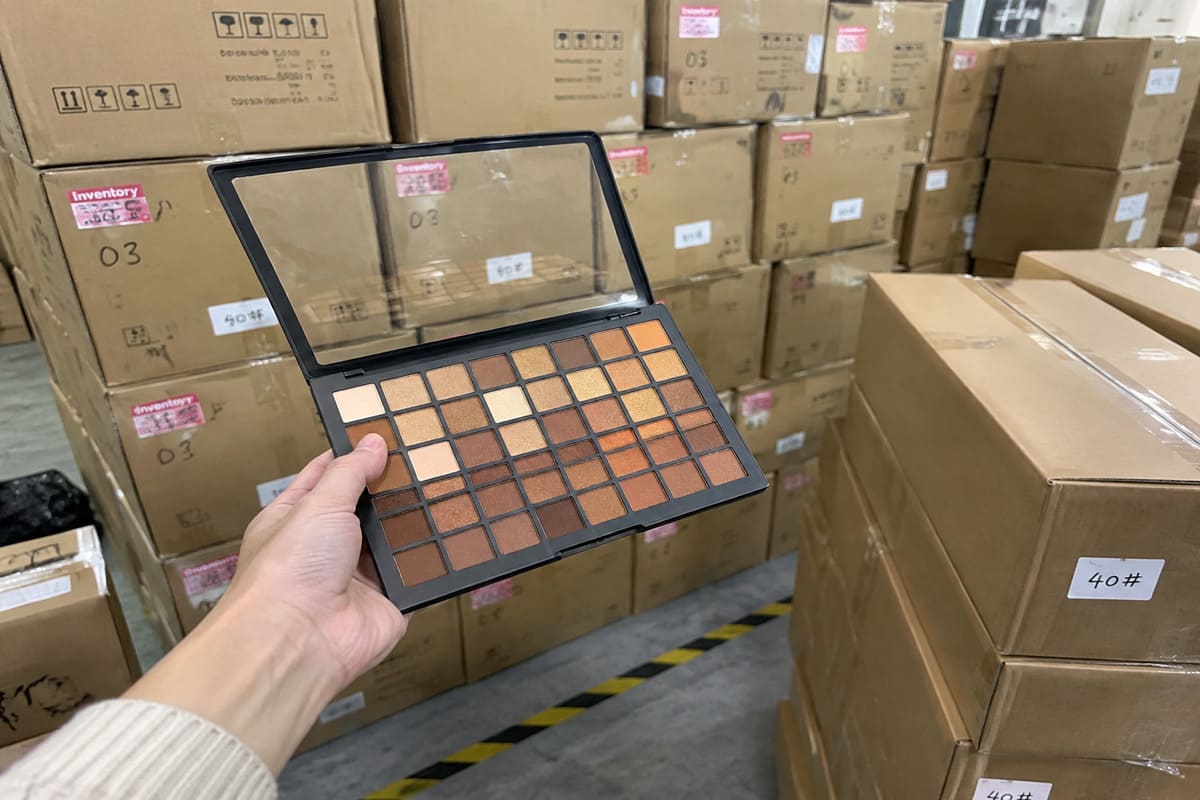
I can manufacture 70-shade and larger palettes, and I understand why buyers find them attractive. They look complete, photograph well, and appear to offer strong value. However, I have learned that procurement decisions should begin with inventory logic rather than visual impact. The following analysis explains how I evaluate a multi-shade eyeshadow palette with distributors, private-label brands, and retail buyers.
What Does “All Colors” Really Mean for Your Inventory?
The phrase “all colors” sounds clear to consumers, but it is not a precise procurement specification. When I discuss an all-color eyeshadow palette with a buyer, I first ask which colors the target market will actually purchase, use, and reorder. A broad color range can create unnecessary inventory if several shades serve the same commercial purpose.
The strict answer is that “all colors” should mean a commercially validated shade architecture, not every possible pigment. A buyer should define color groups by demand, finish, skin-tone compatibility, regional preference, and expected sales velocity. A 40-shade curated palette can often provide better coverage than a 70-shade palette containing redundant or slow-moving colors.
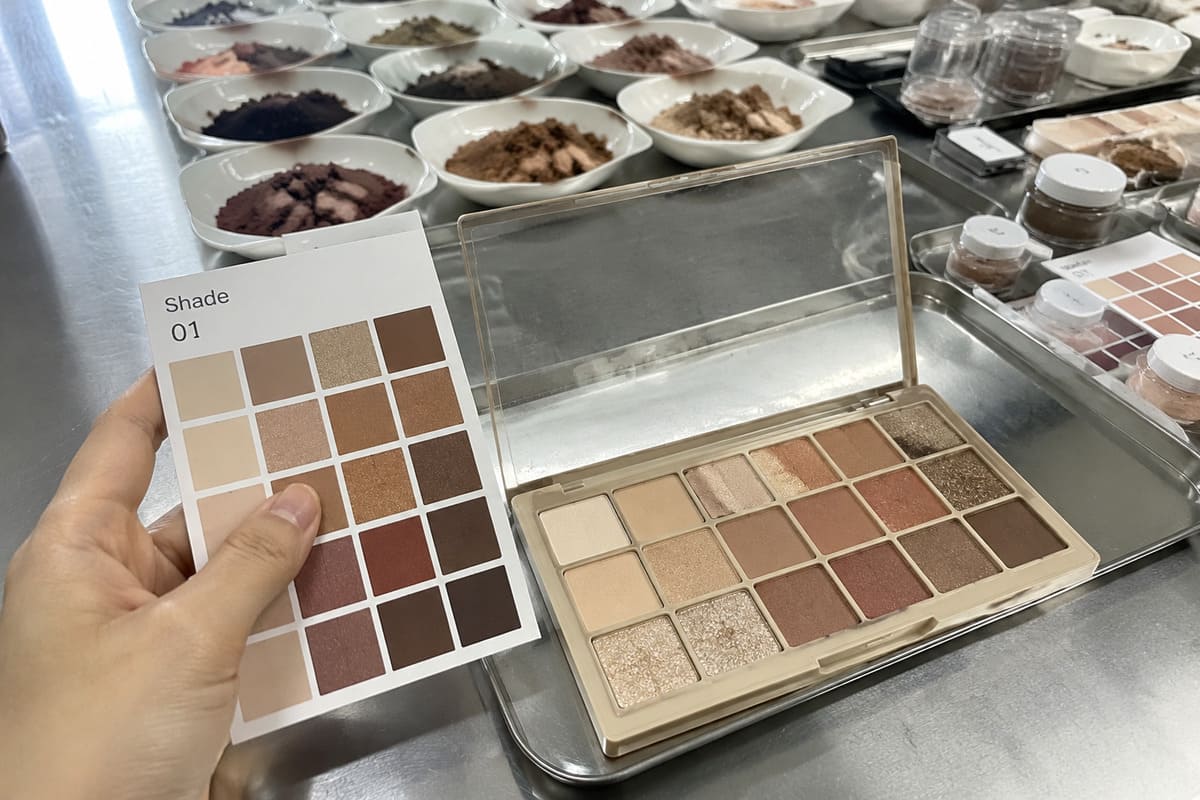
I usually divide a palette into functional shade groups before discussing a formula or quotation. This approach helps me separate genuine assortment value from visual excess.
A practical shade architecture
A professional buyer can evaluate shades through several commercial categories:
| Shade group | Commercial role | Typical procurement question |
|---|---|---|
| Base and transition shades | Support daily use and blending | Will customers use these shades repeatedly? |
| Neutral browns and taupes | Provide broad market appeal | Do they match the dominant preferences in the target market? |
| Black, deep brown, and charcoal | Add definition and depth | Are these shades useful for common makeup styles? |
| Metallic and shimmer shades | Create visual impact | Are they stable, compliant, and differentiated? |
| Bright fashion colors | Support trend-driven purchases | Does the local market have enough demand for them? |
| Duochrome or chameleon shades | Create premium differentiation | Can the brand explain and sell the special effect? |
| Glitter shades | Attract attention and social content | Can packaging protect the pans during transport? |
I also evaluate whether the colors are genuinely distinct. A palette may contain ten shades that appear different in a product photograph but look similar when applied. That duplication increases the number of pans without proportionally increasing customer value.
According to our supply chain observations, distributors often prefer a palette that is easy to explain to retailers. A buyer may not need seventy individual selling points. The buyer may need a clear product story, such as:
- Everyday neutrals plus selected fashion colors
- Warm and cool tones for regional preferences
- Matte, shimmer, sparkle, and chameleon effects
- A balanced palette for both professional and casual use
Regional demand also matters. I would not assume that a shade mix proven in Southeast Asia will perform identically in the Middle East, Africa, South America, North America, or the European Union. Climate, consumer taste, retail price, cultural preferences, and local regulations can all affect the assortment.
Inventory questions I ask before approving shades
Before I recommend production, I ask:
- Which market will receive the product?
- Which retail channel will sell it?
- Is the buyer selling through supermarkets, professional stores, social commerce, or a DTC website?
- What is the planned retail price?
- Does the buyer have historical sales data?
- Are the special-effect shades easy for customers to understand?
- Can the buyer reorder the best-performing shades separately?
For a private-label customer, I may recommend testing a smaller number of shades first. Low MOQ can reduce the cost of market validation, although the final MOQ depends on formula, packaging, color count, decoration, and production planning.
What Are the 3 Hidden Costs of a Mega Multi-Shade Palette?
The three hidden costs of a mega multi-shade palette are transport damage, accumulated manufacturing complexity, and weak repeat-purchase economics. These costs may not appear clearly in the initial unit quotation. I believe buyers should include them in total cost of ownership before selecting a 70-shade design.
A 70-shade eyeshadow palette can create a strong first impression, but every additional pan adds another point of material variation, pressing control, quality inspection, and potential failure1. A lower unit price does not necessarily mean a lower commercial risk.
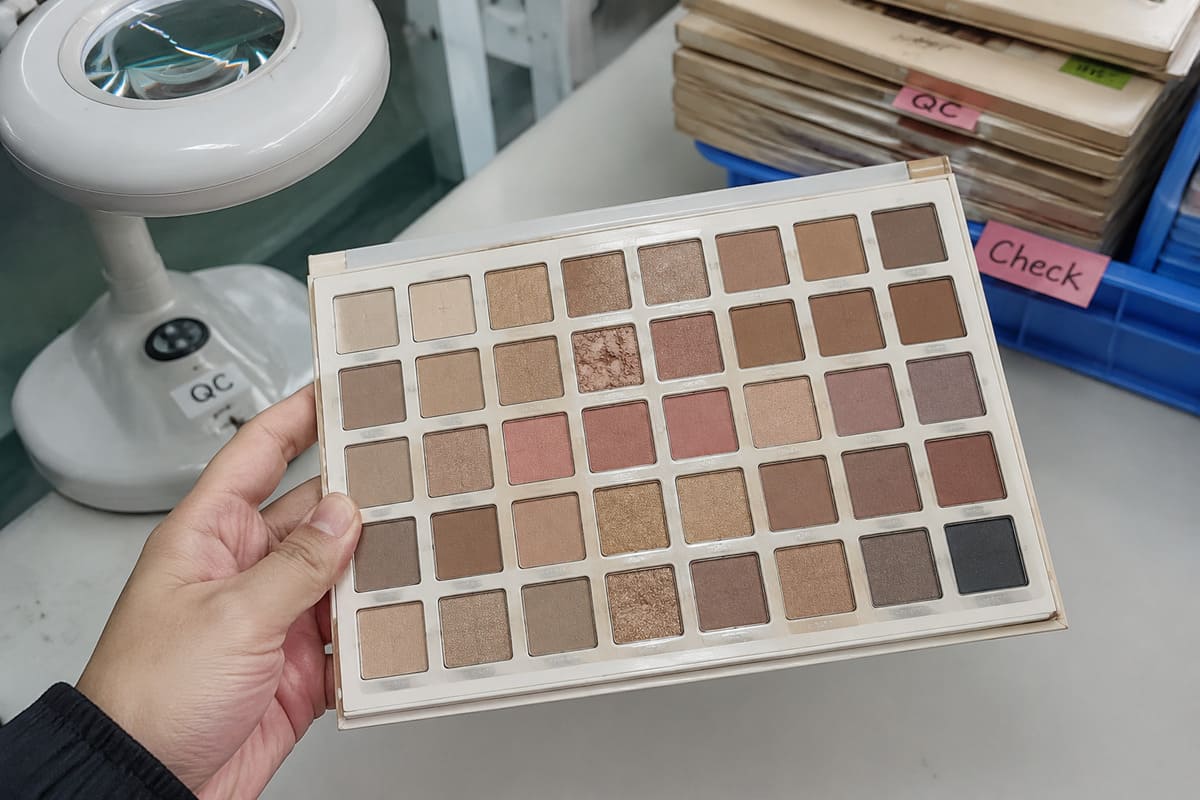
1. Transport damage can affect the entire unit
Pressed powder is fragile.2 Vibration, impact, temperature changes, and insufficient internal protection can cause cracking or powder fallout.3 In a multi-pan palette, one broken pan can contaminate surrounding shades and the inside of the package.
I treat this as a unit-level risk, not only a pan-level risk. If one pan breaks, the buyer may need to classify the entire palette as damaged, especially when the powder spreads across the mirror, brush area, or other colors.
The real risk depends on:
- Pan size and depth
- Powder formula and pressing strength
- Empty space inside the compact
- Adhesive or pan fixation
- Inner tray structure
- Mirror protection
- Carton design
- Palletization and shipping method
- Number of handling stages
2. Cost accumulates across every shade
Every new shade may require separate pigment purchasing, weighing, mixing, pressing, filling, cleaning, coding, and inspection. Similar-looking shades do not automatically create meaningful cost savings.
| Cost area | Why more shades create pressure |
|---|---|
| Raw materials | More pigments and effect materials require more purchasing coordination |
| Formula development | Each shade requires stability, texture, and color evaluation |
| Production setup | More color changes increase line preparation and cleaning |
| Filling and pressing | Each shade requires accurate filling and pressing control |
| Quality control | Inspectors must verify more individual shade positions |
| Packaging control | Shade maps, labels, and artwork become more complex |
| Inventory management | Slow-moving components may remain after the main order |
Special-effect pigments require additional attention. Chameleon eyeshadow, sparkle eyeshadow, and glitter eyeshadow may involve different particle characteristics and visual performance. I always recommend application-specific testing rather than judging only from a digital color image.
3. Large palettes may have weaker repeat-purchase logic
A mega palette often encourages an impulse purchase because it looks complete.4 However, customers may use only a small group of familiar shades5. The remaining colors can create perceived value at the time of purchase but may not contribute equally to repeat demand.
A smaller curated palette can support more frequent repurchase because:
- Customers finish useful shades sooner.
- Retail staff can explain the product more easily.
- The product fits more makeup occasions.
- The brand can release related palettes in stages.
- The customer can purchase a second palette without receiving excessive duplication.
I do not treat this as an absolute rule. A professional makeup education channel, theatrical customer base, or highly trend-driven social audience may justify a larger palette. However, the buyer should prove the use case instead of assuming that “more shades” will create more revenue.
How Did We Help a Client Avoid a 70-Shade Inventory Trap?
I once worked with a client who wanted to launch a 70-shade mega palette. The original plan focused mainly on the visual impression and the apparent value of offering every color in one package. Instead of quoting only a unit price, I helped evaluate the product through shade demand, transport exposure, and reorder potential.
Our recommendation was to launch a curated 40-shade palette first. The client placed an initial order of 5,000 units, and the product sold through quickly according to the client’s feedback. The client later generated stable repeat orders. This case did not prove that every 40-shade palette will outperform every 70-shade palette. It showed that a controlled assortment can reduce avoidable risk when it matches the customer’s market.
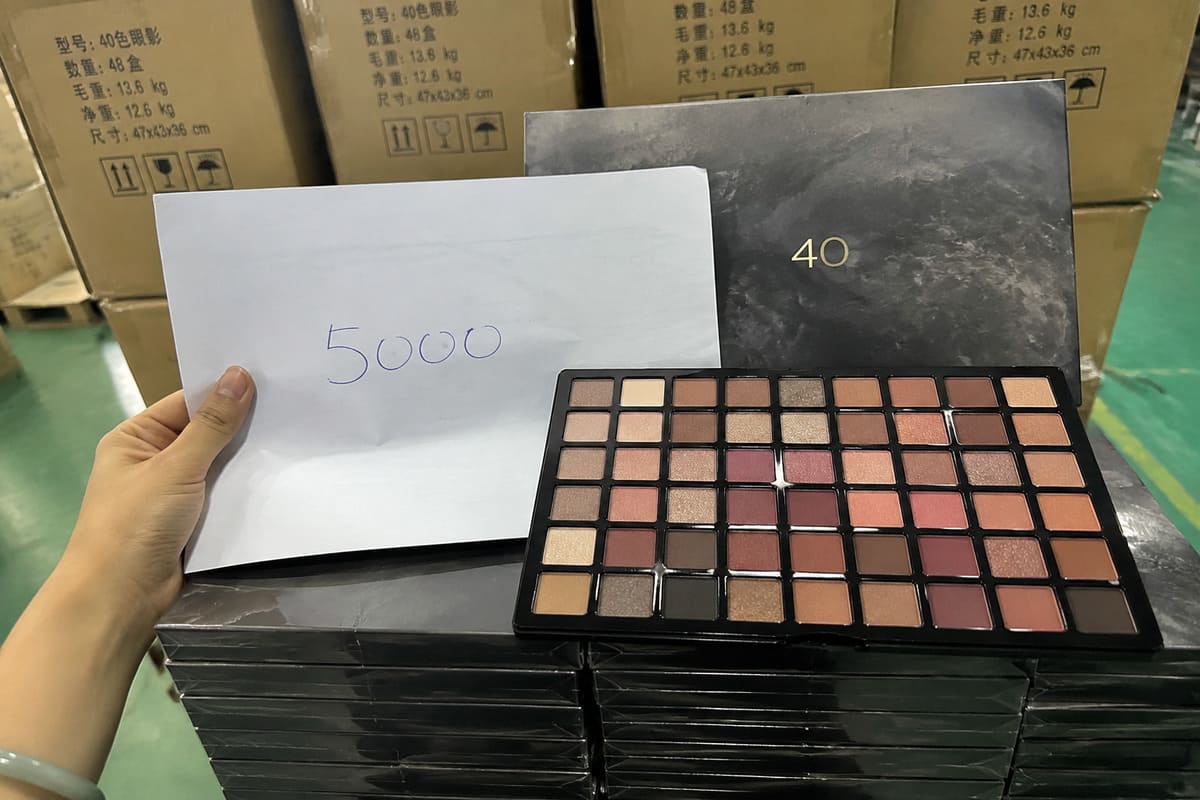
The client’s original concept had three main risks.
Risk one: demand concentration
We reviewed the proposed shade map and identified that basic browns, neutrals, black, selected shimmer tones, and several wearable transition colors were likely to carry most of the commercial use. Several bright and similar shades created visual variety but had uncertain sell-through.
I recommended grouping the colors into:
- Core daily shades
- Definition shades
- High-impact shimmer shades
- A limited number of bright trend colors
- A few distinctive chameleon or sparkle shades
This structure preserved the product’s visual appeal without treating every shade as equally important.
Risk two: breakage exposure
The 70-shade product had a larger internal layout and more total powder surface area. That design increased the number of possible breakage points. We discussed reinforcement, pan fixation, internal separation, cushioning, and carton testing.
A buyer should not rely only on a factory’s visual inspection before shipment. I recommend a documented packaging evaluation that includes:
| Evaluation point | Buyer’s purpose |
|---|---|
| Drop or impact testing | Identify damage caused by handling |
| Vibration simulation | Assess risks during road, air, or sea transport |
| Inner tray inspection | Confirm that pans cannot move excessively |
| Powder adhesion review | Check whether pressed product remains stable |
| Carton compression review | Reduce deformation during stacking |
| Sample shipment | Observe real delivery conditions before mass production |
Qualified packaging and quality professionals should define the final test method because transport conditions differ by destination and logistics provider.
Risk three: reorder flexibility
A 70-shade palette makes it difficult to understand which individual shades drive repeat purchases. A 40-shade palette gives the brand a more manageable starting point. After sales data becomes available, the brand can develop a second palette, refill concept, or smaller single-shade product around proven colors.
The client’s first order of 5,000 units gave the brand enough stock for a meaningful market launch while avoiding the additional complexity of a larger assortment. From my perspective, the most valuable decision was not simply reducing ten or thirty shades. The valuable decision was changing the product from an assortment experiment into a measurable market test.
Why Do 40-Shade Palettes Sell Better Than 70-Shade Mega Palettes?
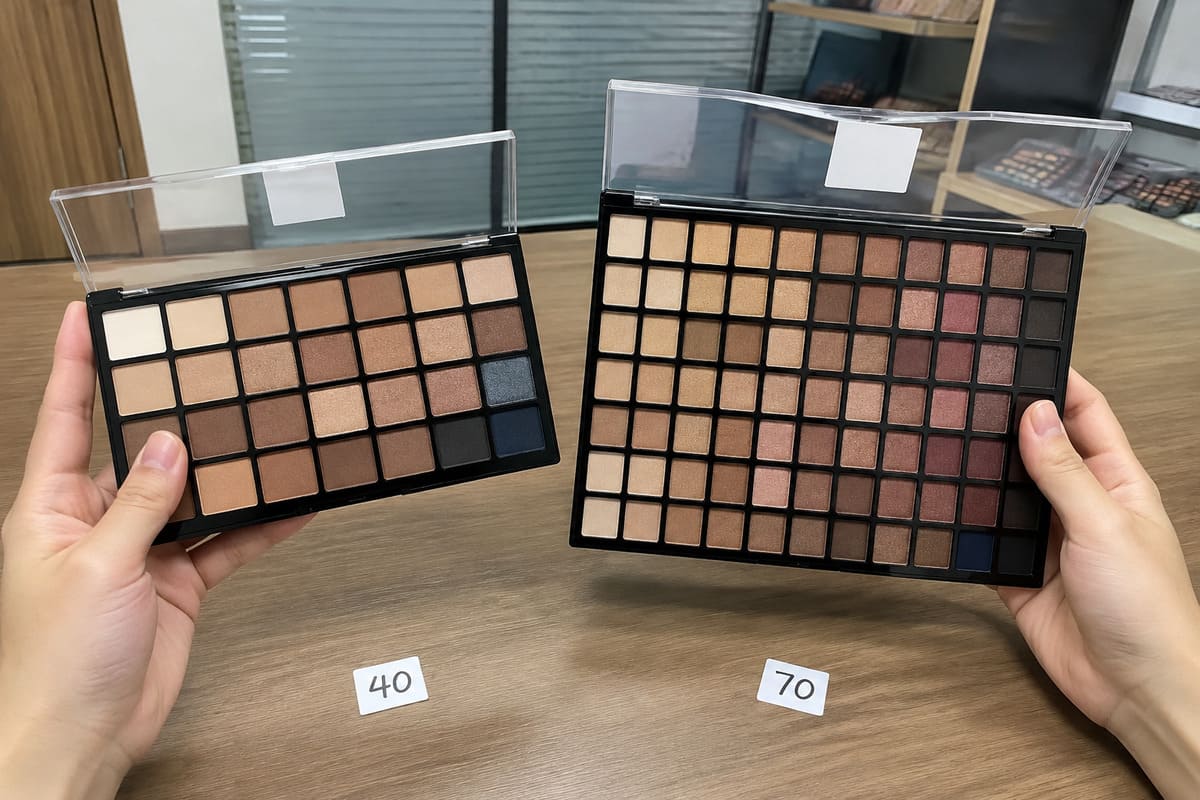
In many offline retail and wholesale situations, 40-shade palettes can sell better than 70-shade mega palettes because they combine strong shelf impact with easier customer understanding, lower redundancy, and better transport control. I regard 40 shades as a practical starting point, not a universal industry law.
The strongest palette size depends on the market, price point, channel, customer skill level, and brand positioning. However, our observations suggest that successful multi-shade palettes in mainstream retail often stay near the 40-shade range rather than expanding indefinitely.
Why 40 shades can create a stronger retail proposition
A 40-shade palette can still appear generous. It can include neutrals, bright colors, mattes, metallics, sparkle effects, and selected chameleon shades. At the same time, the assortment remains easier for a retailer to place and a salesperson to describe.
| Buyer evaluation factor | 40-shade curated palette | 70-shade mega palette |
|---|---|---|
| Visual impact | Strong | Very strong |
| Shade redundancy | Usually easier to control | More likely |
| Packaging complexity | Moderate | High |
| Breakage exposure | Lower than a larger layout | Higher |
| Customer understanding | Generally clearer | May feel overwhelming |
| Inventory commitment | More controlled | Higher |
| Product differentiation | Good with special effects | Often relies on quantity |
| Reorder analysis | Easier to interpret | More difficult |
| Retail shelf efficiency | Usually favorable | May require more space |
I also consider the buyer’s sales model. A wholesaler may want products that move quickly across many small retailers. A mega palette can be difficult for smaller stores to display and may tie up more cash per unit. A DTC brand may have more freedom to tell a detailed color story, but it still needs to explain why customers should use most of the shades.
When a 70-shade palette may be reasonable
I would not reject a 70-shade design automatically. It may be appropriate when the buyer has:
- A professional artist or education customer base
- A strong online content strategy
- A premium price that supports higher packaging costs
- Confirmed demand for many distinct shades
- A reliable distribution network
- Sufficient quality-control and transport testing
- A clear plan for handling damaged units
- A proven brand reputation that supports a large launch
I would also separate a “large palette” strategy from a “single mega palette” strategy. A brand may achieve broader color coverage through two curated 30- or 40-shade palettes. This approach can create more product launches, more targeted merchandising, and better information about customer preferences.
How I use sales data after launch
I recommend tracking more than total units sold. Buyers should monitor:
- Sell-through by market and channel
- Sales velocity by color group
- Retailer reorder frequency
- Damaged-unit percentage
- Customer complaints by shade or finish
- Gross margin after returns and replacements
- Time to first reorder
- Stock remaining by product batch
The buyer can then decide whether to expand, reduce, or reconfigure the assortment. This data-led process is more reliable than selecting the largest possible shade count at the beginning.
What Should Buyers Know About Transport Risks and Repeat Purchase Logic?
Transport risk and repeat purchase logic should be evaluated together because a palette that sells once but arrives damaged does not create healthy revenue. I recommend that buyers assess packaging engineering, shipping conditions, customer usage, and reorder opportunities before approving the best eyeshadow palette with all colors for mass production.
The standard answer is that buyers should approve a multi-shade palette only after representative samples pass formula, packaging, and transport evaluations for the intended market. Buyers should also confirm the legal and regulatory requirements of the destination country before shipment.
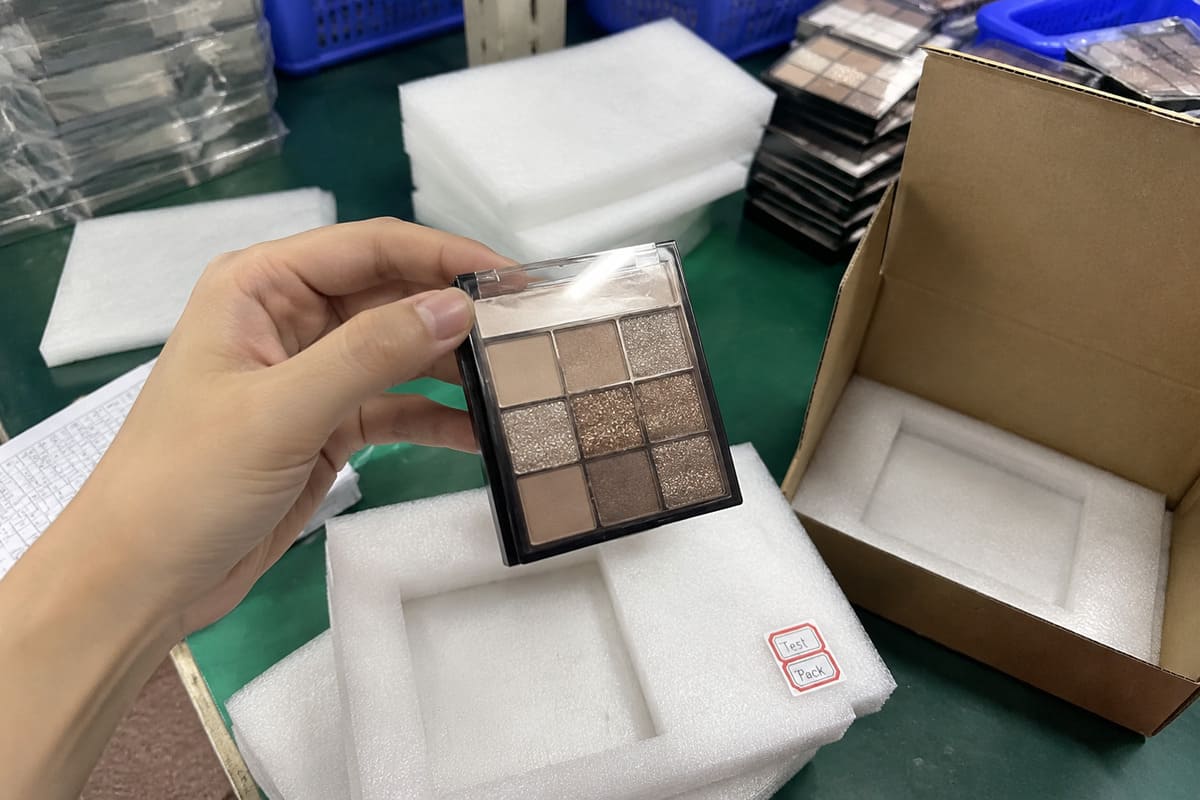
A practical transport risk framework
I use a simple risk matrix during supplier discussions:
| Risk | Low-risk indication | High-risk indication | Recommended action |
|---|---|---|---|
| Pan breakage | Stable pressing and secure fixation | Powder fallout after vibration | Improve formula, pressing, or tray support |
| Internal contamination | Strong separation between pans | Loose powder reaches adjacent shades | Increase barriers and packaging protection |
| Mirror damage | Protected and well-supported mirror | Mirror contacts product during impact | Add spacing and cushioning |
| Carton deformation | Strong outer carton and suitable stacking | Crushed corners or shifted units | Review carton strength and pallet loading |
| Heat exposure | Formula tested for expected conditions | Softening, sweating, or texture change | Conduct stability testing for destination climate |
| Moisture exposure | Sealed and protected packaging | Label, carton, or powder affected by humidity | Review sealing and storage conditions |
I do not promise that any package is damage-proof. I prefer to identify the expected shipping route, handling stages, climate, and container conditions. A qualified packaging engineer or logistics professional should confirm the final test protocol.
Repeat purchase is a product design issue
Repeat purchases do not depend only on marketing. They also depend on how quickly customers consume useful shades and whether the product solves a recurring need.
A brand can support repeat orders through:
- Curated palettes: Customers receive useful combinations without excessive duplication.
- Complementary palettes: The second palette offers new colors rather than repeating the first.
- Single-shade bestsellers: High-performing shades become individual products.
- Seasonal releases: Limited trend colors create controlled newness.
- Professional replenishment: Makeup artists and retailers reorder core colors.
- Low-MOQ testing: Smaller brands can validate demand before scaling.
For our OEM/ODM customers, we can discuss custom formulation, shade development, packaging, and production planning. We can also support buyers who want special finishes such as sparkle or chameleon effects. However, I always recommend that application, stability, safety, and regulatory decisions receive qualified professional review for the target market.
Regulatory and documentation checks
There is no single global certification that automatically makes an eyeshadow palette legal in every country.6 Requirements depend on the destination and the product claims. Buyers should verify the current rules with a qualified regulatory specialist or importer of record.
A procurement file may need:
- Full ingredient or INCI information7
- Product specifications
- Batch and traceability information
- Stability or compatibility evidence where appropriate
- Microbiological or safety documentation where required
- Packaging and labeling review
- Animal-testing, vegan, or clean-beauty substantiation if claimed8
- Market-specific notification, registration, or responsible-person documentation
For Saudi Arabia and other markets, I would not provide a one-size-fits-all certification answer without confirming the product category, importer structure, labeling language, and current authority requirements. Buyers should verify requirements with the relevant authority and local compliance professionals. Certifications and reports should always be treated as documents to inspect, not as assumptions based on a supplier’s marketing description.
Frequently Asked Questions
Is a 70-shade palette better than a 40-shade palette?
Not automatically. A 70-shade palette offers more visual variety, but it also creates higher shade redundancy, manufacturing complexity, transport exposure, and inventory risk. I often recommend starting with approximately 40 curated shades unless the buyer has clear evidence that its customer base needs a larger professional assortment.
What is the best eyeshadow palette with all colors for a distributor?
For many distributors, the best eyeshadow palette with all colors is a balanced palette containing core neutrals, transition shades, definition colors, selected bright tones, and several differentiated finishes. The buyer should choose shades according to local demand, retail price, shelf space, and reorder data rather than selecting the highest shade count.
How can buyers reduce eyeshadow palette breakage during shipping?
Buyers should evaluate pressing strength, pan fixation, tray support, internal separation, mirror protection, carton construction, palletization, and transport testing. I recommend testing production-representative samples under expected shipping conditions. A qualified packaging or quality professional should confirm the final method.
Can Vertina Beauty produce custom 40- or 70-shade palettes?
Yes. We can discuss custom OEM/ODM development for shade selection, formulas, special effects, packaging, and branding. I can support both curated 40-shade concepts and larger palettes, but I recommend selecting the size after reviewing market demand, target cost, transport conditions, and expected reorder behavior.
What should buyers verify before placing a large eyeshadow order?
Buyers should verify samples, shade consistency, ingredient documentation, packaging performance, production lead time, MOQ, quality-control procedures, labeling, destination-market requirements, and replacement or complaint-handling terms. Buyers should also conduct a realistic sell-through forecast instead of relying only on the supplier’s unit price.
Conclusion
The best eyeshadow palette with all colors is the one that protects long-term commercial performance, not simply the one with the largest shade count. I recommend that B2B buyers examine shade redundancy, transport breakage, total production cost, regional demand, regulatory documentation, and repeat-purchase logic before committing to a mega palette. Vertina Beauty can support low-MOQ testing and custom OEM/ODM development for curated or larger palettes. Contact me to discuss your target market, shade plan, packaging requirements, and launch quantity.
"Guidance for Industry - Cosmetic Good Manufacturing ...", https://www.fda.gov/media/86366/download. ISO 22716 sets good-manufacturing-practice guidance for cosmetics, including controls for production, quality control, documentation, and deviations. Evidence role: general_support; source type: institution. Supports: Cosmetics GMP requires controlled production, documentation, and quality control for manufactured product components and processes.. Scope note: The standard does not quantify the incremental cost or risk added by each individual eyeshadow pan. ↩
"[PDF] The Effects of Paperboard Packaging on Consumer Attention to Cosmetic ...", https://open.clemson.edu/cgi/viewcontent.cgi?article=3130&context=all_theses. Studies of compacted powder products describe mechanical impact and vibration as contributors to cracking, caking failure, or powder loss during handling. Evidence role: mechanism; source type: research. Supports: Evidence that compacted powder products are susceptible to mechanical damage under impact and vibration.. Scope note: The degree of fragility depends on the formula, pan geometry, compaction process, and packaging design. ↩
"Drop Test Standards for Packaging Materials", https://www.pakingduck.com/post/drop-test-standards-for-packaging-materials. ISTA distribution-test protocols evaluate how packaged products withstand transport hazards including vibration, shock, compression, and environmental conditioning. Evidence role: mechanism; source type: institution. Supports: Packaging-distribution testing evaluates damage risks caused by vibration, drops, compression, and environmental exposure.. Scope note: Passing a laboratory protocol does not guarantee damage-free performance on every shipping route. ↩
"[PDF] Visual Product Aesthetics and Consumer Impulsiveness in Online ...", https://scholarspace.manoa.hawaii.edu/bitstreams/868bcd78-90dd-4ae4-a86a-eaeac2392029/download. Research on retail choice and impulse purchasing indicates that product presentation and perceived assortment value can affect unplanned purchase behavior. Evidence role: mechanism; source type: paper. Supports: Consumer-behavior research examines how product presentation, perceived value, and assortment influence unplanned purchasing.. Scope note: Such findings are context-dependent and do not establish that every large eyeshadow palette produces impulse purchases. ↩
"How to Make Eyeshadow to Sell? - Source Cosmetic Manufacturer ...", https://vertinabeauty.com/2026/07/26/how-to-make-eyeshadow-to-sell/. Studies of consumer choice in large assortments report that people commonly simplify decisions by favoring familiar or preferred options. Evidence role: general_support; source type: paper. Supports: Research on assortment choice shows that consumers often rely on familiar or preferred options when faced with many alternatives.. Scope note: Choice behavior is not direct evidence of how quickly users consume individual eyeshadow shades after purchase. ↩
"Cosmetics Laws & Regulations", https://www.fda.gov/cosmetics/cosmetics-guidance-regulation/cosmetics-laws-regulations. Cosmetics regulatory frameworks such as the European Union's Cosmetics Regulation and U.S. FDA requirements establish jurisdiction-specific obligations for product safety, labeling, records, and market access. Evidence role: expert_consensus; source type: government. Supports: Major cosmetics jurisdictions impose distinct compliance systems, documentation, labeling, and responsible-party requirements.. Scope note: Applicable obligations also depend on product classification, claims, ingredients, and the destination market's current law. ↩
"Cosmetics Labeling Guide", https://www.fda.gov/cosmetics/cosmetics-labeling-regulations/cosmetics-labeling-guide. EU and U.S. cosmetics-labeling guidance describes ingredient declarations as required product-label information, with internationally recognized ingredient nomenclature commonly used for cosmetics. Evidence role: definition; source type: government. Supports: Cosmetics regulations require or describe ingredient declarations using standardized nomenclature in relevant markets.. Scope note: Exact naming, ordering, exemptions, and label requirements vary by jurisdiction. ↩
"Green Guides | Federal Trade Commission", https://www.ftc.gov/news-events/topics/truth-advertising/green-guides. Consumer-protection and cosmetics-claims guidance requires product claims to be supported by adequate evidence and presented in a manner that does not mislead consumers. Evidence role: expert_consensus; source type: government. Supports: Marketing claims should be truthful, adequately substantiated, and not misleading to consumers.. Scope note: The evidentiary threshold and permitted wording for vegan, animal-testing, and clean-beauty claims vary by jurisdiction and claim wording. ↩