When B2B buyers search for what ingredients to avoid in eyeshadow, what they truly need is not a consumer skincare guide, but a compliance red-line checklist that ensures their product can successfully enter their target market. A wrong ingredient can delay customs clearance, trigger a platform removal, or write off a full production batch. We use market-specific formula screening to reduce those risks.
Buyers should avoid any eye shadow ingredient that is prohibited, restricted above its legal limit, unapproved for eye-area use, inadequately documented, or contaminated. We check color additives, preservatives, siloxanes, heavy-metal impurities, glitter materials, and talc documentation against the destination market before confirming a formula. No universal blacklist applies to every country.

That distinction matters because a formula can be acceptable in one market and unsuitable in another. We therefore start with the sales destination, product format, ingredient percentages, and claims—not with a generic “free-from” list. The following framework explains how we evaluate the practical compliance red lines.
What Does “Avoiding Ingredients” Mean for B2B Sourcing?
Many buyers ask for a formula without parabens, talc, or silicones because those claims are popular online. The problem is that marketing preferences and legal restrictions are not the same1. If we confuse them, we may increase costs while leaving a genuine regulatory risk unresolved.
For B2B sourcing, avoiding an ingredient means excluding or controlling a substance because of a legal prohibition, concentration limit, eye-area restriction, impurity risk, customer standard, or documented brand policy. We classify each requirement by target market and verify the formula before approving samples or mass production.
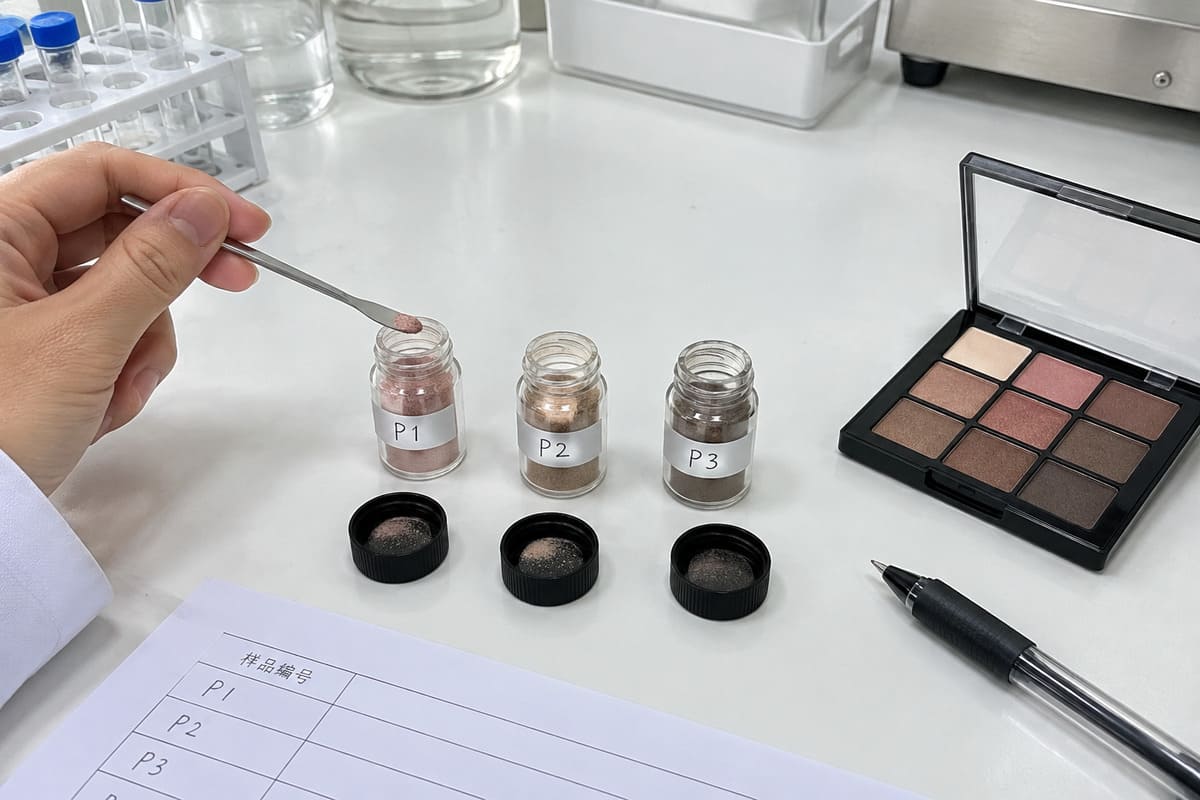
We Separate Legal Red Lines from Marketing Preferences
I use four categories when discussing ingredients to avoid in eye shadow with a buyer:
- Prohibited substances: We do not intentionally formulate with ingredients prohibited in the destination market.
- Restricted substances: We verify the permitted product type, concentration, warnings, and purity criteria.
- High-documentation materials: We require reliable specifications, test reports, and traceability for materials such as talc, pigments, and effect particles.
- Brand exclusions: We can evaluate requests such as talc-free, vegan, silicone-free, or microplastic-conscious formulas, even when the exclusion is not a general legal requirement.
This classification prevents vague requests from controlling a technical purchasing decision. For example, “preservative-free” may sound attractive, but a buyer still needs a formula with adequate microbiological quality and stability. Likewise, a “natural” pigment is not automatically approved for use around the eyes.2
| Ingredient issue | What we ask | What we verify | Typical procurement action |
|---|---|---|---|
| Prohibited substance | Where will the product be sold? | Current applicable regulation | Remove or reformulate |
| Restricted substance | What is the use level? | Maximum concentration and conditions | Reduce, replace, or document |
| Color additive | Is it approved for the eye area? | Market-specific positive list | Approve only for permitted use |
| Talc | Can the supplier document purity? | Specification and asbestos test result | Accept, retest, or replace |
| Glitter or effect particle | What is its composition and particle size? | Cosmetic status, eye-area use, and local rules | Review before shade approval |
| “Free-from” request | Is it legal, retailer-led, or marketing-led? | Claim support and formula impact | Develop a suitable alternative |
We Start with a Market Brief
Before we quote a custom OEM/ODM project, we prefer to collect a short regulatory brief:
- Target country or region
- Eye shadow format, such as pressed powder, loose powder, cream, or liquid
- Intended sales channels
- Ingredient exclusions
- Required claims
- Shade count and special-effect requirements
- Expected order quantity
- Launch date
- Documents expected from the manufacturer
We have seen buyers request an EU formula and then send the same product to the United States, Saudi Arabia, and Southeast Asia without a second review. We advise against that approach. Regulations, color additive permissions, notification systems, labels, and local importer duties can differ.
We treat “compliant formula” as a market-specific conclusion, not a permanent feature of a product.
A qualified safety assessor, regulatory consultant, Responsible Person, importer, or local authority should make the final application-specific determination. We support that evaluation with accurate formula and manufacturing documents.
What Are the 3 Hard Compliance Metrics for Ingredients to Avoid in Eye Shadow?
An ingredient blacklist alone creates false confidence. The harder task is proving that every colorant is permitted, every restricted additive stays within its conditions, and every raw material meets suitable purity standards. Missing any one of these checks can stop a launch.
We evaluate three hard compliance metrics for eye shadow formulas: pigment approval for the intended market and eye area, legal limits and conditions for preservatives or other additives, and contaminant control supported by raw-material testing. We do not release a formula based only on an ingredient name or supplier assurance.
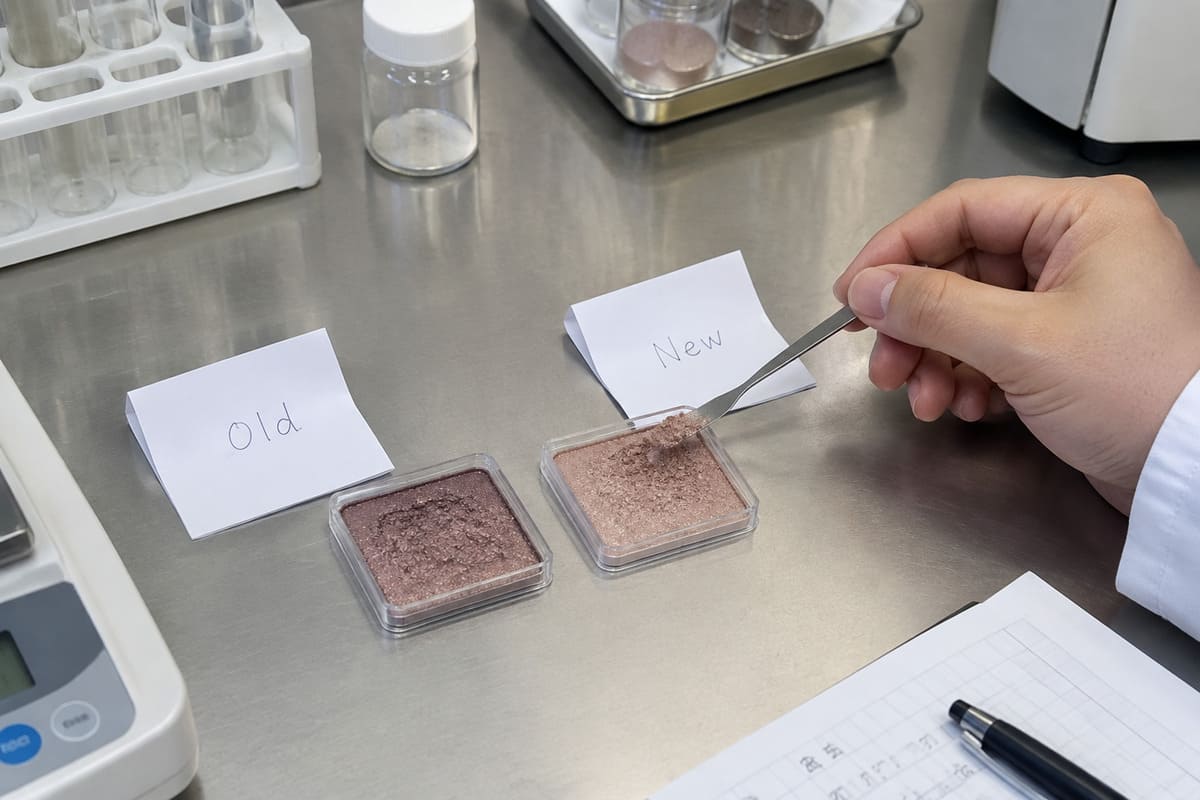
1. We Verify Pigment Approval and Conditions of Use
Colorants are the foundation of an eye shadow palette, but they are also one of its most market-sensitive components. We check each pigment by INCI name, Color Index number, composition, use level, and destination market.
For the United States, we review the applicable FDA color additive regulations, including the listings in 21 CFR Parts 73 and 74.3 We also confirm whether the specific color additive is permitted for use in the eye area and whether certification is required. Some FDA-listed color additives require batch certification, while others are exempt from certification.
We never assume that a pigment permitted in lipstick, nail products, or externally applied cosmetics is automatically permitted around the eyes. Even similarly named pigments can have different legal conditions.
For the European Union, we review the colorant conditions in Annex IV of Regulation (EC) No 1223/2009, together with relevant amendments. We also monitor regulatory developments affecting newer effect materials. Silver powder, for example, has received specific regulatory attention. A 0.2% eye shadow planning limit has appeared in safety and proposal discussions4, but buyers must verify the final applicable legal text and implementation date before placing an order.
| Pigment checkpoint | United States | European Union | Our sourcing response |
|---|---|---|---|
| Legal reference | 21 CFR Parts 73 and 74 | Cosmetics Regulation Annex IV | We check both when a palette serves both markets |
| Eye-area permission | Must be specifically verified | Conditions in the colorant entry apply | We do not infer permission from another product type |
| Batch certification | Required for certain colors | Not based on the same US batch-certification system | We request supporting pigment documents |
| Concentration limits | Depend on the individual listing | Depend on the relevant entry and amendment | We record actual formula percentages |
| Label identity | US naming requirements apply | INCI and EU labeling rules apply | We prepare a market-specific ingredient list |
2. We Check Preservatives and Functional Additives
Pressed powder eye shadow usually has lower water activity than a liquid cosmetic, but it is not automatically free from microbiological or additive concerns. Cream shadows, liquid shadows, wet-look formulas, and certain binder systems require closer preservation review.
We check:
- Whether a preservative is permitted
- The maximum authorized concentration
- Product-type restrictions
- Eye-area conditions
- Required warnings
- Total exposure from blended raw materials
- Whether the substance appears unintentionally through a premix
We pay particular attention to formaldehyde-releasing preservatives, quaternary ammonium compounds such as benzalkonium chloride, and ingredients undergoing regulatory reassessment. We do not describe all of these substances as universally banned. Their status depends on the market, concentration, function, and final product.
We also monitor cyclic siloxanes. EU restrictions affecting D4, D5, and D6 include concentration thresholds and staged application dates under REACH. A 0.1% threshold for certain leave-on cosmetic applications is relevant from 20275, subject to the final product and applicable transition rules. We therefore recommend checking the current consolidated legal text instead of relying on an old supplier declaration.
3. We Control Talc, Heavy Metals, and Other Impurities
The name on an ingredient list does not reveal its full purity profile. We therefore treat contamination control as a measurable sourcing requirement.
For talc, the central procurement issue is reliable mineral sourcing and evidence that asbestos was not detected using an appropriate test method6. In our projects, we request raw-material specifications and test documentation. We can also discuss third-party testing based on the buyer’s risk assessment and destination market.
We apply the same principle to heavy-metal impurities. Lead, arsenic, mercury, cadmium, and other metals may be subject to prohibitions, technically unavoidable trace expectations, market guidance, or customer limits. We do not claim that one generic heavy-metal report guarantees worldwide acceptance. We align the test panel, method, detection limits, and acceptance criteria with the market and buyer specification.
How Did We Help a Client Pass EU Compliance with a Reformulated Palette?
A failed product listing can damage more than one order. It can freeze inventory, interrupt cash flow, and reduce confidence in the buyer’s brand. One client approached us after a previous eye shadow order encountered an Amazon Europe compliance problem linked to its formula documentation and a restricted preservative.
We first reviewed the client’s destination market, complete ingredient list, pigment composition, and preservative system. We then reformulated the palette, checked emerging EU restrictions, prepared an updated ingredient breakdown, and coordinated samples for safety review. The client relaunched after completing the required third-party compliance process.

We Did Not Start with a Price Quote
The client initially wanted a fast quotation for a replacement palette. However, a lower unit price would not solve the underlying problem. We first asked for:
- The previous full ingredient list
- Available raw-material documentation
- The Amazon notice
- The intended EU countries
- The product claims
- The shade and texture targets
- The planned launch schedule
- The contact details of the client’s EU regulatory partner
Our review identified a preservative concern and incomplete supporting information. We also discussed regulatory developments relevant to silver powder and cyclic siloxanes. We explained that proposals, safety opinions, transition periods, and final enacted restrictions are different legal stages. That distinction helped the client plan a formula with a longer commercial life.
We Used a Controlled Reformulation Process
| Reformulation stage | Our action | Buyer benefit |
|---|---|---|
| Formula screening | We reviewed every ingredient and percentage | The buyer received a traceable issue list |
| Pigment review | We checked Color Index identities and effect materials | The buyer reduced eye-area colorant risk |
| Preservative adjustment | We replaced the problematic system | The formula became suitable for further EU assessment |
| Siloxane review | We checked D4, D5, and D6 considerations | The buyer reduced foreseeable reformulation risk |
| Sample testing | We prepared revised laboratory samples | The buyer could assess payoff, wear, and stability |
| Document package | We supplied an updated ingredient list and available specifications | The safety assessor had better source data |
| External approval | The client worked with qualified EU professionals | The final decision did not rely on our sales team alone |
We retained the palette’s color story while changing the underlying system. That was important because compliance reformulation can alter pressability, pickup, adhesion, sparkle, and wear. Our formulation team adjusted the binder balance and checked how the revised base interacted with the special-effect pigments.
According to the project information available to us, the client completed the required review and relaunched the product. The client also reported better customer feedback after relaunch. We present this as our project experience rather than independent proof that one formula will achieve the same result for another buyer.
This case changed how I discuss ingredients to avoid in eye shadow. I now ask buyers about market entry before I discuss packaging or bulk pricing. A beautiful palette has no commercial value if the buyer cannot legally place it on the intended market.
Why Is Compliance the First Barrier for Market Entry?
Buyers often focus first on shade trends, unit price, packaging, and minimum order quantity. Those factors influence sales, but none of them can rescue an unmarketable formula. If the importer cannot support registration, notification, safety assessment, or platform review, inventory can become stranded.
Compliance is the first market-entry barrier because authorities, importers, retailers, and online platforms can require evidence before or after launch. We help provide accurate formula and manufacturing documents, but the buyer must also appoint the correct market-side parties and complete each jurisdiction’s notification, labeling, and safety obligations.
We Match the Document Package to the Destination
There is no single “international cosmetic certificate” that guarantees access to every market.7 Buyers should be cautious when a supplier presents one certificate as universal permission to sell.
| Market | Core market-entry requirements we expect buyers to verify | Typical supplier support |
|---|---|---|
| European Union | EU Responsible Person, Product Information File, CPSR, CPNP notification, compliant label, GMP compliance, substantiated claims | Formula percentages, INCI list, specifications, test data, manufacturing information |
| United States | FDA ingredient and color additive compliance, MoCRA obligations where applicable, safety substantiation, facility registration and product listing unless exempt, compliant labeling, serious adverse event procedures | Ingredient list, pigment information, product specifications, manufacturing records |
| Saudi Arabia | SFDA cosmetic requirements, local responsible/importing entity, product notification or listing through the applicable SFDA system, compliant label and supporting product documents | Formula, ingredient list, test reports, specifications, label data, manufacturing documents requested |
| Other GCC markets | Country-specific notification and conformity requirements | Market-specific technical file support |
| Southeast Asia | National implementation of the ASEAN Cosmetic Directive where applicable, local notification, responsible company, Product Information File | Formula and product documentation aligned with the importer’s request |
For the European Union, the Cosmetic Product Safety Report must be completed by a properly qualified safety assessor.8 The Responsible Person must maintain the Product Information File and complete CPNP notification before placement on the market. CPNP notification is not the same as regulatory approval, and we do not present it as one.
For the United States, the FDA does not generally preapprove cosmetic products, except that color additives are subject to specific approval requirements.9 MoCRA introduced facility registration, product listing, safety substantiation, and other obligations, with exemptions applying in defined circumstances. We advise buyers to obtain US regulatory guidance for their exact business and product.
For Saudi Arabia, buyers should verify current SFDA procedures, product classification, ingredient requirements, notification steps, label format, and importer responsibilities. The exact submission route and supporting documents can change. We therefore provide technical documents while the Saudi importer or qualified consultant confirms current portal and market-entry requirements.
We Treat Certifications as Documents to Verify
We do not recommend accepting a certification claim based on a logo in a catalog. We advise buyers to request:
- Certificate name and issuing body
- Certificate number
- Legal entity and factory address
- Covered activities and product scope
- Issue and expiry dates
- Verification link or issuing-body contact
- Latest audit scope, when appropriate
A certificate can support supplier qualification, but it does not replace formula compliance, safety assessment, notification, or importer responsibilities. We also encourage buyers to conduct factory audits or appoint an independent inspection company when order value or market risk justifies it.
What Should Buyers Know About Talc, Alternatives, and Market-Specific Ingredients to Avoid in Eye Shadow?
Talc creates difficult sourcing conversations because legal requirements, litigation concerns, retailer policies, and clean-beauty positioning often become mixed together. A buyer may reject talc without considering performance, while another buyer may accept undocumented talc solely to reduce cost. Neither approach is sufficiently rigorous.
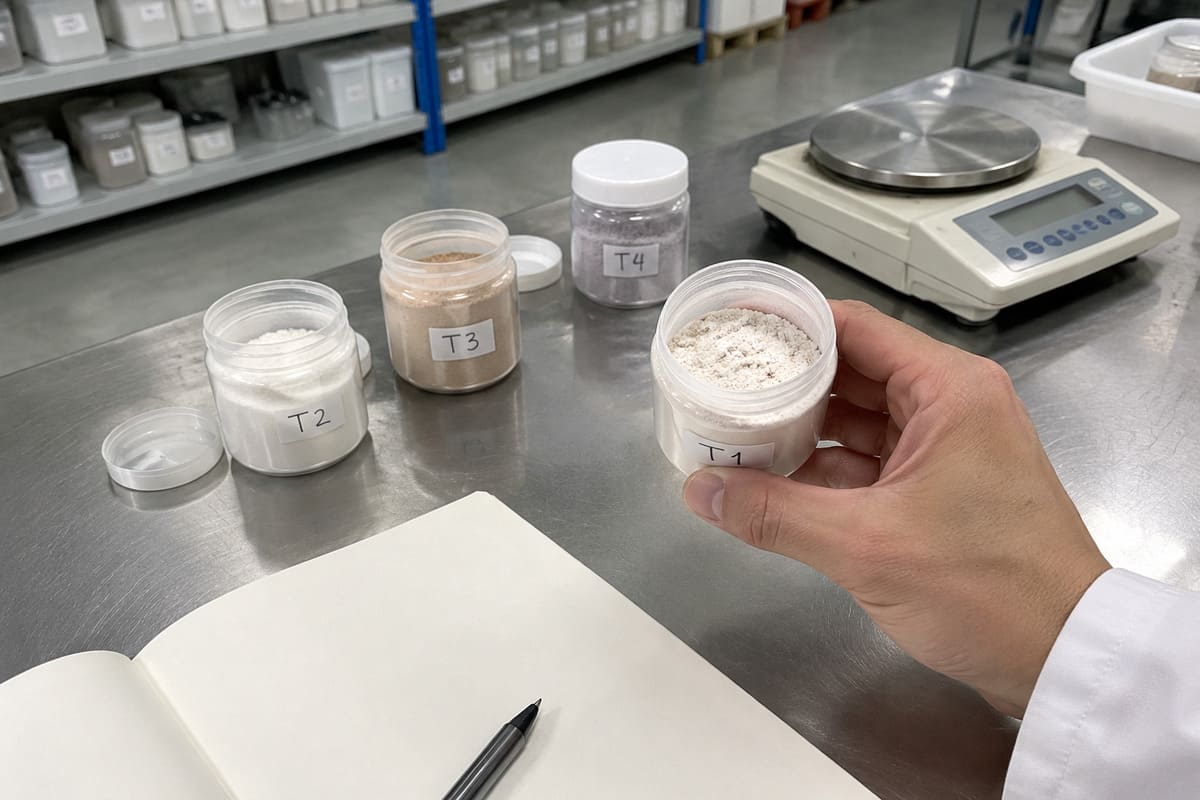
We do not treat cosmetic-grade talc as a universal prohibited ingredient. We require suitable specifications and evidence that asbestos was not detected, based on appropriate testing. When a brand prefers a talc-free position, we can evaluate alternatives such as starches, mica, silica, or other powders, but each substitute changes cost and performance.
We Evaluate Talc Through Evidence, Not Headlines
Talc can provide slip, softness, spreadability, oil absorption, and economical bulk. Those properties make it useful in pressed powders. However, talc is a naturally occurring mineral, so responsible sourcing and mineralogical quality control matter.
For the talc used in our projects, we require documentation supporting an “asbestos not detected” result. Buyers should still review:
- The identity of the raw-material producer
- Mine or source traceability when available
- Particle-size specifications
- Test method
- Detection capability
- Sampling date and batch relevance
- Independent testing expectations
- Destination-market guidance
- Retailer-specific policies
A report from an unrelated batch is not ideal evidence for every future shipment. Buyers with strict retailer requirements should define a testing frequency in the purchase specification.
We Compare Alternatives by Formula Performance
Cornstarch is often mentioned as a simple talc substitute, but a one-to-one replacement rarely produces an identical eye shadow. The reformulation may affect binding, microbial control, hard-pan risk, payoff, drop resistance, and sensory feel.
| Powder option | Potential benefit | Main formulation concern | Suitable positioning |
|---|---|---|---|
| Cosmetic-grade talc | Smooth feel, good slip, cost efficiency | Purity documentation and market perception | Mainstream or performance-led |
| Cornstarch or modified starch | Familiar talc-free story, oil absorption | Microbial control, drag, pressability | Natural-positioned or talc-free |
| Mica | Slip, translucency, shimmer compatibility | Sourcing documentation and variable payoff | Luminous or premium palettes |
| Silica | Oil absorption and soft-focus effect | Dustiness and excessive dryness | Matte and oil-control concepts |
| Boron nitride | Adhesion, slip, premium feel | Higher material cost | Premium pressed powder |
| Synthetic fluorphlogopite | Controlled sparkle and clean appearance | Cost and formula balance | Chameleon and special-effect shades |
We also review the mica supply chain when a buyer has social-responsibility requirements. A talc-free claim does not automatically create a responsible or compliant product. Every replacement introduces its own documentation, performance, and sourcing questions.
We Build Market Requirements into the Purchase Specification
I recommend that buyers turn ingredient concerns into measurable contract terms. A useful eye shadow specification can state:
- Approved target markets
- Final master formula version
- Permitted colorants
- Maximum levels for selected restricted substances
- Ingredients intentionally excluded
- Talc purity and testing requirements
- Heavy-metal test panel and limits
- Microbiological criteria
- Stability and compatibility plan
- Batch traceability requirements
- Change-control procedure
- Documents required before shipment
The change-control clause is especially important. A raw-material supplier should not silently change a pigment blend, preservative carrier, or trade-name composition. We expect any material change that could affect the formula, label, performance, or compliance status to be reviewed before use.
Frequently Asked Questions
Is talc one of the ingredients I should avoid in eye shadow?
We do not classify cosmetic-grade talc as universally prohibited. We assess its source, specification, and asbestos testing. If a buyer wants a talc-free claim or must satisfy a retailer policy, we can develop alternatives using starch, mica, silica, boron nitride, or other powders after testing performance and stability.
Are all glitter pigments safe and compliant for eye-area use?
We do not assume that every decorative glitter is suitable for eye shadow. We verify composition, particle characteristics, cosmetic status, pigment permissions, supplier documentation, and destination-market rules. We recommend separate professional review for special-effect particles because craft glitter and cosmetic eye-area materials are not interchangeable procurement categories.
What documents do we need to sell eye shadow in the EU?
We expect the buyer to arrange an EU Responsible Person, a Product Information File, a qualified Cosmetic Product Safety Report, CPNP notification, compliant labeling, and evidence of GMP compliance. We support the process with formula percentages, ingredient information, specifications, test reports, and manufacturing documents requested by the responsible professionals.
Does an FDA registration mean an eye shadow is FDA approved?
We do not describe a cosmetic or factory as “FDA approved” merely because a facility is registered or a product is listed. US cosmetics generally do not receive premarket FDA approval, although color additives have specific approval and certification rules. Buyers must also evaluate labeling, safety substantiation, MoCRA, and applicable exemptions.
Can we use one eye shadow formula in the EU, US, and Saudi Arabia?
We may be able to develop a formula suitable for all three markets, but we do not assume automatic acceptance. We cross-check pigments, restricted substances, labels, claims, and documentation for each destination. The buyer’s qualified local representative or consultant should confirm the final formula and market-entry file before launch.
Conclusion
The most important ingredients to avoid in eye shadow are not simply the substances criticized in consumer marketing. They are ingredients that are prohibited, over their legal limit, unapproved for eye-area use, poorly documented, or unsuitable for the target market. We focus on pigment approval, restricted additives, contamination control, traceability, and market-entry documents before mass production.
If you are developing a custom palette, we can discuss low-MOQ testing, custom shades, chameleon or sparkle effects, packaging, and OEM/ODM formulation. Contact Vertina Beauty with your target market and product concept so we can review the sourcing requirements before preparing samples and a quotation.
"Cosmetics Labeling Claims - FDA", https://www.fda.gov/cosmetics/cosmetics-labeling/cosmetics-labeling-claims. Regulatory guidance distinguishes legally required safety and labeling conditions from voluntary claims or product-positioning statements made by manufacturers and brands. Evidence role: definition; source type: government. Supports: Official guidance distinguishing mandatory cosmetic safety and labeling requirements from voluntary marketing claims.. Scope note: The distinction does not establish whether a particular voluntary claim is substantiated or permitted in every jurisdiction. ↩
"Summary of Color Additives for Use in the United States", https://www.fda.gov/industry/color-additives/summary-color-additives-use-united-states-foods-drugs-cosmetics-and-medical-devices. Official color-additive rules support the conclusion that authorization depends on the specified substance and permitted cosmetic use, not solely on a pigment’s natural or synthetic origin. Evidence role: general_support; source type: government. Supports: Official rules showing that color additives must satisfy applicable authorization and use conditions, regardless of whether their source is natural.. Scope note: The source must be checked for the exact pigment and jurisdiction because authorization conditions differ among colorants and markets. ↩
"21 CFR Part 73 -- Listing of Color Additives Exempt from ...", https://www.ecfr.gov/current/title-21/chapter-I/subchapter-A/part-73. The United States Code of Federal Regulations places relevant cosmetic color-additive listings and certification provisions in 21 CFR parts 73 and 74. Evidence role: definition; source type: government. Supports: The current US regulations identifying color additives exempt from certification and those subject to certification requirements.. Scope note: The regulation supports the legal framework, but each pigment’s permitted use, certification status, and conditions must be verified from its individual listing. ↩
"EU Regulations to Shake Up Beauty as of May 2026", https://www.cosmeticsandtoiletries.com/regulations/regional/news/22959115/eu-regulations-to-shake-up-beauty-as-of-may-2026. An EU regulatory or safety document records a 0.2% reference level for silver powder in the discussed eye-shadow context. Evidence role: historical_context; source type: government. Supports: An official EU safety opinion, proposal, or regulatory document containing a 0.2% reference for silver powder in eye-shadow products.. Scope note: A proposal or safety discussion is not proof of an enacted restriction; the consolidated legislation and applicable implementation date must be checked separately. ↩
"Regulation - EU - 2024/1328 - EN - EUR-Lex", https://eur-lex.europa.eu/eli/reg/2024/1328/oj/eng. The applicable EU restriction specifies a 0.1% concentration threshold and a 2027 date for the covered leave-on cosmetic applications. Evidence role: statistic; source type: government. Supports: The specific 0.1% threshold and 2027 applicability date for the covered leave-on cosmetic uses.. Scope note: This support is limited to the product categories and transitional rules defined in the legal text and should not be generalized to every cosmetic use. ↩
"Talc", https://www.fda.gov/cosmetics/cosmetic-ingredients/talc. Authoritative talc-safety guidance supports obtaining lot-relevant analytical evidence that asbestos was not detected by a method capable of identifying the relevant contamination. Evidence role: mechanism; source type: government. Supports: Government guidance identifying asbestos testing as relevant to talc safety and describing appropriate analytical approaches or detection expectations.. Scope note: A non-detect result is method- and sample-dependent and does not by itself establish universal safety for every batch or supply source. ↩
"Global regulatory compliance for cosmetics -", https://www.productcomplianceinstitute.com/global-regulatory-compliance-for-cosmetics/. Cross-jurisdictional regulatory guidance supports the conclusion that cosmetic-market access depends on the requirements of the destination jurisdiction rather than on a universally valid international certificate. Evidence role: general_support; source type: institution. Supports: Official or intergovernmental evidence that cosmetic placement requirements, notifications, responsible entities, and certificates differ by jurisdiction.. Scope note: The absence of a universal certificate does not mean that recognized certificates or conformity documents lack evidentiary value in particular markets. ↩
"commission implementing decision - EUR-Lex", https://eur-lex.europa.eu/legal-content/EN/TXT/PDF/?uri=CELEX:32013D0674. Regulation (EC) No 1223/2009 requires the cosmetic product safety assessment to be carried out by a person with specified university-level qualifications or recognized equivalent training. Evidence role: definition; source type: government. Supports: EU legal provisions concerning the Cosmetic Product Safety Report and the qualifications required of the safety assessor.. Scope note: The legal requirement supports the qualification rule but does not determine whether a particular assessor or report is adequate for a specific product. ↩
"Does the FDA approve cosmetics before they go on ...", https://www.fda.gov/industry/fda-basics-industry/does-fda-approve-cosmetics-they-go-market. FDA guidance states that cosmetic products generally are not subject to premarket approval, whereas color additives must comply with applicable statutory and regulatory approval provisions. Evidence role: definition; source type: government. Supports: FDA’s description of the distinction between the general absence of cosmetic-product premarket approval and the approval requirements applicable to color additives.. Scope note: This general rule does not address every product classification, drug claim, exemption, or post-market enforcement obligation. ↩