Which Company Makes the Best Eyeshadow? A Full-Chain Capability Guide
When B2B buyers search for which company makes the best eyeshadow, what they truly need is not a company ranking list, but a full-chain capability evaluation guide that proves a factory can handle everything from formulation to delivery. A weak supplier can delay an entire launch.1 I recommend evaluating technical depth, quality control, flexibility, and execution before comparing prices.
The best eyeshadow company is the manufacturer that can consistently turn a product concept into compliant, production-ready goods. I look for proven formulation skills, special-pigment experience, controlled sampling, stable pressing, packaging coordination, documented quality checks, and dependable delivery. Buyers should verify these capabilities with samples, records, and a trial order rather than relying on quotations or verbal promises.
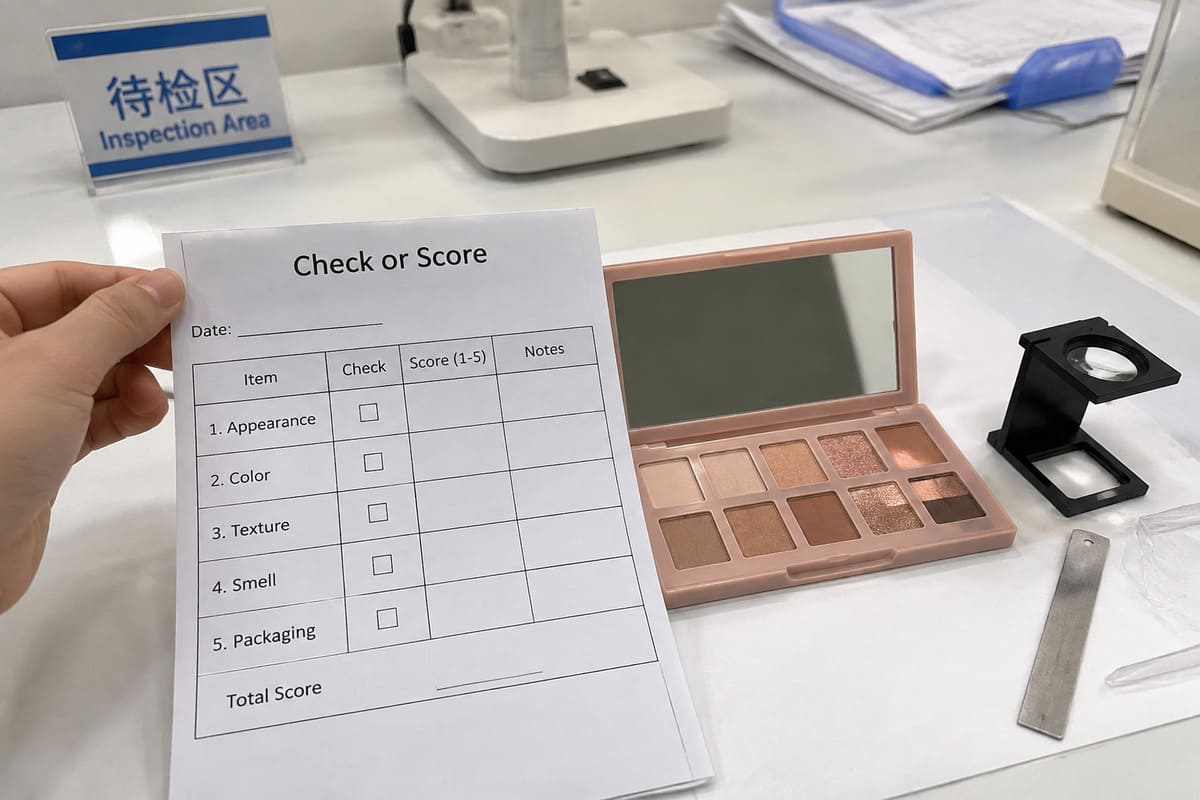
In my experience at Vertina Beauty, buyers rarely fail because they overlooked a small price difference. They usually face trouble because a supplier cannot reproduce an approved sample, control a difficult effect pigment, source suitable packaging, or meet the agreed launch schedule. The following framework helps expose those risks early.
What Does “Best” Mean for Buyers Comparing the Best Eyeshadow Company?
Buyers often receive similar product photographs and very different quotations. That makes a factory comparison look simple when it is not. If we focus only on unit price, we can miss formulation limits, inconsistent batch quality, packaging risks, and hidden coordination costs.
For B2B buyers, the best eyeshadow company is the supplier that meets the required product effect, quality level, target-market documentation, order quantity, packaging specification, and delivery schedule with repeatable results. I define “best” by fitness for the buyer’s project—not by factory size, the lowest quotation, or the broadest product catalog.
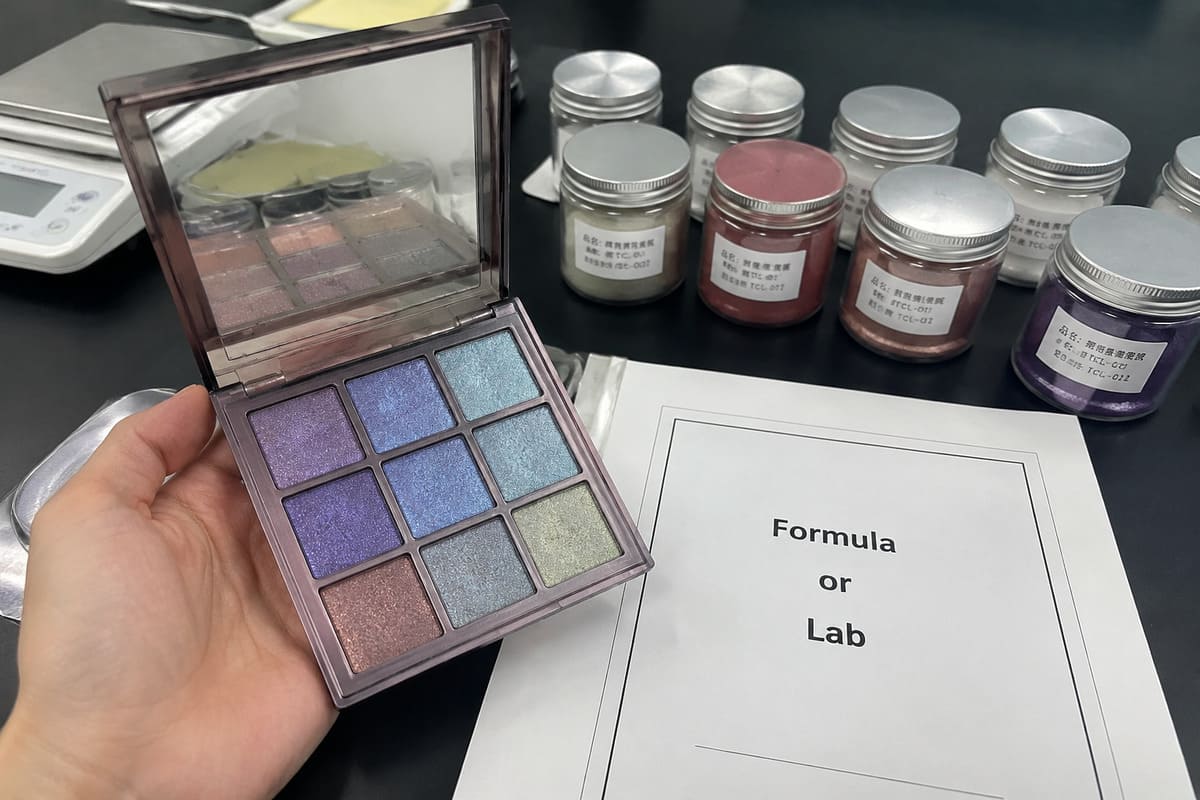
I Start With the Intended Market and Product Position
I cannot evaluate a manufacturer properly without understanding where the product will be sold. A distributor serving Southeast Asia may prioritize intense color, competitive landed cost, fast replenishment, and a manageable MOQ.2 An emerging North American or European brand may place greater weight on ingredient review, substantiation, packaging design, and cooperation with market-specific compliance work.3
I therefore start with five questions:
- Which country or region will receive the product?
- Which effect does the buyer want: matte, shimmer, sparkle, glitter, or chameleon?
- What is the intended retail position and target cost?
- How many units does the buyer need for the first launch?
- Which documents, tests, claims, and labeling elements does the destination market require?
These questions prevent a common sourcing mistake: selecting a product first and investigating feasibility later.
I Use a Weighted Supplier Scorecard
A structured scorecard makes factory comparisons more objective. Buyers can change the weighting to reflect their projects, but I generally suggest giving technical execution and quality more weight than headline price.
| Evaluation area | Suggested weight | Evidence I would request |
|---|---|---|
| Formula and effect capability | 25% | Physical samples, shade range, development records |
| Batch consistency and QC | 20% | Inspection plan, approved standards, batch records |
| Sampling and communication | 15% | Written brief, revision history, response times |
| Packaging integration | 10% | Compatibility checks, component specifications |
| MOQ and commercial flexibility | 10% | Formal quotation and quantity tiers |
| Lead-time reliability | 10% | Production plan and agreed milestones |
| Target-market support | 10% | Ingredient information and available test documents |
I treat every certificate as a document to verify, not as a marketing phrase. Buyers should check the document holder, scope, issuing body, validity period, product relevance, and destination-market requirements. A qualified regulatory or testing professional should review application-specific obligations before the goods enter a market.
I Separate Claims From Evidence
When a factory says, “We can make it,” I ask what that statement means. Does it have an existing base formula? Has it handled the selected pigment before? Can it produce a physical sample? Can it reproduce that sample in bulk? Can it fill or press the formula into the chosen component?
The best eyeshadow company should be able to move from conversation to evidence. I recommend requesting:
- A relevant stock sample or development sample
- A written formula-development scope
- A clear sample approval standard
- A target bulk tolerance or signed reference sample
- A packaging specification
- A QC checklist
- A realistic production schedule
- Available product and ingredient documentation
This process does not eliminate every risk. However, it makes the risks visible before a buyer commits to a large purchase.
What Are the Core Technical Capabilities of the Best Eyeshadow Company?
An attractive shade card can hide serious manufacturing weaknesses. Many suppliers can offer basic matte or shimmer products, but fewer can control difficult textures and optical effects. This gap becomes costly when the approved concept cannot move into stable bulk production.
A top eyeshadow manufacturer needs four connected capabilities: full-category formulation, special-pigment knowledge, controlled pressing or filling, and end-to-end production management. I also expect documented raw-material control, in-process inspection, packaging compatibility evaluation, finished-product checks, and a reliable method for reproducing the buyer’s approved sample.
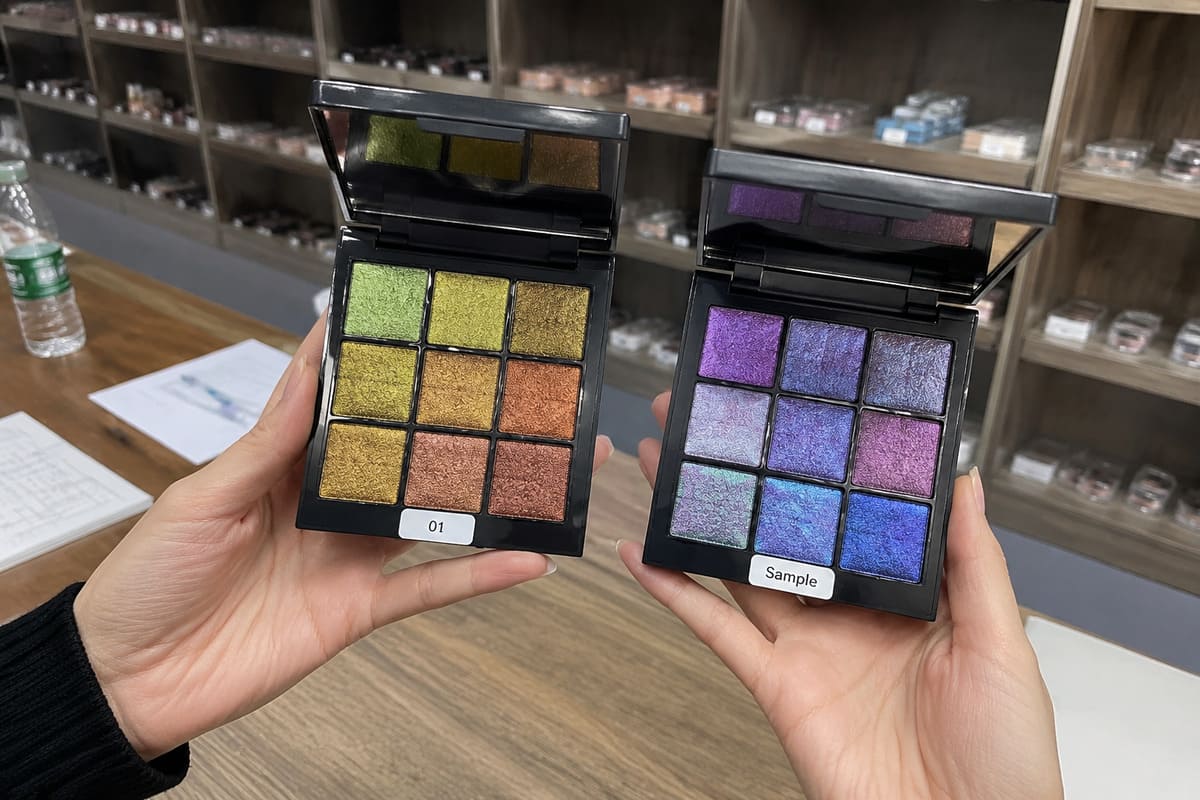
Full-Category Formulation Matters
I do not consider a factory technically broad merely because it offers many colors. Shade variety and formula variety are different things. A manufacturer may be able to tint one conventional shimmer base in dozens of colors while lacking the experience to produce a soft matte, high-impact sparkle, or stable chameleon effect.
At Vertina Beauty, our practical development work covers categories such as:
- Pressed matte eyeshadow
- Conventional shimmer eyeshadow
- Sparkle eyeshadow
- Glitter-effect products
- Chameleon and color-shifting eyeshadow
- Single shades and multicolor palettes
- Related eye products, subject to project requirements
Each category creates different challenges. A matte formula must balance payoff, blendability, adhesion, dust level, and pressing behavior. A sparkle formula must display visible brilliance without becoming unpleasant to apply. A chameleon formula must orient and reveal its optical shift while remaining compatible with the base and manufacturing method.
Special Pigments Are Not Interchangeable
I have seen buyers use “glitter,” “sparkle,” and “chameleon” as if they describe one ingredient class. They do not. Their particle structures, optical behavior, costs, processing needs, and regulatory considerations can differ substantially.4
| Effect type | Main visual goal | Typical development concern | What I verify |
|---|---|---|---|
| Matte | Even, non-reflective color | Payoff, patchiness, dust, blendability | Swatch, application, press condition |
| Shimmer | Smooth reflected sheen | Binder balance and even dispersion | Surface appearance and pickup |
| Sparkle | Distinct points of brilliance | Adhesion, fallout, particle distribution | Ambient and directed-light appearance |
| High-impact sparkle | Strong brilliance in diffuse ambient light | Formula support and cost | Samples under several lighting conditions |
| Chameleon | Color shift by viewing angle | Pigment selection, orientation, base color | Multi-angle visual comparison |
A “super glitter” effect, for example, usually requires more than adding a larger amount of conventional reflective material. I need to consider particle appearance, the binding system, pickup, adhesion, formula transparency, and how the product looks under diffuse and focused light.
Chameleon pigments also vary. A green-to-gold shift does not behave like a purple-to-blue shift. The substrate color, pigment concentration, formula base, application thickness, and lighting environment all affect the final appearance. Digital photos help us communicate, but they are not always reliable enough for final color approval.
Pressing and Scale-Up Can Change the Result
A beautiful laboratory sample does not guarantee a successful production batch. Pressing force, fill weight, pan dimensions, formula flow, surface pattern, and production handling can affect pickup and appearance.5
I therefore look at scale-up as a separate technical stage. We need to confirm that:
- The formula can be processed consistently.
- The pressed product does not become excessively hard or fragile.
- The surface remains acceptable after handling.
- The shade and effect match the approved reference within agreed limits.
- The chosen pan and packaging can protect the formula.
- The finished product passes the project’s agreed inspection plan.
The best eyeshadow company connects formulation decisions with production reality. If the laboratory and production teams work in isolation, the buyer may receive a bulk product that looks or performs differently from the approved sample.
How Did We Help a Southeast Asian Client Find the Best Eyeshadow Company for Chameleon Eyeshadow?
A Southeast Asian client once approached us after a frustrating development process. His existing supplier offered conventional eyeshadow at a competitive price, but it could not produce the chameleon effect he needed. Other factories expressed confidence during sales discussions, then withdrew when physical sampling began.
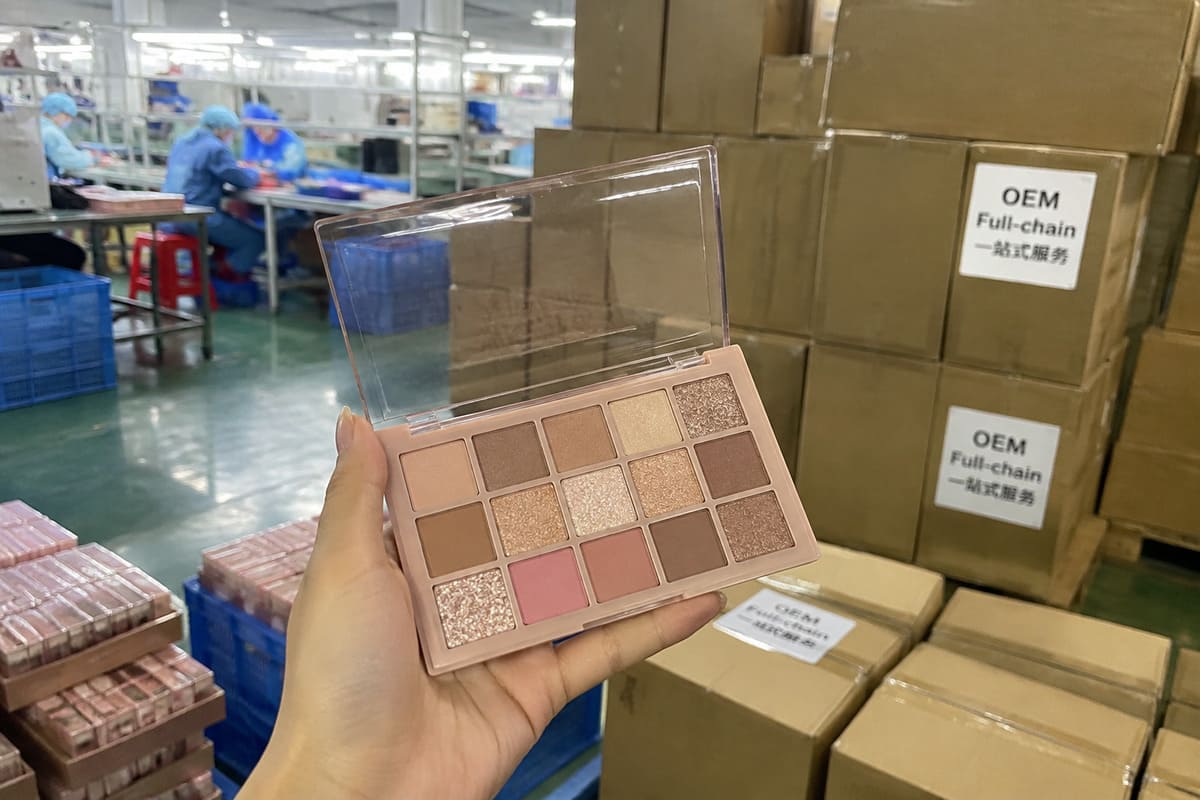
We helped the client by first presenting workable chameleon formulas, including green-to-gold and purple-to-blue effects. We then compared his target with physical references, adjusted the color direction, reviewed the budget implications, and prepared samples for approval. After the selected effect was confirmed, we moved the project through production and delivery.
The Client’s Real Problem Was Technical Risk
The client had identified strong interest in shifting eye colors through TikTok and his local market. He did not simply want another shimmer palette. He wanted a visible angle-dependent color transformation that could give his product line a clear promotional story.
His previous factory was suitable for conventional products. However, it did not have the materials, budget structure, or practical formulation experience required for this development. The client faced a difficult position:
- He had already planned the product concept.
- The trend window could close quickly.
- Several suppliers had made verbal promises.
- No supplier had converted the concept into an acceptable sample.
- A delay in one hero product could affect the entire collection.
This case reminded me that the cheapest supplier for a basic formula is not automatically the best eyeshadow company for a technically demanding product.
We Started With Existing Technical Foundations
Instead of promising an unlimited effect before understanding the request, we showed the client chameleon formulas that we could already demonstrate physically. The ready-made directions included green-to-gold and purple-to-blue shifts.
This step reduced uncertainty. The client could see actual samples rather than interpreting edited photographs. We then discussed:
- His preferred dominant color
- The secondary shift he expected
- The desired intensity
- The intended base color
- The palette format and pan size
- The target cost and retail position
- The acceptable sampling timeline
The client was impressed by the visible effects because they were more concrete than the earlier verbal assurances he had received. We adjusted the samples toward his color preference and successfully delivered the finished project.
Why the Development Required a Real Budget
Chameleon pigments can be expensive and are commonly costed with close attention to gram-level use.6 A small change in pigment concentration can materially change the formula cost. The buyer must therefore align the visual target with the intended retail price.
I explain the trade-off directly:
| Development choice | Likely benefit | Likely cost or risk |
|---|---|---|
| Higher special-pigment loading | Stronger visible shift | Higher formula cost |
| Custom color direction | Greater differentiation | More sampling rounds |
| Existing effect formula | Faster, lower-risk development | Less exclusivity |
| New packaging | Stronger brand identity | Tooling, MOQ, or longer lead time |
| Small trial order | Lower inventory exposure | Higher per-unit cost |
A physical reference remains the best starting point for a specific color requirement. We can also work from clear videos, photographs, or written descriptions, but screen settings and lighting can distort the effect. I always recommend approving physical samples under more than one lighting condition before bulk production.
Why Does Full-Chain Capability Matter More Than Price When Choosing the Best Eyeshadow Company?
A low quotation can feel like an immediate saving. However, the saving can disappear if the buyer must coordinate separate formula developers, pigment suppliers, packaging vendors, assemblers, inspection teams, and freight schedules. Every handoff introduces time, communication, and quality risks.
Full-chain capability matters because one responsible manufacturer can coordinate formulation, sampling, raw materials, pressing or filling, packaging, quality inspection, assembly, and delivery. I find that this reduces handoff errors, shortens problem-solving paths, and gives buyers clearer accountability. Unit price remains important, but total project cost is the better purchasing measure.
I Calculate Total Sourcing Cost, Not Unit Price Alone
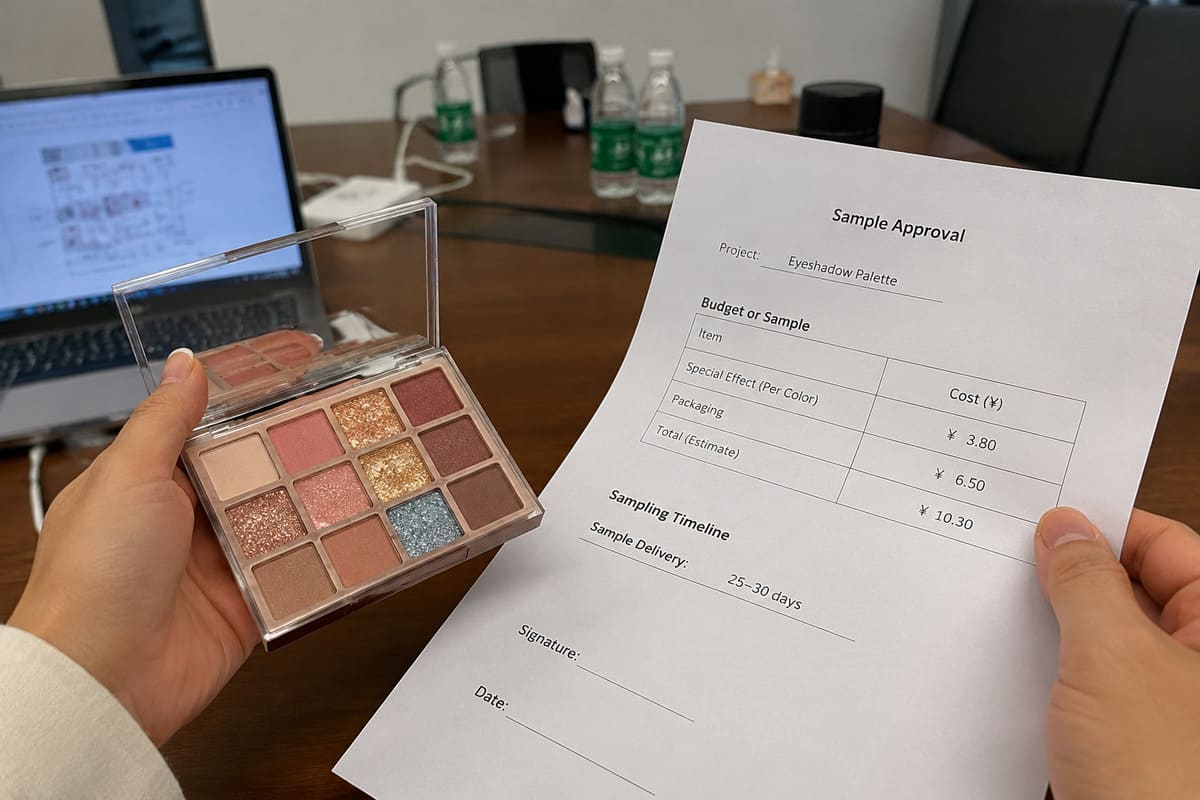
A buyer may compare Factory A at one price and Factory B at a slightly higher price. That comparison remains incomplete unless both quotations cover the same scope, quality, packaging, testing, and delivery conditions.
I recommend using this simplified model:
Total sourcing cost = goods + development + packaging + testing + coordination + inspection + logistics + delay risk + rework risk
Some costs are easy to quantify. Others are probabilistic, but buyers should not ignore them. If a late launch causes a seller to miss a seasonal campaign, the commercial loss may be much larger than the difference between two unit prices.
| Cost area | Fragmented supply chain | Full-chain supplier |
|---|---|---|
| Formula responsibility | May sit with a separate developer | Managed with production feasibility |
| Packaging coordination | Buyer handles multiple parties | Manufacturer can coordinate components |
| Sample tracking | Several approval routes | Centralized revision process |
| Defect investigation | Responsibility can be disputed | Clearer accountability |
| Schedule management | Multiple independent timelines | One integrated project plan |
| Communication load | High | Lower and more focused |
Guangdong Creates a Practical Supply-Chain Advantage
Our manufacturing base is in Guangdong, China, within a mature cosmetics and packaging industrial environment.7 This location gives us practical access to formulation resources, pigment options, packaging vendors, production support, and export services.
Location alone does not prove quality. I would never recommend choosing a factory simply because it operates in a famous manufacturing area. However, a developed industrial cluster can shorten sourcing routes and improve problem-solving when the factory has strong internal coordination.
At Vertina Beauty, we use this network to support projects from R&D and sampling through bulk production, packaging, and delivery. Our team of around 100 people gives us the capacity to support medium-sized orders while maintaining flexibility for emerging brands, wholesalers, and distributors.
Accountability Retains Buyers
According to our experience with B2B clients, the lowest price may win an initial inquiry, but reliable problem-solving is more likely to retain a customer. Buyers remember whether the supplier handled a shade correction, solved a packaging mismatch, communicated a delay early, or provided a realistic replenishment plan.
I believe the best eyeshadow company should provide:
- One clear project contact
- A written specification and approval path
- Realistic sampling milestones
- Transparent change management
- Defined packaging responsibilities
- In-process and finished-product checks
- Prompt communication when a risk appears
- Delivery planning based on the actual order scope
No supplier can promise that every development will be effortless. A trustworthy supplier should instead show how it identifies, communicates, and controls problems.
What Should Buyers Know About Special Effects, Budget, and Sampling From the Best Eyeshadow Company?
Special-effect eyeshadow creates strong visual differentiation, but it also increases technical and commercial complexity. Buyers can become disappointed when a reference effect cannot fit the planned cost, or when digital images create expectations that physical pigments cannot reproduce exactly.
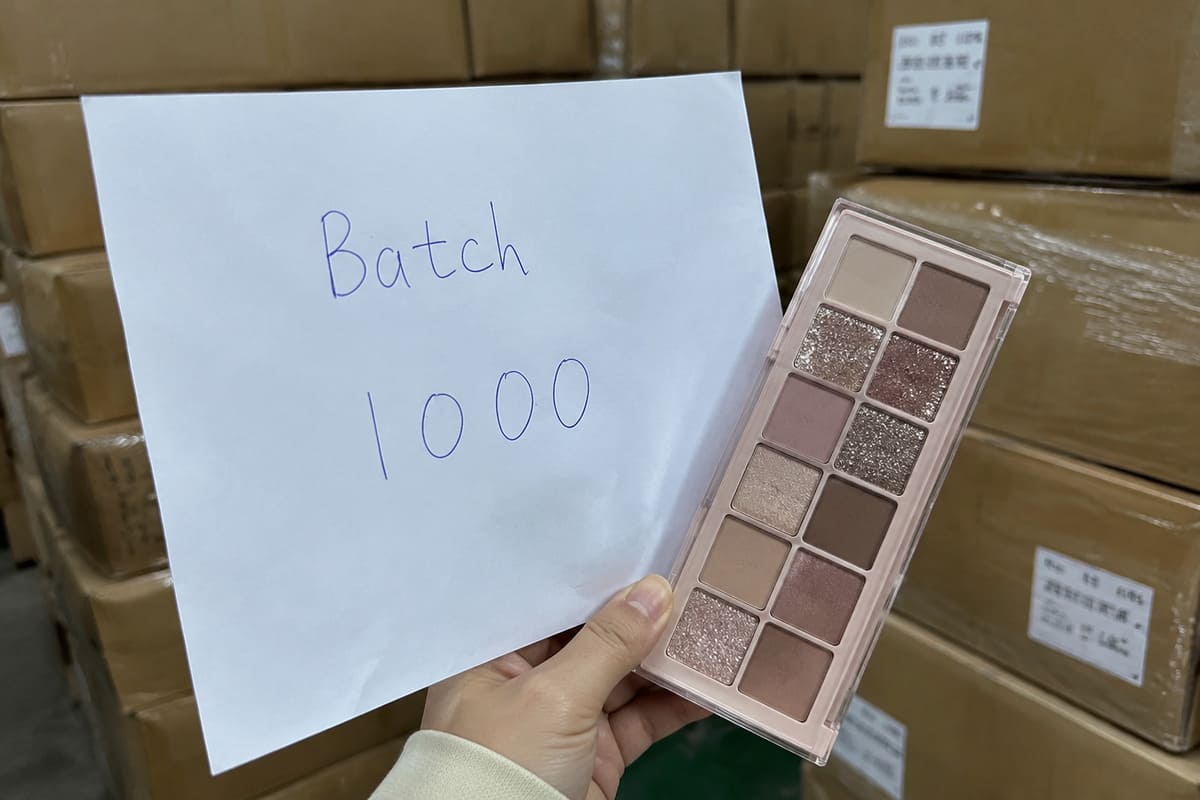
Buyers should expect special pigments to increase material cost, sampling complexity, and sometimes production risk. I recommend setting a target effect, cost range, quantity, and physical approval method before development begins. A small trial order can then test consumer response while limiting inventory exposure, especially for trend-led chameleon or sparkle products.
I Discuss Budget Before Chasing an Exact Effect
I prefer an honest budget conversation at the start. Chameleon and high-impact sparkle materials can be expensive. They are not always suitable for a low-cost product position. If the buyer expects a dramatic optical shift but sets a budget for a basic shimmer, the project will likely stall.
I normally help the buyer consider three development levels:
| Development route | Best suited to | Relative development risk | Commercial implication |
|---|---|---|---|
| Existing stock effect | Fast market testing | Low | Lower development burden |
| Modified existing formula | Brand differentiation | Medium | Additional sampling and adjustment |
| Fully custom effect and packaging | Signature product launch | High | Higher budget and longer preparation |
These categories are planning tools rather than universal price rules. Actual cost depends on the formula, pigment loading, pan size, packaging, quantity, testing scope, and destination market.
Physical Sampling Needs a Written Brief
A good sampling brief prevents repeated revisions. I ask buyers to provide as much of the following information as possible:
- Physical reference, if available
- Clear photographs and multi-angle videos
- Desired primary and shift colors
- Preferred texture and application feel
- Target intensity and finish
- Pan dimensions and fill weight
- Packaging concept
- Target market
- Ingredient or claim restrictions
- Target cost range
- Planned launch date and first-order quantity
I also ask buyers to identify which elements are mandatory and which are flexible. A buyer may consider the purple-to-blue shift mandatory but accept a different pan size. Another buyer may prioritize packaging dimensions because the palette artwork is already complete.
I Recommend Controlled Sample Approval
Sample approval should not rely on one photo or one casual swatch. For special effects, I suggest evaluating the sample:
- Under diffuse daylight or a standardized daylight-type source
- Under indoor ambient light
- Under directed light
- From several viewing angles
- On the intended skin-tone range or suitable application substrates
- In the final or representative packaging format
The buyer and manufacturer should retain matched approval samples where practical. The written specification should identify the approved shade, texture, finish, packaging, and other measurable requirements.
Low MOQ Can Reduce Trend Risk
Trend-led products create inventory pressure. A dramatic TikTok effect can rise quickly and cool just as fast.8 An emerging brand may therefore prefer a low-MOQ pilot before committing to a large order.
Vertina Beauty supports flexible low-order strategies for selected standard and trend-focused products. Exact quantities depend on the formula, packaging, customization level, and production setup. We can also discuss ready-stock or simplified packaging routes when speed matters more than full exclusivity.
A trial order lets buyers evaluate:
- Customer response
- Content performance
- Return and complaint patterns
- Shade preferences
- Reorder speed
- Acceptable retail pricing
- Packaging durability in real distribution
I still recommend professional market and regulatory review. A small quantity reduces inventory exposure, but it does not remove the buyer’s responsibility to verify ingredients, labeling, claims, testing, and documentation for the intended market.
Frequently Asked Questions
How Can I Verify Whether an Eyeshadow Factory Has Real R&D Capability?
I recommend requesting physical samples that match the intended effect, discussing how the factory would modify them, and reviewing the sampling process. A capable team should explain pigment choices, cost trade-offs, pressing concerns, and scale-up risks. Buyers should validate the claims through development samples and a controlled trial order.
What Information Should I Send for a Custom Eyeshadow Quotation?
I suggest sending the target market, product type, shade count, effect, palette format, fill weight, packaging concept, order quantity, target price range, and required delivery date. Physical color references are especially useful for chameleon and sparkle products. Buyers should also identify any ingredient, claim, testing, or labeling requirements.
Why Is Chameleon Eyeshadow More Expensive Than Regular Shimmer?
Chameleon eyeshadow generally uses specialized effect pigments that create different colors at different viewing angles.9 These pigments can carry a much higher material cost and require careful formulation. Pigment concentration, pan size, base formula, sampling rounds, packaging, and order quantity all influence the final quotation.
Should I Start With a Custom Formula or an Existing Formula?
I recommend an existing or lightly modified formula when speed, lower development risk, and market testing are the priorities. A fully custom formula is more suitable when a brand needs a signature texture or effect and has enough time and budget for development, testing, scale-up, and documentation review.
What Documents Should I Verify Before Importing Eyeshadow?
I ask suppliers for available ingredient information, product specifications, batch or inspection records, relevant test reports, and any certificates required by the project. Requirements differ by market and product claims. Buyers should have a qualified regulatory professional confirm current formulation, labeling, notification, testing, and importer obligations before shipment.
Conclusion
The best eyeshadow company is not automatically the largest factory or the supplier with the lowest unit price. I believe the right partner must prove full-chain capability across formulation, special pigments, sampling, production, packaging, quality control, and delivery. Buyers should verify that capability through physical samples, written specifications, relevant documents, and a trial order.
At Vertina Beauty, we support B2B buyers with flexible low MOQs, custom OEM/ODM development, special-effect eyeshadows, and integrated production in Guangdong. Contact us with your target shade, market, packaging idea, quantity, and budget to discuss a practical sampling plan.
"Supply chain disruptions and resilience: a major review ... - PMC", https://pmc.ncbi.nlm.nih.gov/articles/PMC7792559/. Supply-chain research identifies supplier reliability and coordination as factors that can affect new-product-development schedules and product-launch performance. Evidence role: general_support; source type: paper. Supports: Research on supplier integration, supplier reliability, or supply-chain disruption as factors affecting new-product-development and launch performance.. Scope note: Evidence may concern manufacturing supply chains generally rather than eyeshadow production specifically. ↩
"Southeast Asia Color Cosmetics Market Share & Forecast 2026-2032", https://www.marknteladvisors.com/research-library/southeast-asia-color-cosmetics-market-report.html. Regional beauty-market research can contextualize the product, price, and supply considerations relevant to color-cosmetics distribution in Southeast Asia. Evidence role: general_support; source type: research. Supports: Neutral market research on color-cosmetics demand, purchasing behavior, and price or replenishment considerations in Southeast Asian markets.. Scope note: Regional market evidence cannot establish that every Southeast Asian distributor has the same procurement priorities. ↩
"Let's bring your vision to life. - Source Cosmetic Manufacturer", https://vertinabeauty.com/contact/. United States and European Union cosmetics frameworks require or govern product safety, labeling, ingredient information, and claims, making regulatory review a material consideration for brands selling in these markets. Evidence role: general_support; source type: government. Supports: Official requirements concerning cosmetic safety, ingredient information, labeling, product documentation, and claims in the United States and European Union.. Scope note: Regulatory requirements explain why these issues matter but do not directly measure the priorities of emerging brands. ↩
"EU Glitter Ban: Sparkling Change for Environment", https://www.belabservices.com/en/post/european-commission-glitter-ban-cosmetics. Scientific literature describes pearlescent and interference pigments as optically distinct materials whose visible effects depend on particle structure, composition, and interactions with incident light. Evidence role: mechanism; source type: paper. Supports: Materials-science evidence that pearlescent and interference pigments produce optical effects through composition, layer structure, particle geometry, and light interaction.. Scope note: A materials-science source may not directly address commercial cost differences or every pigment category used in cosmetics. ↩
"A mechanistic powder compaction equation: Accounting for the effects ...", https://researchwith.njit.edu/en/publications/a-mechanistic-powder-compaction-equation-accounting-for-the-effec/. Powder-compaction research indicates that material flow, fill characteristics, tooling, and compression conditions can influence compact integrity, surface properties, and product performance. Evidence role: mechanism; source type: paper. Supports: Technical evidence that powder composition, flow, compaction conditions, and tooling influence the integrity and performance of pressed powder products.. Scope note: Studies may focus on pharmaceutical or general powder compaction rather than consumer eyeshadow specifically. ↩
"Biocosmetics: technological advances and future outlook - PMC", https://pmc.ncbi.nlm.nih.gov/articles/PMC8616574/. Formulation-cost analyses generally show that the price and concentration of specialty raw materials can materially influence the cost of a finished formulation. Evidence role: general_support; source type: research. Supports: Evidence that specialty pigments can be relatively high-value raw materials and that raw-material loading contributes directly to formulation cost.. Scope note: Public sources may establish the cost mechanism without providing current prices for a particular chameleon pigment. ↩
"Trusted Makeup Manufacturer for OEM & ODM - Vertina Beauty", https://vertinabeauty.com/home/. Official and institutional reporting describes Guangdong as a significant Chinese manufacturing region with established cosmetics and related packaging supply-chain activity. Evidence role: historical_context; source type: government. Supports: Official or institutional reporting on Guangdong's cosmetics manufacturing base, related packaging industries, and industrial-cluster development.. Scope note: Regional industrial concentration does not establish the quality, compliance performance, or capabilities of any individual factory. ↩
""The Impact of Tik Tok Marketing on Consumer Behavior in ...", https://digitalcommons.lindenwood.edu/theses/1401/. Research on social-media trend diffusion indicates that platform-driven attention can spread rapidly and may be short-lived, particularly for highly visible consumer products. Evidence role: general_support; source type: paper. Supports: Research on social-media-driven trend diffusion, accelerated product attention, and the short life cycles of online trends.. Scope note: General social-media trend evidence does not predict the duration or commercial outcome of a particular TikTok beauty trend. ↩
"Structural coloration - Wikipedia", https://en.wikipedia.org/wiki/Structural_coloration. Interference pigments can exhibit angle-dependent color because their layered structures selectively reflect light through optical interference. Evidence role: definition; source type: encyclopedia. Supports: A definition of interference or color-travel pigments and the optical principle by which their visible color changes with viewing angle.. Scope note: A general definition explains the visual mechanism but does not verify the ingredients or performance of a specific eyeshadow product. ↩