You found a foundation makeup manufacturer promising "100 units, 19 shades, impossibly low price," and it looks like the perfect way to launch your line. Then the doubt creeps in. Is that really your formula, or a stock product wearing your logo? Here is the honest breakdown, so you launch a brand instead of renting a catalog slot.
A foundation makeup manufacturer offering "100 units across 19 shades" is almost always selling white-label stock: an existing formula in existing packaging with your logo added. True custom foundation typically starts at 1,000–5,000 units per shade1, and packaging MOQs of 10,000–20,000 units often force even larger orders2. The "100-unit" route is fast and low-risk, but it gives you zero differentiation.

That gap between the ad and the reality is where most new brands lose money. Below, I break down the shade math, the packaging lock, and the launch sequence I actually recommend to founders who want a brand, not a clone.
What Does "Foundation Makeup Manufacturer" Really Mean for a Startup?
You searched "foundation makeup manufacturer" expecting one clear service. Instead you found pages offering wildly different things at wildly different prices, and no one explained why. That confusion costs founders real money before they place a single order.
A foundation makeup manufacturer can mean three different businesses: a white-label supplier who adds your logo to a stock formula, a private-label factory who fills an existing base in your packaging, or a custom (OEM/ODM) producer who develops a formula to your spec3. The "100-unit" offers you see ranked on Google are almost always the first type.
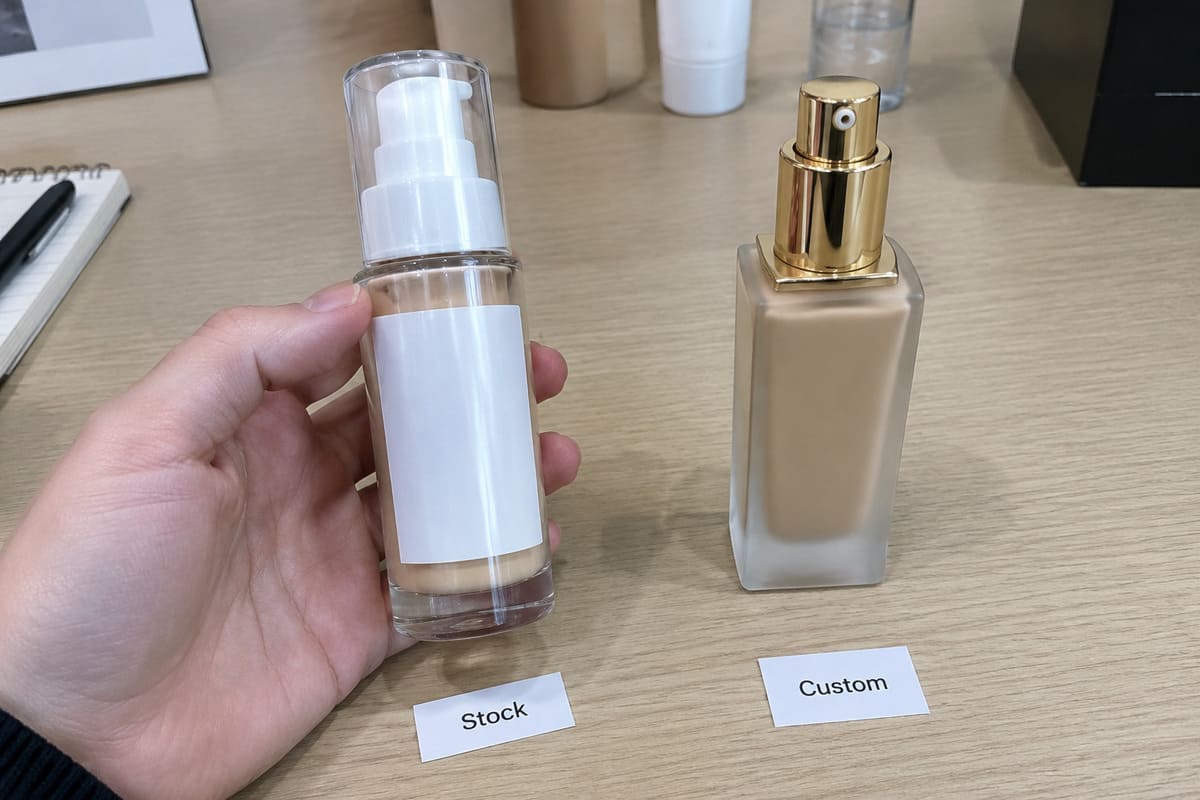
The distinction matters because the word "manufacturer" hides the real question. You are not asking "who can make foundation cheaply?" You are asking "is this my formula, or everyone's formula with my sticker on it?"
Here is how I explain the three models to founders:
| Model | What you get | Typical MOQ per shade | Differentiation | Best for |
|---|---|---|---|---|
| White-label | Stock formula + stock packaging + your logo | 100–500 units | None | Fast market test |
| Private-label | Existing base in your chosen packaging | 500–1,000 units | Low to medium | Budget launch |
| Custom (OEM/ODM) | Formula developed to your brief | 1,000–5,000 units | High | Brand building |
Why the Cheapest Option Is Not Always the Right One
I once spoke with a U.S. founder drawn to a "100-unit, 19-shade" white-label listing. My first question was simple: "How many of those 19 shades are actually your formula, versus stock colors the factory already sells to everyone else?" He had no answer. That silence is the whole problem. A low price per unit means nothing if the product is identical to the one your competitor bought from the same catalog page. For a market test, that trade-off is fine. For a brand, it is a dead end.
The Shade Matrix Trap: Why Every Foundation Shade Is a Separate Inventory Bet
You priced your foundation line like an eyeshadow palette and assumed one order covers all your colors. Foundation does not work that way, and the surprise usually arrives after you have already committed. This single misunderstanding sinks more foundation launches than price ever does.
Every foundation shade is an independent SKU with its own MOQ and its own inventory risk.4 An eyeshadow palette holds 12 colors in one SKU5, but a 15-shade foundation range at just 1,000 units per shade equals 15,000 units of liquid inventory. A broad launch multiplies your approval rounds, your MOQ pressure, and your cash exposure.6
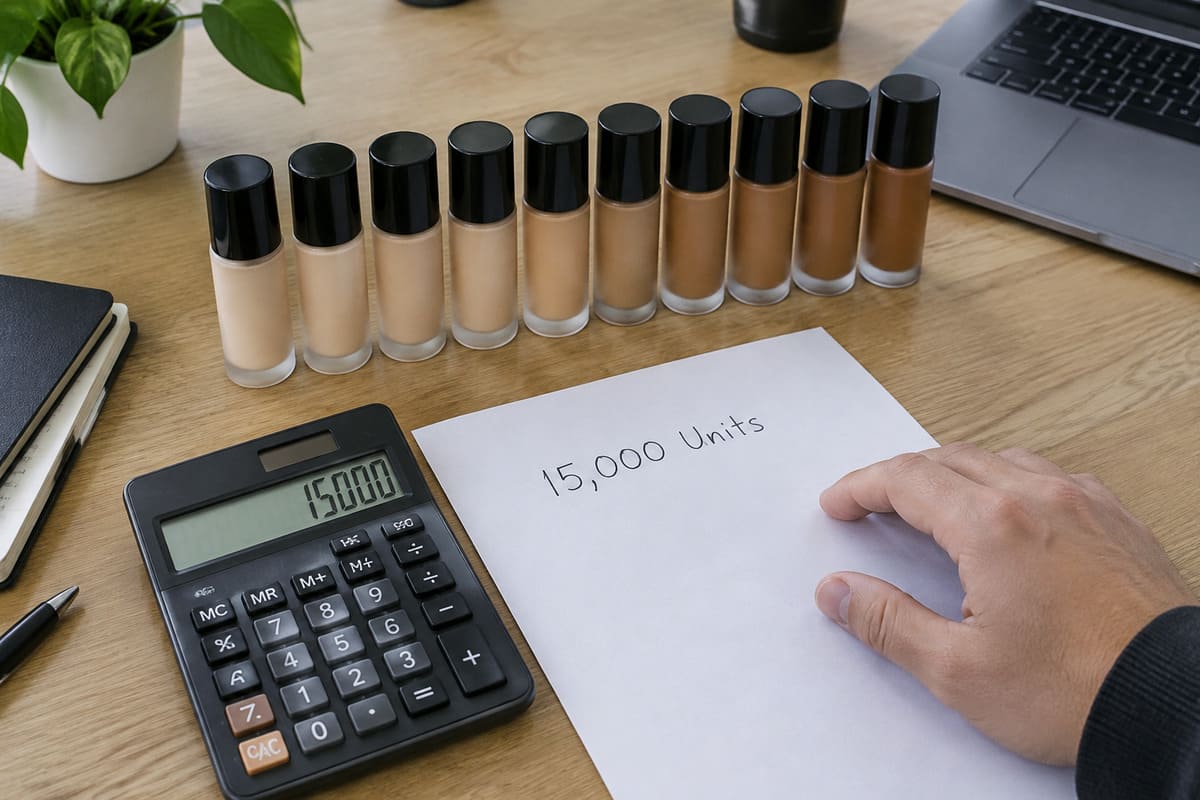
Let me show the math that stops founders cold. Here is what a "full range" ambition actually costs in units before you have sold a single bottle:
| Shade range | Units per shade | Total liquid inventory |
|---|---|---|
| 5 shades | 1,000 | 5,000 units |
| 10 shades | 1,000 | 10,000 units |
| 15 shades | 1,000 | 15,000 units |
| 19 shades | 1,000 | 19,000 units |
| 19 shades | 2,000 (common factory MOQ) | 38,000 units |
The Inventory Imbalance Nobody Warns You About
The deeper trap is demand distribution. Foundation shades do not sell evenly. In most markets, a handful of mid-range shades carry the majority of sales, while the lightest and darkest shades move slowly7. When you launch 19 shades at once, you are guaranteed to over-order the slow movers and under-order the fast ones. You end up with dead stock in some shades and stockouts in others, and no sales data to correct the mistake.
Startup guidance across the industry is consistent on this point: launching a wide shade range before validating demand creates inventory imbalance and weak reorder control8. You tie up cash in colors nobody wanted, and you cannot reorder the winners fast enough. A disciplined 5-shade launch gives you the data to buy the next ten shades with confidence instead of hope.
White-Label vs. True Customization: What "100 Units" Actually Buys You
The "100 units" headline feels like a gift until you understand what you are actually buying. Many founders discover the catch only after their product ships looking exactly like three competitors' products. Knowing the difference upfront saves you from a launch you cannot defend.
A "100-unit" foundation offer buys you a stock formula and stock packaging with your logo applied. You are renting a slot in the factory's existing catalog, not developing a product. It is a legitimate, fast, low-cost way to test a market, but it delivers no formula ownership and no meaningful brand differentiation.
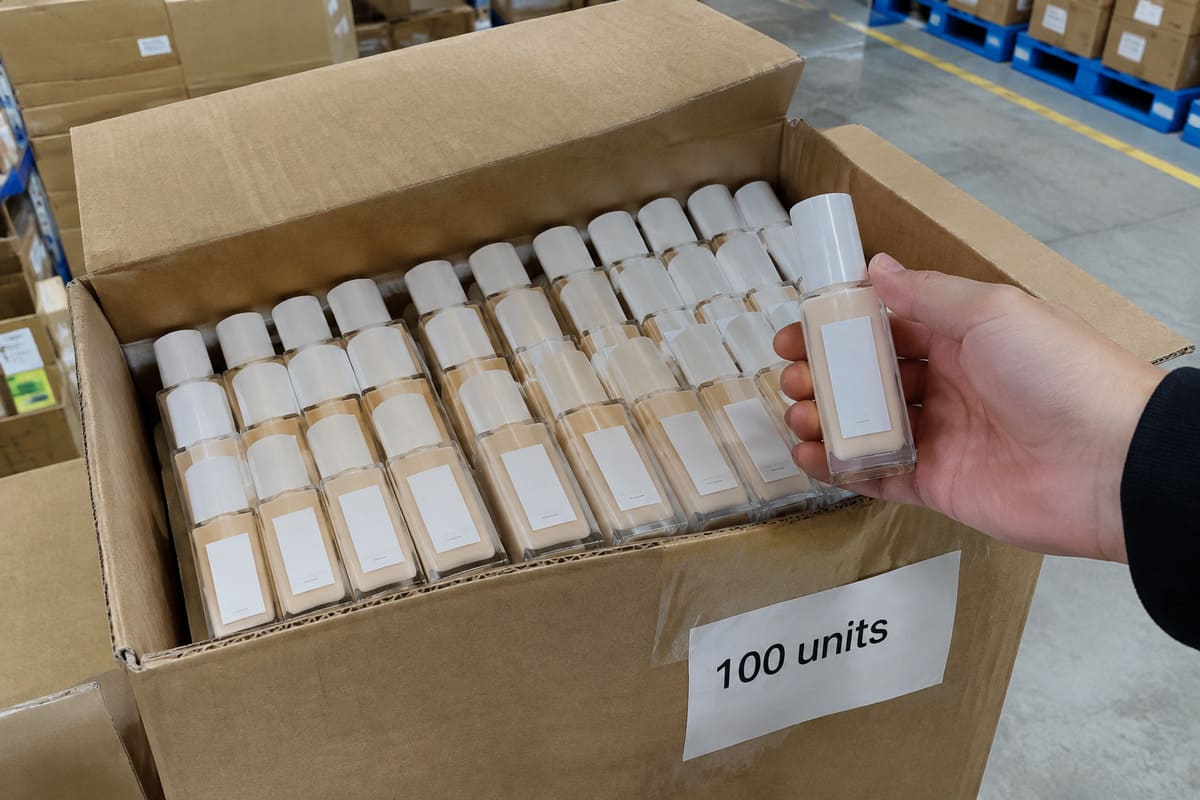
The honest comparison looks like this:
| Factor | White-label "100 units" | True custom formulation |
|---|---|---|
| Your formula? | No, shared stock | Yes, developed to brief |
| Per-shade MOQ | 100–500 units | 1,000–5,000 units |
| Upfront cost | Low | Higher |
| Differentiation | None | Full |
| Reorder identity | Shared with other brands | Exclusive to you |
| Launch speed | Fast | Slower (formula + testing) |
When White-Label Is the Smart Choice
I want to be fair to the white-label model, because it has a real use. If your only goal is to test whether a foundation concept resonates with your audience, and you accept that the product is a shared stock item, the 100-unit route is rational. You spend little, you learn fast, and you lose little if the test fails. The mistake is believing a white-label stock product is a brand. It is not. It is a market probe. Treat it as research, not as your long-term product, and you will use it well.
The Packaging Lock: Why Your Bottle MOQ May Be Higher Than Your Formula MOQ
You negotiated a formula MOQ you could afford, then the packaging quote arrived and doubled your order overnight. This is the hidden threshold that "low MOQ" marketing never mentions, and it has wrecked more than one budget I have seen.
Foundation pumps, glass bottles, and airless containers commonly carry MOQs of 10,000 to 20,000 units9. If your formula MOQ is 5,000 units but your bottle MOQ is 10,000, the packaging forces you to either double your formula order or pay for bottles you cannot fill. Packaging MOQ dictates formula MOQ far more often than founders expect.
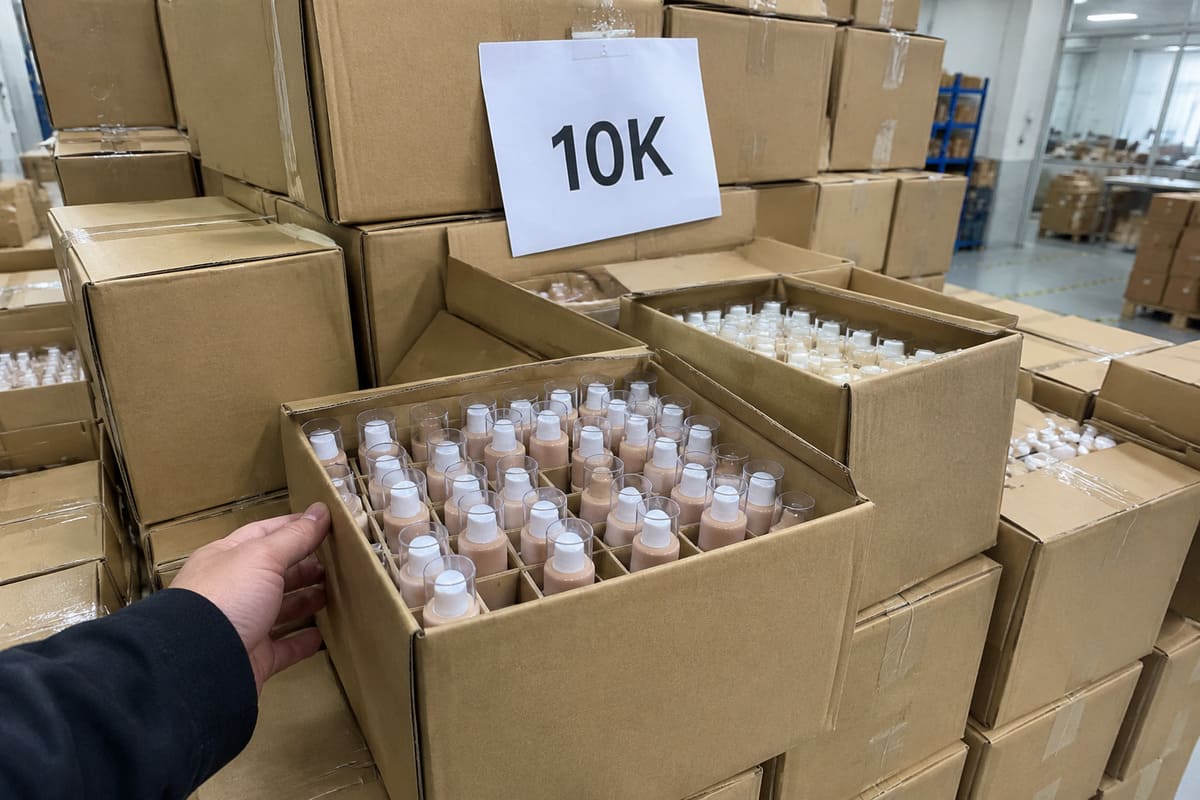
Here is the real example that taught me to lead with this warning. A founder wanted a custom pump bottle for 19 shades. We ran it:
Pump bottle supplier MOQ: 10,000 units per bottle design. 19 shades × 10,000 bottles = 190,000 empty bottles. Even filling only 5,000 units per shade, he still had to buy 190,000 bottles.
The packaging MOQ would have eaten his entire budget on empty containers. We restructured the launch around 5 shades, which meant 50,000 bottles instead of 190,000. He validated demand, then used revenue to fund the next ten shades. The lesson is blunt: align your formula order with your packaging MOQ before you fall in love with a bottle.
How to Avoid the Packaging Trap
- Ask for the bottle MOQ before you discuss the formula. It is usually the binding constraint.
- Consider stock packaging for your first run. Custom bottles can wait until demand is proven.
- Count the empties. Your real order quantity is the higher of your formula MOQ and your packaging MOQ, multiplied by every shade.
- Match shade count to packaging budget, not to your eventual ambition.
A Smarter Path: Launch with 5 Core Shades, Not 19
You feel pressure to launch with a "complete" range because competitors show 19 shades on their site. That pressure pushes you to gamble cash on colors you cannot yet justify. The disciplined path wins more often, and it costs far less to recover from.
The smartest foundation launch starts with 5 core shades that cover your primary market, not a full 19-shade range. You validate demand with roughly 5,000 units per shade, read the sales data, then expand into additional shades funded by revenue. This sequence protects your cash flow and keeps your reorders aligned with real demand.
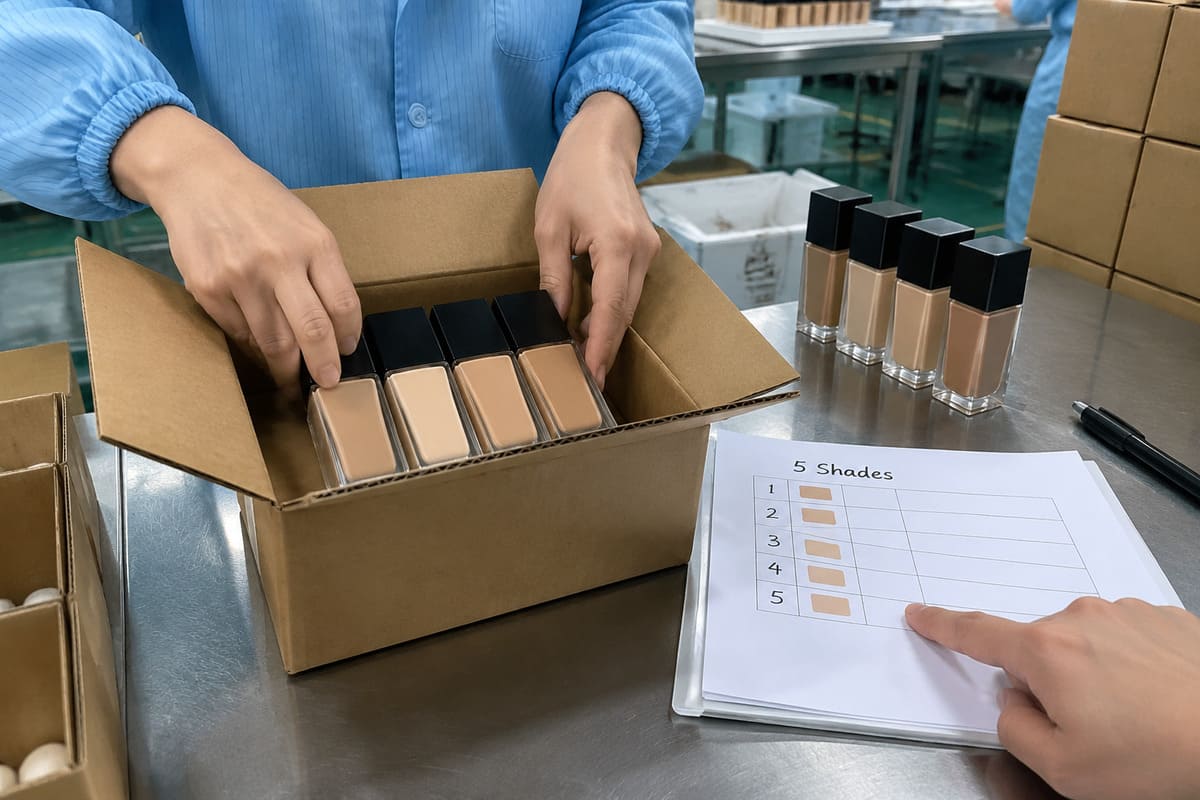
The sequencing logic is straightforward:
| Phase | Action | Purpose |
|---|---|---|
| 1. Validate | Launch 5 core shades (or a 2,000-unit powder palette) | Prove the brand and audience with low risk |
| 2. Read | Analyze which shades sell and reorder rates | Replace guesses with data |
| 3. Expand | Add 5–10 shades funded by phase-1 revenue | Grow on proof, not hope |
| 4. Customize packaging | Commit to custom bottles once volume justifies the MOQ | Avoid overbuying empties early |
For powder-based color cosmetics like eyeshadow palettes, I offer a 2,000-unit validation trial, which is the lowest-risk way to test a brand and audience before touching liquid foundation at all. For liquid foundation, I support 5,000–10,000 units per shade of true custom formulation and help align formula orders with packaging MOQs so you do not overbuy bottles. That alignment is the part most suppliers skip.
What to Ask a Foundation Manufacturer Before You Commit
You are about to send a deposit, and you want to be sure you are not walking into the white-label trap. The right questions expose the real terms in minutes. Ask these before money moves, and you will negotiate from knowledge instead of assumption.
Before committing to any foundation makeup manufacturer, confirm whether the shades are custom or stock, the exact MOQ per shade, the packaging MOQ, and whether any referenced certifications are documented and verifiable for your target market. These four answers separate a brand-building partner from a catalog-rental listing.
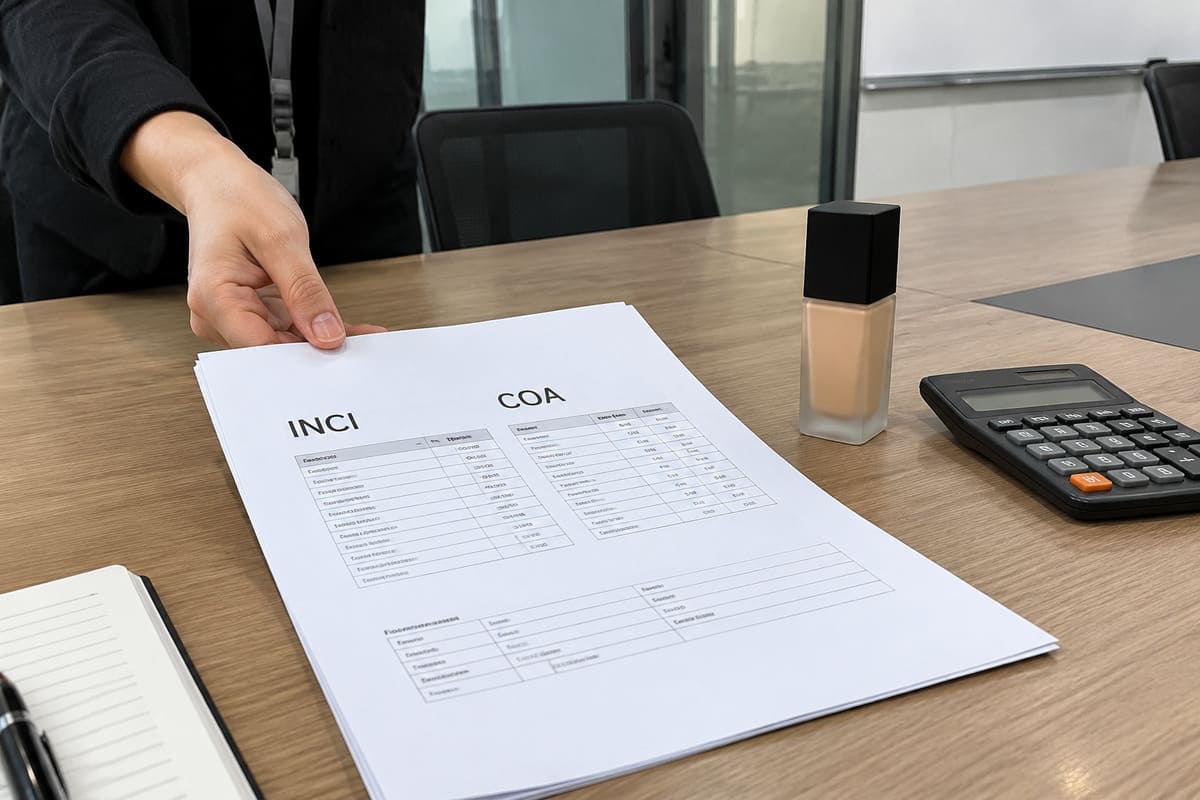
Use this checklist in your first serious conversation:
- Formula ownership: "Are these 19 shades my custom formula, or stock colors you sell to other brands?"
- Per-shade MOQ: "What is the minimum order for each individual shade, not the total range?"
- Packaging MOQ: "What is the bottle and pump MOQ, and does it force a larger formula order?"
- Reorder terms: "What is the lead time and MOQ for reordering a single winning shade?"
- Compliance documents: "Which test reports and certifications apply to my target market, and can I see the documents?"
A Note on Certifications and Compliance
I treat certifications as documents you should verify, not claims you should take on faith. Requirements differ by market, and standards such as FDA registration for the U.S.10 or REACH for the EU carry specific obligations11. I recommend you request the actual documentation and have a qualified regulatory professional confirm it covers your intended market and product before you commit to a large order. A serious manufacturer will match a compliance plan to your target market and order timeline rather than dodge the question.
Frequently Asked Questions
What is the real minimum order for a custom foundation?
True custom foundation formulation typically starts at 1,000–5,000 units per shade, with some factories setting a standard MOQ of 2,000 units per SKU12. Private-label foundation on an existing base often starts at 500–1,000 units per shade. Any "100-unit" offer is almost always white-label stock, not a custom formula.
Why is a foundation shade different from an eyeshadow color?
An eyeshadow palette combines many colors into one SKU, so one order covers the whole palette. Every foundation shade is a separate SKU with its own formula batch, MOQ, and inventory risk. A 15-shade foundation range at 1,000 units per shade means 15,000 units of liquid inventory, not one order.
Why does packaging MOQ matter more than formula MOQ?
Pumps, glass bottles, and airless containers often carry MOQs of 10,000–20,000 units. If your bottle MOQ exceeds your formula MOQ, you must buy more bottles than you can fill, or order more formula than you planned. Always confirm the packaging MOQ before committing to a formula quantity.
How many shades should I launch with first?
Launch with about 5 core shades that cover your primary market, not a full 19-shade range. Validate demand with real sales data, then fund expansion from revenue. A wide initial range creates inventory imbalance, more approval rounds, and weak reorder control before you know which shades sell.
Is a "100-unit" foundation ever a good idea?
Yes, as a market test. If your goal is to test a concept with minimal cash and you accept a shared stock product, the 100-unit white-label route is rational. It is not brand-building, because the formula and packaging are identical to products hundreds of other brands sell.
Conclusion
Choosing a foundation makeup manufacturer is a sequencing decision, not a price decision. The "100-unit, 19-shade" offer is white-label stock: cheap, fast, and identical to everyone else's product. True custom foundation starts at 1,000–5,000 units per shade, and packaging MOQs of 10,000–20,000 units can force you to overbuy before you have any proof of demand. The disciplined path is clear. Validate with 5 core shades or a low-risk powder trial, read your sales data, then expand on revenue, and never let a bottle MOQ dictate your inventory before the market has spoken.
If you want an honest per-shade and packaging MOQ breakdown for your specific launch, send me your target market and shade concept, and I will map a realistic sequence with you.
"What's the Best Eyeshadow Palette to Buy? A Low ... - Vertina Beauty", https://vertinabeauty.com/whats-the-best-eyeshadow-palette-to-buy-a-low-risk-buying-guide/. Industry and trade sources on contract cosmetic manufacturing report that bespoke formulation typically requires per-SKU minimum orders in the range of roughly one to several thousand units, reflecting batch-size economics of custom compounding. Evidence role: statistic; source type: institution. Supports: Custom cosmetic formulation generally carries per-SKU minimum order quantities in the low thousands of units.. Scope note: Reported MOQ ranges vary by manufacturer, region, and product category, so cited figures indicate typical practice rather than a fixed universal threshold. ↩
"Airless Pump Bottles Wholesale for Cosmetics | TPC", https://www.thepkgco.com/product-category/airless-packaging/airless-pump-bottles/. Packaging-sourcing references for cosmetics indicate that custom or semi-custom primary containers such as pumps and glass or airless bottles are commonly quoted at minimum order quantities in the tens of thousands of units, a threshold tied to tooling and molding setup costs. Evidence role: statistic; source type: institution. Supports: Custom primary cosmetic packaging frequently carries minimum order quantities in the tens of thousands of units, often higher than formulation MOQs.. Scope note: Stock components can carry much lower minimums, so the cited figures apply primarily to custom or decorated packaging rather than all packaging options. ↩
"Private label", https://en.wikipedia.org/wiki/Private_label. Reference definitions of private label, white label, and original equipment or design manufacturing describe distinct arrangements distinguished by whether the buyer receives a standardized product with branding applied or a product developed to specification. Evidence role: definition; source type: encyclopedia. Supports: The terms white-label, private-label, and OEM/ODM denote distinct contract-manufacturing arrangements differing in degree of customization.. Scope note: Term usage varies across industries, and the boundaries the article draws for cosmetics are one interpretation of broader, loosely standardized definitions. ↩
"What Is a SKU? Definition, Examples & Best Practices", https://www.orderful.com/blog/what-is-a-stock-keeping-unit. Standard definitions of the stock-keeping unit describe it as a unique identifier for each distinct, sellable product variant, meaning color variations are tracked as separate inventory items each carrying their own stock and ordering parameters. Evidence role: definition; source type: encyclopedia. Supports: A stock-keeping unit is a distinct identifier for each sellable product variant, so each color variant is tracked and ordered as a separate unit of inventory.. Scope note: The definition establishes that variants are separate SKUs generally but does not by itself quantify MOQ or inventory risk specific to foundation. ↩
"What's the Best Eyeshadow Palette to Buy? A Low-Risk Buying ...", https://vertinabeauty.com/whats-the-best-eyeshadow-palette-to-buy-a-low-risk-buying-guide/. Definitions of SKU and product bundling indicate that a fixed assortment sold as one unit, such as a multi-color palette, is assigned a single SKU, while separately sold variants are each tracked as distinct SKUs. Evidence role: definition; source type: encyclopedia. Supports: A bundled product such as a multi-color palette is typically assigned a single SKU, whereas individually sold variants each receive their own SKU.. Scope note: SKU assignment is a merchandising choice that can differ by retailer, so the palette-versus-shade contrast reflects common rather than universal practice. ↩
"Word of the Week: Cash Conversion Cycle", https://online.hbs.edu/blog/post/word-of-the-week-cash-conversion-cycle. Finance and operations literature on working capital and inventory carrying cost supports the mechanism that broader, larger inventory commitments raise cash tied up in stock and the associated holding risk. Evidence role: mechanism; source type: research. Supports: Holding larger and more varied inventory increases working capital tied up and the carrying cost and risk borne by a business.. Scope note: The supporting principle is general to inventory management and is applied to multi-shade foundation launches by extension rather than from cosmetics-specific data. ↩
"Discoloration of liquid foundation across the shade color ...", https://pmc.ncbi.nlm.nih.gov/articles/PMC12480899/. Market and consumer research on foundation purchasing describes an uneven distribution of demand across shade ranges, with sales concentrating in mid-tone shades relative to the lightest and darkest extremes. Evidence role: statistic; source type: research. Supports: Foundation purchases are unevenly distributed across a shade range, concentrating in mid-tone shades.. Scope note: Shade demand varies by regional demographics and brand positioning, so distribution patterns are contextual and not uniform across all markets. ↩
"Lean startup", https://en.wikipedia.org/wiki/Lean_startup. Operations and entrepreneurship literature on assortment planning and SKU proliferation supports the view that launching broad ranges under demand uncertainty raises the risk of overstocking slow sellers and understocking fast movers. Evidence role: expert_consensus; source type: research. Supports: Expanding assortment breadth before demand is validated increases inventory mismatch and reorder difficulty for new ventures.. Scope note: This general operations principle is applied here to foundation lines by analogy and is not drawn from cosmetics-specific studies. ↩
"Airless Pump Bottles Wholesale for Cosmetics | TPC", https://www.thepkgco.com/product-category/airless-packaging/airless-pump-bottles/. Packaging supplier specifications for pumps, glass bottles, and airless containers commonly list minimum order quantities in the tens of thousands of units, reflecting mold and tooling amortization. Evidence role: statistic; source type: institution. Supports: Custom pump, glass, and airless cosmetic containers are typically quoted at minimum order quantities in the tens of thousands of units.. Scope note: Quoted minimums differ between stock and custom-tooled components, so the cited range reflects custom or branded packaging rather than every available option. ↩
"Registration & Listing of Cosmetic Product Facilities and ...", https://www.fda.gov/cosmetics/registration-listing-cosmetic-product-facilities-and-products. U.S. Food and Drug Administration guidance on cosmetics, including provisions under the Modernization of Cosmetics Regulation Act, sets out facility registration and product listing obligations for cosmetics marketed in the United States. Evidence role: general_support; source type: government. Supports: Cosmetic products and facilities in the U.S. are subject to specific FDA regulatory obligations, including facility registration and product listing under current law.. Scope note: The precise obligations depend on product type and company size and have changed under recent legislation, so the article's general reference should be verified against current FDA requirements. ↩
"EC Regulation 1223/2009 on cosmetics", https://en.wikipedia.org/wiki/EC_Regulation_1223/2009_on_cosmetics. European Union regulatory sources describe the obligations of REACH for chemical substances alongside the EU Cosmetics Regulation (EC) No 1223/2009, which is the primary framework governing cosmetic products placed on the EU market. Evidence role: general_support; source type: government. Supports: Cosmetics placed on the EU market are subject to specific regulatory obligations, with REACH applying to chemical substances and Regulation (EC) No 1223/2009 governing cosmetic products directly.. Scope note: REACH is not the principal cosmetics-specific regulation in the EU, so citing it alone may understate the role of the Cosmetics Regulation; the source supports the existence of obligations rather than REACH being the governing standard. ↩
"MOQ (Minimum Order Quantity) - Femfounded", https://femfounded.org/reference/moq/. Contract manufacturing listings and trade references indicate that a subset of cosmetic factories apply standard per-SKU minimums near 2,000 units, consistent with typical production batch sizing. Evidence role: statistic; source type: institution. Supports: Some contract cosmetic manufacturers set per-SKU minimum order quantities around 2,000 units for custom formulations.. Scope note: This reflects the practice of particular manufacturers rather than a sector-wide standard, and figures vary with formulation and equipment. ↩