Cosmetics Barcode & Labeling Requirements: A Manufacturer's Guide to Global Compliance
Don't let a missing symbol or a bad Quiet Zone get your shipment rejected at customs.
You've spent months perfecting your eyeshadow formula, and your first production run is funded. Then a buyer asks for your barcode, and suddenly you worry: what if one missing symbol gets my whole shipment rejected? Cosmetics barcode and labeling requirements trip up more new brands than any formula ever will. I've watched it happen, and I want to help you avoid it.
Cosmetics barcode and labeling requirements cover two separate things: a barcode (a GTIN that identifies your product globally) and the mandatory label text that lets customs and regulators clear it for sale. A barcode gets you listed on retail and e-commerce channels; compliant labeling, including a Responsible Person address and PAO symbol, keeps your shipment from being seized or delisted.
Most guides stop at "buy a UPC." I want to go further. Getting the barcode is the easy 10%. The other 90% is the label around it, and that's where I've seen real money lost. Let me walk you through both, from the factory floor.
What Exactly Is a Cosmetic Barcode and Why Do You Need It?
A client once told me, "It's just black and white lines, right? I'll grab one off a reseller for five dollars." Two weeks later Amazon suspended their listing. That five-dollar shortcut cost them a month of sales.
A cosmetic barcode is a visual representation of a Global Trade Item Number (GTIN), the unique global identity assigned to your product. Without a legitimate GTIN registered to your brand, you cannot list your cosmetics on Amazon, Walmart, Sephora, or most major retail chains. Think of it as the passport of your product.
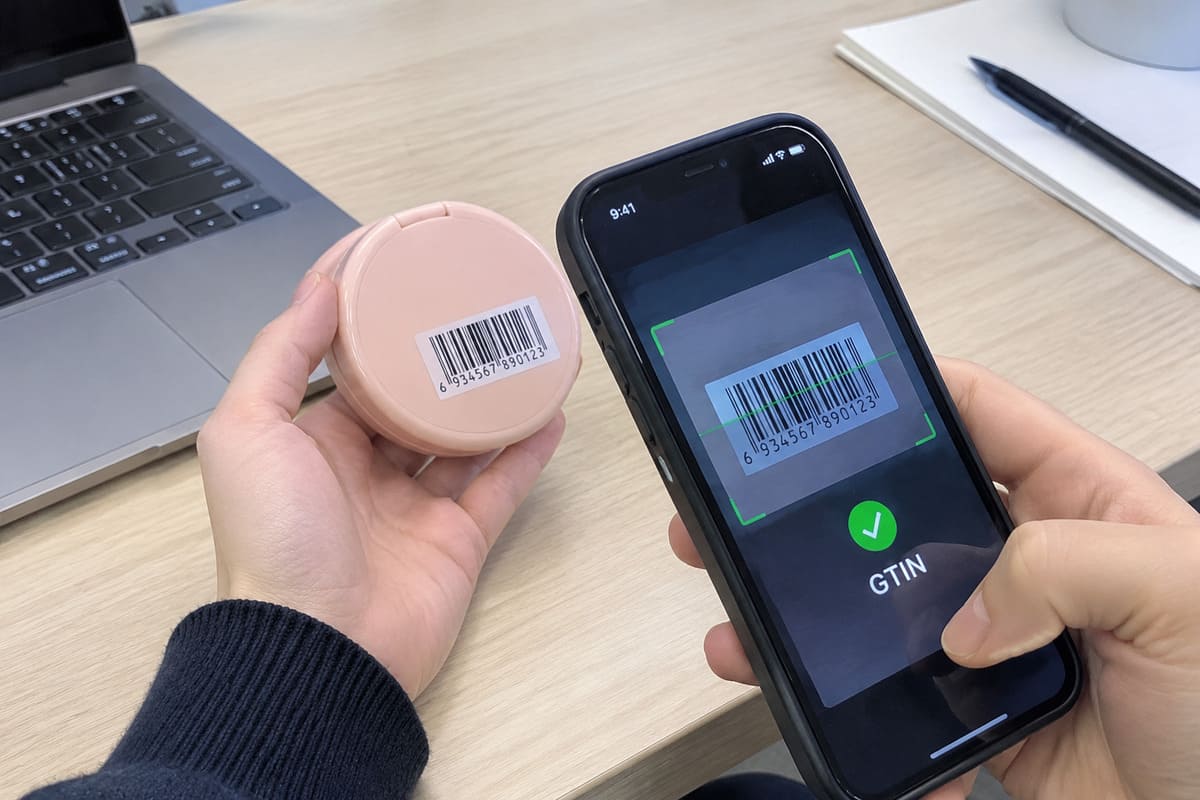
The barcode itself is just a machine-readable rendering of that number. The real value sits in the GTIN behind it. Retailers use it to track inventory, process returns, and sync pricing across stores. E-commerce platforms use it to match your listing against a global registry.
Here's why the "passport" comparison holds up:
- One product, one identity. Each variant, color, or size needs its own GTIN. A 6-pan eyeshadow palette and a 9-pan palette are two different products.
- It's permanent. Once you assign a GTIN to a product, you don't reuse it for something else.
- It's verifiable. Retailers can trace a legitimate GTIN back to the brand that owns it.
When you register properly, your brand name is attached to that number in the global database. That ownership is what platforms check. It's also why buying recycled codes fails, which I'll cover shortly.
UPC vs. EAN: Which Barcode Format Fits Your Target Market?
I get this question weekly from brand founders launching across several regions at once. They panic that they need different barcodes for every country. Usually they don't.
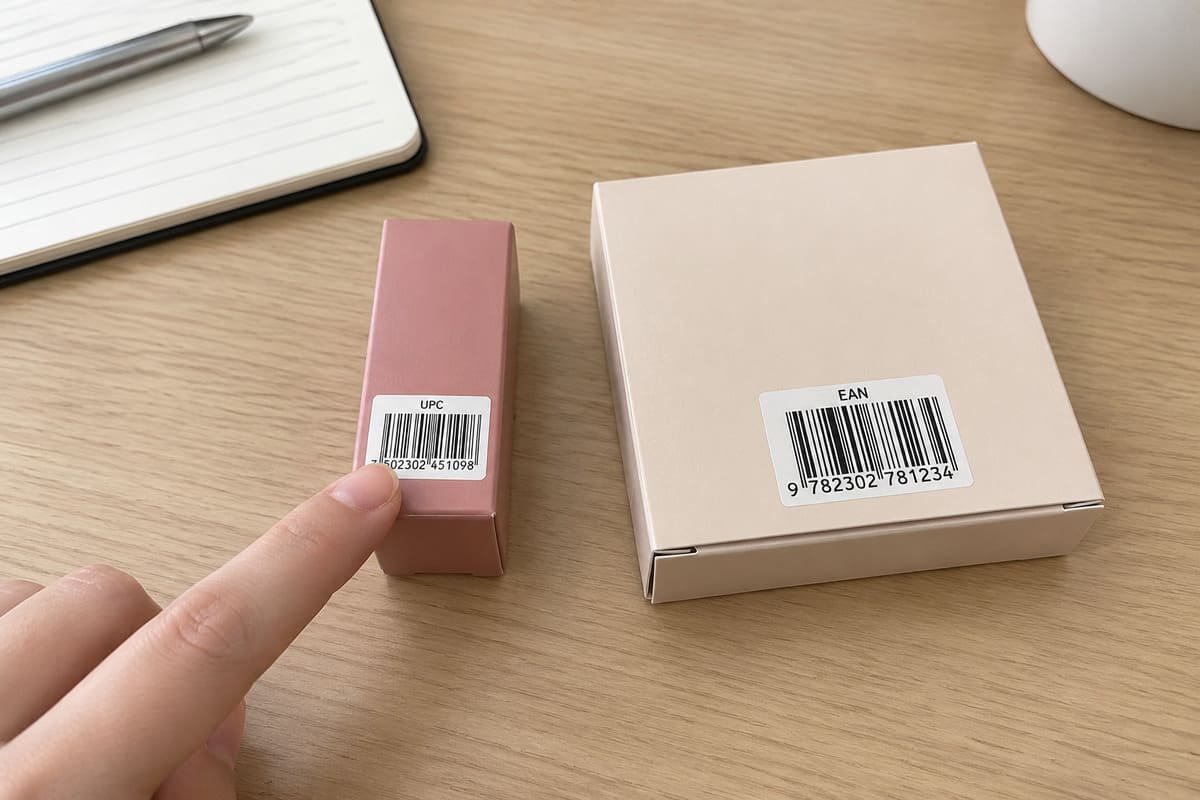
North America uses UPC (12 digits), while Europe, the Middle East, Asia, and most of the world use EAN (13 digits)[^1]. A UPC is effectively an EAN with a leading zero, so modern scanners read both[^2]. For small cosmetic items with limited surface area, consider compressed formats like UPC-E or EAN-8 to save space.
| Format | Digits | Primary Market | Best Use Case |
|---|---|---|---|
| UPC-A | 12 | USA, Canada | Standard retail, Amazon US |
| EAN-13 | 13 | EU, Middle East, Asia, global | International retail, CPNP listings |
| UPC-E | 8 (compressed) | North America | Lip liners, eyeliner pencils |
| EAN-8 | 8 | Global small items | Mini perfumes, single eyeshadow pots |
My pro tip for small cosmetics
Space is the enemy on slim packaging. A standard UPC-A on a lip liner barrel will wrap around the curve and fail to scan. For these items I steer clients toward UPC-E or EAN-8, the compressed versions. They carry fewer digits but still scan reliably, and they fit on surfaces where a full-size code never would.
One caution: compressed codes have formatting rules about which numbers qualify. GS1 handles this during registration, so request the short format up front rather than trying to shrink a full code later.
How to Obtain a Barcode from GS1? (Step-by-Step Guide)
I'll say this plainly because it protects you: we don't sell barcodes. A barcode must be registered under your own brand name to protect your intellectual property and your retail listings. Here's the legitimate path.
To obtain a legitimate barcode, register directly with GS1, the only authorized global barcode issuer[^3]. Create an account on your national GS1 website, apply for a GS1 Company Prefix, and assign GTINs to each product. Expect roughly a $30 initial fee plus an annual renewal around $250[^4], depending on the number of codes.
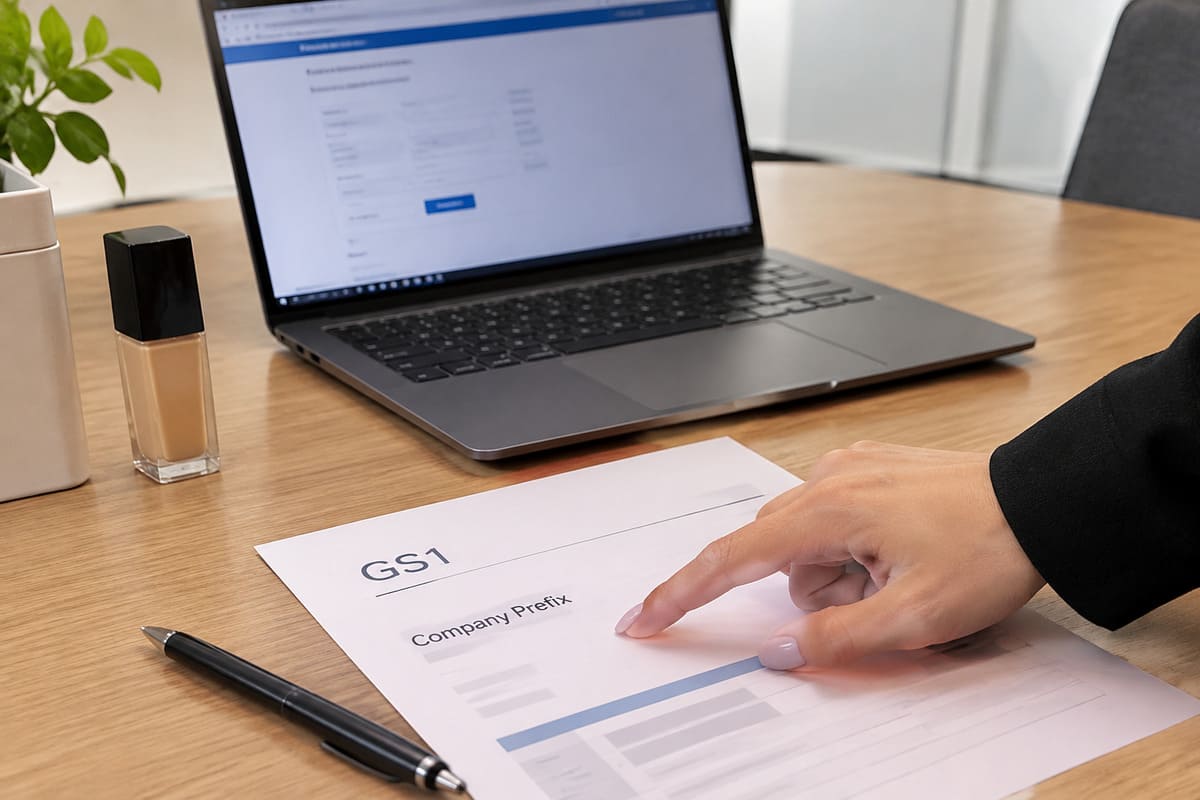
The process in order:
- Go to your local GS1 chapter (GS1 US, GS1 UK, GS1 China, and so on). Register through the official site, not a middleman.
- Apply for a Company Prefix. This is the root number tied to your brand.
- Assign a GTIN to each SKU. One per color, size, and variant.
- Download your barcode artwork in vector format (SVG or EPS) for clean printing.
- Renew annually to keep your prefix active.
⚠️ Serious warning:
Do not buy cheap "second-hand" or "resold" barcodes from third-party sellers advertising codes for a few dollars. These codes originally belonged to a company that split up its prefix. Amazon, Walmart, and most major retailers cross-check GTINs against the GS1 registry. When your brand name doesn't match the registered owner, your listing gets flagged, suspended, or banned. I've seen it kill a launch. The annual GS1 fee is cheap insurance against that.
If you only need one or two codes, GS1 US now offers single GTINs at a lower flat rate with no renewal, which suits founders testing a single product.
Barcode Placement, Size & the "Quiet Zone" Rules for Cosmetics
This is where our factory design team spends real time, because a barcode that looks perfect in a design file can be unscannable in the real world. The culprit is almost always the Quiet Zone.
The standard barcode size is roughly 1.46" x 1.02" (37mm x 26mm), scalable between 80% and 200%. The critical rule is the Quiet Zone: you must leave blank space on both sides of the code equal to at least 10 times the width of the narrowest bar[^5]. Without it, scanners fail. Place the code on a flat, non-reflective back or bottom surface.
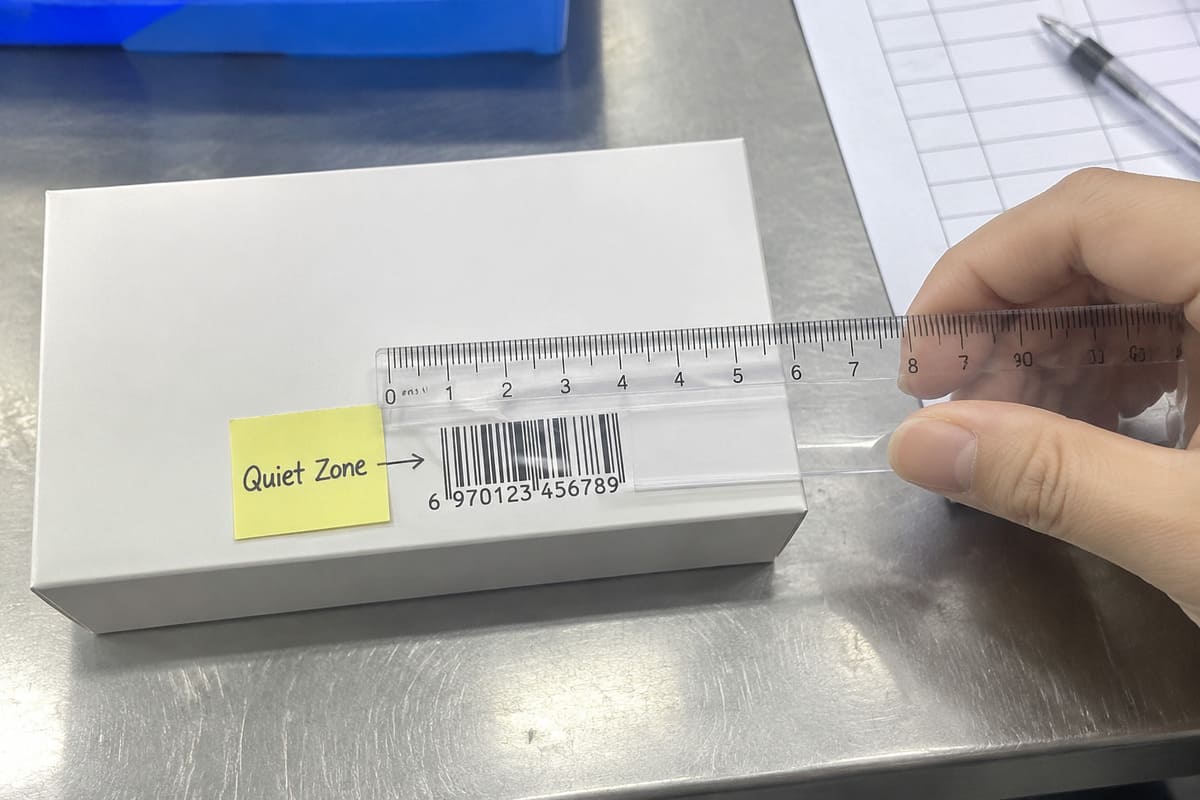
| Specification | Requirement |
|---|---|
| Standard size | 37mm x 26mm (scalable 80–200%) |
| Quiet Zone | ≥ 10x the narrowest bar width on each side |
| Color contrast | Dark bars on light background; no red bars |
| Surface | Flat, matte, back or base of package |
| Avoid | Reflective foil, tight curves, seams, folds |
Why the Quiet Zone breaks so many launches
Designers love to push a logo or decorative element right up against the barcode. The scanner reads that encroaching element as part of the code and gives up. The fix costs nothing: keep a clear margin.
On cosmetics this gets tricky because packaging is small and glossy. A barcode printed on a reflective gold eyeshadow compact can bounce the scanner's light and fail. Red elements near or inside the bars are invisible to many scanners, which read in the red-light spectrum[^6]. I always ask for high contrast, matte placement, and a generous margin.
How to Test Your Barcode Before Mass Production?
I'll share a habit that has saved clients real money: test the barcode on an actual sample, not a screen. A code can look flawless in Illustrator and still fail when printed on textured carton stock.
Always supply your barcode as a vector file (SVG or EPS) so it stays sharp at any size. During the sampling stage, print the barcode on the real packaging material and scan it with several mobile scanner apps under bright, dim, and angled lighting. Confirm it reads every time before you approve mass production.
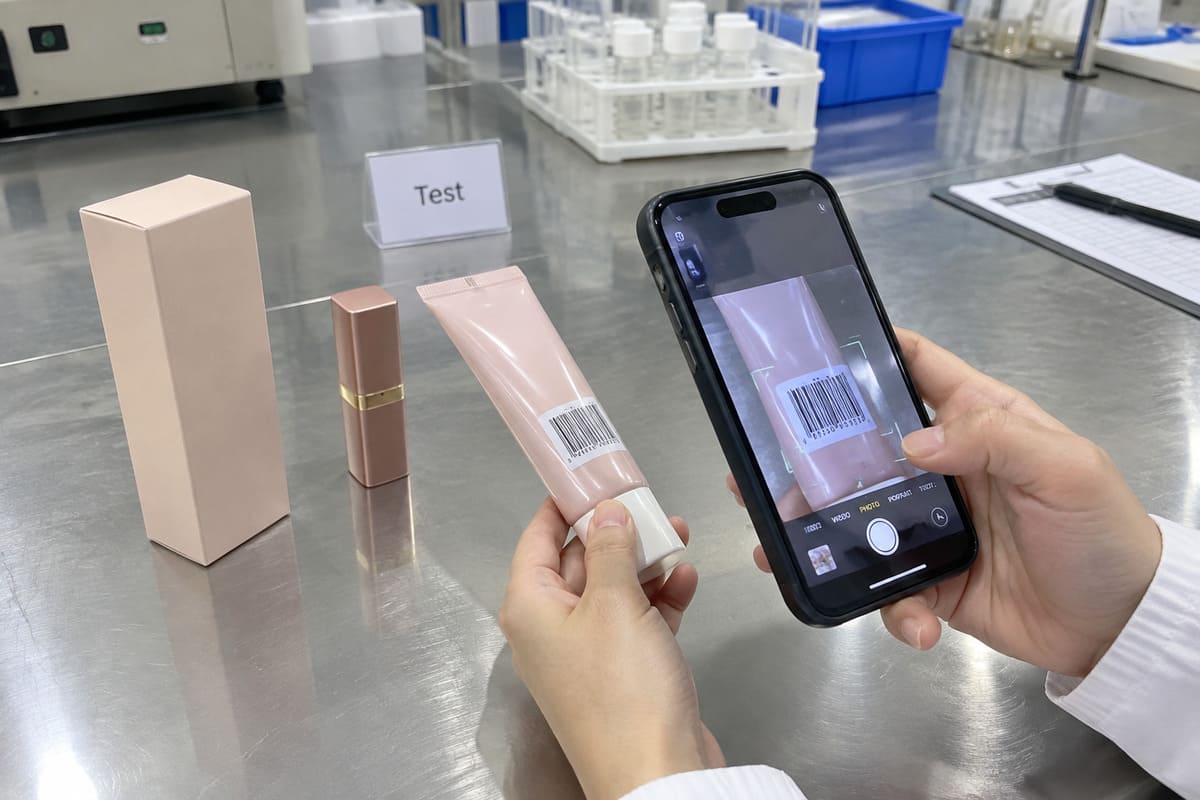
My testing routine on every sample run:
- Use vector artwork only. A JPG or PNG blurs when scaled and ruins bar edges.
- Scan the physical sample, not the digital proof. Ink spread on matte board can thicken bars.
- Try three or four different scanner apps. Phones and apps vary in tolerance.
- Change the lighting. Test under store-bright light, dim shelf light, and at an angle.
- Scan the curve, if any. On tubes and pencils, check the code at the worst-case bend.
Do this during sampling, never after the full run prints. Reprinting 2,000 cartons because of a dead barcode is a painful, avoidable cost.
Getting your UPC is easy. But wait, just because the scanner reads it, does that mean your product is legally ready for the market?
Why Is a Barcode Not Enough? The Hidden Labeling Rules You Must Know.
Here's the moment I watch founders' confidence wobble, and honestly, it should. A working barcode feels like the finish line. It isn't. It's barely the starting gate.
A barcode only identifies your product; it carries no legal information. Customs officers and regulators like the FDA don't care that your scanner beeps. They check the label text around the code: the Responsible Person address, ingredient list, warnings, and market-specific symbols. A missing mandatory line can get your entire shipment held, refused, or destroyed at the border.
Think of it this way. The barcode answers "what product is this?" The label answers "is this product legal to sell here?" Those are completely different questions, and only the second one clears customs.
What Else Must Be on Your Cosmetic Label? (US, EU & Middle East Requirements)
Every market writes its own rules, and they don't overlap neatly. A label perfect for the US can be illegal in the EU, and both can be rejected in Saudi Arabia. Let me give you the serious, standard answer for the three markets my clients ship to most.
Each market mandates specific label elements. The US (under MoCRA) requires a Responsible Person name, address, and contact for adverse event reporting[^7]. The EU requires a PAO (Period After Opening) symbol when shelf life exceeds 30 months[^8]. The Middle East (GCC) requires bilingual Arabic/English text, production and expiry dates, and local importer details[^9].
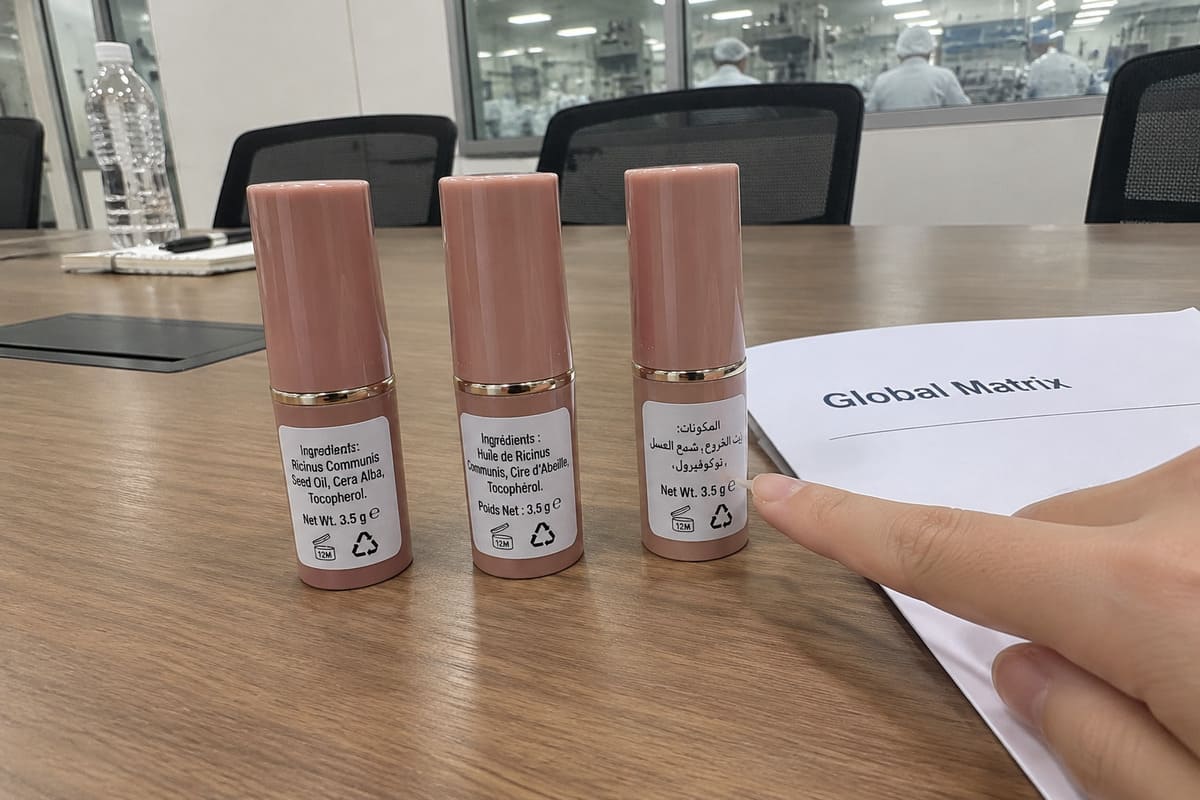
Here is the multi-market matrix I keep on my wall:
| Requirement | US (MoCRA) | EU (CPNP) | Middle East (GCC) |
|---|---|---|---|
| Responsible Person / Importer | US RP name, address, phone | EU RP name and EU address | Local GCC importer details |
| Ingredient list (INCI) | Required | Required, INCI standard | Required |
| PAO symbol | Not mandatory | Required if shelf life > 30 months | Production + expiry date required |
| Language | English | Language of destination country | Bilingual Arabic + English |
| Product registration | Facility & product listing | CPNP notification | GCC conformity / local registration |
| Warnings | As applicable | As applicable | As applicable |
What this means in practice
- US: MoCRA now requires a registered Responsible Person. If you're overseas, you need a US-based entity or agent whose address appears on the label for adverse event reports.
- EU: The PAO symbol (the open-jar icon with a number like "12M") is mandatory for products lasting over 30 months. Under 30 months, you need a date of minimum durability instead[^10].
- Middle East: Arabic is not optional. Labels must be bilingual, and importers must often register the product locally before clearance.
How Do We Audit Your Labels Before Mass Production?
This is where I believe a real custom manufacturer earns its place, and where I'll be direct about what we do and don't do. We are not a code reseller or a blind printer. We act as your compliance gatekeeper.
Because Vertina Beauty offers true custom manufacturing from 2,000 pieces for powder products, our QC and compliance team reviews every label before it goes to print. We run each design against a Pre-shipment Label Audit Checklist covering mandatory text, font sizes, market-specific symbols, and barcode Quiet Zones, so problems are caught on the proof, not at the border.
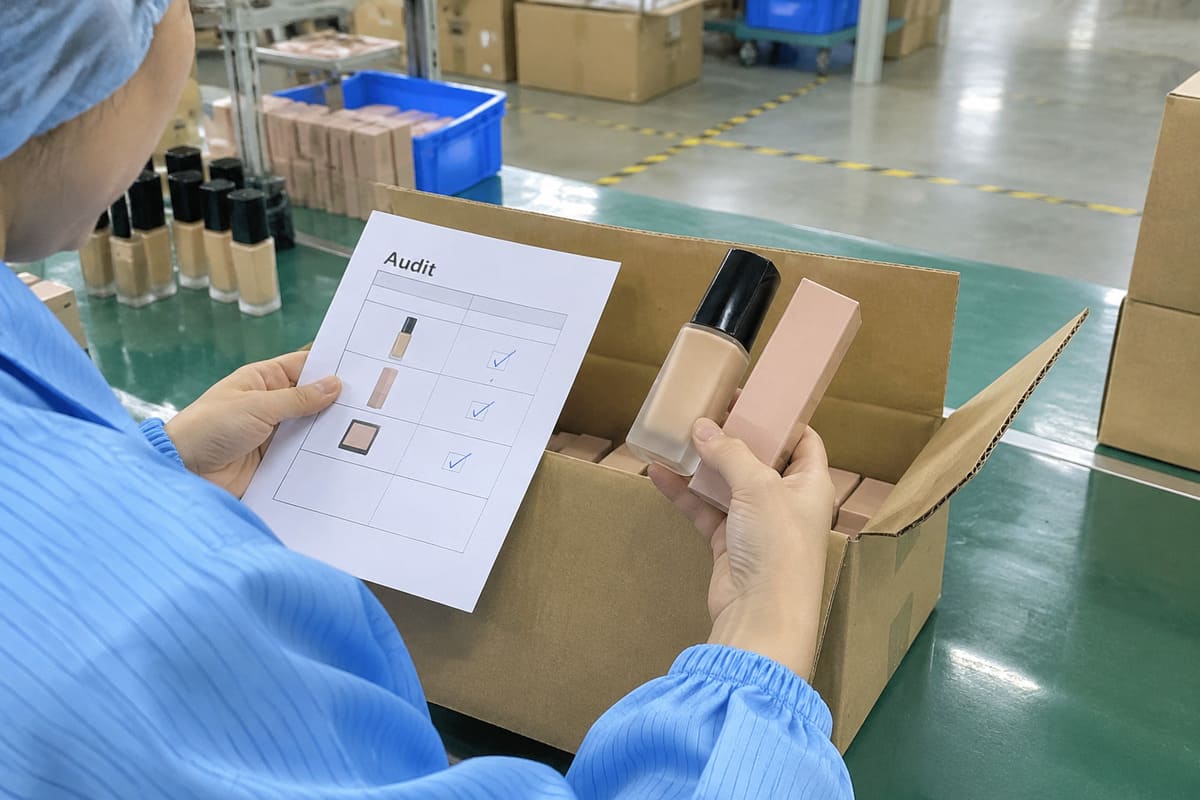
Our internal Pre-shipment Label Audit Checklist:
| Check | What We Verify |
|---|---|
| Responsible Person | Correct RP/importer per target market |
| Ingredient list | Full INCI, correct descending order[^11] |
| PAO / dates | Open-jar symbol or expiry per market |
| Warnings | Mandatory cautions present and legible |
| Font size | Meets minimum legal readability |
| Language | Bilingual panels where required |
| Barcode Quiet Zone | Clear margins, scan-tested on sample |
| Contrast & placement | Matte, high-contrast, flat surface |
A real case from our floor
A brand founder sent us a beautiful eyeshadow palette design for a Gulf-market order. The barcode scanned fine. But our audit caught two problems before printing: the barcode had no Quiet Zone (a decorative line ran right against it), and the label carried no US Responsible Person address, which the client also needed for a parallel Amazon US launch. We flagged both on the proof. We fixed the margin and added the RP panel before a single carton printed. Had a white-label printer run it as-is, that founder would have faced a customs hold on one order and an Amazon suspension on the other.
I want to be transparent about one boundary: we do not sell you a barcode. You register the GTIN with GS1 under your own brand name, because that code is your intellectual property and your listings depend on owning it. What our design team does is audit the Quiet Zone, contrast, and scan-readability of your packaging so the code you own works 100% of the time.
Frequently Asked Questions
Do I need a different barcode for each country I sell in? ▼
Can my manufacturer give me a barcode? ▼
What certifications do I need to export cosmetics to Saudi Arabia? ▼
What happens if my cosmetic label is missing the PAO symbol? ▼
Is a cheap second-hand barcode really a problem? ▼
Conclusion: Don't Risk Your Launch.
Getting a cosmetics barcode is the easy part: register a GTIN with GS1 under your own name, pick UPC or EAN for your market, and protect the Quiet Zone so it scans every time.
The hard part, and the one that actually sinks shipments, is the label around it. US MoCRA, EU CPNP, and GCC rules each demand different mandatory elements, and a white-label printer won't catch what's missing. That's the gap we close. As a true custom manufacturer from 2,000 pieces, we audit every label before it prints.
✓ We support FDA & MoCRA documentation
✓ Pre-shipment label audit included
✓ True custom manufacturing (Powder)
Get Your Free Label Audit Checklist
Enter your details below. We will email you the PDF checklist and a sample shade plan within 24 hours.
View References & Footnotes
[^1]: "International Article Number", https://en.wikipedia.org/wiki/International_Article_Number. The UPC-A symbology encodes a 12-digit number and EAN-13 encodes 13 digits, with UPC adopted first in North America and EAN later standardized for international use.
[^2]: "How to Convert GS1 Barcodes to UPC/EAN Format MS ...", https://sps-support.honeywell.com/s/article/How-can-GS1-codes-be-converted-to-UPCEAN-format. Under GS1 symbology specifications a UPC-A code is equivalent to an EAN-13 code with a leading zero, allowing compliant scanners to read both.
[^3]: "GS1 US: Barcodes Powered by GS1 Standards", https://www.gs1us.org/. GS1 is the international standards organization responsible for the GTIN system and the allocation of Company Prefixes used to generate barcodes for retail trade.
[^4]: "GS1 Company Prefix for UPC Barcodes", https://store.gs1us.org/gs1-company-prefix/p. GS1 national organizations publish fee schedules showing an initial licensing fee and recurring annual renewal costs scaled to the number of GTINs required.
[^5]: "General Specifications Change Notification (GSCN)", https://www.gs1.org/docs/barcodes/GSCN_20-323_Clafiry_Add-on.pdf. GS1 barcode specifications require a quiet (light) margin on each side of EAN/UPC symbols sized relative to the X-dimension to ensure reliable scanning.
[^6]: "Acceptable Color Combinations for Barcode Symbols", https://www.barcode.graphics/acceptable-color-combinations-for-barcode-symbols/. Because many barcode readers use red-wavelength light sources, red-colored bars offer little contrast against the background and are often unreadable.
[^7]: "Modernization of Cosmetics Regulation Act of 2022 (MoCRA)", https://www.fda.gov/cosmetics/cosmetics-laws-regulations/modernization-cosmetics-regulation-act-2022-mocra. Under the Modernization of Cosmetics Regulation Act (MoCRA), FDA requires that cosmetic product labels identify a Responsible Person and provide a means for adverse event reporting.
[^8]: "Regulation (EC) No 1223/2009 of the European Parliament ...", https://health.ec.europa.eu/system/files/2016-11/cosmetic_1223_2009_regulation_en_0.pdf. EU Regulation (EC) No 1223/2009 on cosmetic products requires the period-after-opening (PAO) indication for products whose minimum durability exceeds 30 months.
[^9]: "Cosmetics Labeling Guide", https://www.fda.gov/cosmetics/cosmetics-labeling-regulations/cosmetics-labeling-guide. GCC Standardization Organization (GSO) technical regulations for cosmetic products specify labeling requirements such as Arabic-language information, production and expiry dates, and importer details.
[^10]: "EU - Labeling/Marking Requirements", https://www.trade.gov/country-commercial-guides/eu-labelingmarking-requirements. EU Regulation (EC) No 1223/2009 requires that cosmetic products with a minimum durability of 30 months or less display a date of minimum durability.
[^11]: "Cosmetics Labeling Guide", https://www.fda.gov/cosmetics/cosmetics-labeling-regulations/cosmetics-labeling-guide. Cosmetic labeling rules in the EU and US require ingredient declarations using International Nomenclature of Cosmetic Ingredients (INCI) names, listed in descending order of concentration.
[^12]: "Makeup Manufacturer Dubai: The Real MOQ of ... - Vertina Beauty", https://vertinabeauty.com/makeup-manufacturer-dubai-the-real-moq-of-local-vs-agile-supply-chain-validation/. The Saudi Food and Drug Authority (SFDA) administers cosmetic product registration and conformity requirements, which operate alongside GCC Standardization Organization standards for market access.