When B2B buyers search for how to find a cosmetics manufacturer, what they truly need is not a supplier list, but a practical evaluation guide that helps them use professional metrics to verify real factories, avoid trading company traps, and reduce decision-making risk. I have seen buyers lose time because they compared prices before checking manufacturing capability.
The best way to find a cosmetics manufacturer is to verify four areas: demand-transformation capability, technical development, production and delivery performance, and MOQ and cost control. Buyers should also request factory evidence, compare samples with specifications, review export documentation, and use a video or face-to-face audit before placing a meaningful order.
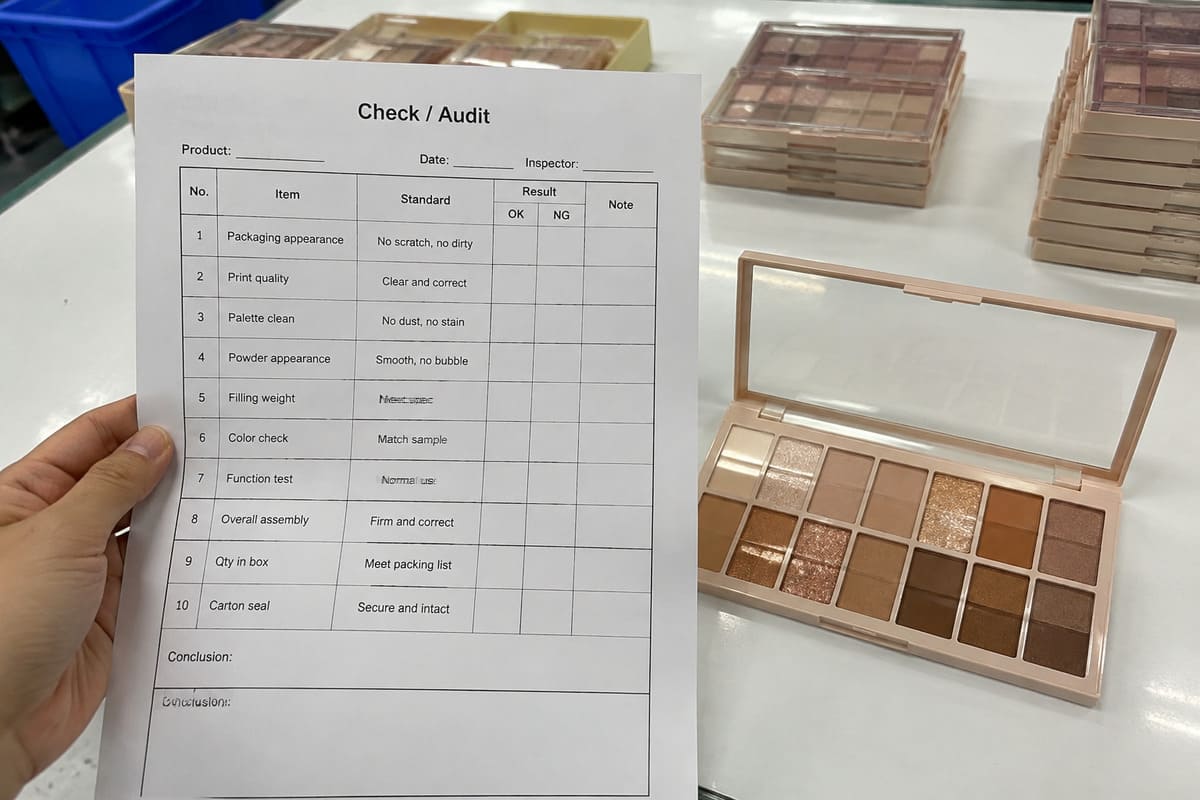
A low quotation can look attractive, but it does not prove that a supplier controls formulation, pigments, packaging, production, and quality inspection. I recommend evaluating the entire supply chain instead of focusing on one price. The following framework explains how I would screen a cosmetics manufacturer before approving a sample or purchase order.
What Does a “Real Factory” Look Like vs. a Trading Company?
Many buyers feel uncertain because online supplier pages can make a trading company look like a cosmetics manufacturer. The problem becomes serious when the supplier cannot explain its formula, sampling process, production flow, or quality controls. I believe buyers should verify operational evidence, not rely on photographs or labels.
A real cosmetics manufacturer can usually explain and demonstrate its product development, sample approval, raw material sourcing, production, packaging, and quality inspection processes.1 A trading company may still provide useful sourcing services, but it should clearly disclose its role and identify the actual factory responsible for manufacturing.2
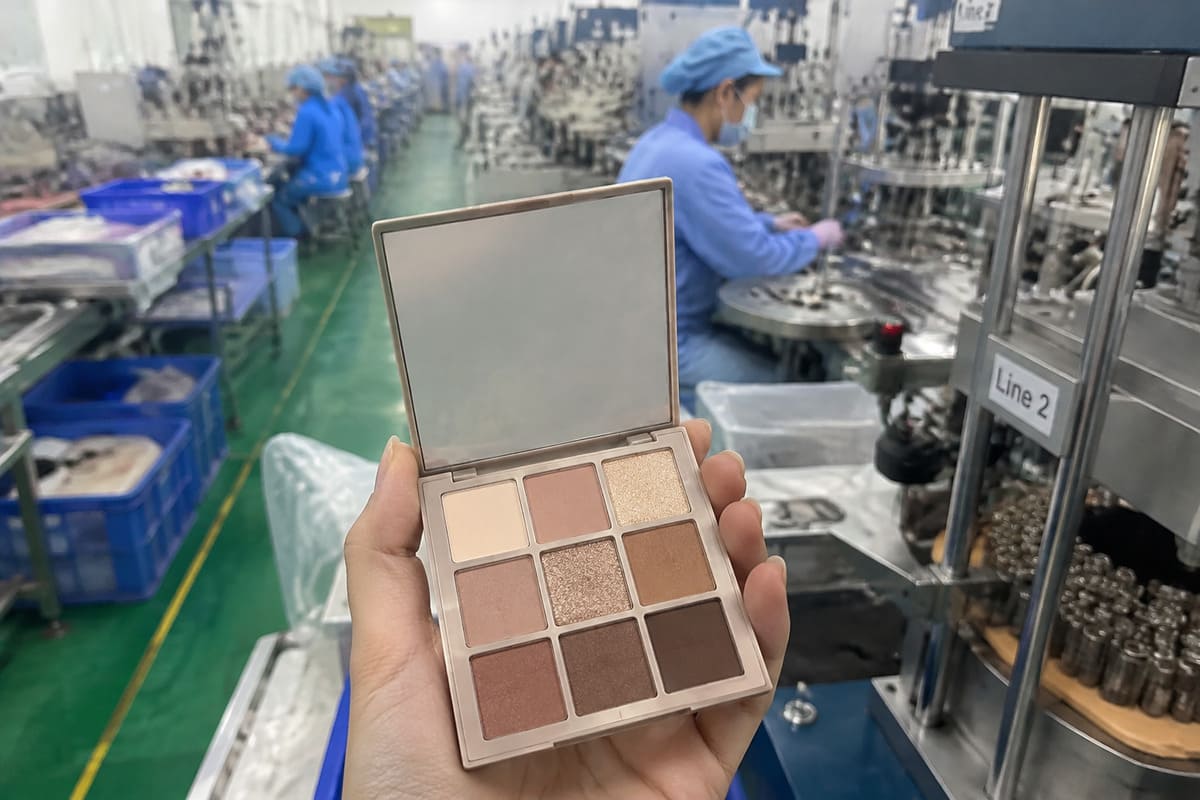
What evidence should a buyer request?
I do not think a supplier becomes trustworthy simply because it uses the word “factory” in a profile. A buyer should request evidence that connects the company’s legal identity with its physical production activities.
Useful evidence includes:
- A business license showing the company’s legal name and registered activity.
- A factory address that can be verified through video or an in-person visit.
- A live factory video showing the exterior, production area, warehouse, sample room, and quality-control points.
- A clear explanation of which processes are completed internally and which are outsourced.
- Product specifications that identify formula, shade, packaging, net weight, and tolerance requirements.
- Sample records and approval procedures.
- Batch or production records, where commercially appropriate.
- Export and market-entry documents relevant to the destination country.
- A written quotation that separates product, packaging, tooling, testing, shipping, and other costs.
I also recommend asking the same technical question to sales staff and production or development staff. If the answers are inconsistent, I would pause the evaluation.
Factory or trading company: a practical comparison
| Evaluation point | Direct cosmetics manufacturer | Trading company or sourcing agent |
|---|---|---|
| Product development | Usually has internal development or controlled technical partners | Often depends on an external factory |
| Sample adjustments | Can often communicate directly with engineers | May need several communication layers |
| Production visibility | Can show production and quality processes | May show a partner’s facility |
| Cost structure | May offer clearer factory-level pricing | May include an additional margin |
| Product range | Often focused on specific categories | May offer a very broad catalogue |
| Flexibility | Depends on its equipment and MOQ | Depends on the selected factory |
| Accountability | Direct responsibility for manufacturing | Responsibility may be divided between parties |
A trading company is not automatically unsuitable. Some trading companies have strong supplier-management systems and can help buyers consolidate products. However, I would ask for a written explanation of who owns the formula, who controls quality, who handles complaints, and who is responsible if the bulk goods do not match the approved sample.
How can I test whether the factory understands my project?
I suggest sending a structured inquiry rather than asking only, “What is your best price?” For example, I would include:
- Product category and target market.
- Estimated order quantity and annual forecast.
- Required shade, finish, texture, and performance.
- Packaging material and decoration requirements.
- Target launch date.
- Required documents and testing expectations.
- Expected retail positioning and target cost.
A capable cosmetics manufacturer should ask clarifying questions.3 A weak supplier may immediately send a catalogue and a low price without checking whether the product is technically or commercially realistic.
What should I verify before an audit?
I would prepare an audit checklist that follows the product journey:
- Development: Who creates the formula and shade?
- Materials: How are pigments, binders, powders, and packaging components approved?
- Production: Which machines and lines are used?
- Quality: What inspections occur before, during, and after production?
- Traceability: Can the factory identify batches and raw materials?
- Packing: How are finished goods counted, labeled, and protected?
- Complaint handling: Who investigates defects and provides corrective action?
This approach helps me distinguish a real operating manufacturer from a company that only coordinates orders.
What Are the 4 Hard Metrics to Evaluate a Cosmetics Manufacturer?
A supplier can have attractive packaging and persuasive sales staff, but buyers still need measurable evaluation criteria. I use four hard metrics because they connect directly to project risk: the ability to transform demand, technical capability, production and delivery performance, and MOQ and cost control.
The four most useful metrics for evaluating a cosmetics manufacturer are: (1) demand-transformation capability, (2) technical and sampling capability, (3) production capacity and delivery control, and (4) MOQ flexibility linked to total cost. Buyers should score each area with evidence rather than accepting general claims.
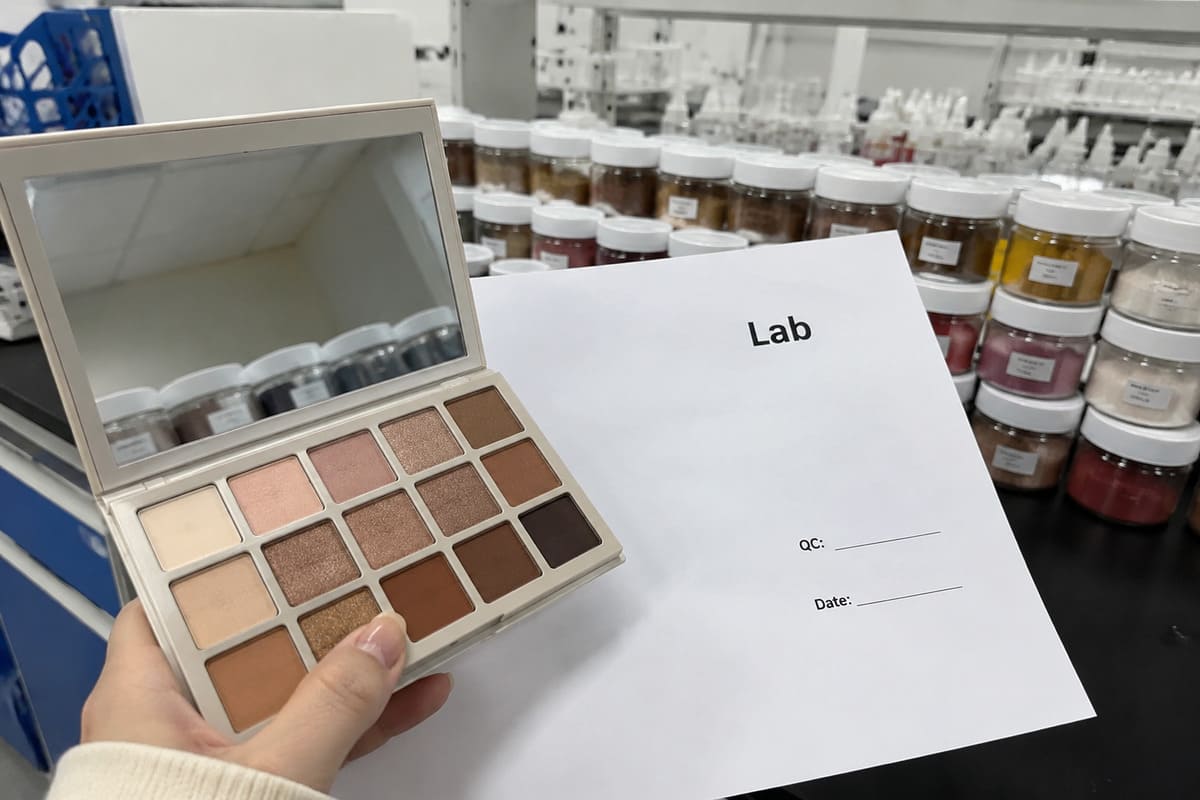
1. Can the supplier transform my demand into a product?
A real manufacturer should not simply say, “This is what we have.” It should ask, “What result are you trying to achieve, and how can we develop it?” I consider this demand-transformation capability.
For an eyeshadow project, I may need to understand:
- Whether the buyer wants a pressed powder, cream, or hybrid texture.
- How strong the color payoff should be.
- Whether the finish should be matte, shimmer, sparkle, glitter, or color-shifting.
- Whether the product must support a specific market claim.
- Whether the packaging protects the formula during transport.
- Whether the target price is compatible with the requested materials.
The supplier should convert these business and product goals into a specification, sample plan, and quotation.
2. Does the supplier control technical development?
Technical capability matters particularly for chameleon eyeshadow, sparkle eyeshadow, glitter products, and customized shades. A catalogue image cannot prove that the bulk batch will reproduce the same effect.4
I would ask whether the cosmetics manufacturer has:
- An internal laboratory or controlled technical development process.
- Shade-matching and color-adjustment experience.
- Access to qualified pigment suppliers.
- Experience with special-effect pigments.
- A documented sample approval process.
- Testing appropriate to the formula and target market.
- Engineers who can explain limitations such as fallout, adhesion, color shift, or packaging compatibility.
3. Can the supplier meet production and delivery commitments?
I would request practical capacity information, such as:
| Metric | Buyer’s question | Evidence to request |
|---|---|---|
| Production lines | How many lines can produce this category? | Factory tour or process explanation |
| Monthly capacity | What is realistic for this product, not the whole factory? | Capacity estimate by product type |
| Lead time | What is the normal and peak-season lead time? | Written production schedule |
| On-time delivery | How often are orders shipped on the agreed date? | Historical internal KPI, if available |
| Quality inspection | What checks occur before shipment? | Inspection checklist or sample report |
| Packaging control | How are printed components and finished goods checked? | Packaging approval process |
| Traceability | How are batches identified? | Batch and production-record examples |
I would be cautious when a supplier promises unlimited capacity or extremely short lead times without discussing raw materials, packaging approval, production queues, and inspection.
4. Is the MOQ commercially realistic?
MOQ should not be evaluated separately from raw material economics. A regular eyeshadow with cardboard packaging may be feasible at approximately 1,000 units in some projects. A special chameleon formula may require a higher quantity because the pigment is expensive and suppliers may sell it in larger commercial quantities.
I use a simple total-cost model:
Total project cost = product quantity × unit cost + packaging development + testing + tooling + freight + inventory risk
A lower MOQ can still create a higher unit cost. A higher MOQ can reduce unit cost but increase inventory exposure. The best decision depends on the buyer’s sales forecast and cash flow.
Suggested supplier scorecard
| Category | Weight | What I would score |
|---|---|---|
| Demand understanding | 25% | Questions, feasibility analysis, development plan |
| Technical capability | 30% | Laboratory, shade work, pigments, sample consistency |
| Production and delivery | 25% | Capacity, process control, lead-time reliability |
| MOQ and commercial fit | 20% | Pilot order flexibility and transparent cost structure |
I recommend setting a minimum acceptable score for technical capability. A supplier should not pass only because it offers a low price if it cannot reproduce the approved formula or shade.
How Did We Help a Middle East Client Verify Our Factory with a Face-to-Face Visit?
Online sourcing can save time, but it can also create uncertainty. One Middle Eastern buyer had previously contacted a supplier that claimed to be a factory. When he proposed visiting, the supplier made repeated excuses and later appeared to be a trading company. That experience made factory verification a central part of his next supplier search.
We helped the Middle Eastern client verify our cosmetics manufacturing capability by welcoming a face-to-face visit, showing our sample room and pigment library, preparing trial samples in advance, and arranging on-site color adjustments with our engineers. The visit allowed him to evaluate both our facility and our working process directly.
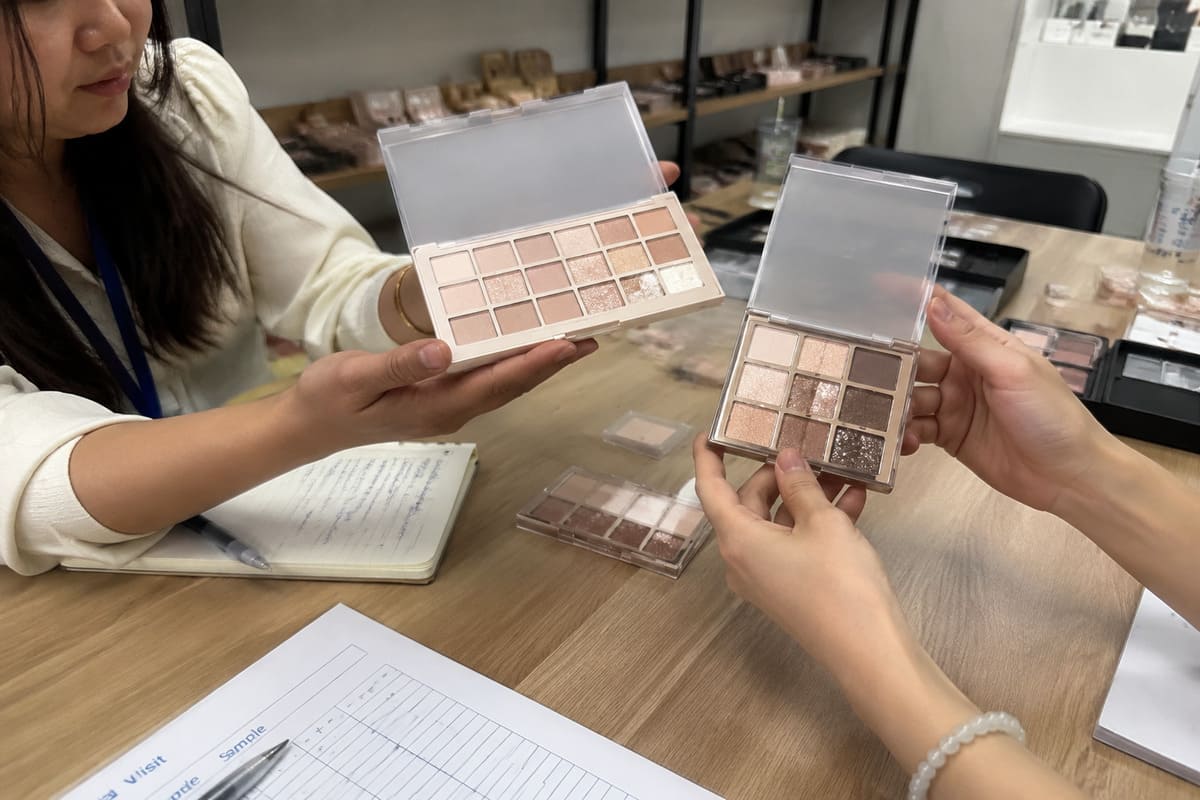
What did the buyer need to verify?
The client was not only looking for a catalogue product. He wanted to understand whether we could support special-effect eyeshadow development and respond to new ideas quickly.
Before the visit, we discussed:
- Desired color families.
- Expected finish and visual effect.
- Target market preferences.
- Packaging direction.
- Approximate order quantity.
- Possible custom shade requirements.
We prepared relevant samples and pigment references before he arrived. This preparation helped us use the visit for product decisions instead of spending the entire meeting on general introductions.
What happened during the visit?
We showed the client our sample room and pigment library. We discussed the differences between standard shimmer, sparkle, glitter, and chameleon effects. We also explained that visual performance depends on pigment selection, base formulation, application method, and packaging.
When the client suggested new ideas, our engineers prepared small samples for review. When a shade needed adjustment, we worked through the change and brought the updated result back for confirmation. The process was practical because the client could see how an idea moved from a visual reference toward a defined product direction.
I believe this is one of the strongest benefits of visiting a direct cosmetics manufacturer: the buyer can evaluate communication between sales, development, and production instead of judging only the final quotation.
What should buyers observe during a factory visit?
I would not treat a factory tour as a ceremonial event. I would use it as an operational audit.
| Area to observe | What it may reveal |
|---|---|
| Sample room | Product range and development discipline |
| Pigment or raw material area | Material organization and technical familiarity |
| Production floor | Actual equipment and process flow |
| Warehouse | Inventory control and storage conditions |
| Packaging area | Labeling, counting, and assembly controls |
| Quality-control area | Whether inspection is a real activity |
| Staff interaction | Communication between departments |
| Documentation | Whether records support traceability |
I would also ask to see the areas relevant to my own product. A factory may be strong in powder products but less experienced with cream or liquid formulas. The audit must match the purchase.
What if an in-person visit is not possible?
A video audit is not equal to an independent audit, but it is better than relying on edited images. I would request a live, unplanned walkthrough that includes:
- The building exterior and address.
- The sample and development area.
- Relevant production equipment.
- Raw material and packaging storage.
- Quality-control activities.
- A discussion with a technical or production representative.
For a larger order, I would consider an independent inspection company or qualified professional evaluator. I would also request pre-production and pre-shipment inspection arrangements. Certifications, test reports, and market-entry documents should be treated as documents to verify for the destination market, not as substitutes for product-specific evaluation.5
Why Does the Guangdong vs. Yiwu Industrial Cluster Difference Matter?
Buyers often compare Chinese manufacturing regions as if one location automatically guarantees better quality. I do not view the decision that simply. Industrial clusters influence supplier specialization, cost structure, access to materials, and service models, but each company still requires individual verification.
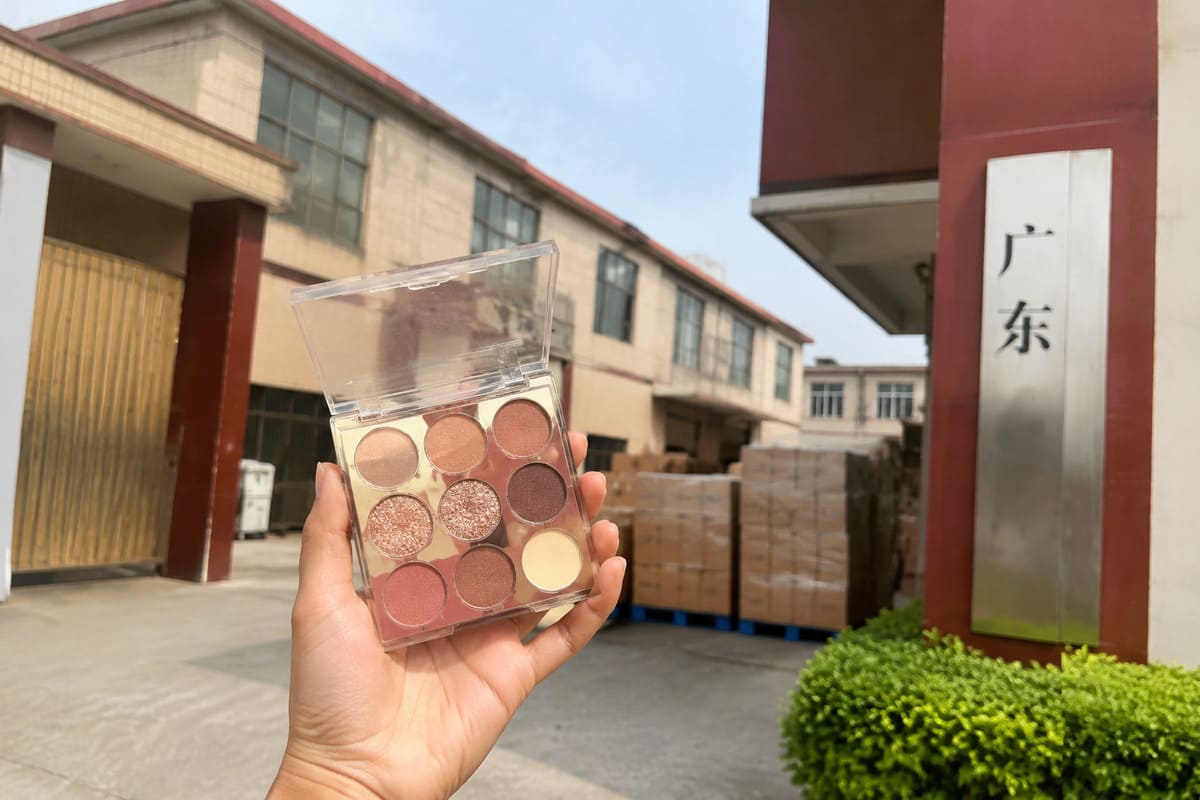
The Guangdong and Yiwu manufacturing clusters can differ in emphasis: Guangdong often has deeper manufacturing and cosmetics-development capabilities, while Yiwu is widely known for efficient wholesale sourcing and cost-focused product distribution.6 Neither location automatically proves quality, so buyers should compare process control, technical evidence, and total value.
How can cluster differences affect procurement?
Guangdong has a dense manufacturing ecosystem, including packaging, electronics, plastics, printing, and cosmetics-related production.7 In my experience, this can make it easier to coordinate product development, packaging customization, and manufacturing communication in one regional network.
Yiwu is strongly associated with wholesale markets, trading activity, small commodities, and rapid product sourcing. This can be useful for buyers who need broad product selection, low-cost standard items, or mixed purchasing. However, a wholesale supplier may not control formulation or production directly.
The following comparison is a starting point, not a final judgment:
| Factor | Guangdong | Yiwu |
|---|---|---|
| Manufacturing depth | Often strong in specialized production | Often strong in sourcing and wholesale |
| Product customization | Common among suitable factories | Depends heavily on the supplier |
| Packaging ecosystem | Broad regional supplier network | Available, but may involve more coordination |
| Price orientation | Mix of value and quality segments | Often highly cost-competitive |
| Factory verification | Requires company-level audit | Requires company-level audit |
| Best fit | OEM/ODM, technical products, repeat manufacturing | Standard goods, wholesale, sourcing flexibility |
I want to be careful here: Yiwu is not “bad,” and Guangdong is not automatically “good.” A well-managed Yiwu supplier can outperform a poorly managed Guangdong supplier. The buyer’s evaluation method matters more than the city name.
Why is the cheapest quote often misleading?
A supplier may reduce the quotation by changing:
- Pigment grade or loading.
- Packaging thickness.
- Decoration method.
- Inner tray material.
- Formula components.
- Inspection frequency.
- Carton protection.
- After-sales responsibility.
These changes may not be obvious from a catalogue photograph. They may only become visible when the bulk product arrives or when consumers use it.
I would compare value per acceptable unit, not the lowest unit price. A useful procurement table should include:
| Cost and risk item | Supplier A | Supplier B | Supplier C |
|---|---|---|---|
| Unit product cost | |||
| Packaging cost | |||
| Development fee | |||
| Testing or documentation | |||
| Freight estimate | |||
| MOQ inventory exposure | |||
| Rework or defect risk | |||
| Expected total cost |
How should buyers screen a cluster-based supplier?
I recommend using the same questions regardless of location:
- Who owns and controls the formula?
- Where are the products actually manufactured?
- Which production steps are outsourced?
- What happens if the approved sample differs from bulk production?
- How are special pigments sourced and controlled?
- What is the realistic MOQ for the exact specification?
- Can the supplier support the destination market’s regulatory documentation?
- Who is responsible for corrective action?
A cluster can provide useful advantages, but it cannot replace evidence.
What Should Buyers Know About MOQ, Special Pigments, and Supplier Fit?
MOQ is one of the most important commercial questions for emerging brands, distributors, and online sellers. Buyers want to test demand without holding excessive inventory, while a cosmetics manufacturer must purchase materials and schedule production economically. The correct MOQ depends on the product, packaging, formula, and raw material supply chain.
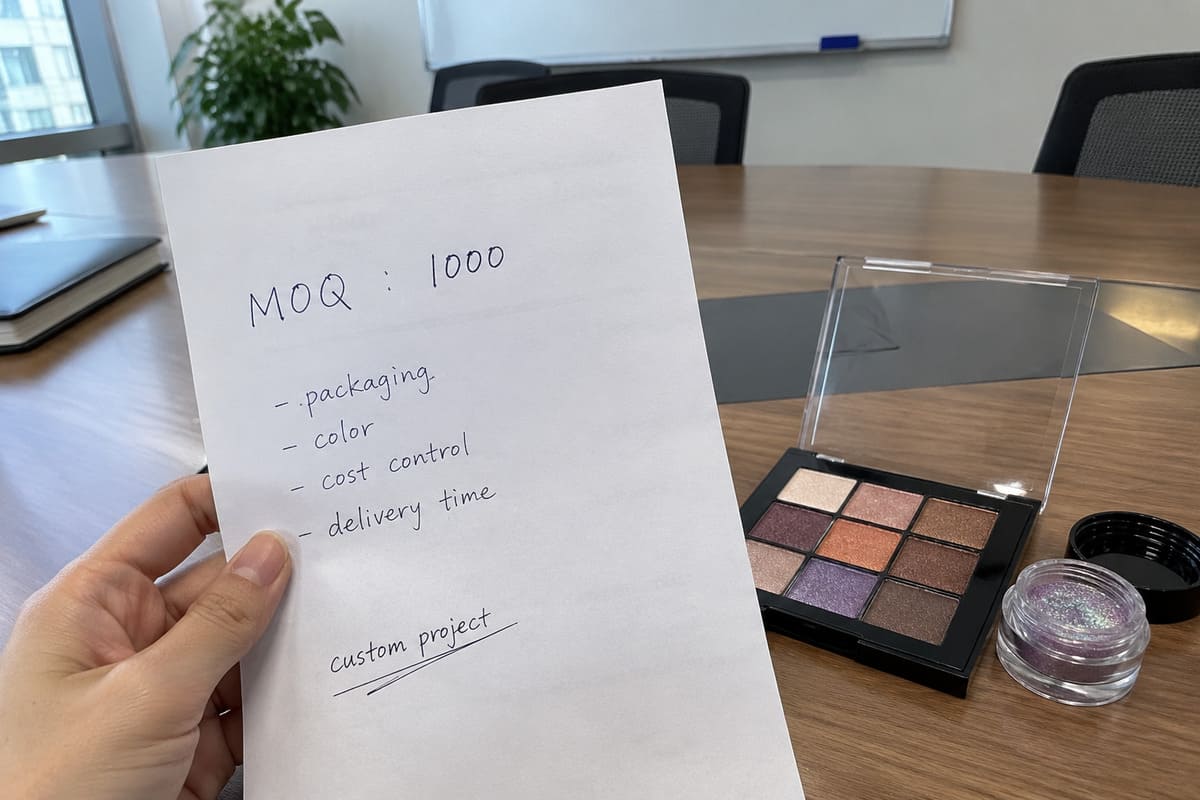
A regular eyeshadow project with simple cardboard packaging may be suitable for a lower MOQ, sometimes around 1,000 units depending on the specification. Special chameleon pigments can require a higher MOQ because the raw material is expensive and may only be available in larger supplier quantities.
Why do special-effect products require different MOQs?
Standard eyeshadow uses a relatively predictable material structure. Special-effect products can require more expensive pigments and more careful development. Chameleon pigments may be priced per gram or in commercial pack sizes that are not economical for very small projects.
The MOQ can be affected by:
- Pigment pack size.
- Minimum purchase quantity from the raw material supplier.
- Number of custom shades.
- Formula development time.
- Packaging customization.
- Printing plate or tooling requirements.
- Required testing and documentation.
- Production-line setup and cleaning.
- Expected yield and material loss.
This is why I prefer to discuss the buyer’s budget and product priority before promising an MOQ.
What is the most economical way to reduce initial risk?
I usually recommend separating the project into stages:
- Technical feasibility: Confirm that the finish, shade, texture, and packaging are achievable.
- Sample approval: Define the reference sample and written specifications.
- Pilot order: Use a manageable quantity to test market response.
- Bulk production: Increase volume after demand becomes clearer.
- Repeat planning: Forecast materials and delivery dates based on actual sales.
For a new brand, the best low-MOQ strategy may not be “customize everything.” The buyer might use a standard compact, select a controlled number of shades, and customize the outer packaging. This can reduce tooling and component risk while preserving brand differentiation.
How do I decide whether a supplier is the right fit?
I would compare the order requirement with the manufacturer’s strengths:
| Buyer requirement | Likely fit |
|---|---|
| About 1,000 regular eyeshadows with cardboard packaging | Potentially suitable for a flexible manufacturer |
| Small order with many custom shades | Needs careful cost and development review |
| Small order with expensive chameleon pigment | May not be economically suitable |
| Large repeat order of standard products | Suitable if capacity and quality controls are verified |
| Custom color and packaging for a new brand | Suitable if the supplier has OEM/ODM development support |
| Urgent replenishment | Suitable only if relevant stock or production capacity exists |
At Vertina Beauty, we support B2B customers including distributors, wholesalers, emerging brands, KOL-owned brands, and cross-border sellers. We can discuss low-MOQ options for appropriate products and provide OEM/ODM support for formula, shade, and packaging development. However, I do not believe every request should receive an automatic promise. A buyer should receive an honest evaluation of what is technically and commercially realistic.
What should the buyer include in an MOQ inquiry?
I recommend sending this information:
- Product type.
- Quantity per shade.
- Number of shades.
- Desired finish.
- Packaging concept.
- Target market.
- Target budget.
- Required delivery date.
- Expected repeat-order potential.
- Required testing or documentation.
This allows the cosmetics manufacturer to recommend the most economical combination. Sometimes the best solution is a smaller product range. Sometimes it is standard packaging with customized color. Sometimes it is a higher initial MOQ that prevents a much higher unit cost.
Frequently Asked Questions
How can I verify whether a cosmetics manufacturer is genuine?
I recommend checking the legal company identity, factory address, live video evidence, production equipment, sample room, quality process, and manufacturing responsibility. Buyers should also ask whether the supplier owns production or outsources it. For larger orders, an independent factory audit or inspection is appropriate.
What certifications should I request from a cosmetics manufacturer?
The required documents depend on the destination market and product category. Buyers may need evidence related to cosmetic GMP, product safety, ingredient compliance, labeling, testing, and product registration. I recommend verifying current requirements with the destination authority or a qualified regulatory professional rather than accepting a certificate without checking its scope and validity.
What documents are needed to export cosmetics to Saudi Arabia?
Saudi Arabia generally requires cosmetics to comply with Saudi regulatory and product-registration procedures8, which may involve the Saudi Food and Drug Authority, product information, ingredient and safety documentation, labeling, and an importer or responsible party. Requirements can change, so I recommend confirming the current SFDA process with a qualified Saudi regulatory specialist before shipment.
Is a low MOQ cosmetics manufacturer always the best choice?
No. A low MOQ can reduce inventory risk, but it may increase unit cost or limit formula and packaging choices. I compare MOQ with material pack sizes, development fees, testing, packaging, and repeat-order potential. The best supplier offers a commercially realistic combination, not simply the smallest number.
Should I choose a Guangdong or Yiwu cosmetics supplier?
I would not choose by location alone. Guangdong may offer strong manufacturing and OEM/ODM resources, while Yiwu may provide broad wholesale sourcing and cost efficiency. I recommend comparing the actual supplier’s technical capability, factory evidence, quality system, delivery record, MOQ, and accountability.
Conclusion
"Source Cosmetic Manufacturer: Offering Premium Wholesale ...", https://vertinabeauty.com/. Official cosmetics good-manufacturing-practice guidance describes documented controls for materials, production, packaging, quality control, and records as components of controlled cosmetic manufacture. Evidence role: general_support; source type: government. Supports: Official cosmetics GMP guidance should support the relevance of documented controls for personnel, premises, materials, production, packaging, quality control, and records.. Scope note: GMP guidance supports the importance of these controls but does not by itself prove that a particular supplier owns every manufacturing step or is not using qualified contractors. ↩
"Responsible mineral supply chains - OECD", https://www.oecd.org/en/topics/sub-issues/due-diligence-guidance-for-responsible-business-conduct/responsible-mineral-supply-chains.html. Supply-chain due-diligence frameworks emphasize identifying relevant business partners and clarifying responsibilities across outsourced production and intermediary relationships. Evidence role: general_support; source type: institution. Supports: Supply-chain due-diligence guidance should support identifying business partners, production locations, and responsibilities within outsourced or multi-tier supply chains.. Scope note: Such frameworks establish transparency principles rather than a universal legal obligation for every trading company to disclose a specific factory in every transaction. ↩
"An integrative approach to product development—A skin-care ...", https://pmc.ncbi.nlm.nih.gov/articles/PMC7112257/. Quality-management frameworks describe the identification and review of customer, regulatory, and technical requirements as an early control in product development and manufacturing. Evidence role: mechanism; source type: research. Supports: Quality-management and product-development literature should support the role of collecting and reviewing customer and technical requirements before development or production.. Scope note: Requirement-review practices support the diagnostic logic but cannot alone establish a supplier's technical competence. ↩
"What Is the Highest Rated Eyeshadow Palette? Market Data ...", https://vertinabeauty.com/what-is-the-highest-rated-eyeshadow-palette-market-data-for-b2b-buyers/. Studies of cosmetic pigment systems indicate that formulation composition, particle dispersion, and processing conditions can affect the color and visual performance observed between samples and production batches. Evidence role: mechanism; source type: paper. Supports: Technical studies should support the influence of pigment dispersion, formulation variables, and process conditions on color and appearance reproducibility.. Scope note: This evidence explains why images and samples are insufficient on their own, but it does not quantify the expected variation for a particular eyeshadow formula. ↩
"FDA Authority Over Cosmetics: How Cosmetics Are Not FDA-Approved", https://www.fda.gov/cosmetics/cosmetics-laws-regulations/fda-authority-over-cosmetics-how-cosmetics-are-not-fda-approved-are-fda-regulated. Regulatory and accreditation guidance indicates that certificates and compliance documents must be assessed for their stated scope, validity, issuing body, and applicability to the relevant product and market. Evidence role: general_support; source type: government. Supports: Regulatory and accreditation authorities should support the need to verify document scope, applicability, validity, and product-specific safety or compliance evidence.. Scope note: Document verification does not replace all product testing or manufacturing evaluation, but the exact requirements vary by jurisdiction and product category. ↩
"Let's bring your vision to life. - Source Cosmetic Manufacturer", https://vertinabeauty.com/contact/. Regional economic and industrial sources describe Guangdong as a major manufacturing base and Yiwu as a prominent small-commodities wholesale and distribution center. Evidence role: historical_context; source type: government. Supports: Government and economic-development sources should document the industrial composition and commercial roles of Guangdong manufacturing regions and Yiwu's wholesale market ecosystem.. Scope note: Regional profiles describe aggregate specialization and cannot establish the capability, quality, or business model of an individual supplier. ↩
"China Flexible Packaging Market Analysis Report 2031", https://www.mordorintelligence.com/industry-reports/china-flexible-packaging-market. Regional industry reports characterize Guangdong as a diversified manufacturing province with established supplier networks in packaging, plastics, printing, and consumer-product production. Evidence role: historical_context; source type: institution. Supports: Regional economic reports should support the presence of manufacturing, packaging, plastics, printing, and related supplier networks in Guangdong.. Scope note: The existence of a regional supplier network does not demonstrate integrated supply, lower costs, or better performance for a particular cosmetics project. ↩
"Saudi Food and Drug Authority (SFDA) Certification ...", https://www.qima.com/consumer-products/certifications/sfda. Saudi regulatory guidance establishes that cosmetics marketed in the Kingdom must comply with applicable national requirements and follow the relevant product notification or registration procedures. Evidence role: definition; source type: government. Supports: Current Saudi Food and Drug Authority or applicable GCC regulatory guidance should establish the market-entry, compliance, and product-registration requirements for cosmetics.. Scope note: The exact procedure, documentation, responsible-party obligations, and applicability may vary by product classification and can change over time. ↩