Finding a makeup manufacturer feels simple until your startup capital is on the line. You search directories, pay sample fees, and wait. Then the samples arrive late, the "factory" turns out to be a middleman, and the "50-unit MOQ" comes wrapped in generic packaging that makes your brand look like every Amazon knockoff. That fear is real. Here is how I help founders avoid it.
To find a makeup manufacturer safely, use a three-step verification framework: demand a time-stamped video of the live production line1, check the business license scope for the word "Trading,"2 and start with a low-risk trial order on standard products before investing in full customization. This filters out trading companies and protects your capital from fake low-MOQ promises.

Most guides stop at "check reviews and ask for samples." That advice is thin. Below, I break down what the search really means, why directories fail startups, and how a real vetting case saved one seller from two trading-company scams.
What Does "How to Find a Makeup Manufacturer" Really Mean for Founders?
You type "how to find a makeup manufacturer" into Google expecting a list. But a list is not your real problem. Your real problem is protecting your savings from fake suppliers, rigid minimums, and inventory you cannot sell. The search is a cry for a vetting method, not a directory.
When founders search for a makeup manufacturer, they are not asking "Where are the factories?" They are asking "How do I verify a real factory and test its capability with almost zero risk?" The core need is a filter that removes trading companies, exposes fake MOQs, and protects startup capital before any large order is placed.
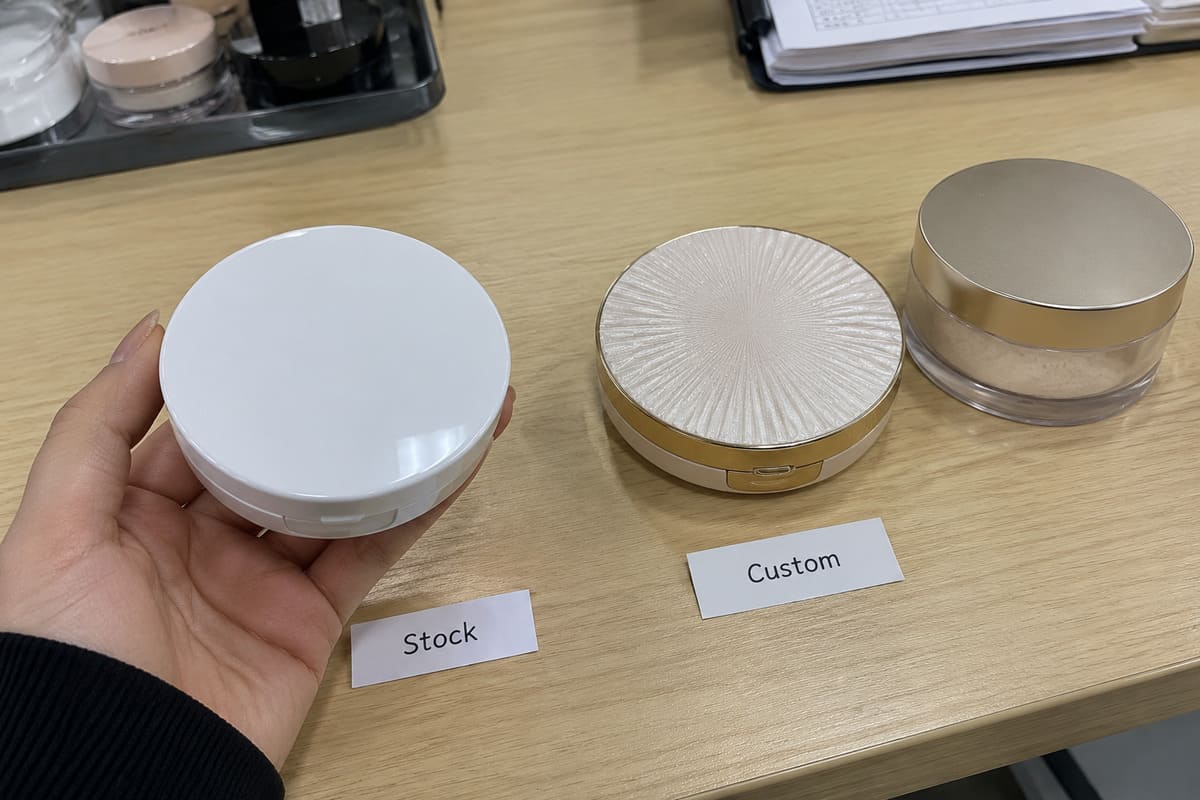
Let me bridge the gap between the question people type and the question they mean.
The Question Behind the Question
I have talked to dozens of cosmetics brand founders and e-commerce sellers. When they ask how to find a cosmetics supplier, they almost never mean geography. They mean risk management. Here is the translation I keep in my head:
| What They Type | What They Actually Mean |
|---|---|
| "Where can I find factories?" | "How do I avoid middlemen pretending to be factories?" |
| "What's the MOQ?" | "Will I be forced into 10,000 units before I know it sells?" |
| "Can I get samples?" | "Will I pay sample fees and get scammed?" |
| "Do you do custom packaging?" | "Will my brand look unique, or like a cheap knockoff?" |
The founder is terrified of three specific traps. First, a supplier that uses stock photos and hides behind a trading company. Second, a factory that forces a massive minimum order. Third, inventory that sits in a warehouse because the packaging looks generic.
A good answer to "how to find a makeup manufacturer" is therefore a verification process, not a phone book. It teaches you how to separate a real production line from a reseller's office. It gives you honest numbers on minimum order quantity. And it shows you how to test the market with small money before you commit big money3. That is the lens I use for the rest of this guide.
Why Do Sourcing Directories and Trade Shows Often Fail Startups?
You spend weeks on a B2B platform or fly to a trade show. You collect business cards and quotes. Then you realize the big players will not touch your small order, and the small players might not be factories at all. The effort feels productive but rarely solves the startup's real problem.
Sourcing directories and trade shows work well for established brands with large budgets, but they often fail cosmetics startups because major manufacturers prefer orders of 50,000+ units4. This volume gap pushes founders toward middlemen who pose as factories, leaving beginners exposed to misrepresentation and inflated minimums.
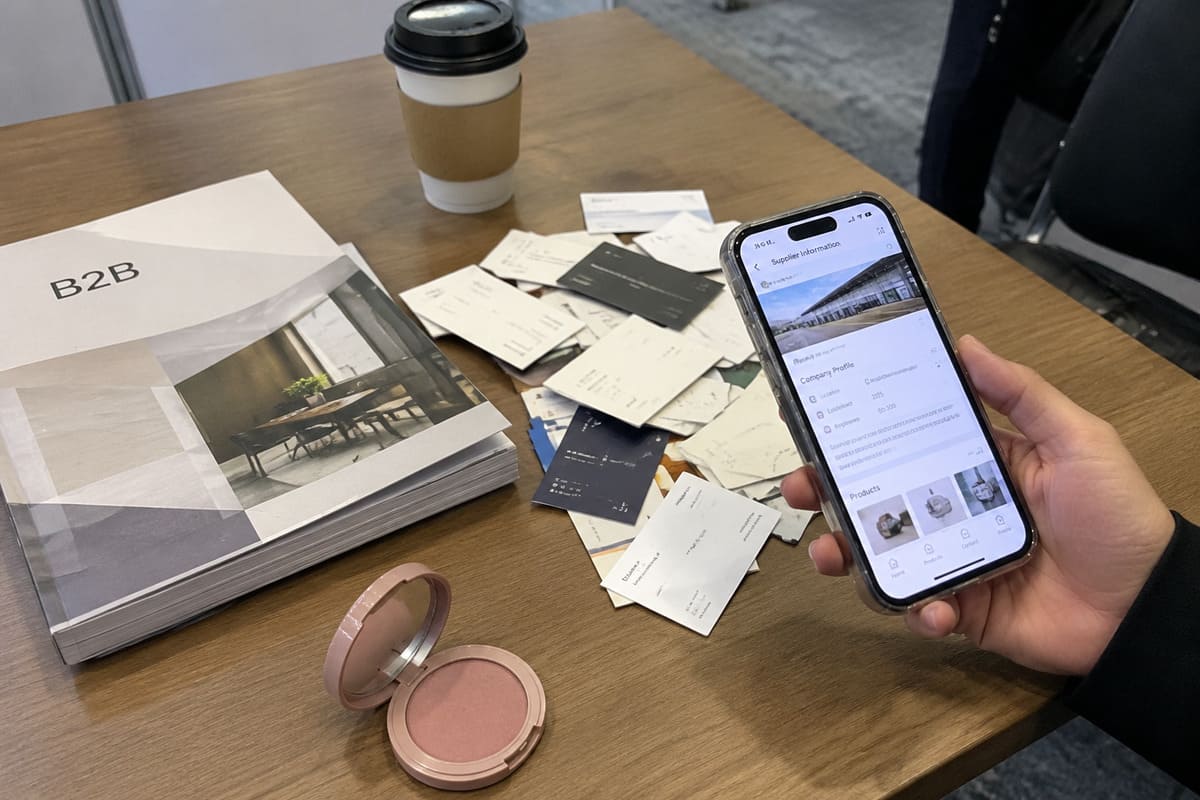
So where does the mismatch come from? Let me break down the economics.
The Volume Gap Nobody Explains
Trade shows and directories are networking tools. They are excellent for discovery. But discovery is not verification, and a booth is not a production line. Based on my experience serving global B2B buyers, the structural problem is simple: the suppliers that are easiest to find are often the worst fit for a new brand.
Here is how the channels actually line up against startup needs:
| Sourcing Channel | Best For | Typical Weakness for Startups |
|---|---|---|
| Large B2B directories | Price discovery, wide reach | Many listings are trading companies, not factories |
| Major trade shows | Established brands, big volume | Large factories want 50,000+ unit orders |
| Social media (Instagram, TikTok) | Trend research, inspiration | Hard to verify production capability |
| Google search | Finding specialized factories | Still requires a vetting framework |
A large manufacturer that sets up a booth at a major show is optimizing for 50,000-unit buyers. When a founder with a 2,000-unit budget walks up, the sales team is polite but uninterested. That founder then drifts toward the smaller, more "flexible" sellers. Many of those sellers are trading companies. They buy generic product from real factories, slap on stock packaging, and resell at a markup5.
This is why so many beginners get burned. They do the work, attend the events, and still end up with a middleman. The directory and the show did their job, discovery, but they never taught the founder how to verify. Verification is a separate skill, and it is the one that actually protects your money. The next section is where that skill begins.
How Can You Tell a Real Factory from a Trading Company?
A trading company looks identical to a factory on a website. Same glossy photos, same confident sales pitch, same promises. You cannot tell them apart by appearance, and that ambiguity is exactly what scammers rely on. One wrong choice costs you sample fees, time, and sometimes a full order.
You can tell a real makeup manufacturer from a trading company by demanding a time-stamped live video of the production line and checking the business license scope. A genuine factory will film its lines holding a paper with today's date on request. If the license scope says "Trading" instead of "Manufacturing," walk away.
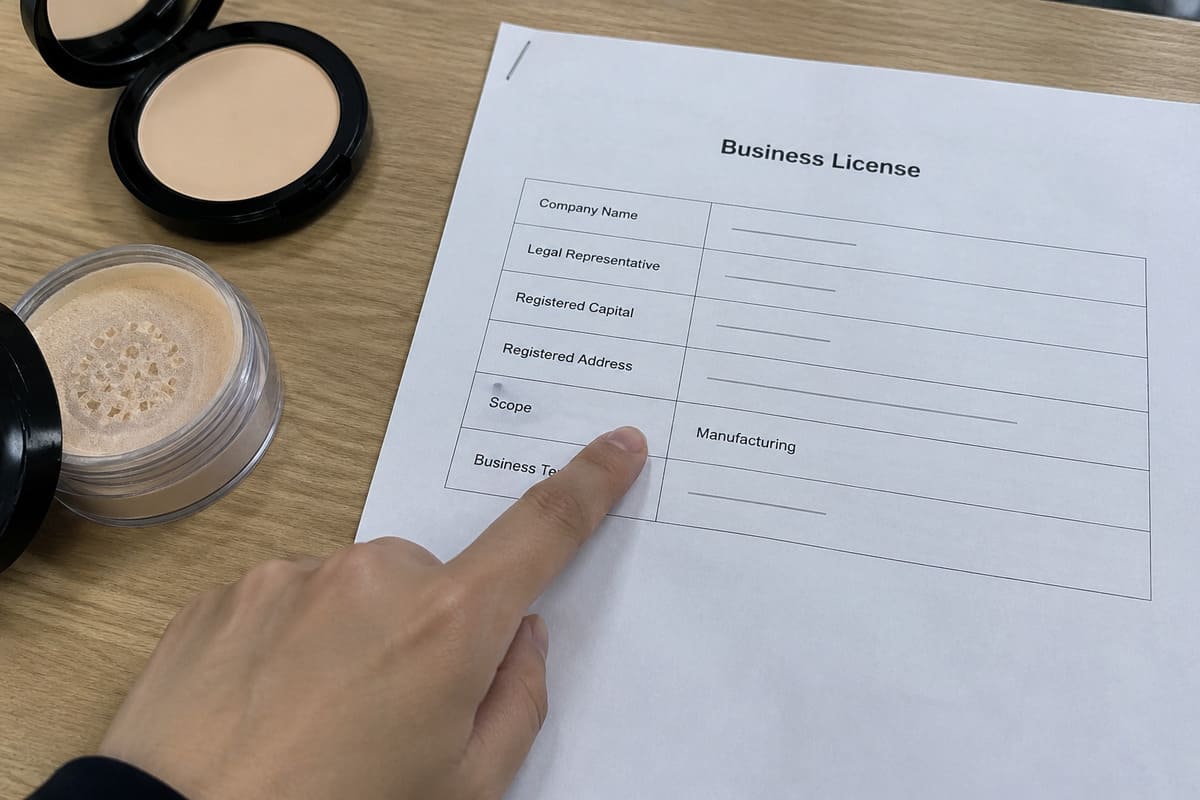
Let me turn this into a repeatable framework you can use on every supplier.
The 3-Step Verification Framework
I give this exact checklist to every founder who asks me how to vet a cosmetics factory. It is strict on purpose. Your capital deserves a strict filter.
- Video Verification. Ask for a live, time-stamped video of the actual production lines. The test: request they hold up a piece of paper showing today's date while filming the floor. Stock photos and old videos cannot pass this. A real factory does it within a day.
- Business License Check. Request the business license and read the "Business Scope" section. Manufacturers list production and processing activities. Pure resellers list "Trading" or "Wholesale." If you see trading language and no manufacturing scope, you are talking to a middleman.
- The Low-Risk Trial. Do not place a large order first. Start with a standard product to test both the supplier's reliability and your market. Scale only after both are proven.
Here is how the two types usually respond to the same requests:
| Verification Request | Real Factory Response | Trading Company Response |
|---|---|---|
| Live dated production video | Sends it within 24 hours | Delays, excuses, or old footage |
| Business license scope | Shows manufacturing activities | Shows "Trading" or avoids the topic |
| Factory audit / video call | Welcomes it | Reluctant or "too busy" |
| Technical formula questions | Answers in detail | Vague, defers to "the factory" |
Treat any certification claims as documents to verify, not promises to trust6. A certificate is a starting point for your own due diligence, and I always recommend qualified professional evaluation for your specific target market. The framework above does not make you an expert overnight. But it filters out the majority of bad actors, which is most of the battle when you are learning how to find a makeup manufacturer you can trust.
What Is the Truth About "Low MOQ," and Why Does Real Differentiation Require Volume?
The "50-unit MOQ" headline is seductive. It promises a brand for almost no money. But that promise hides a trap. Low minimums almost always mean generic stock packaging, which means your product looks exactly like hundreds of cheap competitors. No uniqueness, no brand equity, no margin.
The truth about low MOQ is that ultra-low minimums of 50–100 units rely on generic stock packaging and standard formulas, so your product looks identical to cheap competitors. True differentiation with custom molds, exclusive colors, and proprietary textures requires the factory to set up dedicated production, making a realistic MOQ for custom products 5,000–10,000 units7.
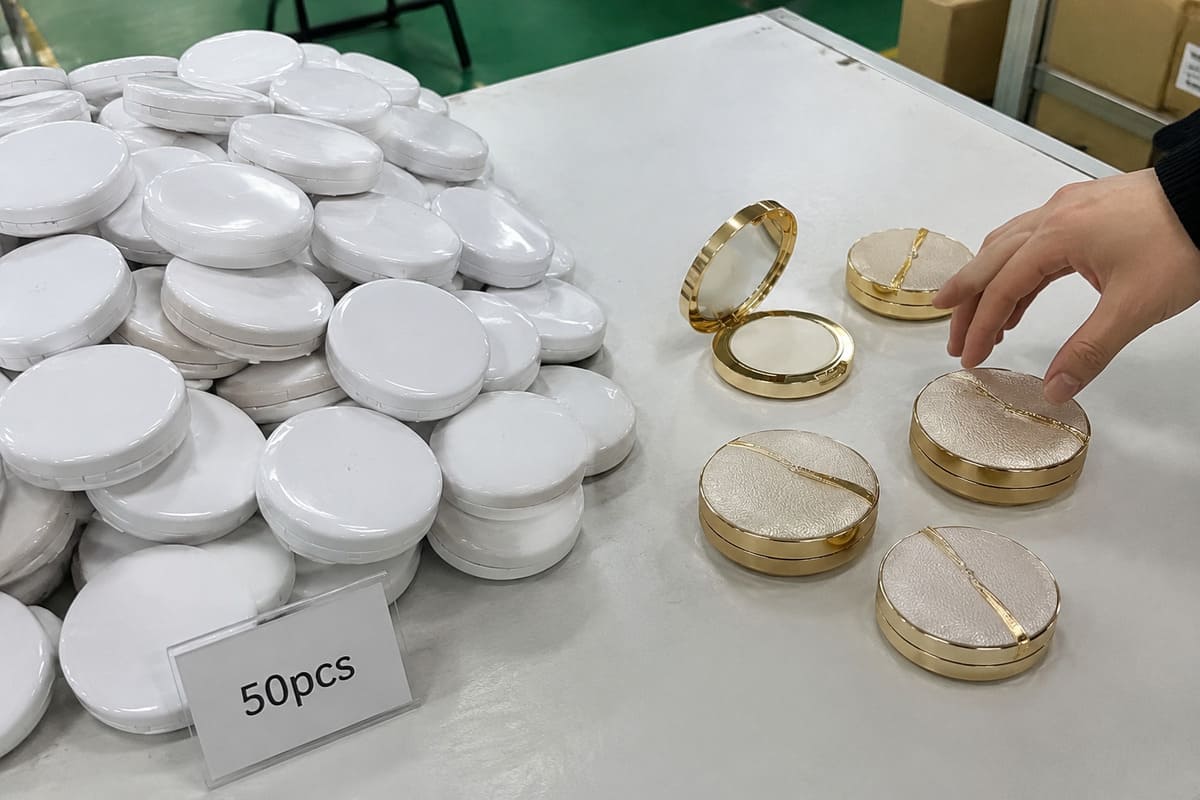
This is the hardest lesson for new founders, so let me be specific about the numbers.
The Ultra-Low MOQ Trap vs. Real Customization
When a factory advertises 50 to 100 units, it is selling you public mold packaging. The Chinese industry term is 公模, meaning open or shared tooling8. Dozens of brands use the exact same component. You add a sticker label, and that is your "brand." The result is a product that looks like every generic item on a marketplace. You compete only on price, and that is a race to the bottom9.
True differentiation costs more because it requires the factory to commit real resources:
| Customization Level | What You Get | Realistic MOQ | Brand Impact |
|---|---|---|---|
| Stock / public mold | Generic packaging, standard formula | 50–2,000 units | Looks like competitors |
| Semi-custom | Custom color print, stock mold | 2,000–5,000 units | Mild differentiation |
| Full custom | Custom mold, exclusive Pantone, proprietary texture | 5,000–10,000 units | Real brand moat |
Custom molds cost money to cut10. Exclusive Pantone colors require dedicated mixing and cleaning of equipment11. Proprietary textures need formula development and testing. Each of these forces the factory to dedicate a production line to you alone. That setup only makes economic sense at volume, which is why the honest number for true custom work lands between 5,000 and 10,000 units.
So here is my blunt advice. Do not waste money on 2,000 units of a generic product that will not sell because it looks like everything else. You have two smart paths. Either accept the 5,000-unit minimum to build a genuine brand moat from the start. Or use a 2,000-unit standard product purely to validate the market before you upgrade to full customization. Both are rational. Paying for a fake "brand" with stock packaging is not. When founders understand this math, the whole search for a makeup manufacturer changes from hunting for the lowest MOQ to finding the right partner for each stage.
What Can a Real Vetting Case Teach You About Avoiding Scams?
Theory is useful, but a real story sticks. A founder can read every framework and still get scammed in the heat of a deal. So let me share a case that shows exactly how the vetting process plays out, including the part most guides hide: the true cost of differentiation.
A real vetting case teaches that live video verification instantly separates genuine factories from trading companies, and that honest MOQ advice saves founders from unsellable inventory. In one case, a U.S. seller who had already paid two trading companies finally verified a real factory through a dated production video, then scaled from a trial order to full customization.
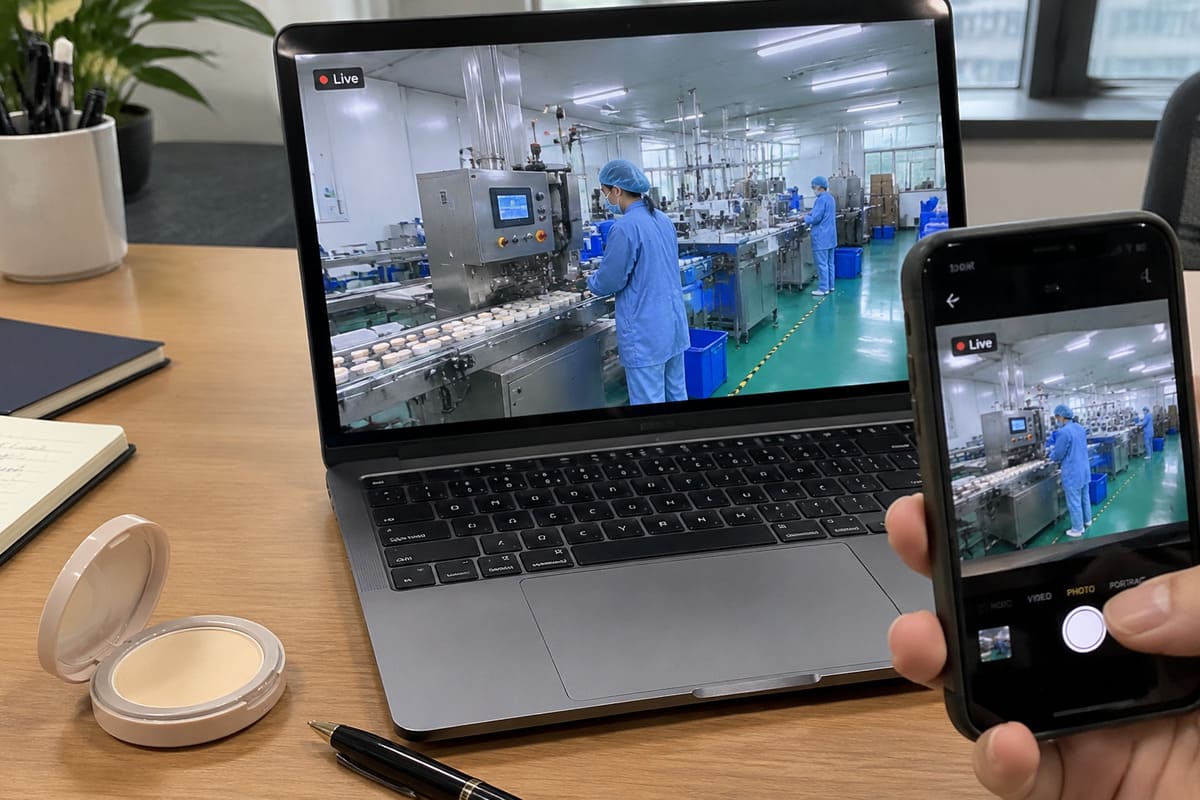
Here is the full story, start to finish.
The Client, the Problem, and the Result
The client was a U.S. e-commerce seller. He spent three months searching on a major B2B platform. By the time he reached me, he was exhausted and burned. He had already paid sample fees to two suppliers who turned out to be trading companies, not factories. Worse, he had received "50 unit" quotes from several sellers, only to discover the quotes assumed cheap generic stock packaging. His brand would have looked identical to the knockoffs he was trying to beat.
I gave him one piece of advice first: "Don't trust product photos. Ask them to take a live video of the production line holding a piece of paper with today's date." He sent that request to five suppliers. We were the only one who did it immediately. That single test cut four suppliers in one afternoon.
Then I told him the truth about volume. "If you want unique packaging and an exclusive formula, a realistic order of 5,000 units is necessary. If you want to test the waters first, start with our 2,000-unit standard eyeshadow palette." No fake low-MOQ, no hidden setup fees. Just real numbers.
Here is how his journey mapped out:
| Stage | Action | Outcome |
|---|---|---|
| Months 1–3 | Searched platform, paid two sample fees | Scammed by trading companies |
| Verification | Requested dated production video from 5 suppliers | Only 1 (us) complied immediately |
| Trial | Ordered 2,000-unit standard eyeshadow palette | Tested audience with low cash risk |
| Scale | Product sold well, placed 5,000-unit order | Upgraded to custom packaging and tweaked formula |
That is how you build a real brand. He did not bet his savings on an unproven product. He validated demand with a modest, low-risk trial, then reinvested in true differentiation once the data supported it. The scam attempts failed because he had a framework. The scale-up succeeded because he had honest numbers.
How Do You Start with a Low-Risk Trial Order and Scale to Customization?
Even with the right factory, one fear remains: committing cash before you know the product sells. Order too little and you get generic junk. Order too much and you are stuck with dead inventory. The way out is a staged approach that matches your spending to your proof.
You start with a low-risk trial by ordering a standard product like a 2,000-unit eyeshadow palette to validate market demand, then scale to a 5,000–10,000 unit custom order once sales prove the concept. This staged path keeps early capital small, tests your audience, and reserves heavy investment for a product the market has already approved.
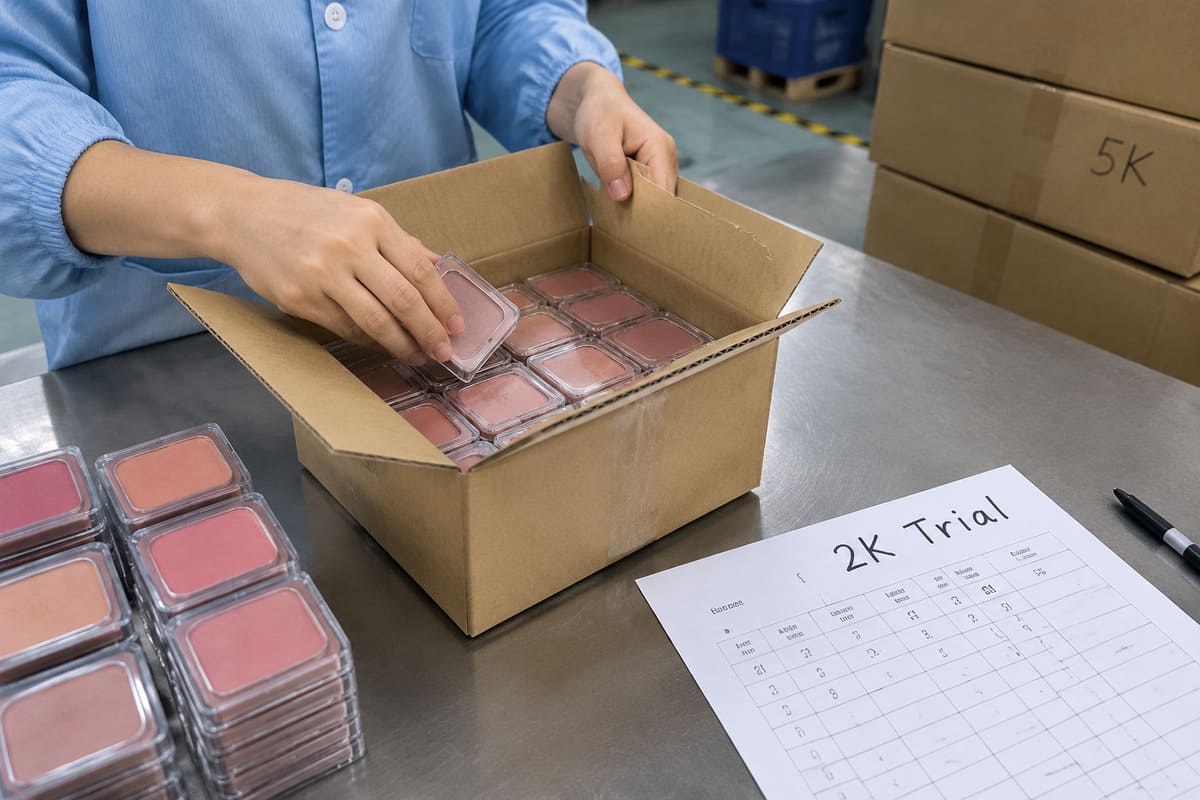
Let me lay out the exact sequence I recommend.
The Validate-Then-Scale Playbook
The principle is simple: spend small to learn, spend big to differentiate. Here is the path I walk founders through:
- Validate with a standard trial. Order a proven standard product, such as a 2,000-unit standard eyeshadow palette. This tests your marketing, your audience, and the supplier's reliability at once. Your cash exposure stays low.
- Read the market data. Track sell-through, repeat buyers, and feedback. Let real sales, not a gut feeling, decide the next move.
- Scale into customization. Once the trial sells well, move to a 5,000-unit order with custom packaging and a tweaked formula. Now you build the brand moat, on a product the market already wants.
Here is the trade-off between the two main starting points:
| Approach | Upfront Cash | Brand Differentiation | Best Use |
|---|---|---|---|
| 2,000-unit standard trial | Low | Low (standard look) | Validating market demand |
| 5,000–10,000 custom order | Higher | High (custom mold, exclusive color) | Building a real brand after validation |
As a manufacturer based in one of the core supply chain clusters in Guangdong, China12, I lean on agility and transparency rather than fake promises. We offer tiered MOQs. We will tell you honestly that true differentiation needs 5,000 to 10,000 units. But we also offer the 2,000-unit standard trial so you can test the market without a massive cash commitment.
Here is my honest boundary, though. A trial order will not guarantee your brand becomes a hit. Marketing, product-market fit, and timing are on you. What a smart supply chain guarantees is that your supplier won't be the reason you fail. Start smart, validate the market, then invest in true differentiation. For application-specific or market-entry decisions, I still recommend qualified professional and regulatory evaluation.
Frequently Asked Questions
How do I verify a makeup manufacturer is a real factory?
Request a time-stamped video of the live production line, with a staff member holding a paper showing today's date. Then check the business license "Business Scope" for manufacturing activities. A genuine factory complies quickly. A trading company stalls or shows only "Trading" in its scope.
What is a realistic MOQ for custom cosmetics?
True customization with custom molds, exclusive colors, and proprietary textures realistically requires 5,000 to 10,000 units, because the factory dedicates a production line to you. Ultra-low minimums of 50 to 100 units almost always use generic stock packaging, so your product looks identical to cheap competitors.
Are ultra-low MOQ offers a scam?
Not always a scam, but usually a trap. Minimums of 50 to 100 units rely on shared public-mold packaging, which means no real differentiation. You can use a low volume to validate the market, but do not mistake stock packaging for a genuine, defensible brand.
Should startups use trade shows to find a makeup manufacturer?
Trade shows suit established brands with large budgets. For startups, large manufacturers at these shows often want 50,000+ unit orders, which pushes founders toward middlemen. Shows are great for discovery and trend research, but you still need a separate verification framework before ordering.
How much should I spend on a first makeup order?
Keep your first order small enough to survive if the product fails. A 2,000-unit standard product like an eyeshadow palette validates demand at low cash risk. Reserve heavy spending for a 5,000-unit custom run only after sales prove the concept works.
Conclusion
Learning how to find a makeup manufacturer is really about managing risk, not collecting a list. The founders who succeed use a three-step framework: verify the factory with a dated production video, check the business license scope, and start with a low-risk trial before scaling. They reject fake ultra-low MOQs that deliver generic packaging, and they accept that real differentiation needs a realistic 5,000 to 10,000 unit volume. They validate first, then invest. If you want honest numbers and a factory that will film its line for you today, send me your target market and I will match you to the right starting order.
"How to Find a Cosmetics Manufacturer: A Buyer's Guide to Verifying ...", https://vertinabeauty.com/how-to-find-a-cosmetics-manufacturer-a-buyers-guide-to-verifying-real-factories/. Supply-chain due-diligence guidance identifies direct facility verification, including live video or on-site audit, as a method to confirm a supplier's manufacturing capability. Evidence role: general_support; source type: institution. Supports: Direct visual verification of a supplier's production facilities is a recognized due-diligence step in overseas sourcing.. Scope note: Guidance supports facility verification in general; the specific dated-paper video technique is a practical adaptation not independently validated. ↩
"How to Find the Best OEM Makeup Kit Manufacturers with Low ...", https://vertinabeauty.com/2025/03/07/how-to-find-the-best-oem-makeup-kit-manufacturers-with-low-moq/. Official registration frameworks for Chinese enterprises require a declared business scope on the business license, which delimits the activities, including manufacturing versus trading, that the entity is authorized to perform. Evidence role: mechanism; source type: government. Supports: Chinese business licenses specify a registered business scope that constrains the activities a company may legally conduct.. Scope note: The presence of 'Trading' in a scope does not by itself prove a company lacks any manufacturing capacity, so the signal is indicative rather than conclusive. ↩
"Risk assessment in supply chains: a state-of-the-art review of ...", https://pmc.ncbi.nlm.nih.gov/articles/PMC9063627/. Entrepreneurship and operations research supports staged market validation, where small early commitments test demand before larger investment, as a means of reducing capital and inventory risk. Evidence role: expert_consensus; source type: paper. Supports: Validating demand with small initial commitments before scaling reduces capital risk for new products.. Scope note: Supporting literature addresses the general principle and may not quantify risk reduction for cosmetics specifically. ↩
"Contract Manufacturing and Packaging Agreement with ...", https://www.sec.gov/Archives/edgar/data/1431897/000119312512015538/d261388dex1017.htm. Industry analyses of contract and private-label cosmetics manufacturing describe minimum order quantities that scale with production setup costs, limiting access for low-volume buyers. Evidence role: statistic; source type: institution. Supports: Large contract cosmetics manufacturers typically require high minimum order quantities that are impractical for startups.. Scope note: Reported MOQ figures vary widely by product category and region, so a single 50,000-unit threshold may not generalize across all manufacturers. ↩
"Supply chain management", https://en.wikipedia.org/wiki/Supply_chain_management. Reference sources define a trading company as an intermediary that buys goods from producers and resells them, as distinct from an entity that manufactures products directly. Evidence role: definition; source type: encyclopedia. Supports: Trading companies act as intermediaries that source and resell goods produced by third-party manufacturers.. Scope note: General definitions do not confirm the specific markup or packaging practices described, which are illustrative. ↩
"GMP Guidelines/Inspection Checklist for Cosmetics", https://www.fda.gov/cosmetics/cosmetics-guidance-documents/good-manufacturing-practice-gmp-guidelinesinspection-checklist-cosmetics. Trade-compliance and due-diligence guidance recommends verifying supplier certifications directly with the issuing authority, as submitted documents may be falsified or outdated. Evidence role: general_support; source type: government. Supports: Supplier-provided certifications can be misrepresented and should be verified with the issuing body.. Scope note: Guidance is general to supplier due diligence and not specific to cosmetics certifications. ↩
"How to Find a Cosmetics Manufacturer: A Buyer's Guide to Verifying ...", https://vertinabeauty.com/how-to-find-a-cosmetics-manufacturer-a-buyers-guide-to-verifying-real-factories/. Trade and manufacturing-economics sources indicate that dedicated tooling and formulation setup costs push the viable production volume for customized goods substantially higher than for standard stock products. Evidence role: statistic; source type: institution. Supports: Custom tooling and dedicated formulation raise the economic break-even volume for bespoke cosmetics production.. Scope note: The exact 5,000–10,000 unit band is a practitioner estimate; published sources describe the cost mechanism rather than confirming this precise range. ↩
"Differences Between Closed Molding vs Open Molding", https://www.osborneindustries.com/news/differences-closed-molding-vs-open-molding/. Reference material on manufacturing tooling distinguishes shared or stock molds, reused across customers, from dedicated custom molds commissioned for a single buyer. Evidence role: definition; source type: encyclopedia. Supports: Open or shared molds are standardized tooling reused across multiple customers, in contrast to dedicated custom tooling.. Scope note: General tooling references may not address the specific Chinese-language industry term, which is contextual rather than directly documented. ↩
"Price-Directed Search, Product Differentiation and Competition", https://pmc.ncbi.nlm.nih.gov/articles/PMC10541849/. Competitive-strategy literature holds that undifferentiated or commoditized products compete chiefly on price, which tends to erode profit margins. Evidence role: mechanism; source type: paper. Supports: Lack of product differentiation shifts competition toward price and compresses margins.. Scope note: The principle is drawn from general strategy theory rather than a cosmetics-specific empirical study. ↩
"The Business of Molding, Part 20 Tooling amortization: How not to get", https://www.plasticstoday.com/business/the-business-of-molding-part-20-tooling-amortization-how-not-to-get-burned. Engineering and manufacturing-economics literature describes mold tooling as a high fixed cost that is amortized across production volume, lowering per-unit cost at higher quantities. Evidence role: mechanism; source type: education. Supports: Custom mold fabrication carries high fixed tooling costs that decrease per-unit as production volume rises.. Scope note: General tooling-cost principles apply broadly and are not specific to cosmetics packaging components. ↩
"Effective cleaning strategies for changeover", https://www.linkedin.com/top-content/change-management/strategies-for-change-implementation/effective-cleaning-strategies-for-changeover/. Process-manufacturing references note that color or formulation changeovers require dedicated mixing and equipment cleaning, introducing setup costs that favor larger production runs. Evidence role: mechanism; source type: institution. Supports: Custom color runs require equipment changeover and cleaning that add setup time and cost in manufacturing.. Scope note: Supporting material addresses changeover costs generally rather than cosmetic color formulation specifically. ↩
"Factory Tour - Real Cosmetic Manufacturing Facility", https://vertinabeauty.com/factory-tour-behind-the-scenes/. Economic and industry profiles identify Guangdong as a leading regional cluster for cosmetics and consumer-goods manufacturing within China. Evidence role: historical_context; source type: institution. Supports: Guangdong is a major geographic concentration of cosmetics and consumer-goods manufacturing in China.. Scope note: Cluster descriptions establish regional concentration but do not verify any particular firm's standing within it. ↩