You searched for a lipstick OEM and got buried in "500 units, 2 weeks, pick any color" offers. Here is the problem: that promise hides a physical risk. The bullet can sweat in transit, snap off its base, or scrape the tube wall. You pay for custom, and you receive a melting disaster.
A lipstick OEM is not a tube-filling service. It is a physics problem. The real work balances the wax-to-oil ratio, thermal stability, and the mechanical friction between the bullet and your packaging. A factory that hands you a catalog is selling a stock formula, not engineering. A true partner asks about your climate, your tube material, and your full color matrix before quoting a single number.
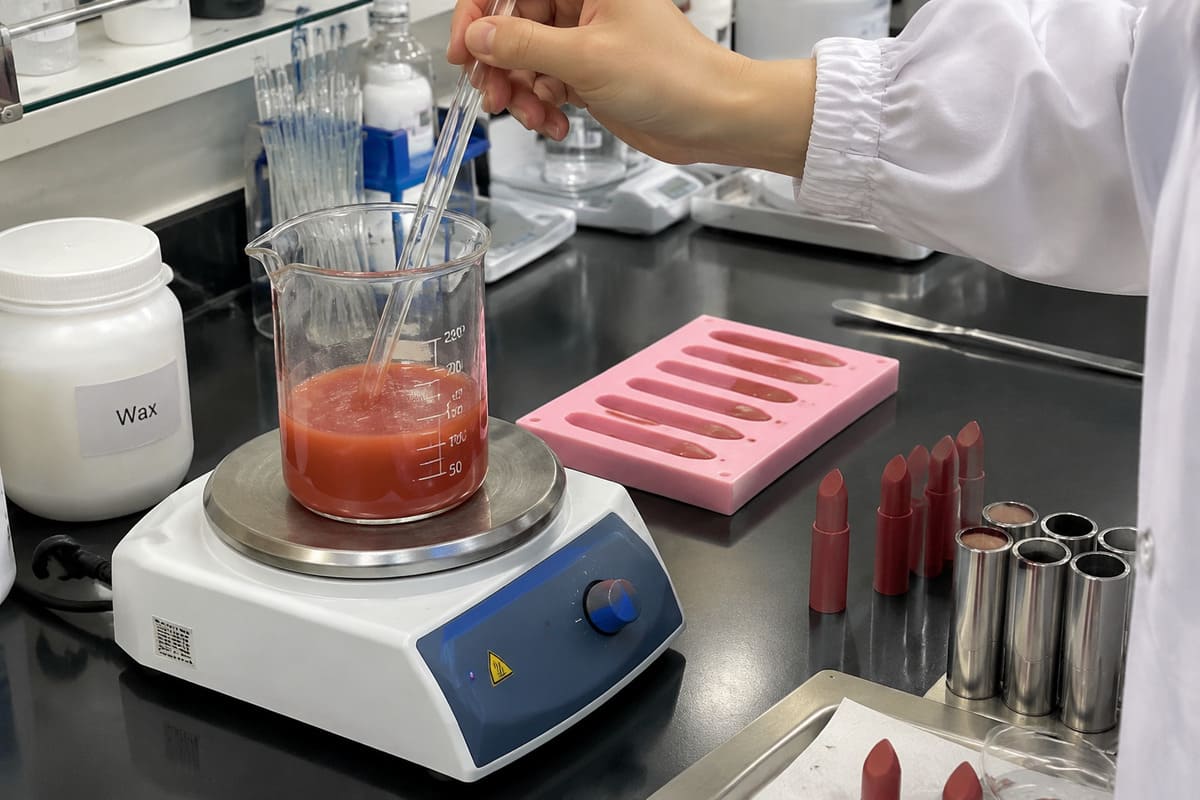
I have watched too many founders learn this the hard way. Below, I will show you the exact traps, the three physics tests that expose a filler factory, and the scripts you can copy-paste to vet any supplier. Keep scrolling. The details decide whether your launch survives.
Why Is a Low-MOQ Lipstick OEM Often a Physical Trap?
You want to test the market without burning cash. A low-MOQ lipstick OEM feels safe. But cheap and custom rarely live together, and the gap between them is where brands get hurt.
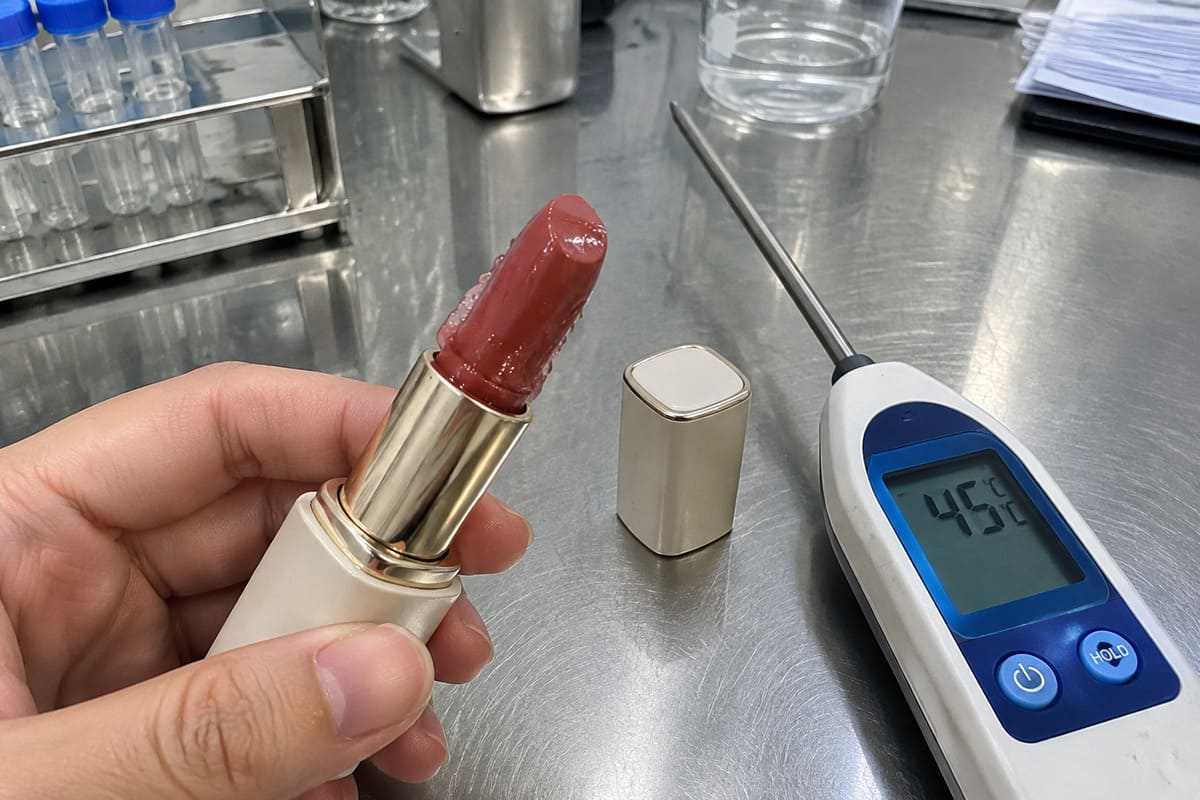
A low-MOQ lipstick OEM is often a trap because true bespoke lipstick requires Non-Recurring Engineering (NRE)1: thermal stress tests, packaging compatibility checks, and formula tuning. A factory promising 100 custom units with no NRE is using a generic wax base and skipping the mechanical testing. The failure surfaces later, at the consumer's hands, and your brand takes the blame.
Let me paint the scene I see all the time. A founder flies in with beautiful custom packaging. She sits down at a low-MOQ factory, proud of her tube. The sales rep smiles and says: "Here is our color chart. Pick 5 shades. We fill 500 units in two weeks."
Nobody asks about her market. Nobody asks about her tube material. That silence is the red flag.
Now compare that to the first conversation I would have. I would ask:
- "What is your target market? If it is the Middle East, we need 45°C stability testing.2"
- "What material is your outer tube? Aluminum expands differently than plastic."
- "Have you locked the wax-to-oil ratio to that tube? If not, the bullet will scratch the wall or snap off the base."
The Hidden Cost of "Just Pick a Color"
The stock-catalog model works by hiding risk inside a single generic wax base. That base was never tuned for your tube or your climate. So the factory saves on R&D, and you inherit the failure rate.
| What You Think You Buy | What You Actually Get |
|---|---|
| A custom lipstick for your brand | A stock bullet in your tube |
| A tested, stable formula | An untested generic wax base |
| A partner managing risk | A filler shifting risk to you |
| Low cost, low risk | Low cost, hidden high risk |
The economics are simple. Real custom development carries a high failure rate before the formula passes. Someone pays for that. In the low-MOQ model, you pay for it in returns, melted shipments, and one-star reviews.
What Three Physics Tests Expose a "Filler Factory"?
Capabilities sound abstract until you force them into a test. Any factory can say "high quality." Few can survive a direct, technical question with a data-backed answer.
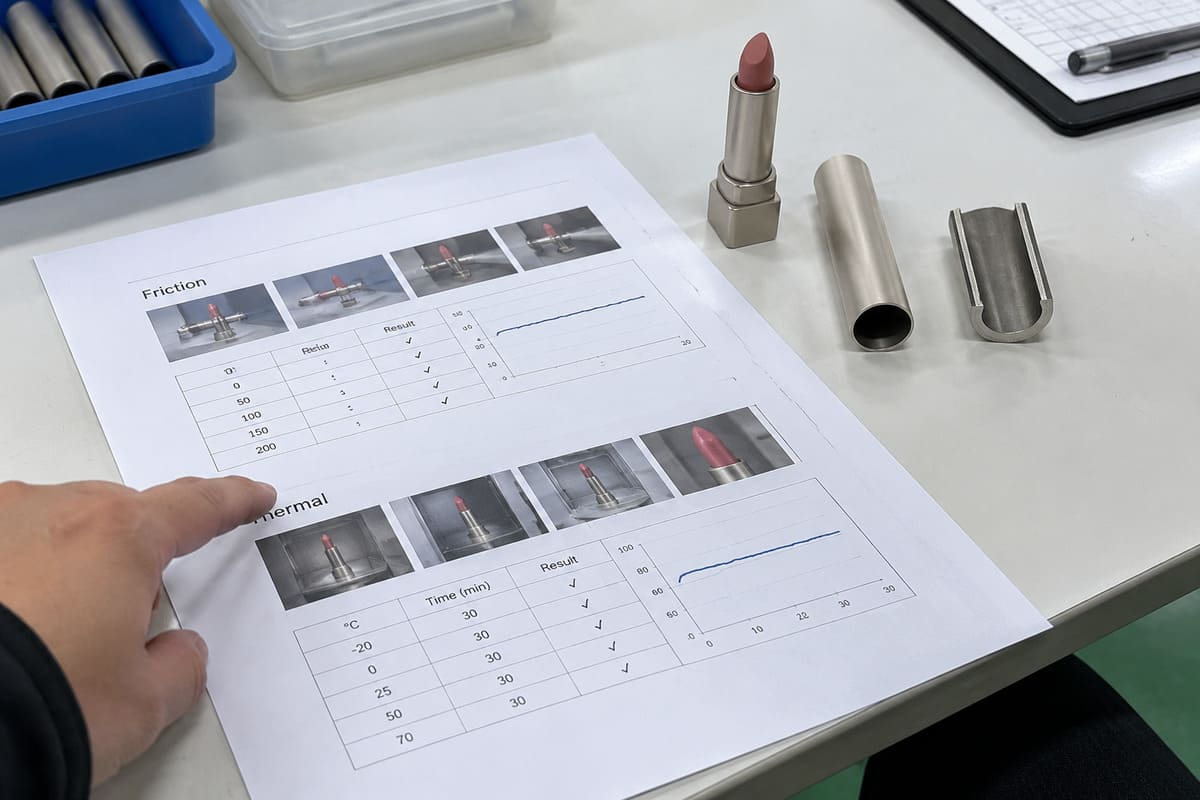
Three physics tests expose a filler factory instantly: a packaging friction test (does the bullet stick to your tube material?), a thermal stability test (45°C for 24 hours, with a batch COA), and a cross-category color sync test (does a centralized ΔE system match your lipstick to your powder?). A trading company cannot answer these. An engineering factory can.
I turned these into three interrogation emails. Copy them. Send them. Watch who goes quiet.
Test 1: Packaging Friction
"Can you provide a friction test report proving that the bullet won't stick to my specific tube material?"
This question matters because aluminum and plastic behave differently. Aluminum conducts heat and expands at a different rate than plastic.3 If the wax-to-oil ratio is not tuned to the tube, the bullet drags, scratches, or fuses to the wall on the first upstroke.
Test 2: Thermal Stability
"Do you run a 45°C / 24-hour stability test for transit in hot climates, and will you provide the batch COA?"
Oil syneresis is the technical name for a lipstick "sweating."4 When the wax matrix cannot hold the oil, droplets bead on the surface.5 In a container crossing the Gulf in summer, internal temperatures climb fast. A batch-level Certificate of Analysis proves the formula held.6
Test 3: Cross-Category Color Sync
"If I also make my eyeshadows here, how does your color lab ensure my lipstick pigment matches my powder pigment? Do you use a centralized ΔE control system?"
ΔE (Delta-E) measures the visible difference between two colors.7 A ΔE under 1.0 is nearly invisible to the human eye.8 Without centralized ΔE control, your "nude" lipstick and your "nude" blush will clash on the shelf.
Here is how I grade the answers:
| Test | Filler Factory Answer | Engineering Factory Answer |
|---|---|---|
| Friction | "It's fine, don't worry." | Friction report tied to your exact tube spec |
| Thermal | "Our products are stable." | 45°C / 24h data + batch COA |
| Color Sync | "We match the chart." | Centralized ΔE ≤ 1.0 across categories |
If a supplier dodges even one, you have your answer. A real lipstick OEM treats these as routine. A filler treats them as threats.
How Do You Ensure Lipstick Color Synergy Across a Full Makeup Line?
You are not launching one product. You are launching a look. The terror here is color disconnection. Your lipstick comes from one factory, your eyeshadow palette from another, and the shades never agree.
You ensure color synergy by locking all pigments under one centralized ΔE control system inside a single lab. When lipstick wax and pressed powder draw from the same pigment library and the same color standard, the shades align into a cohesive makeup line. Sourcing categories from separate factories almost guarantees visible mismatch, because each lab calibrates to its own reference.
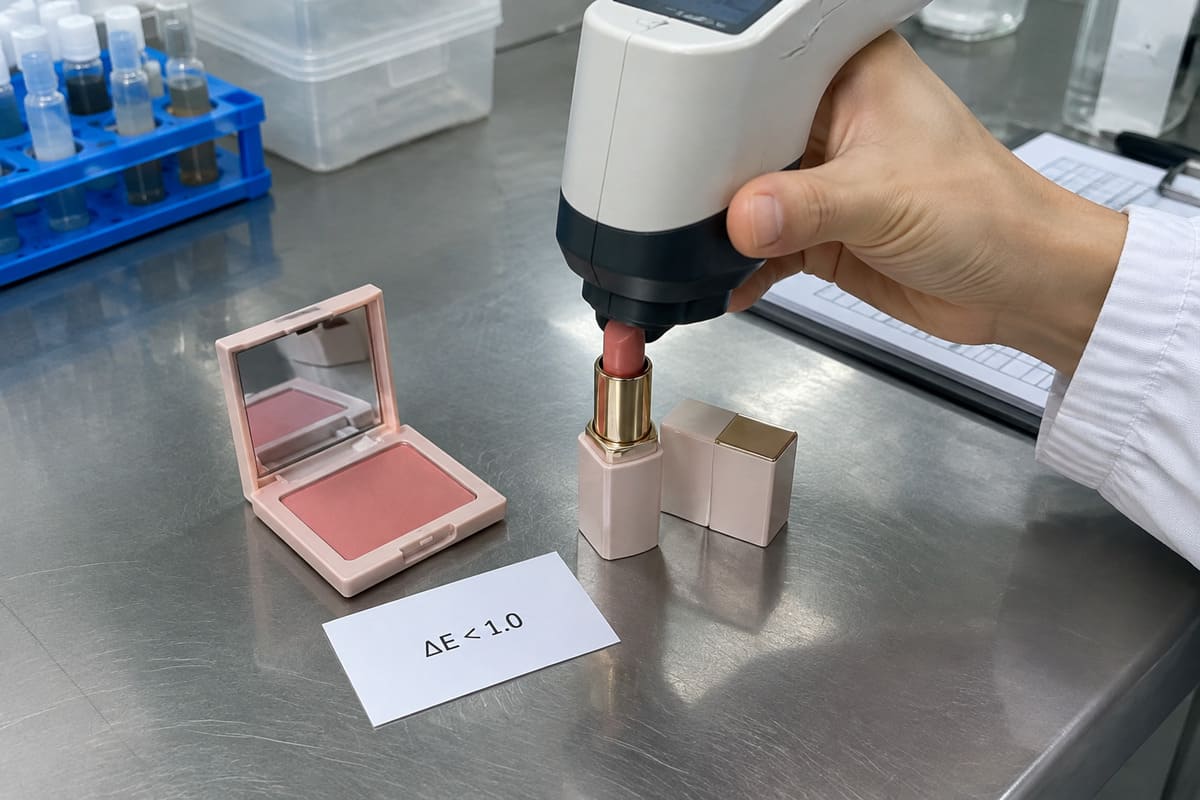
Here is the physics that most buyers miss. Pigment behaves differently in a wax base than in a pressed powder.9 The same red oxide looks warmer in oil and flatter in powder. A lab that controls both can compensate. A lab that controls only one is guessing.
Why Two Factories Cannot Align
Each factory calibrates its color instruments to its own master standard.10 Two different masters produce two different "nudes." No amount of good intent fixes a reference-point mismatch.
- Different pigment suppliers mean different undertones.
- Different base chemistry shifts how pigment reflects light.
- Different ΔE tolerances stack error on error.
At Vertina, we build eyeshadow, blush, pressed powder, and highlighter in-house. That is not a sales line. It is why I can promise a lipstick that sits in the same color family as the powder beside it.
| Sourcing Model | Pigment Library | Color Standard | Shelf Result |
|---|---|---|---|
| Two separate factories | Two libraries | Two masters | Visible clash |
| One engineering factory | One shared library | One ΔE master | Cohesive line |
I once had a founder show me her lipstick from "Factory A" next to her blush from "Factory B." Under store lighting, one leaned pink and one leaned coral. She thought she was losing her mind. She was not. She was looking at two color standards fighting each other.
The Deeper Dive on ΔE Discipline
A disciplined lab logs every batch against the master. If batch variance drifts past the ΔE threshold, the batch is rejected, not shipped. This is slow. This is expensive. This is also the only way a full line stays consistent across production runs, so your reorder in six months still matches the launch stock on a customer's vanity.
What We Engineer—and Why We Refuse to Do "Mix-and-Match" Formulas
I would rather lose a quick sale than ship a bullet that fails in a hot warehouse. So I will be blunt about where we fit and where we do not.
We engineer tested, climate-specific, color-locked lipstick as part of a cohesive makeup line. We refuse mix-and-match stock formulas because they skip the mechanical and thermal testing that keeps a bullet intact. If you want a generic bullet in 500 units, a trading company serves you better. If you want a physically stable, color-synchronized line, we are ready for the engineering work.

Let me be honest, the way I would be in a real call. A premium, unique lipstick that survives the supply chain and matches your eyeshadow palette cannot be done for 500 units. The real development threshold for a customized, tested lipstick is higher, and we evaluate it per project. That is not a sales tactic. It reflects the NRE, the stress tests, and the compatibility work the formula demands.
Our Project Evaluation, Not a Catalog
We do not say "pick a color." I ask for three things before I quote:
- Your target climate — this sets the thermal stability target (for example, 45°C testing for the Gulf).
- Your packaging material — aluminum versus plastic changes the wax-to-oil ratio.
- Your full color matrix — so the lipstick locks to your powder line under one ΔE standard.
I am honest about the trade. If your priority is simply testing the market with a stock bullet, we are not the right fit. The traders are. But if you want to build a cohesive, physically stable color line, we are ready for the engineering challenge.
This boundary protects you as much as me. A factory that says yes to everything is a factory that has never said no to a bad formula.
| If You Need... | Right Partner | Why |
|---|---|---|
| 500 stock units, fast | Trading company | Low cost, no engineering |
| Tested, custom, color-locked line | Engineering lipstick OEM | NRE, stress tests, ΔE control |
Frequently Asked Questions
What certifications do I need to export lipstick to Saudi Arabia?
For Saudi Arabia, lipstick typically requires SFDA (Saudi Food and Drug Authority) cosmetic notification and a SASO/SABER conformity certificate11 for import clearance. Treat every certificate as a document you should verify independently, and consult a qualified regulatory professional for your specific product and market before shipping.
What is a safe wax-to-oil ratio for a hot-climate lipstick?
There is no single safe ratio. It depends on your target temperature, pigment load, and tube material. A hot-climate formula leans toward higher structural wax content to resist sweating12, then tunes oil for glide. The only real proof is a 45°C stability test with a batch COA, not a number on paper.
Why do some factories quote 500 custom units and others require a project evaluation?
A 500-unit quote usually means a stock wax base with a color swap, so there is no engineering cost to recover. A project evaluation means real Non-Recurring Engineering: thermal testing, friction testing, and color locking. The higher threshold reflects the testing that keeps the bullet stable in transit and on the shelf.
How do I know if my lipstick will match my eyeshadow palette?
Ask whether both products come from one lab under one centralized ΔE control system. If your lipstick and powder draw from the same pigment library and the same color master, they align. If they come from two factories with two standards, expect a visible clash under store lighting.
Can a low-MOQ lipstick OEM still produce good quality?
Yes, for stock formulas in standard packaging and mild climates. The risk appears with custom tubes, hot markets, and full color lines, where skipping thermal and friction testing turns a low MOQ into a hidden liability. Match the sourcing model to the risk level of your launch.
Conclusion
A lipstick OEM lives or dies on physics, not price. The flood of low-MOQ offers hides a real danger: untested wax bases that sweat, snap, or scratch once they leave the factory. Use the three tests. Demand a friction report, a 45°C stability COA, and centralized ΔE color control. If you want a generic bullet, the traders can help. If you want a tested, color-locked line that survives the supply chain, send us your target climate, tube material, and full color matrix, and let us run the engineering evaluation.
"Non-recurring engineering", https://en.wikipedia.org/wiki/Non-recurring_engineering. Reference sources define non-recurring engineering (NRE) as the one-time cost incurred to research, design, develop, and test a new product before volume production. Evidence role: definition; source type: encyclopedia. Supports: Non-recurring engineering refers to the one-time cost of researching, designing, and testing a new product, separate from recurring per-unit manufacturing cost.. Scope note: General definitions of NRE do not establish the specific engineering steps the article attributes to lipstick formulation. ↩
"Devices and Methods for Maintenance of Temperature ... - PMC", https://pmc.ncbi.nlm.nih.gov/articles/PMC2799926/. Cosmetic stability-testing guidance recommends accelerated storage at elevated temperatures, and meteorological records for the Gulf region document summer temperatures that justify testing near 45°C. Evidence role: statistic; source type: institution. Supports: Cosmetic stability protocols use elevated-temperature storage, and ambient and in-transit temperatures in the Gulf region reach ranges consistent with a 45°C test.. Scope note: Standard accelerated-testing temperatures are often cited around 40–45°C; the precise value and duration are not universally fixed and depend on the testing protocol adopted. ↩
"Thermal Conductivity of Aluminum Alloys—A Review - PMC", https://pmc.ncbi.nlm.nih.gov/articles/PMC10144406/. Standard materials-property references report aluminum's thermal conductivity and linear expansion coefficient alongside those of common plastics, confirming a substantial difference between the two classes of material. Evidence role: mechanism; source type: education. Supports: Aluminum has markedly higher thermal conductivity and a different coefficient of thermal expansion than common polymers.. Scope note: Generic property tables do not quantify how these differences translate into bullet-to-tube friction in a specific lipstick package. ↩
"Observation of the sweating in lipstick by scanning electron ...", https://hero.epa.gov/reference/1612841/. The term syneresis denotes the release of liquid from a contracting gel or structured matrix, a phenomenon documented in colloid and food science literature and applied by analogy to oil separation in wax-based cosmetics. Evidence role: definition; source type: paper. Supports: Syneresis is the expulsion of liquid from a gel or structured matrix, applicable to oil separating from a wax network.. Scope note: General syneresis literature describes gels broadly; direct studies naming lipstick oil bleed as syneresis are less common, so the support is partly by analogy. ↩
"Formulation and evaluation of alternative to beeswax ... - PMC", https://pmc.ncbi.nlm.nih.gov/articles/PMC12319492/. Studies of wax-structured lipid systems describe how the crystalline wax network immobilizes liquid oil and how thermal or compositional changes can release oil to the surface. Evidence role: mechanism; source type: paper. Supports: The wax crystal network in anhydrous cosmetic sticks structures and retains liquid oils, and weakening of that network allows oil migration and surface exudation.. Scope note: Much of the relevant research concerns oleogels and food lipids rather than lipstick specifically, so application is by analogy to similar wax-oil systems. ↩
"OEM Makeup Manufacturer: 5 Questions to Verify Real ...", https://vertinabeauty.com/oem-makeup-manufacturer-5-questions-to-verify-real-customization/. Regulatory and quality-standard references define a Certificate of Analysis as a document recording test results for a specific lot or batch relative to established specifications. Evidence role: definition; source type: government. Supports: A Certificate of Analysis is a document reporting the results of tests performed on a specific batch against defined specifications.. Scope note: A COA attests to the tests actually performed; it does not inherently prove thermal stability unless the relevant stability test is among those reported. ↩
"The CIEDE2000 color-difference formula: Implementation ...", https://hajim.rochester.edu/ece/sites/gsharma/papers/CIEDE2000CRNAFeb05.pdf. The International Commission on Illumination (CIE) defines ΔE as a metric of the difference between two colors computed within a color space such as CIELAB. Evidence role: definition; source type: institution. Supports: ΔE is a numerical measure of the distance between two colors in a perceptually organized color space as defined by the CIE.. Scope note: Multiple ΔE formulas exist; the generic definition does not specify which the article's suppliers use. ↩
"Color difference", https://en.wikipedia.org/wiki/Color_difference. Colorimetry references associate a ΔE of roughly 1 with the just-noticeable-difference threshold for human observers under standardized conditions. Evidence role: statistic; source type: research. Supports: Color differences near ΔE of 1 approximate the threshold of human perceptibility under controlled viewing conditions.. Scope note: Perceptibility thresholds vary by color-difference formula (ΔE76 vs CIEDE2000), lighting, and observer, so a single value of 1.0 is an approximation rather than a fixed boundary. ↩
"What is the refractive index value of common binders?", https://www.facebook.com/groups/eggtempera/posts/30029148433399910/. Color-science literature on pigment optics explains that the contrast between a pigment's refractive index and that of its surrounding medium affects scattering and perceived color, accounting for differences between oil-based and powder presentations. Evidence role: mechanism; source type: research. Supports: The perceived color of a pigment depends on the refractive index and optical properties of the surrounding medium, so the same pigment appears different in oil versus air-containing powder.. Scope note: General pigment-optics findings do not quantify the specific shift between a lipstick wax base and a pressed powder. ↩
"NIST Measurement Services Photometric Calibrations", https://nvlpubs.nist.gov/nistpubs/SpecialPublications/NIST.SP.250-95.pdf. Metrology and color-management guidance holds that consistent color evaluation depends on calibration to shared standards, so facilities working to separate references can produce measurably different results for the same target. Evidence role: mechanism; source type: institution. Supports: Reliable color matching across sites requires measurement against a common reference and calibrated instruments, and divergent references or calibration reduce inter-site agreement.. Scope note: Standards guidance establishes the principle but does not quantify the specific mismatch between two unnamed cosmetic factories described in the article. ↩
"Saudi Arabia Testing, Inspection and Certification", https://www.trade.gov/saudi-arabia-testing-inspection-and-certification. Official Saudi Food and Drug Authority and SASO/SABER guidance sets out cosmetic notification and conformity-certificate requirements for products entering the Saudi market. Evidence role: case_reference; source type: government. Supports: Saudi regulators require cosmetic product notification through the SFDA and conformity documentation via the SABER/SASO platform for import clearance.. Scope note: Regulatory requirements change over time and by product category, so current official guidance should be checked for the exact product. ↩
"Hardness, plasticity, and oil binding capacity of binary ... - PMC", https://pmc.ncbi.nlm.nih.gov/articles/PMC9213233/. Formulation studies of wax-structured sticks report that increasing structuring wax raises melting temperature and oil-holding capacity, which correlates with reduced oil release under heat. Evidence role: mechanism; source type: paper. Supports: Higher structuring-wax content raises the melting profile and oil-binding capacity of anhydrous sticks, improving resistance to heat-induced exudation.. Scope note: The relationship is not linear and depends on wax type, oil polarity, and pigment load, so higher wax alone does not guarantee stability. ↩