Choosing an OEM makeup manufacturer feels simple until the first sample arrives and it looks exactly like something already in the factory's catalog. You paid a custom price. You received a stock product with your logo pressed on top. By then the mold is cut, the deposit is gone, and your brand's whole reason for existing—being different—has quietly disappeared.
A real OEM makeup manufacturer develops to your specification: formula, texture, press, and packaging. A white-label supplier only relabels a catalog product.1 You tell them apart by asking five structural questions—about formula change, sample iteration, formula ownership, MOQ logic, and batch-level COA. Real OEM can answer all five because development is built into how it produces. White label cannot.
I wrote this because the search results never answer the question you are actually asking. You already know what OEM means. What you want is a way to test a factory before you wire money. The five questions below do exactly that—but they only make sense once you see the real sequence of an OEM project.
What Does an OEM Makeup Manufacturer Project Actually Look Like?
You ask a supplier "can you do OEM?" and they say "yes, 100 units, send your logo." It sounds easy. That ease is the warning. A genuine OEM makeup manufacturer project has a middle—development work that cannot be skipped—and when the middle is missing, you are not buying OEM at all.
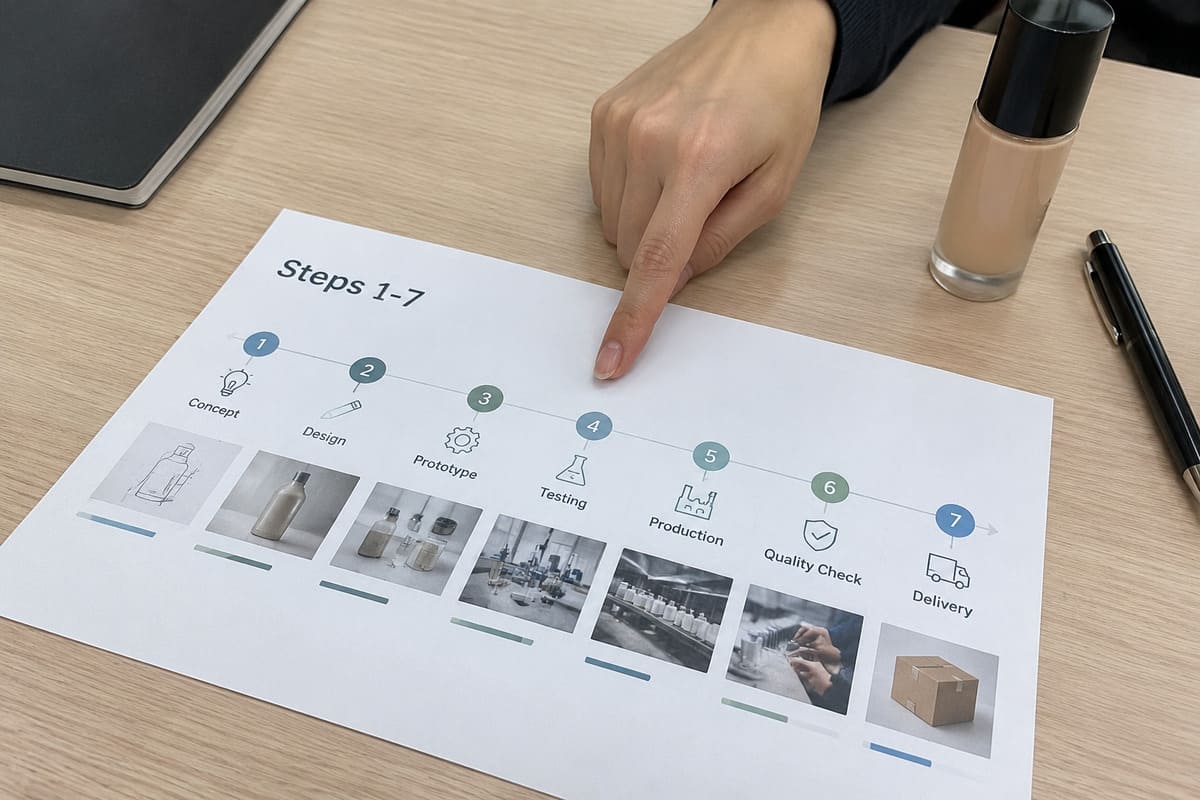
A true OEM project follows a fixed sequence: brief and concept, formula and packaging direction, prototype sampling, specification lock, quotation, mass production, then QC and release.2 The quotation comes after the formula and press are developed, not before. White label shortcuts the middle because there is nothing to develop—the product already exists.
Here is the honest reason the sequence matters. Each of the five verification questions lives at a specific step. If a factory collapses the sequence into "pick from catalog, add logo, ship," then there is no step where your formula could possibly be created. The structure itself tells you whether real customization is on the table.
The seven steps, and what each one protects
| Step | What Happens | Why It Matters to You |
|---|---|---|
| 1. Brief & concept | You share market, finish, trend direction | Defines what "different" means for your brand |
| 2. Formula & packaging direction | Factory proposes base formula and component options | First signal of real development capacity |
| 3. Prototype sampling | Physical samples made and revised | Where iteration happens—or does not |
| 4. Specification lock | Shade, texture, press, component fixed in writing | Prevents silent substitution later |
| 5. Quotation | Price set against the locked spec | A price before this step is a catalog price |
| 6. Mass production | Batch produced to the locked spec | Consistency depends on step 4 |
| 7. QC & release | Testing, COA, inspection before shipment | Your proof the batch matches the spec |
Notice where quotation sits. It is step five, not step one. When a supplier quotes instantly, they are quoting a product that already exists. That is fine if you want stock goods. It is not OEM. I tell founders to map every supplier against this sequence first, because the five questions that follow are simply tests applied at steps two, three, four, five, and seven.
Can the Factory Actually Change the Formula—or Only the Shade Name?
Your brand concept depends on a texture or a finish no one else has. You hand it to a supplier. Weeks later you get a familiar powder with a new name on the pan. The finish you described never materialized. The differentiation you were paying for was never technically possible.
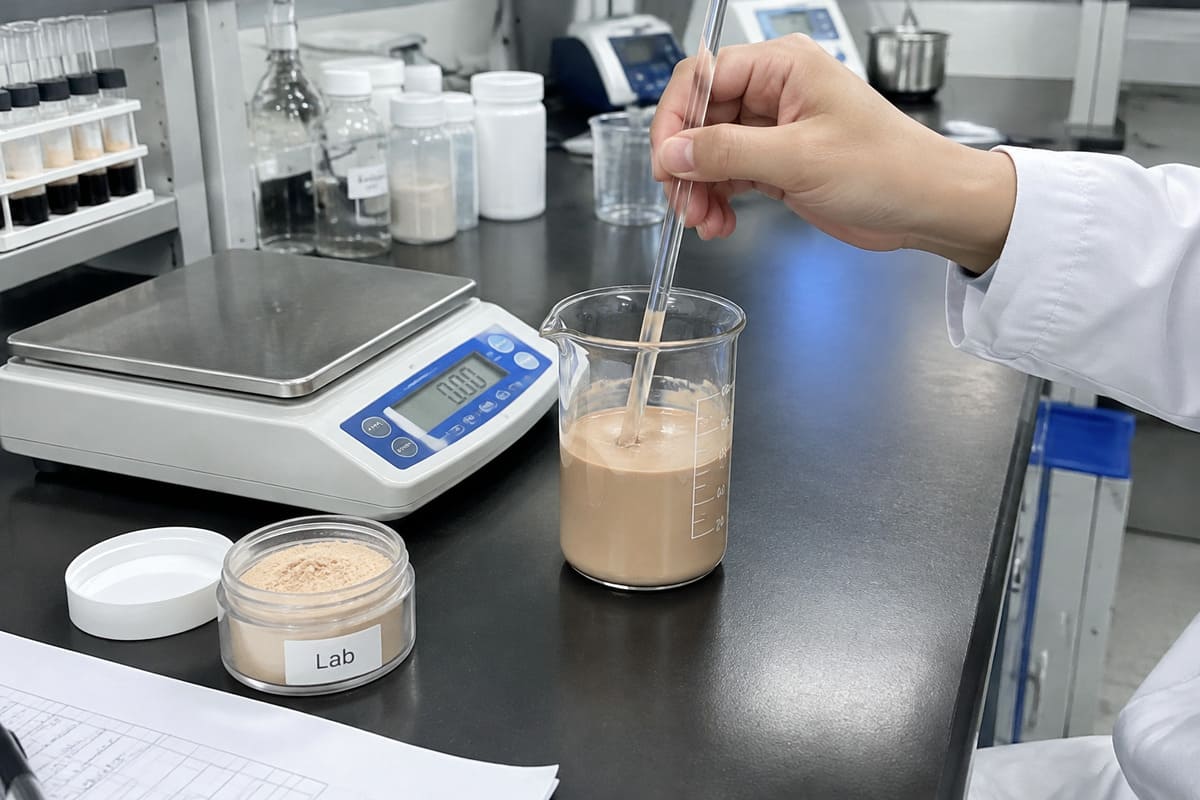
A real OEM makeup manufacturer can adjust the base formula—binder ratio, pearl load, pressing density, slip, payoff—to hit your described finish.3 A white-label supplier can only rename an existing shade. The test is specific: ask them to change the texture, not the color. Formula change lives at step two of the project sequence.
This question matters most for the products we actually make—eyeshadow, especially effect finishes like chameleon and sparkle shades4, plus pressed blush, highlighter, and setting powder. Those finishes are not color choices. They are formula choices.
White label vs. real OEM: how each answers
| Your Request | White-Label Answer | Real OEM Answer |
|---|---|---|
| "Make it creamier, less fallout" | "We have a similar one" | "We adjust binder and press; expect 2–3 sample rounds" |
| "I want a stronger color-shift" | "This shade is popular" | "We tune the pearl system and base tone to shift direction" |
| "Change the pan size and press depth" | "Our molds are standard" | "We quote tooling for your private mold" |
The difference is not that one factory is honest and the other lies. The difference is structural. A white-label operation is built around catalog selection, so "change the formula" has no process to attach to. A real OEM operation is built around formula development, so the same request routes straight to the lab. When I answer a founder, I ask what finish they are chasing before I talk price—because the finish decides whether the project is even an OEM project.
Does Sampling Involve Iteration—or One Round and a Price?
You approve a brief, you pay a sample fee, and you get one sample back with an invoice attached. Something is slightly off—the shimmer is coarse, the payoff is weak—but there is no round two offered. You are being pushed to accept a near-match because the factory never planned to revise anything.
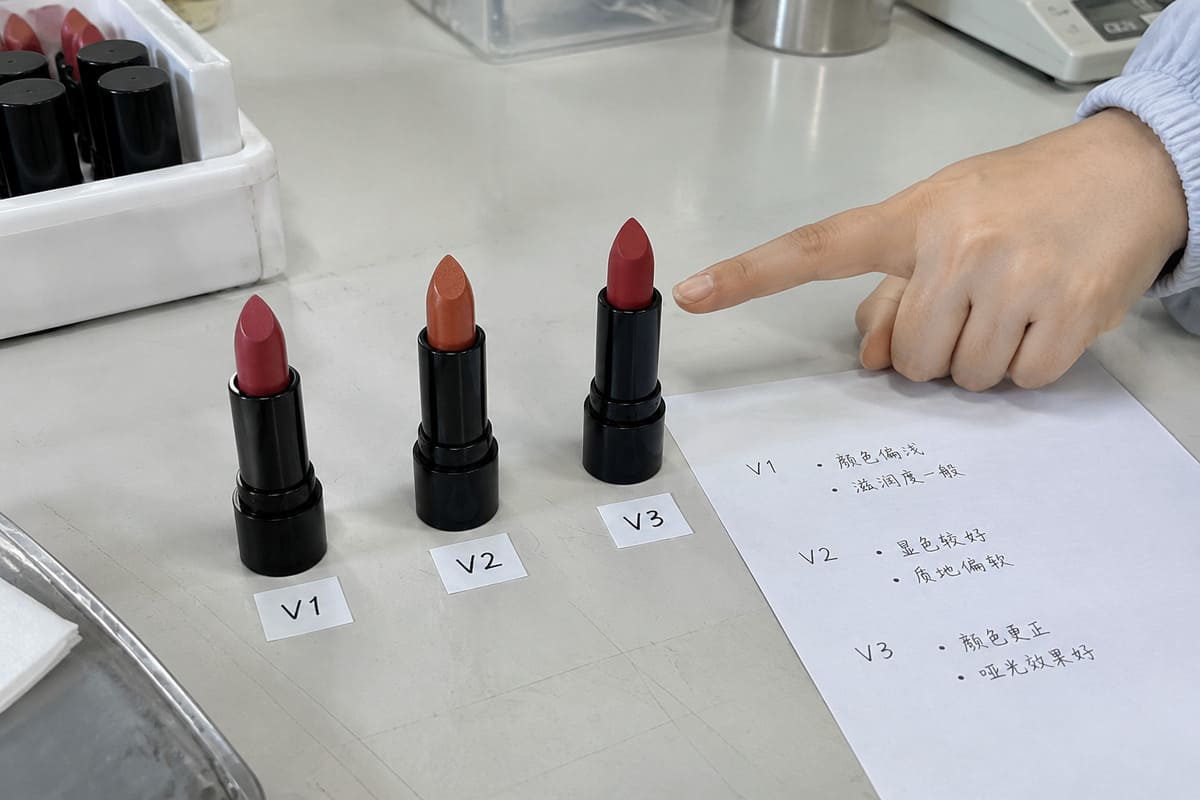
Real OEM sampling is iterative: the factory expects multiple rounds, adjusts the formula against your feedback, and treats "close but not right" as a normal step. White label offers one sample—because it is pulling from stock, and there is nothing to revise. Iteration lives at step three, before the specification is locked.
I treat the number of expected sample rounds as one of the cleanest signals in the whole evaluation. A factory that develops formulas knows the first sample is rarely the last. A factory that relabels stock has no reason to offer a second round, because the second round would still be the same stock product.
What a healthy sampling conversation sounds like
- You say: "The color shift is too subtle and there's fallout."
- Real OEM says: "We'll re-balance the pearl load and tighten the press. Next sample in about two to three weeks."
- White label says: "This is our best-selling version. Shall I quote it?"
A few practical markers I look for during sampling:
- The factory asks clarifying questions about your end market and application, not just your logo file.
- They give a realistic timeline per round rather than promising a finished sample overnight.
- They document each revision so round three builds on round two.
- They are comfortable saying "that finish needs another pass" instead of pressing you to approve.
When a supplier rushes you from one sample straight to a quotation, they are skipping step three and four. The quote that follows is therefore a catalog quote. Iteration is the proof that development is really happening.
Who Owns the Formula?
You invest in sample rounds, you refine a finish you love, you build your launch around it. Then you discover the same formula on a competitor's shelf under a different name. You did not own what you developed. The factory treated your "custom" formula as another catalog entry it can resell.
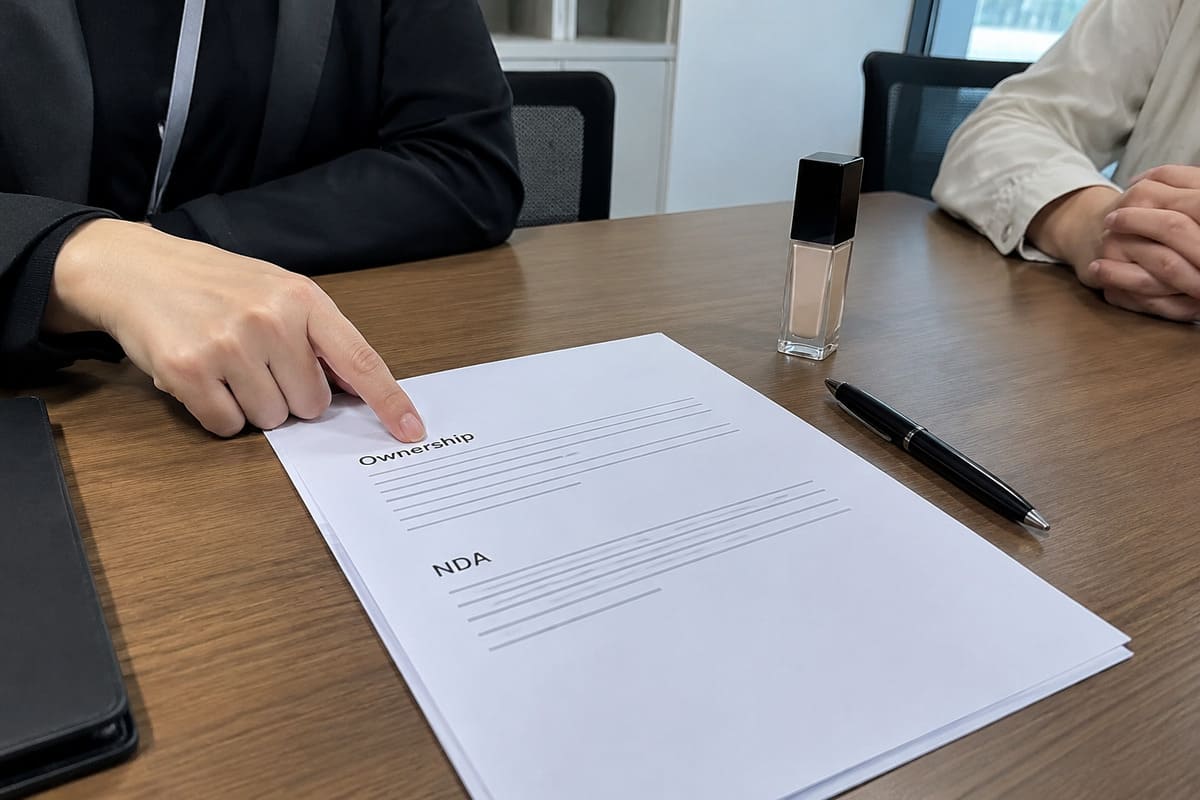
In a real OEM arrangement, the ownership and exclusivity of a developed formula should be agreed in writing before mass production5. A private, exclusive formula can be contracted as yours; a shared base formula may be reused by the factory. You must clarify which you have. This should be settled at the specification-lock step.
Ownership is where a lot of founders assume instead of asking. "Custom" does not automatically mean "exclusive." These are two separate things, and a serious OEM makeup manufacturer will explain the distinction rather than blur it.
Three ownership models you should be able to name
| Model | What You Get | Typically Suits |
|---|---|---|
| Shared base formula | A proven base, possibly reused by the factory | Faster launch, lower cost, non-exclusive lines |
| Customized formula | Adjustments on a base, exclusivity by agreement | Most brand founders wanting differentiation |
| Fully private formula | Developed and contracted exclusively to you | Brands whose core identity is one signature product |
Here is the honest part I always state plainly. Many real projects start on a shared or adjusted base, and that is a legitimate, cost-effective choice. The problem is not using a base. The problem is being told it is "yours and only yours" when the contract never says so. Ask directly: is this formula exclusive to me, and will that exclusivity be written into the agreement? A factory built on development can answer with a document. A white-label supplier usually cannot, because the formula was never yours to begin with.
Does the MOQ Reflect Development Cost—or Catalog Stock?
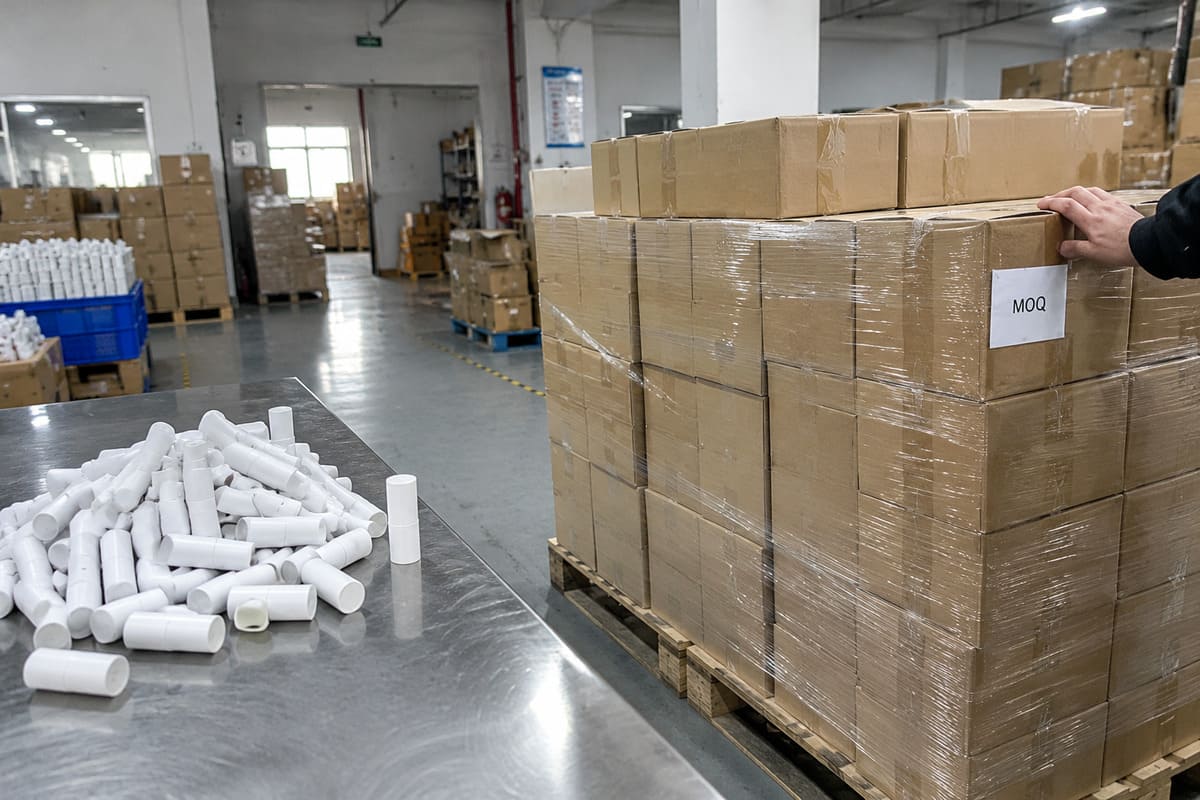
A supplier offers "100 units, fully customized." It sounds generous. It is actually a tell. Real development—formula work, sampling, a dedicated batch run—cannot be amortized across 100 units.6 If the MOQ is tiny and the price is low, you are almost certainly buying catalog stock with a logo, not OEM.
MOQ is a signal of what the factory is actually doing. Industry OEM ranges commonly sit around 1,000–3,000 units per SKU because development work is involved.7 Very low MOQs usually mean catalog selection, not customization. The MOQ question belongs at the quotation step, where price finally meets the locked specification.
I do not read MOQ as a barrier. I read it as a diagnosis. The number tells you which process the factory is running before anyone shows you a certificate or a photo of the plant.
What different MOQ levels usually mean
| MOQ per SKU | What It Usually Signals |
|---|---|
| A few dozen–100 units | White label: stock product, logo added |
| ~1,000–3,000 units | Standard OEM: base adjustment + dedicated batch |
| 5,000–10,000+ units | Full custom development: private formula and mold |
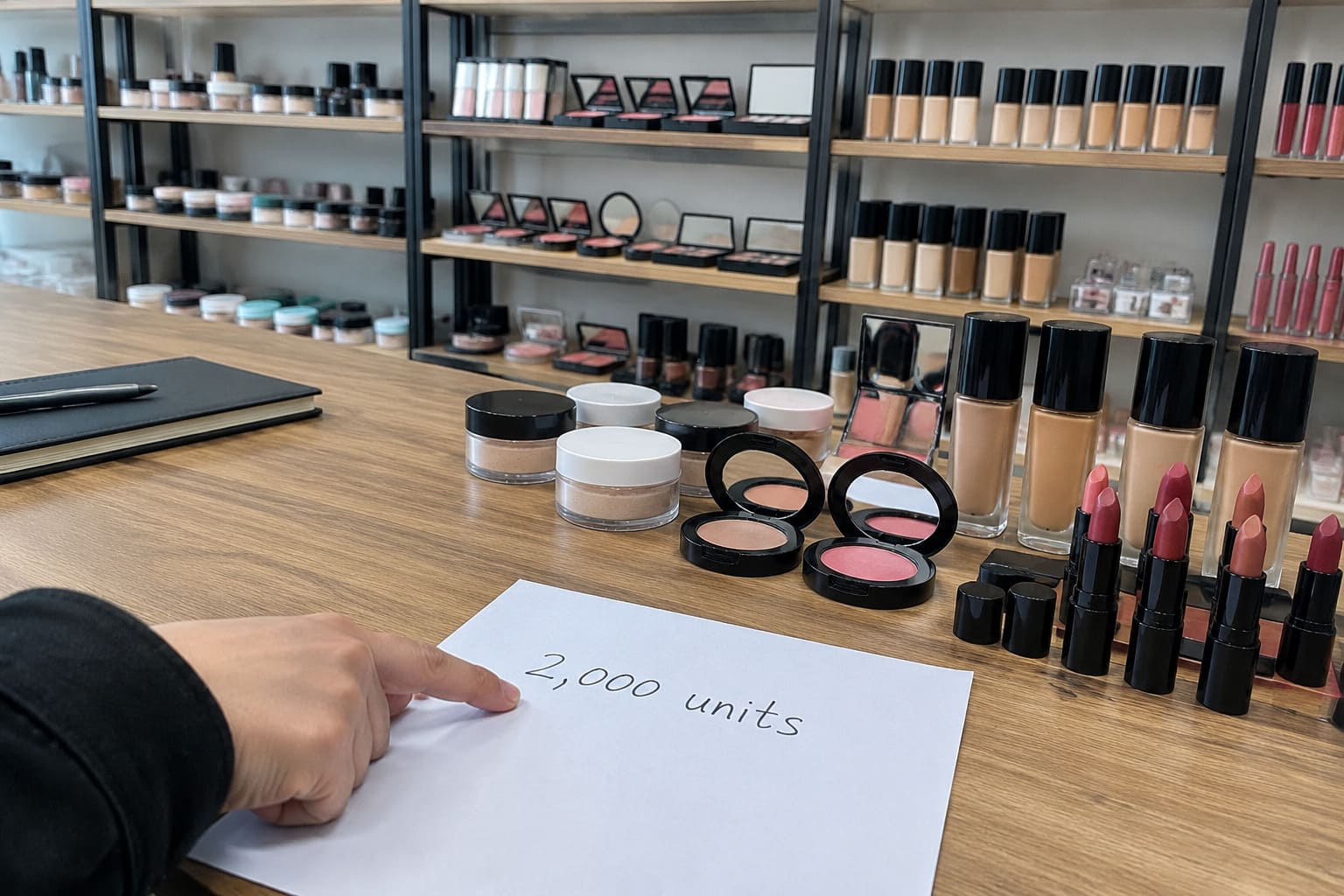
At Vertina, I give founders our real numbers so the signal is readable. Our standard powder validation starts at 2,000 units. That is not an arbitrary gate. It is the quantity at which formula adjustment, sample iteration, and batch control can actually happen together. Full custom development—private formula, private mold—starts at 5,000–10,000 units, because that work costs more to develop and takes longer to run. When a competing quote shows "fully custom, 100 units," compare it against this logic. The math of development does not bend to fit 100 pieces.
Can the Factory Provide Batch-Level COA for the Customized Formula?
Your product reaches a market with real scrutiny, a buyer asks for documentation, and your supplier sends a generic certificate that does not match your specific batch. Now you are exposed—at customs, on a retailer's shelf, or in front of a distributor who knows what to check. The paperwork gap becomes your problem.
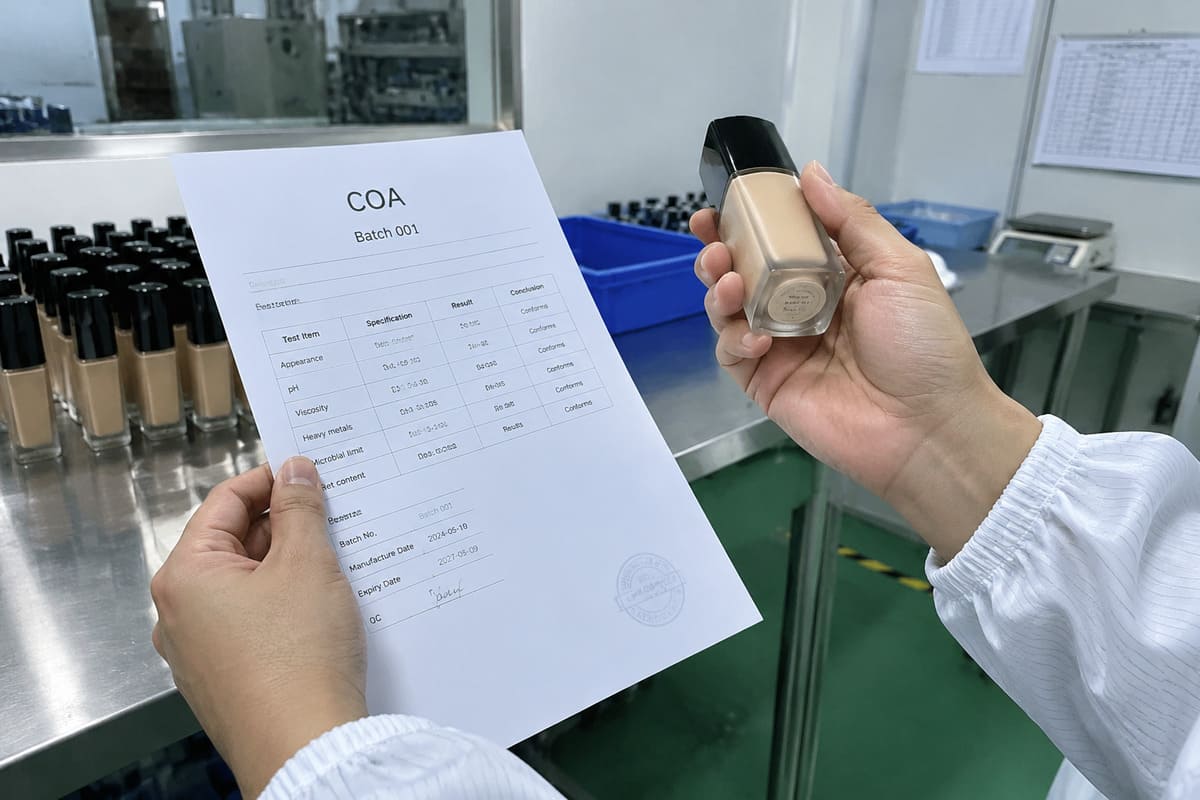
A credible OEM makeup manufacturer can provide a batch-level Certificate of Analysis tied to your customized formula and the specific production run.8 A generic, non-batch document suggests the output was not uniquely produced for you. Batch COA lives at the final QC-and-release step, and you should confirm availability before you order.
Batch control is the quiet backbone of real OEM. A factory that develops and runs a dedicated batch can trace that batch. A factory selecting from stock has no batch that is truly yours to certify.
How buyers should treat documentation
I want to be precise and restrained here, because this is where credibility is won or lost:
- Treat every certificate as a document to verify, not a promise to trust.9 Ask for the issuing body and check it.
- Match the COA to your batch. A COA should reference the production run you are receiving, not a factory-wide sample.
- Separate factory capability from market compliance.10 FDA, MoCRA, CPNP, REACH requirements depend on your destination market.11 A factory can support documentation, but your market's legal requirements are your responsibility to confirm.
- Get qualified professional evaluation for application-specific decisions. Claims about safety or suitability for a specific use should be reviewed by a qualified specialist, not assumed from a brochure.
When a founder asks me about certifications, my first question is always which market the product is selling into, because the right documentation follows the destination. That is not evasion. It is how responsible sourcing actually works.
What Vertina Can Answer—and What We Cannot?
You have read five questions and you still do not know if we are the right factory. Fair. So I will apply the same five questions to ourselves, plainly, including the part most suppliers hide: where we are not a fit.
Vertina is a powder-focused OEM makeup manufacturer specializing in eyeshadow, chameleon and sparkle effects, blush, highlighter, and setting powder12. We adjust formulas, run iterative sampling, agree formula ownership in writing, set MOQ by development reality, and provide batch-level documentation. We do not do white label. If you want a few dozen units of stock with a logo, we are not your factory.
Our straight answers to the five questions
| Question | Vertina's Answer |
|---|---|
| Change the formula? | Yes—binder, pearl load, press, and finish, especially on effect powders |
| Sample iteration? | Yes—multiple rounds expected before specification lock |
| Formula ownership? | Agreed in writing; shared base, customized, or exclusive clearly defined |
| MOQ logic? | 2,000 units standard powder validation; 5,000–10,000 for full custom |
| Batch-level COA? | Yes, tied to your production run; market compliance confirmed per destination |
Here is the boundary I state before anyone wires a deposit. We are a factory of around 100 people built for mid-size, development-driven powder orders. That size lets us move quickly and adjust formulas without the rigidity of a giant plant. It also means we are not the place for 50 units of catalog stock. I would rather lose that order than pretend a relabel is OEM. The founders who do well with us are the ones whose brand lives or dies on a finish being genuinely different.
Frequently Asked Questions
What is the difference between an OEM makeup manufacturer and white label?
An OEM makeup manufacturer develops products to your specification—formula, texture, press, and packaging—and runs a dedicated batch. White label sells an existing catalog product with your logo added. The fastest test is the MOQ and the sample process: real OEM involves development; white label involves selection.
How many sample rounds should a real OEM project include?
Expect multiple rounds. A development-based factory treats the first sample as a starting point and revises against your feedback until the finish is right. One sample followed immediately by a quotation usually signals a catalog product, not a formula being created for you.
What MOQ is normal for custom makeup?
Industry OEM commonly ranges around 1,000–3,000 units per SKU because development work is involved. At Vertina, standard powder validation starts at 2,000 units, and full custom development with a private formula and mold starts at 5,000–10,000 units. Very low MOQs usually indicate stock, not customization.
Do I automatically own the formula I develop?
No. "Custom" and "exclusive" are different. Ownership and exclusivity must be agreed in writing before mass production. Clarify whether you have a shared base, a customized formula, or a fully private exclusive formula, and make sure the agreement reflects it.
Which certifications do I need to sell cosmetics abroad?
It depends on your destination market—FDA and MoCRA for the US, CPNP for the EU, and others regionally. Treat every certificate as a document to verify, and get qualified professional evaluation for your specific market before committing.
Conclusion
Finding a real OEM makeup manufacturer is not about reading a definition—it is about testing structure before you pay. The five questions do that: can the factory change the formula, does sampling iterate, who owns the result, does the MOQ reflect development, and can they certify your batch. Real OEM answers all five because development is how it produces. White label cannot. At Vertina, we answer them plainly, and we state our boundary just as plainly: we build differentiated powder products, not relabeled stock. If your brand depends on a finish being genuinely different, send me your concept and target market, and I will tell you honestly whether we are the right factory.
"Original equipment manufacturer", https://en.wikipedia.org/wiki/Original_equipment_manufacturer. General reference sources define original equipment manufacturing as production built to a purchaser's specifications, distinct from relabeling an existing stock product, which supports the distinction drawn here. Evidence role: definition; source type: encyclopedia. Supports: The general definitions of OEM and white/private-label manufacturing arrangements.. Scope note: General manufacturing definitions may not reflect cosmetics-industry-specific conventions for the terms OEM and white label. ↩
"New product development", https://en.wikipedia.org/wiki/New_product_development. Standard product-development process models describe sequential stages from concept and prototyping through specification lock and production quality control, which is consistent with the workflow described. Evidence role: general_support; source type: institution. Supports: That structured product development typically proceeds through concept, prototyping, specification, and production/quality stages.. Scope note: General product-development models are not specific to cosmetics OEM and may order or name stages differently. ↩
"What Is the Eyeshadow Trend in 2026? (A Sourcing & Formulation ...", https://vertinabeauty.com/what-is-the-eyeshadow-trend-in-2026-a-sourcing-formulation-guide/. Cosmetic formulation literature describes how binder levels, pigment and pearl loading, and compression parameters affect the payoff and feel of pressed powder products, supporting the claim that finish is a formulation variable. Evidence role: mechanism; source type: paper. Supports: That binder content, filler/pearl loading, and compression force influence the texture, payoff, and finish of pressed powder cosmetics.. Scope note: Published formulation parameters are general and may not map precisely to the specific effect finishes the article describes. ↩
"What Is Color Shift Pigment and How Does It Work", https://www.kolortekpigments.com/blog/what-is-color-shift-pigment-and-how-does-it-work. Research on effect pigments explains that color-travel appearances are produced by thin-film optical interference in multilayer pigment structures, supporting the claim that such finishes are formulation-driven rather than shade selection. Evidence role: mechanism; source type: research. Supports: That color-shift and sparkle effects arise from interference and multilayer effect pigments engineered into the formula.. Scope note: Pigment-science sources describe the optical mechanism in general and do not address OEM manufacturing capability specifically. ↩
"Frequently Asked Questions on Trade Secrets", https://www.wipo.int/en/web/trade-secrets/tradesecrets_faqs. Intellectual property guidance notes that rights to confidential formulations and trade secrets in manufacturing relationships depend on the contractual terms agreed between parties, supporting the emphasis on written ownership agreements. Evidence role: general_support; source type: government. Supports: That ownership and exclusivity of formulations developed under manufacturing arrangements are governed by the terms of written agreements.. Scope note: IP guidance is jurisdiction-dependent and does not address cosmetics-specific formula ownership norms. ↩
"Economies of scale", https://en.wikipedia.org/wiki/Economies_of_scale. Economics references on economies of scale explain that fixed setup and development costs are amortized over output, so small production volumes carry a high per-unit cost, supporting the argument against very low MOQs for custom development. Evidence role: mechanism; source type: education. Supports: That fixed development and setup costs are spread across units produced, raising per-unit cost sharply at low volumes.. Scope note: The economic principle is general and does not quantify the specific development costs of cosmetics manufacturing. ↩
"How to Find the Best OEM Makeup Kit Manufacturers with Low ...", https://vertinabeauty.com/2025/03/07/how-to-find-the-best-oem-makeup-kit-manufacturers-with-low-moq/. Industry sources on contract cosmetics manufacturing report minimum order quantities commonly in the low-thousands of units per SKU, which is consistent with the stated 1,000–3,000 range. Evidence role: statistic; source type: institution. Supports: That minimum order quantities for custom cosmetic manufacturing commonly fall in a multi-thousand-unit range per SKU.. Scope note: MOQ figures vary widely by product type and factory and no single authoritative benchmark exists, so the range is indicative rather than definitive. ↩
"Q7A Good Manufacturing Practice Guidance for Active ...", https://www.fda.gov/regulatory-information/search-fda-guidance-documents/q7a-good-manufacturing-practice-guidance-active-pharmaceutical-ingredients. Quality and regulatory guidance defines a Certificate of Analysis as a batch-specific document reporting test results against established specifications, supporting the claim that a credible COA should reference the actual production run. Evidence role: definition; source type: government. Supports: That a Certificate of Analysis documents test results for a specific production batch against defined specifications.. Scope note: COA guidance is often drawn from pharmaceutical or general GMP contexts and may differ in cosmetics-specific application. ↩
"Laboratory Test Verification and Validation Toolkit", https://stacks.cdc.gov/view/cdc/153395. Accreditation and quality-assurance guidance advises confirming certificates with the issuing body, supporting the recommendation to treat documentation as something to verify rather than trust on its face. Evidence role: general_support; source type: institution. Supports: That certificates should be verified with the issuing or accrediting body to confirm authenticity.. Scope note: Verification guidance is general and does not address the specific certificates used in cosmetics sourcing. ↩
"Importing Cosmetics", https://www.fda.gov/industry/importing-fda-regulated-products/importing-cosmetics. Regulatory frameworks assign compliance responsibility for a cosmetic product to a designated responsible person or importer placing it on the market, supporting the distinction between factory documentation capability and the brand's legal compliance obligations. Evidence role: general_support; source type: government. Supports: That legal responsibility for cosmetics market compliance generally rests with the brand owner, importer, or responsible person rather than the contract manufacturer.. Scope note: The allocation of legal responsibility varies by jurisdiction and by the specific contractual and regulatory roles of the parties. ↩
"Modernization of Cosmetics Regulation Act of 2022 (MoCRA)", https://www.fda.gov/cosmetics/cosmetics-laws-regulations/modernization-cosmetics-regulation-act-2022-mocra. Official regulator publications confirm that cosmetics are subject to market-specific frameworks, including FDA oversight under MoCRA in the US, CPNP notification in the EU, and REACH chemical requirements, supporting the claim that compliance obligations depend on destination market. Evidence role: general_support; source type: government. Supports: That cosmetics placed in different markets are subject to distinct regulatory frameworks, including US MoCRA/FDA oversight, EU CPNP notification, and REACH chemical requirements.. Scope note: Regulatory frameworks change over time and the applicability of each regime depends on product type and specific market scope. ↩
"Cosmetic Product Categories and Codes", https://www.fda.gov/cosmetics/registration-listing-cosmetic-product-facilities-and-products/cosmetic-product-categories-and-codes. General cosmetic references classify blush, highlighter, and setting powder among standard powder-based color cosmetic categories, supporting the product scope described. Evidence role: definition; source type: encyclopedia. Supports: That blush, highlighter, and setting powder are recognized categories within powder-based color cosmetics.. Scope note: General category definitions do not speak to any manufacturer's capability to produce these products. ↩