Liquid eyeshadow vs powder is not only a formulation question for a new Southeast Asian beauty brand. It is a budget, MOQ, channel, and market-fit decision. If you are still testing your customer, pricing, and sales channel, choosing the more fashionable format can create unnecessary inventory risk. I usually begin with the format that gives the brand room to learn.
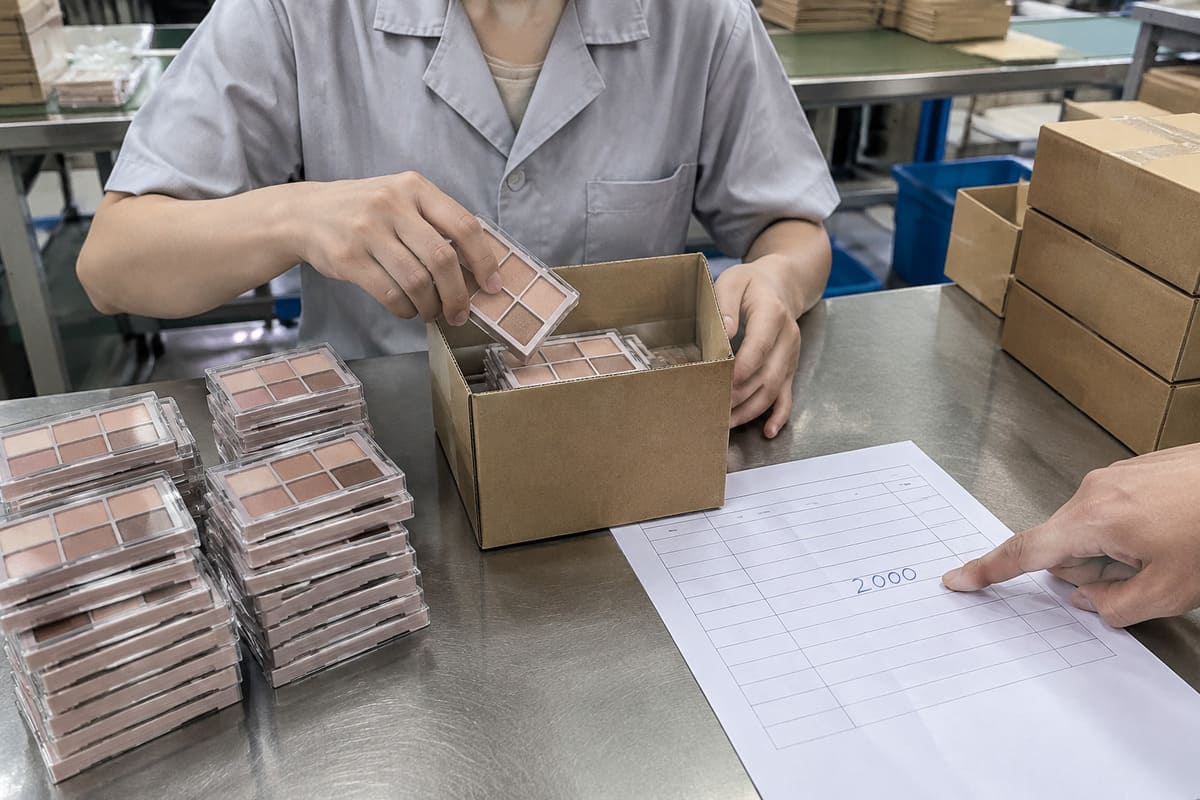
For most first-time Southeast Asian color cosmetics brands, powder eyeshadow is the safer starting format.1 A ready-stock powder palette can often support a finished goods MOQ of about 2,000 units, while liquid eyeshadow custom packaging commonly starts at 10,000 units.2 Powder also suits daily-wear demand, tropical climate requirements, and neutral multi-shade palettes. Liquid eyeshadow is better suited to TikTok-led brands, Gen Z play makeup, and high-impact metallic or chrome products.3
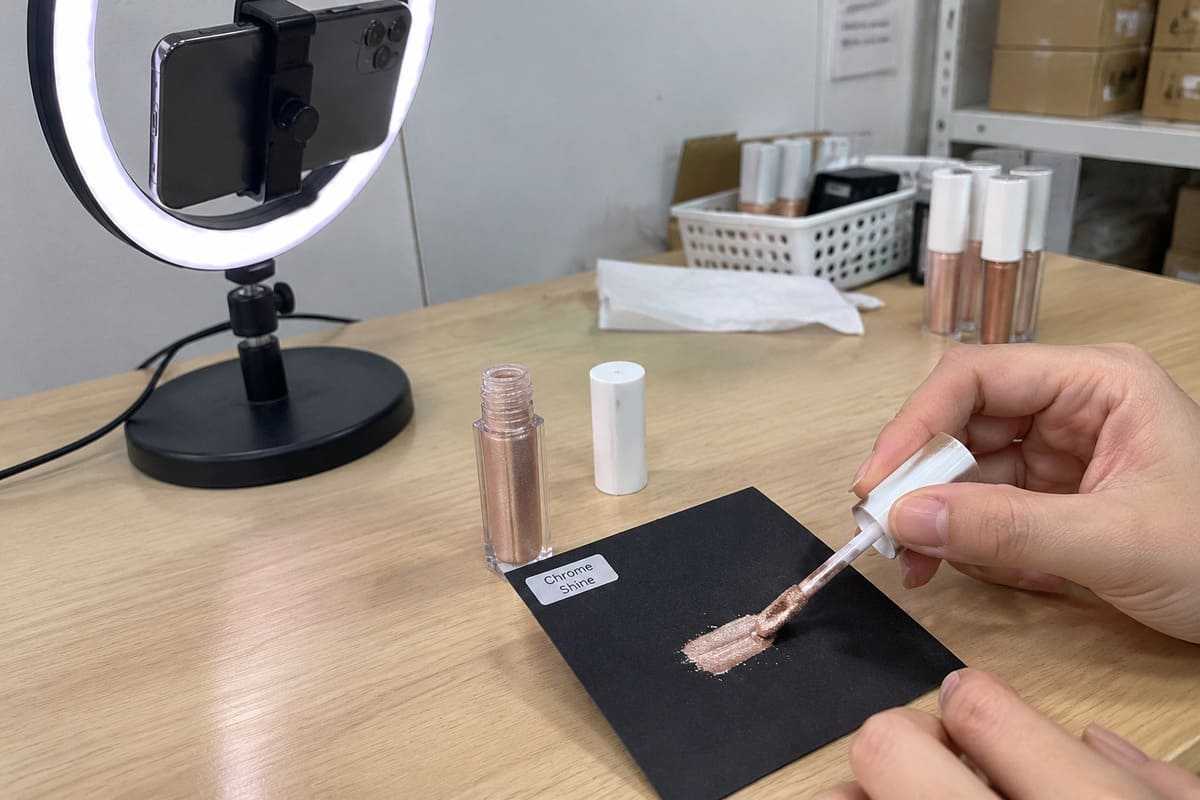
The most useful comparison is not simply whether liquid eyeshadow looks more modern or whether powder is easier to use. I need to examine the buyer, sales channel, packaging commitment, finished goods MOQ, formula stability, and local compliance requirements together. These factors explain why the best first product is often different from the product that receives the most attention online.
Is Liquid Eyeshadow Really the Better Choice for a New Brand in Southeast Asia?
A new brand may see liquid eyeshadow everywhere on TikTok and assume that it is the fastest route to attention. That assumption can become expensive when the brand has limited category experience and an unproven sales channel. I believe liquid eyeshadow is a strong product, but it is not automatically the strongest first product.
Liquid eyeshadow can be the better choice when the brand has a visual-content strategy, a clear Gen Z audience, and enough capital to meet the packaging MOQ. It can create metallic, chrome, shimmer, and high-impact finishes that perform well in short-form video. However, most new brands should first confirm that their customers want dramatic makeup rather than reliable daily-wear products.
Liquid Eyeshadow vs Powder Depends on the Job
When a brand asks me about liquid eyeshadow vs powder, I first ask what the product needs to do.
Liquid eyeshadow is useful for:
- Metallic and chrome finishes
- High-impact social media content
- Fast application with a doe-foot applicator
- Play makeup and event makeup
- A focused, trend-led product launch
- TikTok, Instagram, and creator-led selling
Powder eyeshadow is useful for:
- Daily office and commute makeup
- Multi-shade palettes
- Neutral and soft-color stories
- Flexible application and blending
- Retail shelves and assortment building
- Lower-risk trial orders using ready-stock packaging
These differences matter in Southeast Asia because the region contains several different beauty behaviors. A consumer who enjoys bold editorial looks for a TikTok video may still purchase a neutral palette for work, university, family events, and everyday use.
Malaysian buyers, for example, often look for wearable products that suit daily routines and local weather.4 Thai and Indonesian beauty trends have also shown strong interest in lightweight, natural, and dimensional makeup.5 That does not mean consumers in these markets avoid strong color. It means that a first product must fit more than one occasion if the brand wants to reduce inventory risk.
When Liquid Eyeshadow Makes Strategic Sense
I would consider liquid eyeshadow for a new brand when several conditions are already clear:
- The brand has a TikTok-first or creator-led sales channel.
- The target buyer is comfortable with trend-led and expressive makeup.
- The product concept requires metallic, chrome, or wet-look impact.
- The brand can commit to approximately 10,000 units of custom packaging.
- The brand has enough time for formulation, compatibility, and stability testing.
- The brand has a content plan that demonstrates application and wear.
Liquid eyeshadow can create a more immediate visual difference than a standard neutral palette. A creator can show one swipe, a reflective finish, and a quick transformation. That content can make the product easy to understand.
However, visual impact does not automatically produce repeat purchases. The brand still needs to prove that the product applies evenly, dries at a comfortable speed, does not crease excessively, and remains stable in a hot and humid environment.
When Powder Is the More Reliable First Product
Powder is usually more practical when the brand is still answering basic commercial questions:
- Which price range will the market accept?
- Which shades will sell first?
- Will customers reorder?
- Does the brand’s content convert to sales?
- Can the brand manage inventory and cash flow?
- Does the retailer or distributor want a broad daily-wear assortment?
A powder palette allows the brand to test multiple shades in one product. The brand can also use a ready-stock compact or palette while customizing colors, labels, and outer packaging. That approach reduces the initial packaging commitment.
I often tell first-time brands that a product should earn the right to become complicated. A powder palette can provide early market data before the company invests in a highly specific liquid format, custom tube, applicator, and filling process.
Why Is the Custom Packaging MOQ 10,000 Units for Both Formats?
Packaging MOQ is often the point where a first-time brand misunderstands the difference between product format and finished goods. A buyer may hear that both powder and liquid eyeshadow have a 10,000-unit custom packaging MOQ and conclude that the two formats have identical startup costs. They do not.
Custom packaging for both formats can begin at approximately 10,000 units because suppliers must produce dedicated molds, components, or tooling. Powder palettes can still use ready-stock packaging, while liquid eyeshadow usually has fewer practical ready-stock options that meet the required tube, applicator, wiper, and sealing specifications.
Why Liquid Packaging Has a High MOQ
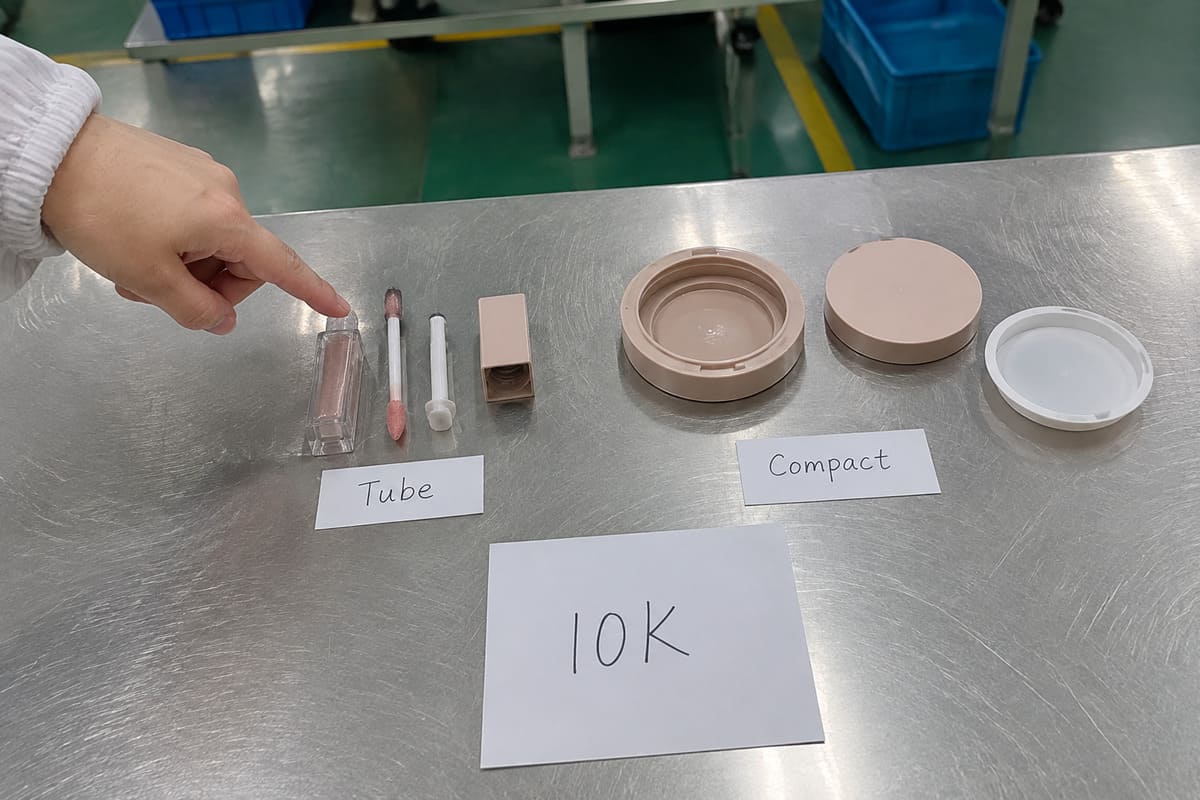
Liquid eyeshadow packaging usually contains more than a simple container. The packaging system may include:
- A plastic or glass tube
- A cap
- A doe-foot applicator
- A wiper or sealing ring
- Inner components
- Decoration or printing
- Compatibility requirements with the formula
Each component must work together. The tube must hold the formula without leaking or swelling. The applicator must pick up an appropriate amount of product. The wiper must control dosage. The sealing system must reduce evaporation and contamination risk.6
A factory cannot always purchase these parts in very small quantities because packaging manufacturers produce them through specialized tooling and production runs. The supplier must recover mold development, setup, decoration, and production costs across the order volume. That is why liquid eyeshadow custom packaging commonly starts at 10,000 units.7
This MOQ is not simply an arbitrary supplier policy. It reflects the physical supply chain behind the package.
Why Powder Can Use Ready-Stock Packaging
Powder eyeshadow packaging offers more flexibility because the product can fit a standard compact or palette format. A brand can select an existing palette shape and customize certain elements, such as:
- Pan configuration
- Shade arrangement
- Printed artwork
- Labeling
- Outer carton
- Sticker or logo application
- Color selection
The brand may not receive a completely unique mold, but it can still create a coherent branded product. For an early trial, this tradeoff can be commercially sensible.
Custom powder palette molds can also start at around 10,000 units. However, a brand does not always need a new mold for its first order. It can use a ready-stock palette and keep the initial finished goods MOQ closer to 2,000 units, subject to the specific product configuration and supplier quotation.
Packaging MOQ Versus Finished Goods MOQ
I recommend that buyers separate these terms in every supplier conversation.
| Term | Meaning | Typical implication |
|---|---|---|
| Custom packaging MOQ | Minimum quantity for a new mold or dedicated packaging component | Often around 10,000 units |
| Ready-stock packaging MOQ | Minimum quantity using an existing package | May be lower |
| Finished goods MOQ | Minimum number of completed products ordered | Depends on formula, shades, packaging, and decoration |
| Shade MOQ | Minimum quantity required per color or pan | Can affect total inventory |
| Artwork MOQ | Quantity required for printing or labeling | Depends on the decoration process |
A buyer who asks only, “What is your MOQ?” may receive an incomplete answer. I ask for the MOQ by packaging type, shade, finished product, and decoration method.
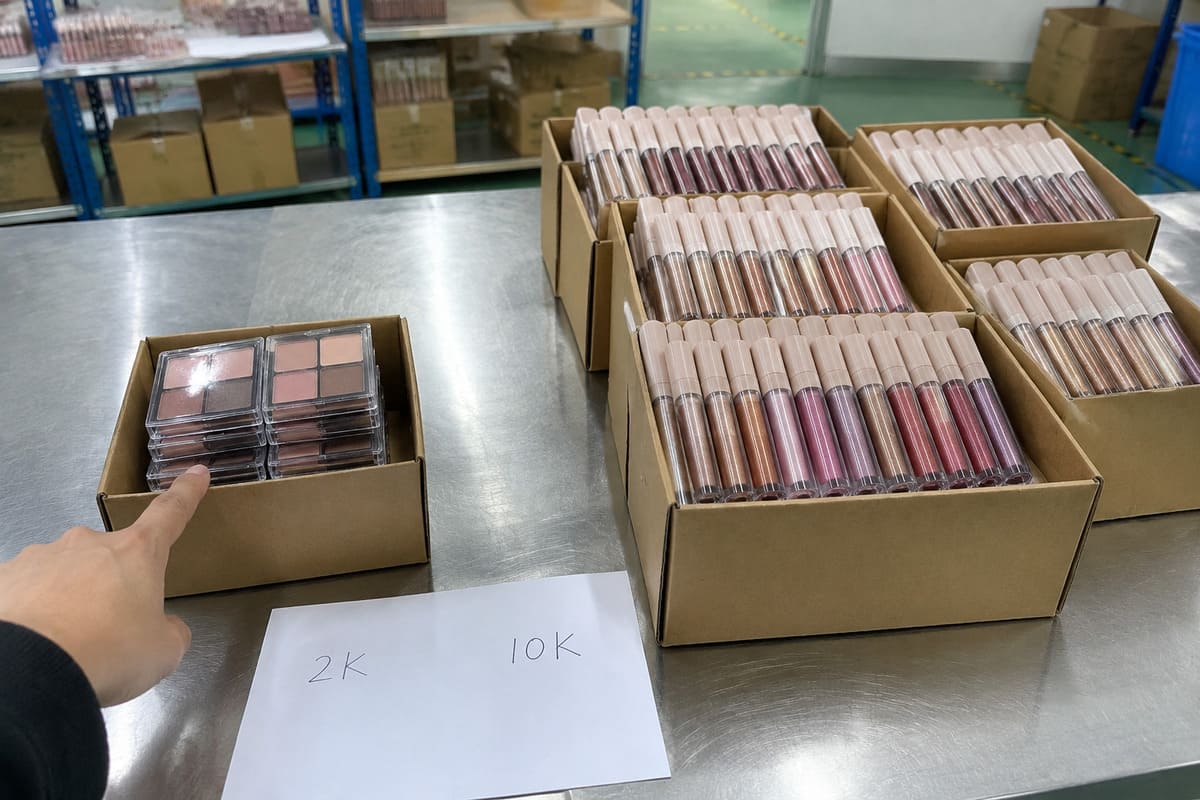
The practical difference is significant. A powder palette using ready-stock packaging may allow a 2,000-unit trial. A liquid eyeshadow using custom tubes and applicators may require 10,000 units before production begins. The product price is only one part of the commitment. Packaging inventory can determine the entire project economics.
Which Format Has a Lower Finished Goods MOQ for a First-Time Brand?
A first-time brand usually needs a lower finished goods MOQ because it is testing demand rather than replenishing an established bestseller. The lower MOQ reduces cash exposure, storage pressure, and the risk of being left with shades that do not sell. In this comparison, powder eyeshadow usually offers the more accessible entry point.
A powder multi-shade palette can often reach a finished goods MOQ of about 2,000 units when the brand uses ready-stock packaging. Liquid eyeshadow generally requires approximately 10,000 units when the package, applicator, and sealing components must be produced or reserved for the project.
Why 2,000 Units Changes the Decision
The difference between 2,000 and 10,000 units is not only a quantity difference. It changes the level of business risk.
A 2,000-unit trial can help a brand evaluate:
- Customer response to the price
- Which shades sell fastest
- Whether the packaging communicates the brand correctly
- Whether online content drives conversions
- How quickly distributors reorder
- Whether customers report application or wear problems
- How much working capital the brand needs for replenishment
A 10,000-unit order creates a larger commitment before the brand has enough evidence. The brand may need to spend more on inventory, storage, freight, launch content, and marketing at the same time.
The figures of approximately $3,000 for a smaller trial and $15,000 for a larger commitment can be useful as commercial illustrations8, but buyers must confirm the actual quote. The final amount depends on formula, packaging, decorations, testing, cartons, freight, and destination market requirements.
Trial Quantity and Product Architecture
A lower finished goods MOQ does not mean the brand should create too many shades. A six-shade palette with a clear color story can provide more useful data than six unrelated shades.
For an initial powder palette, I would consider:
- Four matte earth tones
- One soft satin or pearl shade
- One slightly brighter accent shade
- A palette structure that suits daily wear
- Shade names and packaging that work across the target market
The brand should also decide whether the 2,000-unit order refers to total palettes or a quantity per shade. This distinction can change the actual inventory. A supplier may quote one MOQ for the complete palette but apply a separate MOQ to individual pans or replacement colors.
A Basic MOQ Decision Table
| Business situation | More suitable starting format | Reason |
|---|---|---|
| Unproven brand and unproven channel | Powder | Lower trial quantity with ready-stock packaging |
| Distributor wants daily-wear assortment | Powder | Broad consumer use and easier shade selection |
| TikTok creator has strong demand | Liquid | High visual impact can support a focused launch |
| Brand wants a unique custom tube | Liquid | Requires stronger packaging commitment |
| Brand is testing neutral shades | Powder | Multi-shade palette supports broader use |
| Brand already has repeat customers | Either | Existing data can justify a larger order |
I would not select liquid eyeshadow merely because the product appears more distinctive. Distinctiveness has value only when the brand can finance the inventory and sell through it.
For many first-time brands, a 2,000-unit powder trial creates a more controlled learning cycle. The company can measure sell-through, collect consumer feedback, and use reorder data to decide whether a liquid launch deserves the next investment.
What Certifications Are Required for Exporting Either Format to Southeast Asia?
Cosmetic export requirements depend on the destination country, product classification, ingredients, claims, responsible company, labeling, and documentation. Neither liquid nor powder eyeshadow has one universal Southeast Asian certification that automatically covers every market.9
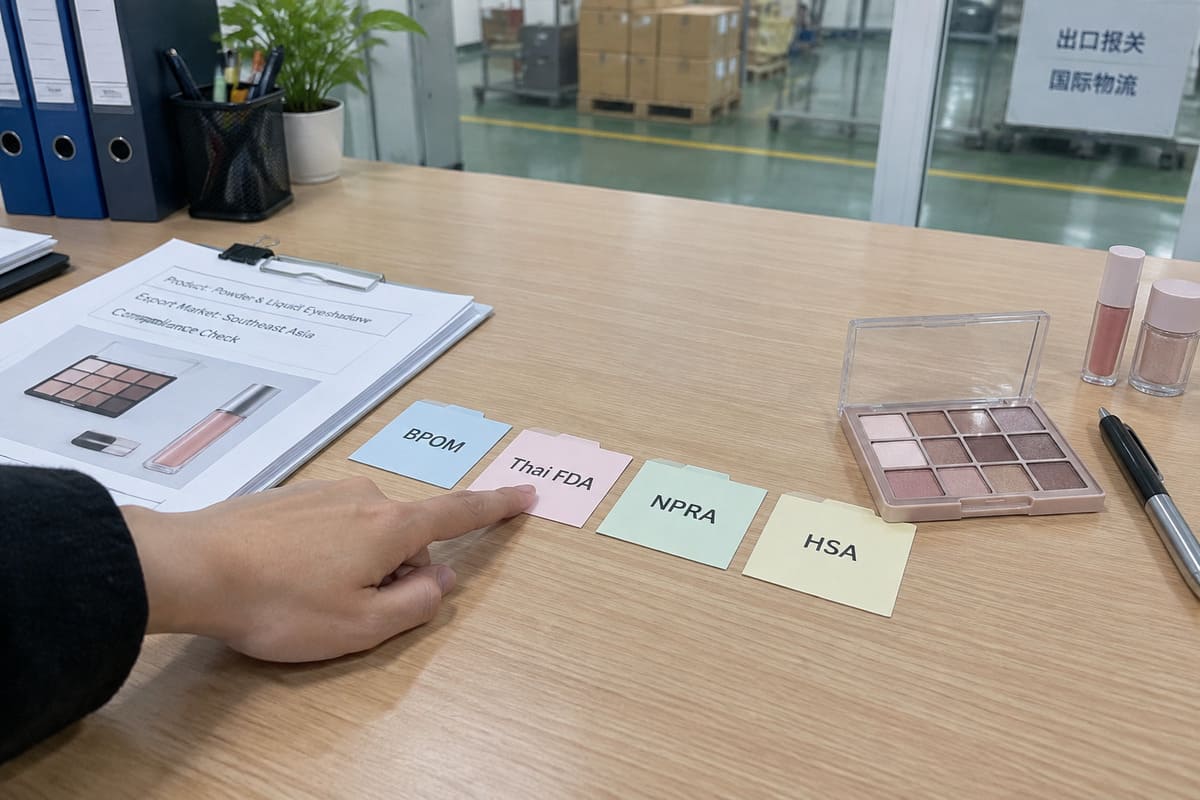
For common destinations, buyers may need to address BPOM requirements in Indonesia, Thai FDA requirements in Thailand, NPRA requirements in Malaysia, and HSA requirements in Singapore.10 The exact process can change based on the product and importer structure, so I recommend confirming the current requirements with the local responsible party and a qualified regulatory professional.
Country-Specific Compliance Matters
The main markets commonly discussed with our B2B customers include:
| Market | Relevant authority or system | Buyer focus |
|---|---|---|
| Indonesia | BPOM | Product notification or registration pathway, ingredients, labels, importer responsibilities |
| Thailand | Thai FDA | Cosmetic notification, local responsible party, labels, product documents |
| Malaysia | NPRA | Cosmetic notification, ingredient and labeling review, local company responsibilities |
| Singapore | HSA | Cosmetic product notification and supporting safety information |
These names are useful starting points, but they are not a substitute for a current regulatory review. A buyer should confirm whether the product requires notification, what documents must be translated, and who will act as the responsible company in the destination market.
Typical Compliance Documents
A buyer may need some combination of:
- Full ingredient list using appropriate nomenclature
- Product specifications
- Manufacturing information
- Certificate of analysis or batch documentation
- Safety or product information file
- Stability or compatibility data
- Packaging and labeling artwork
- Microbiological information where applicable
- Claims support
- Free sale or manufacturing documents where required
- Importer and responsible person details
The exact file depends on the market and the authority’s current requirements. Buyers should verify every document request before production because a late label change can affect packaging inventory.
Both liquid and powder products require technical review. Liquid eyeshadow may receive additional attention because of evaporation, preservation, viscosity, applicator compatibility, and microbial stability.11 Powder eyeshadow may require attention to pressed powder integrity, contamination control, colorant compliance, and breakage during transport.
How We Handle Compliance Discussions
When a buyer asks about export compliance, I first ask where the products will be sold. A product for Malaysia may follow a different process from a product for Indonesia or Thailand. The buyer’s sales channel also matters because a distributor may have responsibilities that differ from a direct-to-consumer importer.
At Vertina Beauty, we can prepare the relevant compliance file according to the target market and project requirements before shipment. Buyers should treat certificates, registrations, and regulatory documents as items to verify for the specific product, order, and destination. I do not recommend relying on a general statement that a product is “approved everywhere.”
A responsible evaluation should include:
- Identify the destination country.
- Confirm the local importer or responsible person.
- Review the ingredient list and product claims.
- Confirm the required label language and warnings.
- Prepare the supporting technical file.
- Submit or notify through the applicable local process.
- Confirm that the final shipped product matches the submitted documentation.
This process applies to both liquid and powder eyeshadow. The lower MOQ of powder does not remove compliance obligations, and the visual appeal of liquid does not replace technical documentation.
How Did a Southeast Asian First-Time Brand Decide Between Liquid and Powder for a 2,000-Unit Trial?
A 2,000-unit trial usually points toward powder eyeshadow because liquid eyeshadow custom packaging may require around 10,000 units. The brand must separate the preferred product concept from the feasible first purchase. In a practical case, the brand selected powder because it could test the market without committing to a large liquid packaging run.
The decision was based on budget, consumer behavior, color versatility, and the need to establish reorder data. The brand did not reject liquid eyeshadow permanently. It postponed the liquid launch until the market provided evidence that customers wanted stronger visual impact.
The Brand’s Starting Questions
I would guide the brand through five questions:
- Who is the first buyer?
- What occasion will the product serve?
- Which sales channel will carry the launch?
- How much inventory can the company safely hold?
- What result will justify a second order?
If the answer is “daily-wear consumers through a distributor or general beauty channel,” powder usually has a stronger starting case. If the answer is “Gen Z consumers through a creator’s TikTok videos,” liquid becomes more relevant, but the 10,000-unit packaging commitment still needs to be addressed.
Why the Powder Trial Was More Defensible
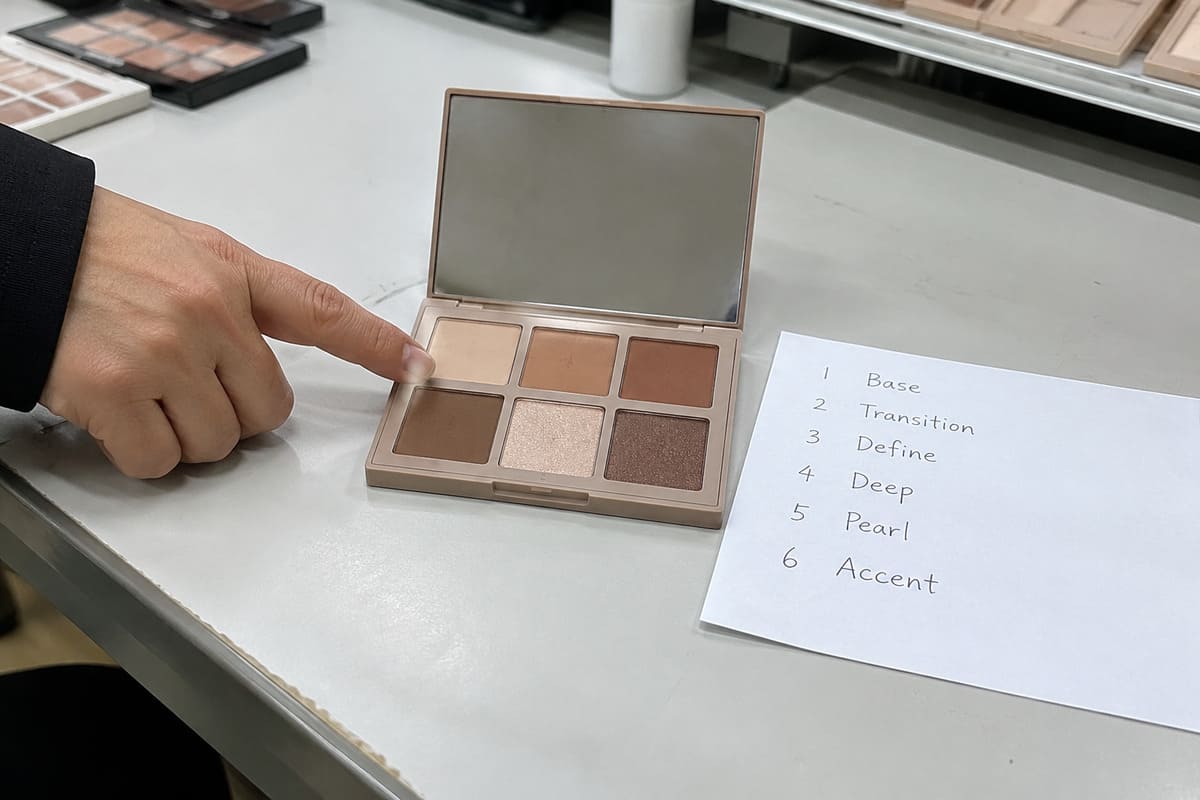
The brand chose a six-shade neutral powder palette. The color story included warm browns, matte earth tones, peach, and a soft pearl accent. This structure created several advantages:
- It supported daily office and casual makeup.
- It worked across yellow and tan undertones.
- It reduced the need to choose one dramatic color.
- It allowed customers to use shades separately or together.
- It matched a broad content strategy.
- It could use ready-stock packaging for a smaller starting order.
The brand also considered the climate. A product designed for Southeast Asian conditions should be evaluated for humidity, sebum, wear time, and packaging transport. Powder eyeshadow is not automatically stable in every environment, but it can be developed with tropical use in mind.
The Metrics That Matter After Launch
A first trial should have defined measurements. I would track:
| Metric | Why it matters |
|---|---|
| Sell-through rate | Shows how quickly the first stock moves |
| Reorder interval | Indicates repeat demand and channel health |
| Best-selling shades | Guides future palette development |
| Return or complaint rate | Reveals product or expectation problems |
| Content conversion | Connects views with actual purchases |
| Distributor feedback | Shows whether the product fits the channel |
| Gross margin after freight | Tests commercial viability |
The brand should not judge the trial only by social media views. A product can receive attention without generating profitable orders. Reorder rate and customer feedback are stronger signals.
When the Brand Should Add Liquid
The brand can consider liquid eyeshadow after it sees evidence such as:
- Customers request stronger metallic finishes.
- Creators demonstrate high conversion with eye makeup content.
- The powder palette sells through consistently.
- The brand can fund a 10,000-unit liquid packaging order.
- The team has enough time for additional formula and stability work.
- The product concept has a clear difference from existing liquid products.
This approach turns liquid eyeshadow into a planned second-stage launch. The brand uses the powder product to learn about its consumer, price point, and distribution. It then uses that information to build a more targeted liquid product instead of guessing.
What Color Story and Finish Should a Southeast Asian Daily-Wear Palette Have?
A Southeast Asian daily-wear palette should prioritize versatility, comfort, and reliable color harmony. I would begin with matte earth tones, warm browns, muted peach, and one or two soft pearl accents. The finish should create dimension without requiring advanced application skills.
A new brand should avoid designing its first palette around heavy editorial pigment unless its channel and audience clearly support that direction. A daily-wear palette has a larger potential use case because customers can wear it to work, university, shopping, family occasions, and casual events.
A Practical Six-Shade Structure
I would consider the following structure:
| Shade role | Example direction | Finish |
|---|---|---|
| Light base | Soft warm beige or cream | Matte or soft satin |
| Transition shade | Muted peach-brown | Matte |
| Definition shade | Warm medium brown | Matte |
| Deepening shade | Cocoa or deep brown | Matte |
| Dimension shade | Soft champagne or rose gold | Pearl |
| Accent shade | Terracotta, bronze, or muted copper | Satin or soft shimmer |
This arrangement gives the customer a complete eye look without making the palette feel too specialized. It also allows the brand to demonstrate several application methods in content.
Why Matte Earth Tones Matter
Matte earth tones have practical value because they can serve as base, transition, crease, and definition shades. A palette with only bright shimmer may photograph well, but it may not provide enough structure for daily makeup.
Warm browns and soft peach shades can work well with many yellow and tan undertones, but the brand should still conduct actual shade testing across a representative range of skin tones. Color selection should not rely only on the color in the pan. The brand needs to evaluate payoff, blending, undertone, buildability, and appearance under different lighting.
How to Design for Tropical Conditions
The formula should be assessed for:
- Humidity resistance
- Sebum resistance
- Creasing
- Color fading
- Fallout
- Pressed powder hardness
- Payoff with brush and fingertip
- Breakage during transport
- Packaging closure and pan security
A powder formula that feels smooth in a dry factory environment may perform differently in a humid market. I recommend application testing under realistic conditions and qualified professional evaluation for specific performance claims.
The brand should also avoid making unsupported claims such as “all-day waterproof” or “sweatproof” without suitable testing. Clear, defensible communication protects both the brand and its distribution partners.
Choosing Finishes Carefully
Soft pearl and satin finishes can add dimension while remaining suitable for daily wear. Strong glitter or highly reflective sparkle can be added later if customer data supports it.
For a first palette, I would use:
- Four matte or soft-matte shades
- One pearl shade
- One satin or moderate shimmer shade
This balance supports both understated and slightly elevated looks. It also gives the brand enough visual interest for social media without making the product difficult for beginners.
Frequently Asked Questions
Is liquid eyeshadow more popular than powder eyeshadow in Southeast Asia?
Liquid eyeshadow may receive strong attention on TikTok and Instagram because metallic and chrome finishes are visually immediate. However, social media popularity does not prove broad daily demand. Powder eyeshadow is often more versatile for office, casual, and event makeup, so each brand should evaluate its specific customer and channel.
What is the MOQ for liquid eyeshadow custom packaging?
Liquid eyeshadow custom packaging commonly starts at approximately 10,000 units. The tube, applicator, wiper, and sealing system usually need coordinated production. Buyers should confirm the MOQ for the complete package and ask whether any ready-stock option is genuinely suitable for their formula and branding needs.
Can powder eyeshadow start at 2,000 units?
A powder eyeshadow palette may support a finished goods MOQ of about 2,000 units when the brand uses ready-stock packaging. A custom palette mold can require approximately 10,000 units. The final MOQ depends on the formula, shade count, packaging, decoration, and production plan.
Which Southeast Asian markets require cosmetic notification or registration?
Common requirements include BPOM processes in Indonesia, Thai FDA processes in Thailand, NPRA requirements in Malaysia, and HSA notification requirements in Singapore. The importer or responsible person should confirm the current rules for the specific product, ingredients, claims, and label before shipment.
Should a new brand launch liquid eyeshadow after powder?
A brand can add liquid eyeshadow after it has evidence of customer demand, channel performance, and sufficient cash flow. A powder trial can show which colors and finishes sell. The brand can then invest in liquid eyeshadow with a clearer concept and a better basis for accepting the approximately 10,000-unit packaging commitment.
Conclusion
Liquid eyeshadow vs powder is ultimately a question of market fit, financial risk, and launch timing. For most Southeast Asian first-time brands, a powder multi-shade palette with ready-stock packaging provides a more manageable starting point at around 2,000 finished units. A six-shade neutral palette with matte earth tones and soft pearl accents can serve daily-wear customers while generating useful reorder data. Liquid eyeshadow can follow when a TikTok-first audience, visual product concept, and 10,000-unit packaging commitment are justified. At Vertina Beauty, I help B2B buyers evaluate formula, packaging, MOQ, customization, and destination-market documentation before production.
"Population‐Based Cosmetics Exposure Parameters: Survey ...", https://pmc.ncbi.nlm.nih.gov/articles/PMC12481470/. A regional consumer or market study may support the association between daily-use cosmetics, purchase behavior, and lower-risk product positioning; however, it would provide contextual evidence rather than direct proof that powder eyeshadow is the safest format for every first-time brand. Evidence role: general_support; source type: research. Supports: Research on Southeast Asian cosmetics purchasing behavior and startup inventory constraints should support the contextual rationale for preferring a lower-commitment, daily-use format.. Scope note: Consumer studies may not compare liquid and powder eyeshadow directly or measure startup inventory risk. ↩
"How to Find the Best OEM Makeup Kit Manufacturers with Low ...", https://vertinabeauty.com/2025/03/07/how-to-find-the-best-oem-makeup-kit-manufacturers-with-low-moq/. Supplier quotations or industry procurement records can substantiate the cited MOQ ranges for particular packaging configurations, but these figures should be treated as illustrative because minimums differ by supplier, order specifications, and production market. Evidence role: statistic; source type: other. Supports: Current supplier quotations or documented industry procurement data should establish whether the stated MOQ ranges are representative for the specified packaging arrangements.. Scope note: Commercial MOQ data are often proprietary, time-sensitive, and not representative of all manufacturers. ↩
"The Impact of TikTok Influencers on Gen Z the Cosmetic Industry", https://digitalcommons.bryant.edu/cgi/viewcontent.cgi?article=1000&context=honors_mathematicseconomics. Research on Gen Z beauty consumption and short-form social commerce may support the relevance of visually demonstrable, expressive makeup products to this audience, but it does not by itself establish that liquid eyeshadow will outperform powder. Evidence role: general_support; source type: research. Supports: Studies of Gen Z makeup preferences and social-commerce behavior should support the relationship between short-form visual content, expressive makeup, and liquid-format product positioning.. Scope note: Platform behavior and generational preferences vary by country, creator network, and product category. ↩
"Malaysian consumers' awareness, perception, and attitude ...", https://pmc.ncbi.nlm.nih.gov/articles/PMC4929959/. Malaysian consumer studies may support the reported importance of wearable, routine-oriented cosmetics and climate-related product considerations; such findings describe market tendencies rather than the preferences of every Malaysian buyer. Evidence role: general_support; source type: research. Supports: Malaysian consumer research should document preferences for practical, wearable cosmetics and the influence of local climate or daily-use occasions.. Scope note: Available studies may use narrow samples or measure facial cosmetics generally rather than eyeshadow specifically. ↩
"Southeast Asia's Beauty and Personal Care Market", https://cosmetic.chemlinked.com/news/cosmetic-news/southeast-asias-beauty-and-personal-care-market-a-pivotal-global-future-market. Market and consumer studies from Thailand and Indonesia may document demand for natural or dimensional makeup aesthetics, although trend evidence is time-dependent and should not be interpreted as a uniform preference across either population. Evidence role: general_support; source type: research. Supports: Country-specific consumer or trend research should indicate whether lightweight, natural, or dimensional makeup has meaningful demand in Thailand and Indonesia.. Scope note: Trend reports may rely on social-media signals or commercial samples and may not predict broader purchasing behavior. ↩
"Type of closure prevents microbial contamination ...", https://pubmed.ncbi.nlm.nih.gov/2339896/. Cosmetic packaging and stability literature supports the role of container-closure integrity in limiting volatile loss and external contamination, although the specific performance of a liquid eyeshadow package depends on its formula, materials, and use conditions. Evidence role: mechanism; source type: paper. Supports: Packaging and cosmetic-stability literature should explain how closure integrity influences evaporation, contamination, and preservation of liquid products.. Scope note: General packaging studies may not test the particular applicator, wiper, and formula used in this product. ↩
"How Can I Create My Own Makeup Brand? (A Startup Founder's ...", https://vertinabeauty.com/how-can-i-create-my-own-makeup-brand-a-startup-founders-guide-to-first-launch/. Manufacturing research supports the general relationship between dedicated tooling, setup costs, component production, and larger minimum order quantities; it does not independently establish 10,000 units as a universal threshold for liquid eyeshadow packaging. Evidence role: mechanism; source type: research. Supports: Packaging-manufacturing research should explain how tooling, setup costs, component sourcing, and production-run economics influence minimum order quantities.. Scope note: The precise MOQ remains supplier- and specification-dependent. ↩
"Makeup Palette Pro: Private Label Eyeshadow Palette ...", https://makeuppalettepro.com/. Itemized manufacturer quotations can support the plausibility of the cited order-value illustrations under defined assumptions, but they should not be presented as typical costs without specifying product composition, packaging, freight, duties, and market. Evidence role: statistic; source type: other. Supports: Recent itemized quotations should establish whether the two illustrative order values are plausible under clearly stated formula, packaging, testing, freight, and destination assumptions.. Scope note: Commercial prices are highly variable and may become outdated quickly. ↩
"The ASEAN Cosmetic Directive", https://www.registrarcorp.com/blog/cosmetics/cosmetic-regulations/cosmetics-regulations-asean/. ASEAN and national regulatory materials indicate that the ASEAN Cosmetic Directive provides a harmonized framework while market access continues to involve country-specific notification, labeling, and responsible-person procedures; therefore, no single regional certificate automatically replaces national compliance steps. Evidence role: historical_context; source type: government. Supports: Official ASEAN and national regulator materials should establish the regional harmonization framework and the continuing role of country-specific notification and responsible-person requirements.. Scope note: Requirements can change, and the applicable process depends on the destination, product claims, importer, and formulation. ↩
"peraturan badan pengawas obat dan makanan nomor 21 ...", https://standar-otskk.pom.go.id/regulasi/rancangan/peraturan-badan-pengawas-obat-dan-makanan-nomor-21-tahun-2022-tentang-tata-cara-pengajuan-notifikasi-kosmetika. Official guidance from BPOM, the Thai FDA, Malaysia's NPRA, and Singapore's HSA identifies the competent authorities and applicable cosmetic notification or regulatory procedures in their respective jurisdictions. Evidence role: definition; source type: government. Supports: Current official regulator pages should identify the relevant cosmetic notification authorities and describe the applicable market-entry procedures in the four named countries.. Scope note: The authorities' procedures do not imply identical documentation or approval outcomes, and requirements depend on the individual product and importer arrangement. ↩
"Cosmetics Preservation: A Review on Present Strategies - PMC", https://pmc.ncbi.nlm.nih.gov/articles/PMC6099538/. Cosmetic formulation and stability literature supports evaluating liquid products for rheology, preservative efficacy, microbial stability, volatile loss, and container compatibility; the need and extent of testing remain formulation-specific and do not establish that every liquid eyeshadow is technically more demanding than every powder product. Evidence role: mechanism; source type: paper. Supports: Cosmetic-science literature should explain why liquid formulations require assessment of volatile loss, rheology, preservative efficacy, microbial stability, and package compatibility.. Scope note: The comparison depends on the formulation, packaging system, preservative design, and intended use. ↩