Finding a trustworthy makeup manufacturer in China feels like walking through a maze blindfolded. You log onto Alibaba, see hundreds of "Top 10 factories" with glossy photos and 50-unit MOQs, and wire money to a stranger. Then the samples arrive: cheap, generic, nothing like promised. I have watched this happen too many times. Here is how to stop it.
A real makeup manufacturer in China is a licensed production facility whose business license lists "Manufacturing/Production" in its scope, not "Sales" or "Trading." You verify it with three steps: request the business license, demand a live video tour of the production lines, and confirm realistic MOQs. True custom brands start at 5,000–10,000 units, not 50. Anything cheaper is usually a trading company reselling stock.
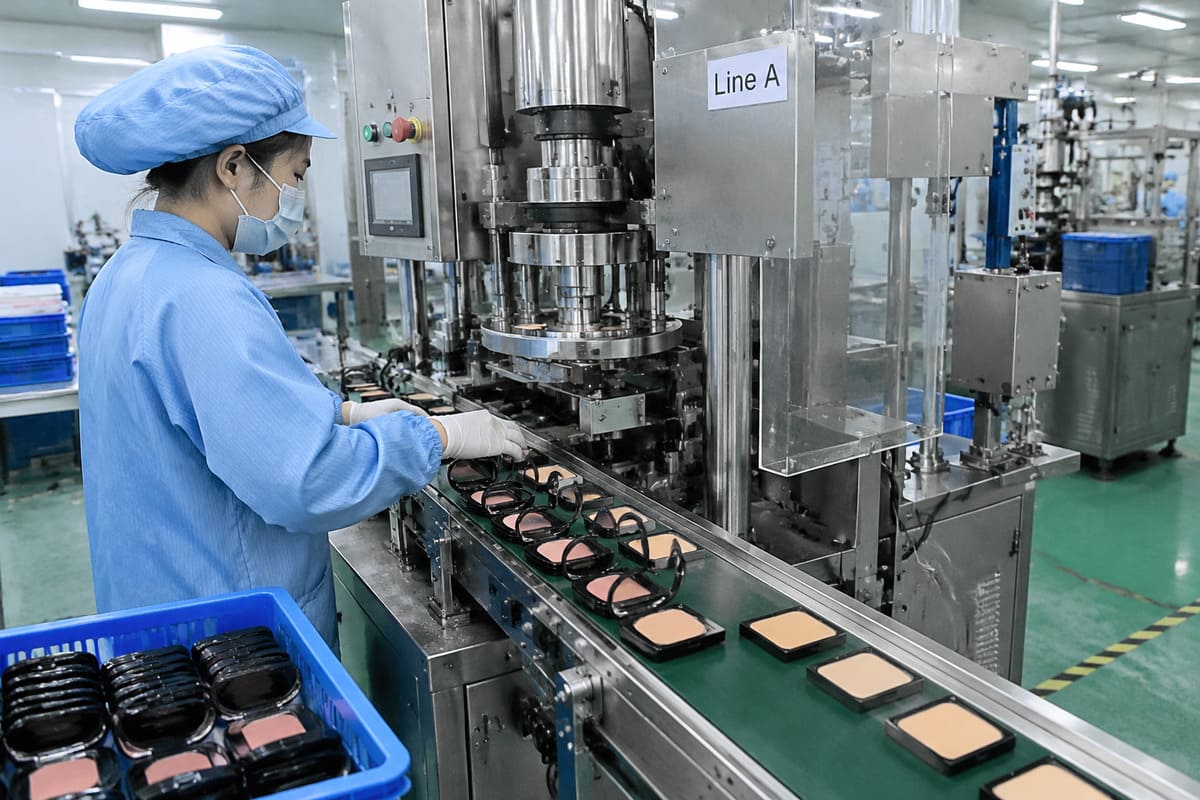
So how do you tell a real factory from a middleman with a laptop? And what is the safest way to spend your first order budget? Let me break down everything I have learned from the inside of this industry.
What Does "Makeup Manufacturer in China" Really Mean for International Brands?
Most founders type "makeup manufacturer in China" into Google expecting a clear answer. Instead, they get thousands of near-identical listings. The word "manufacturer" has quietly lost its meaning on B2B platforms, and that confusion costs brands real money.
For international brands, a makeup manufacturer in China means a company that physically produces cosmetics: it owns pressing machines, blending equipment, cleanrooms, and raw material inventory. It controls formula, quality, and lead time directly. This is different from a trading company, which buys finished goods from factories and resells them at a markup with zero production control.
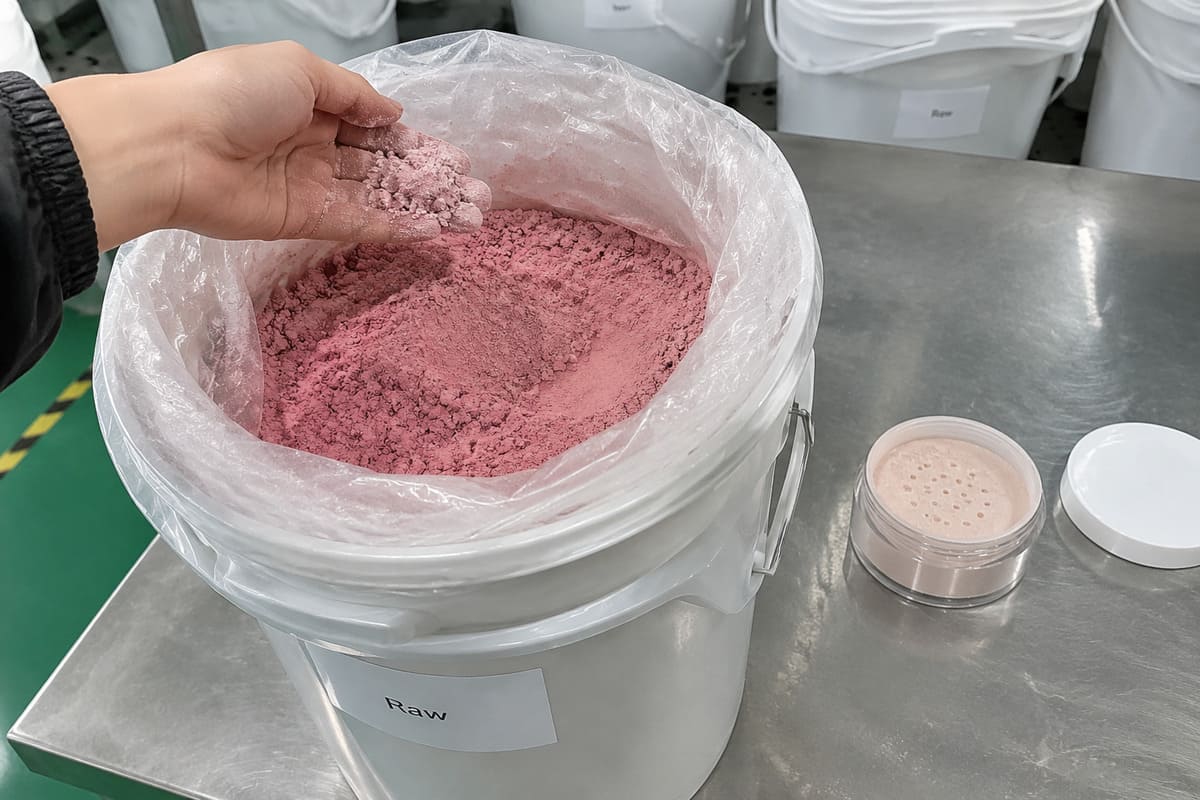
The distinction matters more than most buyers realize. When you work with a real factory, you talk to the people who can change a shade, adjust a formula, or push a deadline. Let me show you exactly why so many "manufacturers" are not what they claim.
Why the Label Gets Abused
China genuinely has the best cosmetics manufacturing infrastructure in the world.1 Core clusters in Guangdong supply a huge share of global color cosmetics.2 That strength attracts thousands of intermediaries who want a slice of the margin without owning a single machine.
Here is a simple comparison I give every new client:
| Factor | Real Factory | Trading Company |
|---|---|---|
| Owns production equipment | Yes | No |
| Controls quality directly | Yes | No, relies on third party |
| Controls lead time | Yes | No, depends on supplier queue |
| Business scope on license | Manufacturing/Production | Sales/Trading |
| Price markup | Factory price | 15–40% markup |
| Can show live production | Yes | No |
A trading company is not always a scam. Some are competent agents. But if you think you are buying factory-direct and you are actually three layers deep, you lose price control, quality control, and the ability to fix problems fast. As a factory based in Guangdong, I compete to be your direct partner, not a hidden link in a chain.
Why Are 70% of "Makeup Manufacturers in China" on B2B Platforms Actually Trading Companies?
You searched for a makeup manufacturer in China and found "verified suppliers" everywhere. It feels safe. Then you dig in and realize the glossy factory photos are stock images, the address is an office, and the "production line" is someone else's. The platform badge did not protect you.
A large share of suppliers labeled as makeup manufacturers in China on B2B platforms are trading companies.3 They purchase a platform membership, upload borrowed factory images, and resell generic stock. They mark up prices but cannot control quality or lead times. The platform's "verified" badge usually confirms the business exists, not that it owns a factory.4
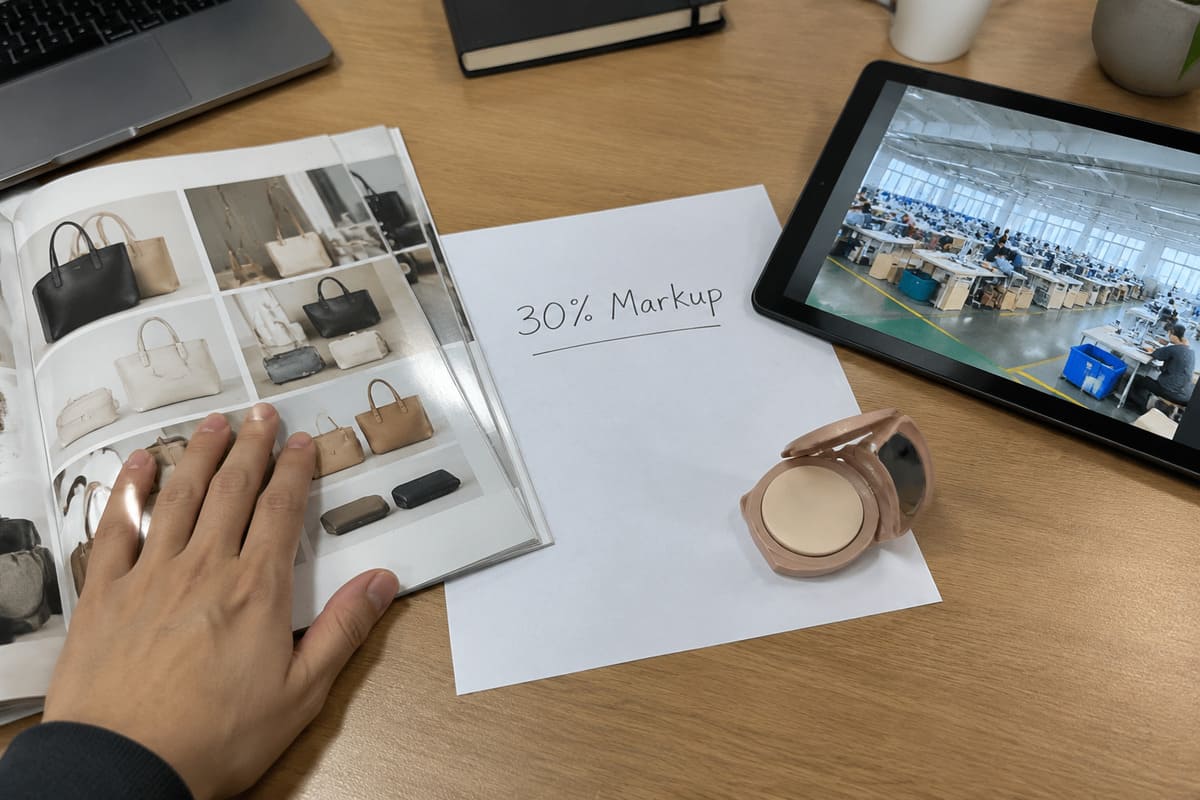
I want to share a story that still bothers me. A European brand founder spent three months contacting five suppliers, all promising 500-unit MOQs. Four turned out to be trading companies. They collected sample fees and shipped cheap, generic white-label eyeshadow. The fifth was worse in a sneaky way: it waited until he paid the deposit, then revealed a hidden $3,000 mold fee. He was trapped. Lose the deposit, or pay double his budget.
The Tactics I See Repeated
Over years of talking to burned buyers, the same patterns come up:
- Photo theft: Real factory images lifted from other sites.
- Hidden fees: Mold or tooling costs revealed only after the deposit lands.
- Stock-as-custom: Generic palettes relabeled as "your brand."
- Badge hiding: Leaning on a platform badge instead of real documents.
Here is a rough breakdown of what buyers actually encounter:
| Supplier Type | Approx. Share on Platforms | Risk Level |
|---|---|---|
| Genuine factories | ~30% | Low |
| Trading companies (honest agents) | ~40% | Medium |
| Trading companies posing as factories | ~30% | High |
The exact numbers vary by category, but the lesson holds: most listings are not direct factories. You must verify, not trust.
How Do You Verify a Makeup Manufacturer in China Before Paying a Sample Fee?
You are about to wire a sample fee to someone thousands of miles away. Your stomach knots. What if they vanish? What if the "factory" is a desk and a laptop? This fear is rational, and it is also solvable before you spend a cent.
You verify a makeup manufacturer in China with a 3-step process: First, request a photo of the business license and check the business scope for "Manufacturing/Production." Second, demand a live video call showing the production lines, pressing machines, and raw materials. Third, run an MOQ reality check, since genuine factories are transparent about customization costs and realistic order sizes.
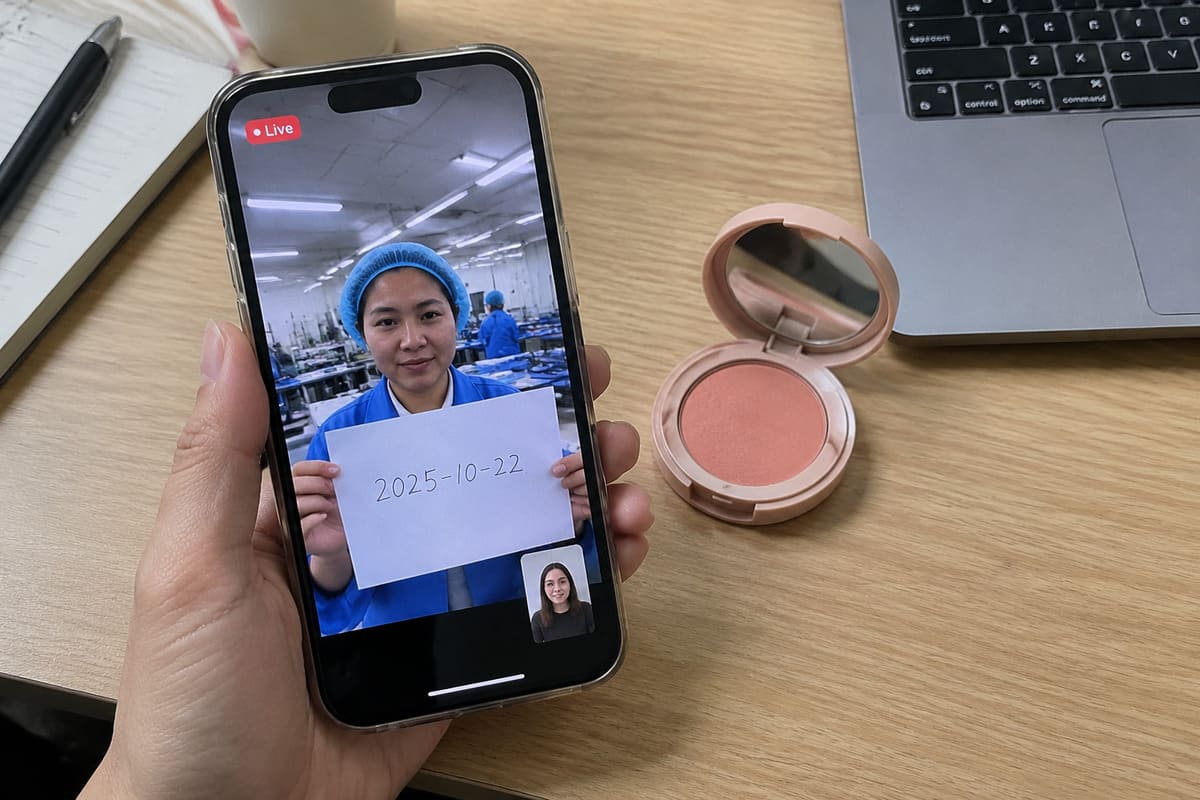
This is the exact framework I taught the European founder from the story above. It saved him. Let me walk through each step in detail.
Step 1: The License Check (The Paper Trail)
Before you pay anything, ask: "Can you send me a photo of your business license?" A real factory sends it within minutes. A trading company hesitates, makes excuses, or sends a blurry or fake one. This costs you nothing and filters out roughly half the scammers instantly.
Then read the Business Scope (经营范围)5. If it says "Sales" or "Trading" (销售/贸易) instead of "Manufacturing" or "Production" (生产/制造), walk away. This single line of text is the most honest thing a supplier will ever show you.
Step 2: Video Verification (The Visual Proof)
Demand a live video call. Ask them to walk through the production lines, show the pressing machines, and pan across raw material stock. For extra proof, ask them to hold a sheet of paper with the day's date on it. Trading companies cannot fake a moving production line in real time. When I gave the European founder a live tour with a dated paper in hand, his anxiety dropped immediately.
Step 3: The MOQ Reality Check
Suppliers advertising 50–100 unit MOQs are selling generic stock with zero differentiation. A real factory is transparent about customization costs. Use this checklist:
- Ask for the full mold and tooling cost in writing before any payment.
- Ask what is customizable at each MOQ tier.
- Ask for the standard lead time for production and shipping.
- Confirm who owns the mold after you pay for it.
I told that founder plainly: "Ask for the full mold cost upfront. A real factory gives it to you before you pay." That one sentence protects more budgets than any contract clause.
Why Won't a 50-Unit "Low MOQ" Build a Real Brand?
The 50-unit MOQ looks like a dream for a new founder. Low risk, low cash, fast start. Then the product arrives and it is the identical palette ten other sellers already dropship. You did not launch a brand. You bought a sample someone else also sells.
A 50-unit low MOQ will not build a real brand because it only buys generic stock products with zero differentiation. At that quantity, you cannot change the formula, create a custom mold, or develop exclusive shades. You are relabeling an existing product that competitors can buy too. Real brand building requires custom formulation, which starts at far higher volumes.
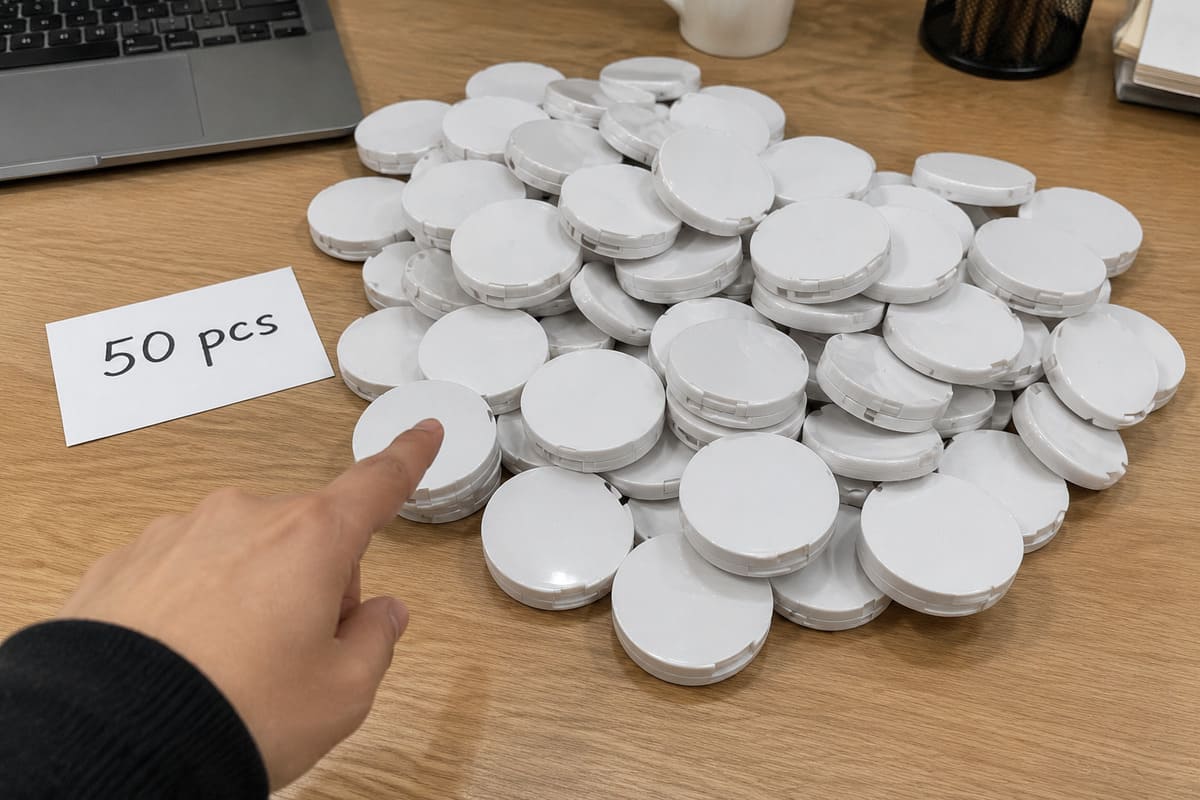
The "low MOQ" number is not a lie by itself. The illusion is the implication that 50 units equals a unique, ownable product. It does not. Here is what each tier actually gets you:
| Order Size | What You Actually Get | Brand Differentiation |
|---|---|---|
| 50–100 units | Generic stock, your sticker | None |
| 500 units | Stock with minor packaging swap | Very low |
| 2,000 units | Standard product, custom branding | Moderate |
| 5,000–10,000 units | Custom molds, exclusive formulas/shades | High |
I will not tell you a 50-unit order builds a unique brand. That would be selling you a fantasy. The honest path costs a little more upfront and protects your brand identity for years.
What Is the Real Starting Line: 2,000 Units to Validate or 5,000+ to Customize?
You have a limited first-order budget and a big dream. You want something unique, but you also cannot risk your savings on unsold inventory. So what quantity actually makes sense for a first order? This is where most founders freeze.
The real starting line has two tiers. To validate a market, order around 2,000 units of a standard product with your custom branding, which a $5,000 budget can typically support. To build a fully custom, exclusive brand with proprietary molds and formulas, scale to 5,000–10,000 units. Validate first, then customize once demand is proven.
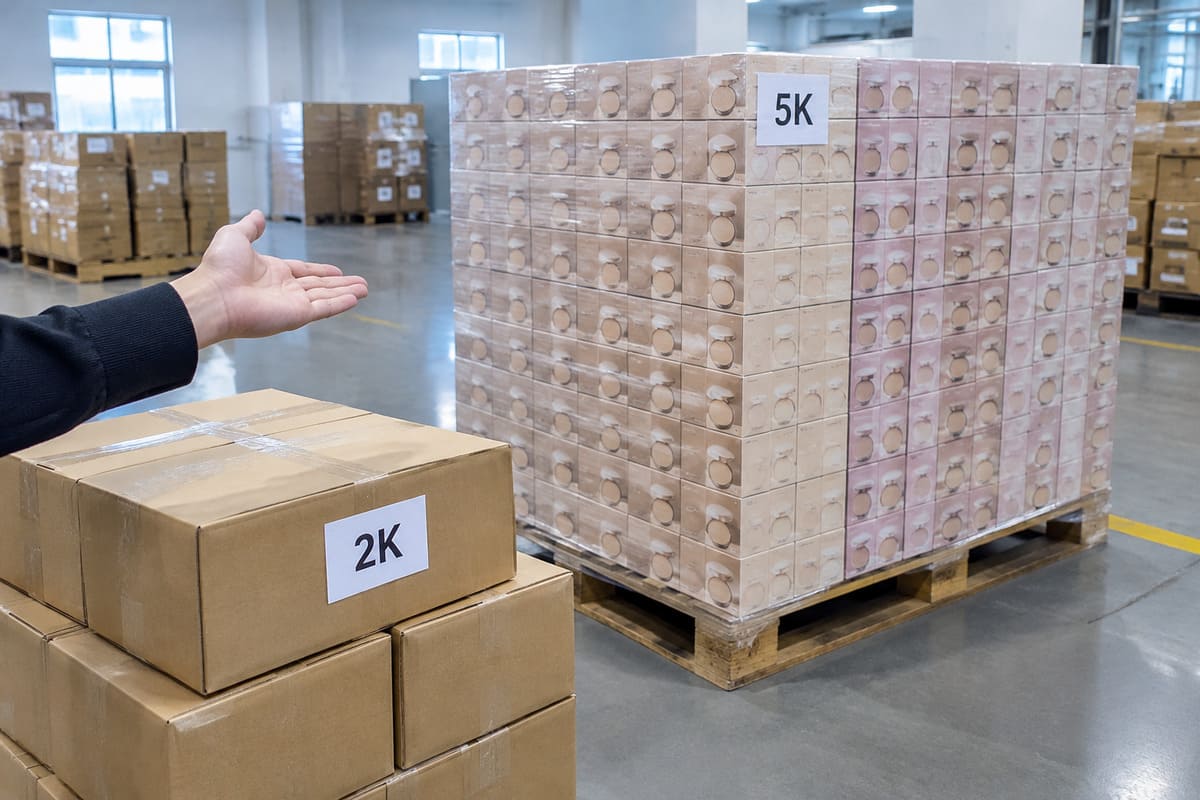
This is exactly how I helped the European founder recover. We offered him a 2,000-unit trial on our standard eyeshadow palettes so he could test real market demand without gambling on custom tooling. He validated his product, avoided the trading company trap entirely, and is now preparing a 5,000-unit custom order with us.
A Realistic Budget Boundary
Let me be direct about money, because vague promises are how buyers get hurt:
| Budget | Realistic Option | Outcome |
|---|---|---|
| ~$5,000 | 2,000-unit standard palette, custom branding | Validate the market |
| $15,000+ | 5,000–10,000 units, custom molds/formulas | Build an exclusive brand |
If you have a $5,000 budget, validate with a 2,000-unit standard palette. If you want a fully custom, exclusive brand, scale to the 5,000–10,000 unit tier. My job is to help you make that leap safely when your numbers are ready, not to push you into tooling costs before you have a single confirmed customer.
What Compliance Documents Must a Real Makeup Manufacturer in China Provide?
You found a real factory, verified the license, and ran the video call. Then customs or a marketplace asks for compliance paperwork you have never heard of. A missing document can freeze your shipment at the border and burn your launch window. Compliance is where many first-time brands stumble.
A real makeup manufacturer in China should help you obtain the documents your target market requires. For the US, this means MoCRA facility registration (FEI number)6 and accurate INCI ingredient lists7. For the EU, this means REACH-compliant ingredients and CPNP-ready documentation8. Treat every certificate as a document you must independently verify, and consult a qualified regulatory professional for your specific market.
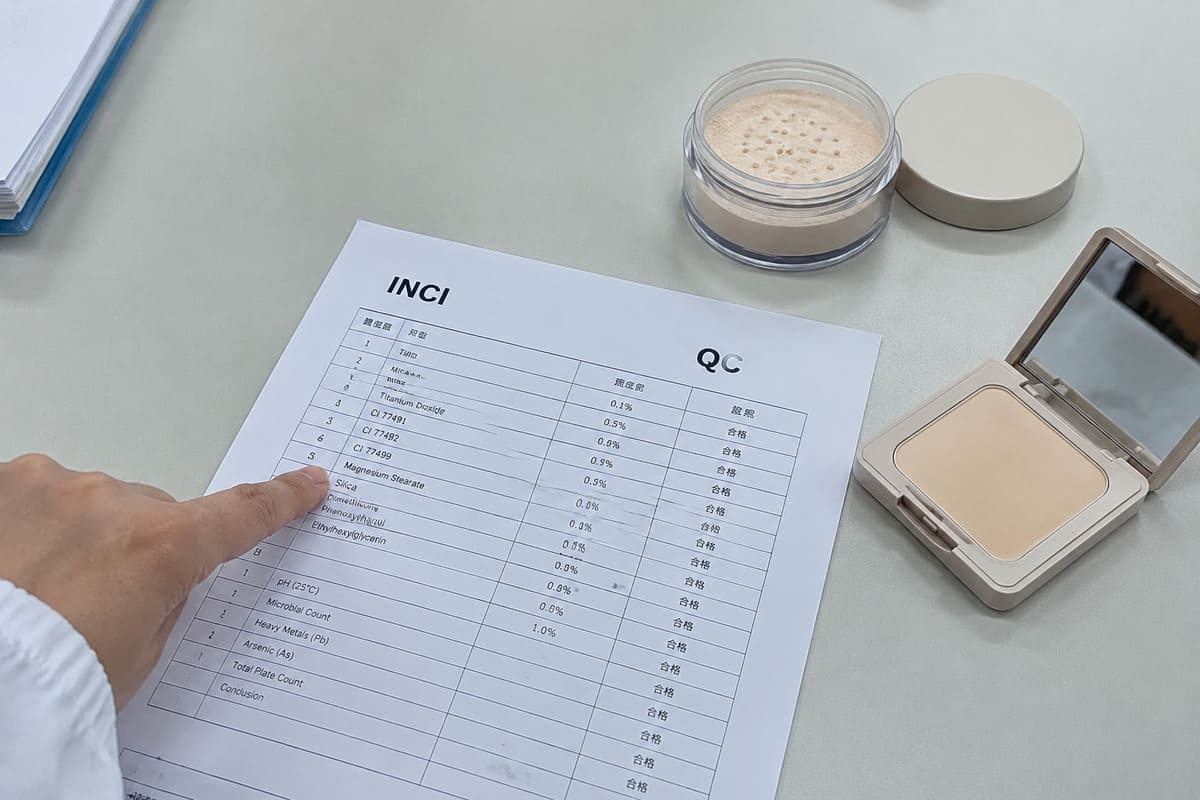
I want to be careful and honest here. I can supply documentation to support your legal obligations, but I am not your regulatory lawyer. You should verify every certification yourself and get application-specific advice from a licensed compliance professional. Here is a market-by-market reference:
| Target Market | Key Requirements | Supplier's Role |
|---|---|---|
| United States | MoCRA facility registration (FEI), INCI list | Provide facility registration support and accurate INCI |
| European Union | REACH ingredients, CPNP notification, Responsible Person9 | Provide formula and safety data; buyer appoints RP |
| Saudi Arabia / Gulf | SFDA/GSO cosmetic registration, Arabic labeling10 | Provide formula data and ingredient disclosure |
| Southeast Asia | ASEAN Cosmetic Directive notification11 | Provide product information file support |
How to Handle Certification Claims
Follow a simple rule: treat certifications as documents buyers must verify, not as promises to trust. When a supplier claims a certification, ask for the certificate number and issuing body, then confirm it independently. A transparent factory welcomes this. For anything tied to a specific market or product application, I always recommend a qualified professional evaluation. Compliance is too important to guess.
Frequently Asked Questions
How do I know if a makeup manufacturer in China is a real factory or a trading company?
Ask for a photo of the business license and read the business scope. A real factory lists "Manufacturing/Production," while a trading company lists "Sales/Trading." Follow up with a live, dated video tour of the production lines. These two free steps filter out most middlemen before you pay anything.
What is a realistic MOQ for a custom cosmetics brand?
For a fully custom brand with proprietary molds and exclusive formulas, the realistic MOQ is 5,000–10,000 units. To simply validate a market first, you can order around 2,000 units of a standard product with custom branding. Any supplier promising 50 units of a "custom brand" is selling relabeled stock.
Can I visit a makeup manufacturer in China without flying to China?
Yes. Request a live video call where the supplier walks through production lines, pressing machines, and raw materials while holding a paper with the current date. A trading company cannot fake a moving production line in real time. This remote verification is the single most effective anti-scam tool I recommend.
What certifications do I need to sell cosmetics in the US?
For the US market, you generally need MoCRA facility registration with an FEI number and accurate INCI ingredient labeling. Requirements change and depend on your specific product, so verify current rules and consult a qualified regulatory professional before launch. I provide the documentation to support these obligations.
Why are hidden mold fees so common, and how do I avoid them?
Some suppliers reveal mold or tooling fees only after you pay a deposit, trapping you between losing the deposit and doubling your budget. Avoid this by requesting the full mold cost in writing before any payment. A genuine makeup manufacturer in China provides tooling costs upfront without hesitation.
Conclusion
Choosing the right makeup manufacturer in China comes down to verification, not trust. Run the three steps every time: check the business license scope, demand a live dated video tour, and reality-check the MOQ. Remember that 50 units buys generic stock, 2,000 units validates your market, and 5,000–10,000 units builds a true custom brand. Insist on upfront mold costs and verifiable compliance documents. I built my factory to be a transparent, long-term partner, not a $500 white-label reseller. If you are ready to verify a real factory and start safely, reach out for a live video tour and a 2,000-unit validation plan.
"Asian Cosmetics in Global Market: A Comparative Study of ...", https://dash.harvard.edu/bitstreams/a61452e7-2ccb-40a6-ba81-ba9a7ee77dab/download. Market analyses rank China among the leading countries by cosmetics production volume and export value. Evidence role: general_support; source type: institution. Supports: China is among the largest cosmetics manufacturing and export economies globally.. Scope note: Scale and export leadership do not directly establish that infrastructure is 'the best,' which is a qualitative judgment not captured by production statistics. ↩
"How to Find a Cosmetics Manufacturer: A Buyer's Guide to Verifying ...", https://vertinabeauty.com/how-to-find-a-cosmetics-manufacturer-a-buyers-guide-to-verifying-real-factories/. Industry and regulatory data indicate that Guangdong province concentrates a substantial portion of China's licensed cosmetics production enterprises and output. Evidence role: statistic; source type: government. Supports: Guangdong accounts for a large proportion of China's cosmetics manufacturing output.. Scope note: Official figures typically report national or provincial manufacturing output rather than a specific global market share of color cosmetics, so the source supports concentration rather than the exact 'huge share of global' framing. ↩
"Evaluating the drivers of B2B performance - PMC - NIH", https://pmc.ncbi.nlm.nih.gov/articles/PMC11244795/. Research on cross-border sourcing documents the prevalence of trading intermediaries presenting themselves as direct manufacturers on online B2B platforms. Evidence role: general_support; source type: research. Supports: A meaningful proportion of suppliers presenting as manufacturers on B2B platforms are trading intermediaries.. Scope note: Available studies rarely report a precise percentage specific to the cosmetics category, so they support the general pattern but not the article's exact 70% figure. ↩
"Alibaba Verified Suppliers: What the Badge Does and ...", https://www.cosmosourcing.com/blog/what-are-alibaba-verified-suppliers. Published platform verification criteria describe checks on business registration and documentation, which do not inherently confirm ownership of production facilities. Evidence role: definition; source type: other. Supports: Platform verification programs confirm business existence and documentation rather than guaranteeing in-house production.. Scope note: This references a specific platform's stated criteria; verification scope varies across platforms and tiers, so it is contextual rather than universal. ↩
"China - Licensing Requirements for Professional Services", https://www.trade.gov/country-commercial-guides/china-licensing-requirements-professional-services. Chinese company registration regulations define the business scope recorded on the business license as the set of activities a registered enterprise is authorized to undertake. Evidence role: definition; source type: government. Supports: The business scope field on a Chinese business license legally defines the activities a company is authorized to conduct.. Scope note: Regulatory sources define the field's legal function but do not quantify how reliably scope wording distinguishes genuine factories from intermediaries in practice. ↩
"Registration & Listing of Cosmetic Product Facilities and ...", https://www.fda.gov/cosmetics/registration-listing-cosmetic-product-facilities-and-products. FDA guidance under the Modernization of Cosmetics Regulation Act sets out facility registration requirements, including use of a Facility Establishment Identifier (FEI) number. Evidence role: definition; source type: government. Supports: MoCRA requires cosmetic manufacturing and processing facilities to register with the FDA, using an FEI number.. Scope note: Regulatory requirements and enforcement timelines are periodically updated, so the source supports the requirement as published rather than guaranteeing current applicability to a specific product. ↩
"International Nomenclature of Cosmetic Ingredients", https://en.wikipedia.org/wiki/International_Nomenclature_of_Cosmetic_Ingredients. The International Nomenclature of Cosmetic Ingredients (INCI) provides a standardized naming system used for declaring cosmetic ingredients on labels across multiple jurisdictions. Evidence role: definition; source type: institution. Supports: INCI is the standardized international nomenclature used to name cosmetic ingredients on product labels.. Scope note: The naming system is standardized, but how it is required on labels varies by jurisdiction, so the source supports the definition rather than market-specific labeling obligations. ↩
"What Ingredients Should I Avoid in Eye Shadow? A ... - Vertina Beauty", https://vertinabeauty.com/what-ingredients-should-i-avoid-in-eye-shadow-a-compliance-guide-for-buyers/. The EU Cosmetic Products Regulation requires notification through the Cosmetic Products Notification Portal, alongside chemical compliance obligations under REACH. Evidence role: definition; source type: government. Supports: EU cosmetics placed on the market require notification via the CPNP portal and ingredient compliance under applicable chemicals regulation.. Scope note: REACH applies to chemical substances broadly and interacts with the Cosmetics Regulation in specific ways, so its role for cosmetics is contextual rather than a standalone requirement. ↩
"What Ingredients Should I Avoid in Eye Shadow? A Compliance ...", https://vertinabeauty.com/what-ingredients-should-i-avoid-in-eye-shadow-a-compliance-guide-for-buyers/. Regulation (EC) No 1223/2009 requires that each cosmetic product placed on the EU market have a designated Responsible Person established within the EU. Evidence role: definition; source type: government. Supports: EU law requires a designated Responsible Person established in the EU for each cosmetic product placed on the market.. Scope note: The regulation defines the obligation; it does not address the article's claim about the division of documentation duties between supplier and buyer. ↩
"Saudi Arabia - Labeling/Marking Requirements", https://www.trade.gov/country-commercial-guides/saudi-arabia-labelingmarking-requirements. Saudi Food and Drug Authority and GSO technical regulations set out cosmetic registration and labeling requirements, including language provisions for the regional market. Evidence role: definition; source type: government. Supports: Cosmetic products in Saudi Arabia and Gulf markets require registration with the relevant authority and labeling consistent with regional standards.. Scope note: Requirements differ across individual Gulf states, so a single source supports the general framework rather than every market's specific labeling rule. ↩
"What Ingredients Should I Avoid in Eye Shadow? A Compliance ...", https://vertinabeauty.com/what-ingredients-should-i-avoid-in-eye-shadow-a-compliance-guide-for-buyers/. The ASEAN Cosmetic Directive sets out a harmonized notification scheme and product information file requirements for cosmetics marketed in member states. Evidence role: definition; source type: institution. Supports: The ASEAN Cosmetic Directive establishes a harmonized notification scheme for cosmetic products in member states.. Scope note: Implementation is carried out through each member state's national authority, so the directive supports the framework while specific procedures remain country-dependent. ↩