Finding the right makeup manufacturer feels like a gamble. You worry about high minimums, slow lead times, and generic formulas that make your brand look like everyone else. Worse, you fear tying up cash in unsold inventory before your first sale. I wrote this guide to remove that fear and show you a smarter path.
A makeup manufacturer is a production partner that develops, formulates, and produces cosmetic products for your brand1. The best makeup manufacturer does more than fill boxes. It balances speed, cost, and risk by offering tiered MOQs, fast lead times, and a staged path from market validation to full customization, so new brands can test before they scale2.
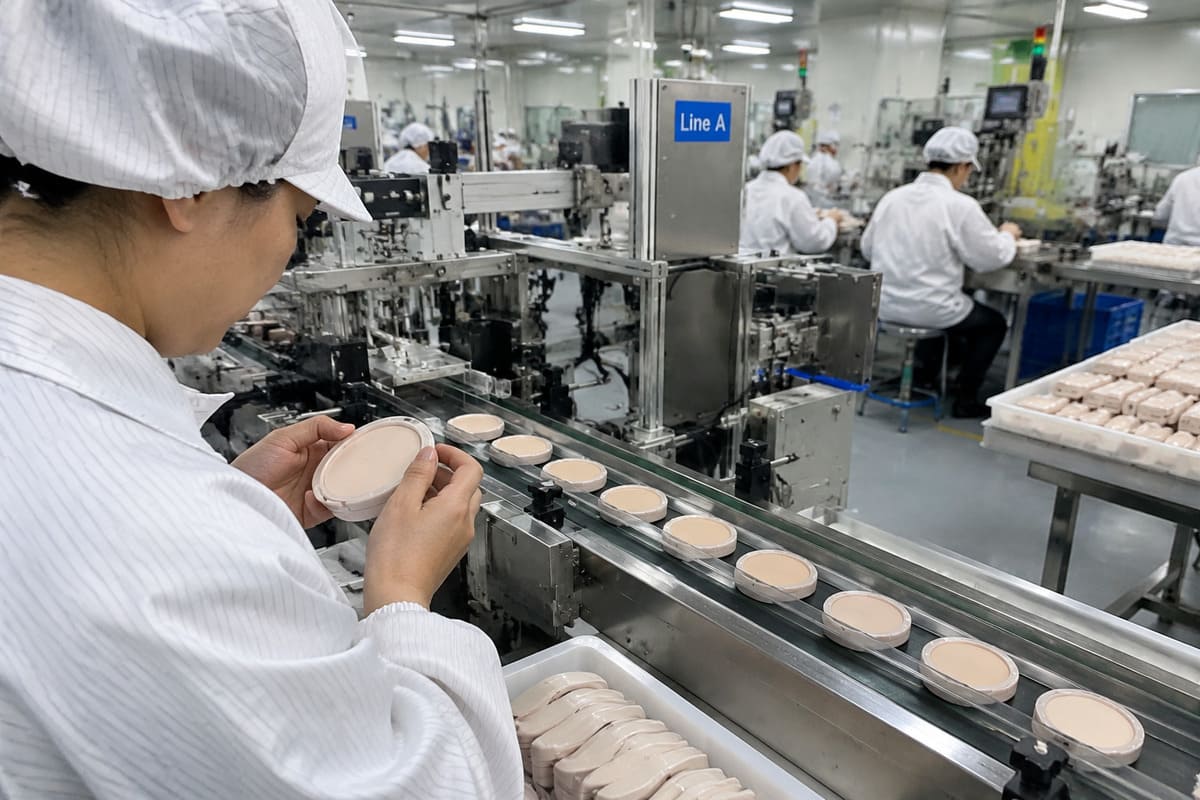
That answer sounds simple. The reality underneath it is where most founders stumble. Below, I break down what this partnership really means, the three supply chain stages every growing brand passes through, and how to start with almost no risk.
What Does "Makeup Manufacturer" Really Mean for a Brand Founder?
Most founders type "makeup manufacturer" into Google expecting to find a factory address. Then they get buried in quotes, MOQ sheets, and lead-time jargon. The real problem is not finding a factory. The problem is finding one that will not sink your cash flow.
For a brand founder, a makeup manufacturer is a supply chain partner, not just a production site. The right partner helps you launch without getting trapped by high MOQ, slow delivery, or zero product differentiation. It guides your first order toward low risk instead of pushing you toward a large, speculative commitment.
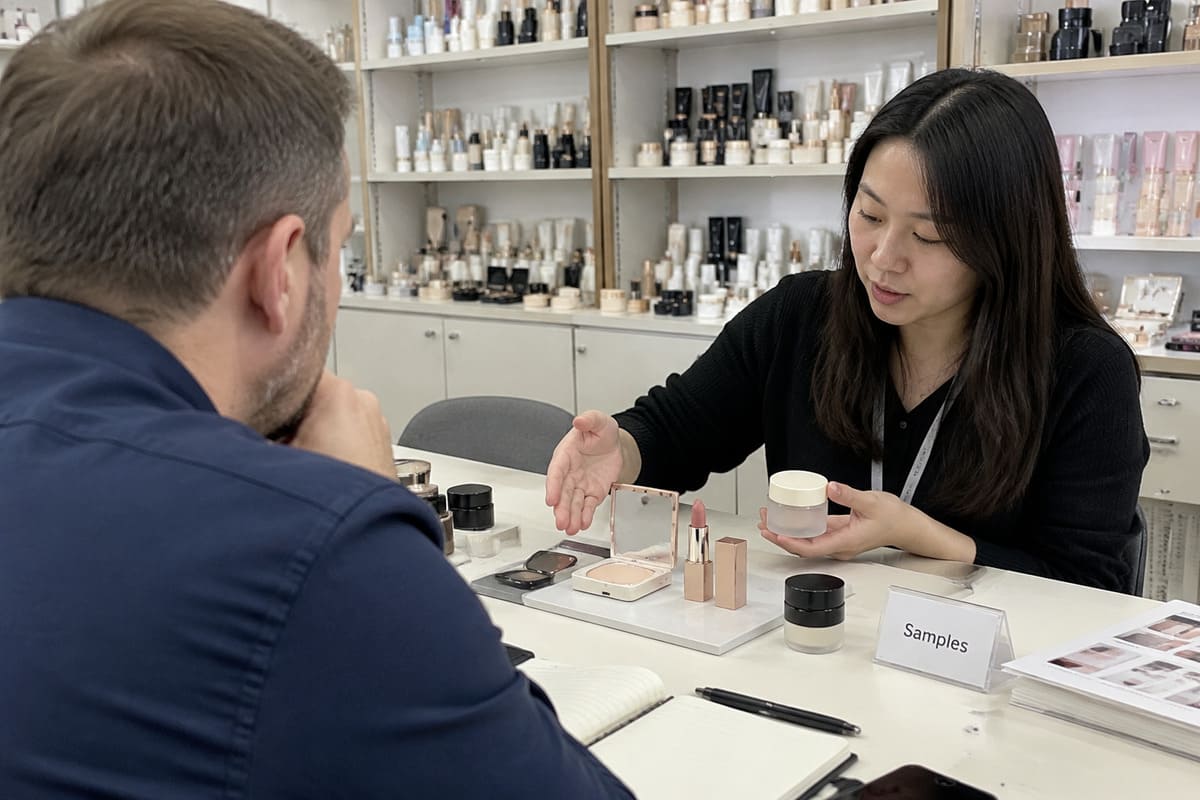
Here is the shift in thinking. When you search for a makeup manufacturer, you are not really asking "Who can make my makeup?" You are asking a harder question: "How do I manufacture my products without getting stuck with high MOQ, slow lead times, and zero differentiation?"
The Question Behind the Question
I talk to founders every week. Their stated request and their real fear rarely match. The table below shows what I actually hear.
| What the buyer says | What the buyer fears |
|---|---|
| "What's your price per unit?" | "Will I tie up cash in unsold stock?3" |
| "What's your MOQ?" | "Am I forced to over-commit on my first order?" |
| "Can you make a custom palette?" | "Will I spend $20,000 testing a hunch?" |
| "How fast can you ship?" | "Will I miss the trend window?" |
A good makeup manufacturer answers the right-hand column. I see my job as risk management first and production second. If I help you survive your launch, you come back for years. If I push a big order and you fail, I lose a partner. The incentives line up when I protect your downside.
What Are the 3 Supply Chain Stages of a Growing Beauty Brand?
New founders often think manufacturing is one single step: pay money, get product. That belief causes the most expensive mistakes I see. They jump straight to full customization, order 10,000 units, and discover too late that their shades do not sell.
A growing beauty brand moves through three supply chain stages: Market Validation (private label), Differentiation (semi-custom), and Brand Asset Building (full OEM/ODM). Each stage carries a different MOQ and risk level. Smart brands start at validation with low minimums, prove demand, then scale into customization. Skipping stages is the most common cause of early failure.
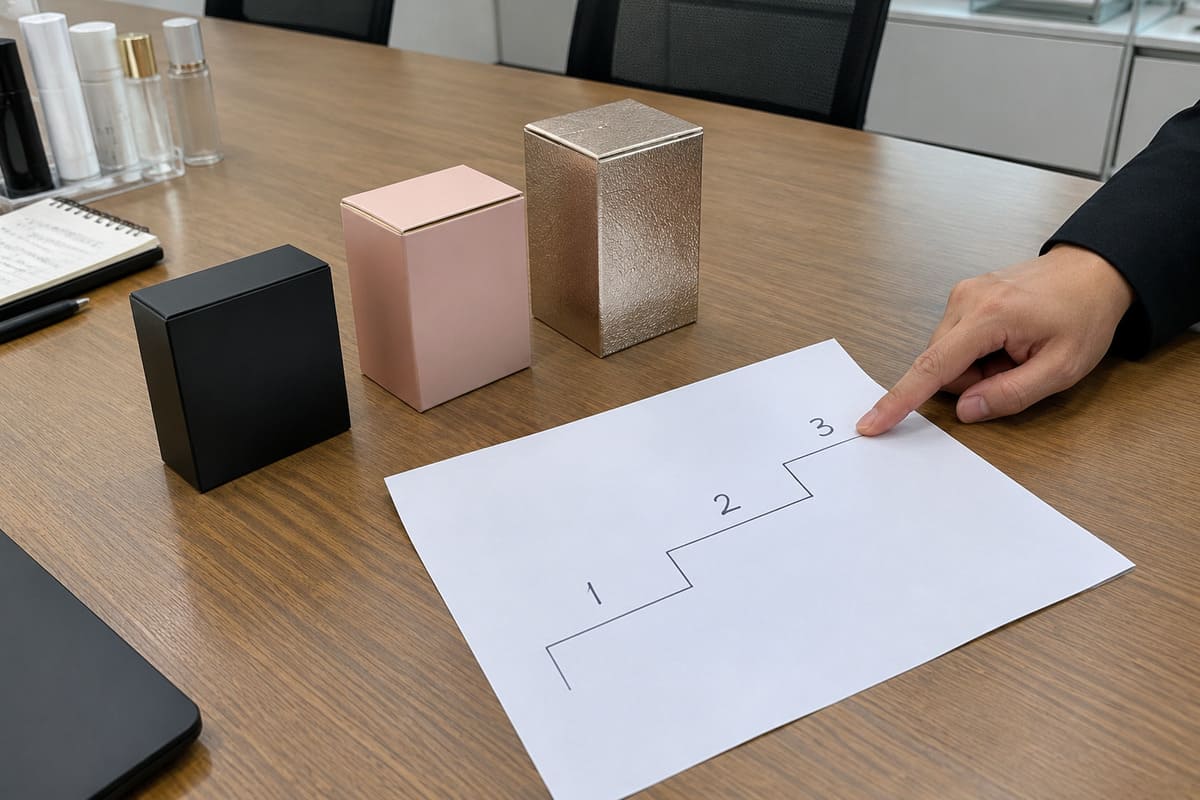
Let me walk through each stage, because understanding this map is the single most useful thing a founder can learn before signing any contract.
Stage 1: Market Validation (Private Label)
You start with standard formulas and existing shades. You add your logo and launch fast.4 The goal is simple: find out whether real customers buy your product. At this stage with us, selected standard eyeshadow palettes start at 2,000 units. That low MOQ keeps your initial cash flow risk small while you learn.
Stage 2: Differentiation (Semi-Custom)
Once your audience is validated, you make the product your own. We tweak standard formulas, adjust pigment loads, or add custom logo and packaging. MOQ typically scales to 5,000–10,000 units. You spend more now because you already have proof that demand exists.
Stage 3: Brand Asset Building (Full OEM/ODM)5
For established brands, we develop exclusive formulas and custom-molded packaging. This builds a long-term moat that competitors cannot copy easily. Higher MOQs apply, but by now you have the sales data and capital to justify them.
| Stage | Model | What changes | Typical MOQ | Risk level |
|---|---|---|---|---|
| 1. Market Validation | Private Label | Logo on standard product | From 2,000 units | Low |
| 2. Differentiation | Semi-Custom | Formula tweaks, custom packaging | 5,000–10,000 units | Medium |
| 3. Brand Asset Building | Full OEM/ODM | Exclusive formula and molds | Higher | High |
The lesson threaded through all three stages is the same: test first, scale later.
Why Fast Response and Low MOQ Matter More Than "Made in USA"?
Many founders assume a U.S. makeup manufacturer is automatically the safest choice. Then they get the quote: high minimums, long lead times, and often a forced choice from generic ready-made formulas. The "safe" option quietly becomes the risky one for a cash-strapped startup.
Fast response and low MOQ matter more than country of origin because they directly control your startup risk. U.S. manufacturers offer great domestic service but often require high minimums and long lead times. A makeup manufacturer that offers tiered MOQ and quick production lets you test the market cheaply, adapt to trends fast, and avoid dead inventory6. Agility beats geography for new brands.
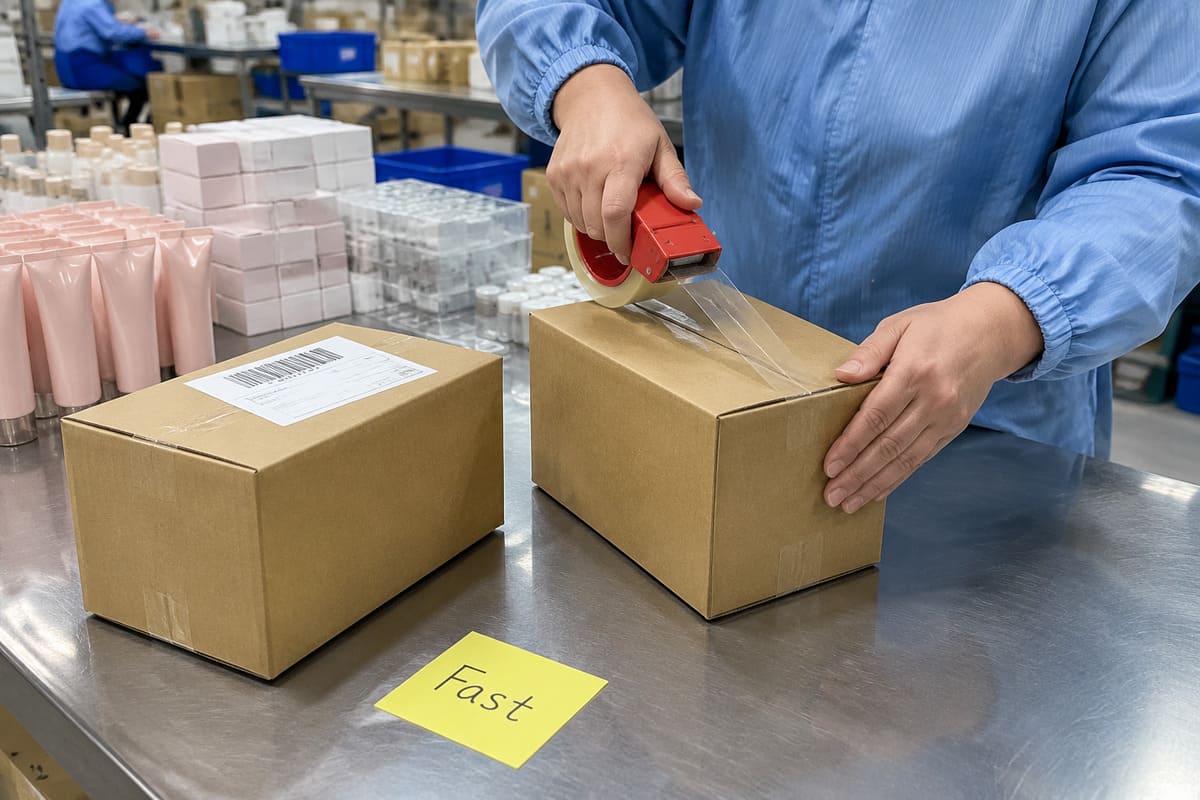
I am based in one of the core supply chain clusters in Guangdong, China7. That location is not a marketing line. It means pigment suppliers, packaging workshops, and testing labs sit within an hour of my factory. That density is why I can offer faster production cycles and lower startup MOQs without sacrificing quality control or export compliance.
A Clear-Eyed Comparison
I will not pretend one model wins every time. The right choice depends on your stage. Here is how I see it.
| Factor | Typical U.S. Manufacturer | Our Guangdong Model |
|---|---|---|
| Startup MOQ | Often high | Tiered, from 2,000 units |
| Lead time | Can be long | Faster cycles, some stock ready |
| Customization | Sometimes limited to ready-made | Full ODM/OEM available |
| Domestic shipping speed | Excellent | Export logistics required |
| Cost structure | Higher | Competitive |
If you need product in a U.S. customer's hands tomorrow, domestic wins on last-mile speed. If you need to launch a brand affordably and test shades without betting your savings, agility and low MOQ win. For most founders at Stage 1, the second need is the urgent one.
The Real Conversation: How We Help Founders Avoid Inventory Nightmares?
Let me drop the theory and tell you what actually happens when a founder calls me. These conversations are where risk management becomes real, and they are the reason I sleep well at night.
We help founders avoid inventory nightmares by challenging oversized first orders before they happen. When a founder asks for a large fully custom run, we ask whether the product has been tested with real customers. If not, we steer them toward a small private-label trial. This protects their cash and builds a relationship based on their survival, not a quick sale.
A Scenario From Last Month
Last month, a U.S. DTC brand founder contacted me. He wanted a fully custom 12-shade palette, ready to go. Most factories would have cheered and sent an invoice. I asked him one question first: "Have you tested these shades with your target audience yet?"
He said no.
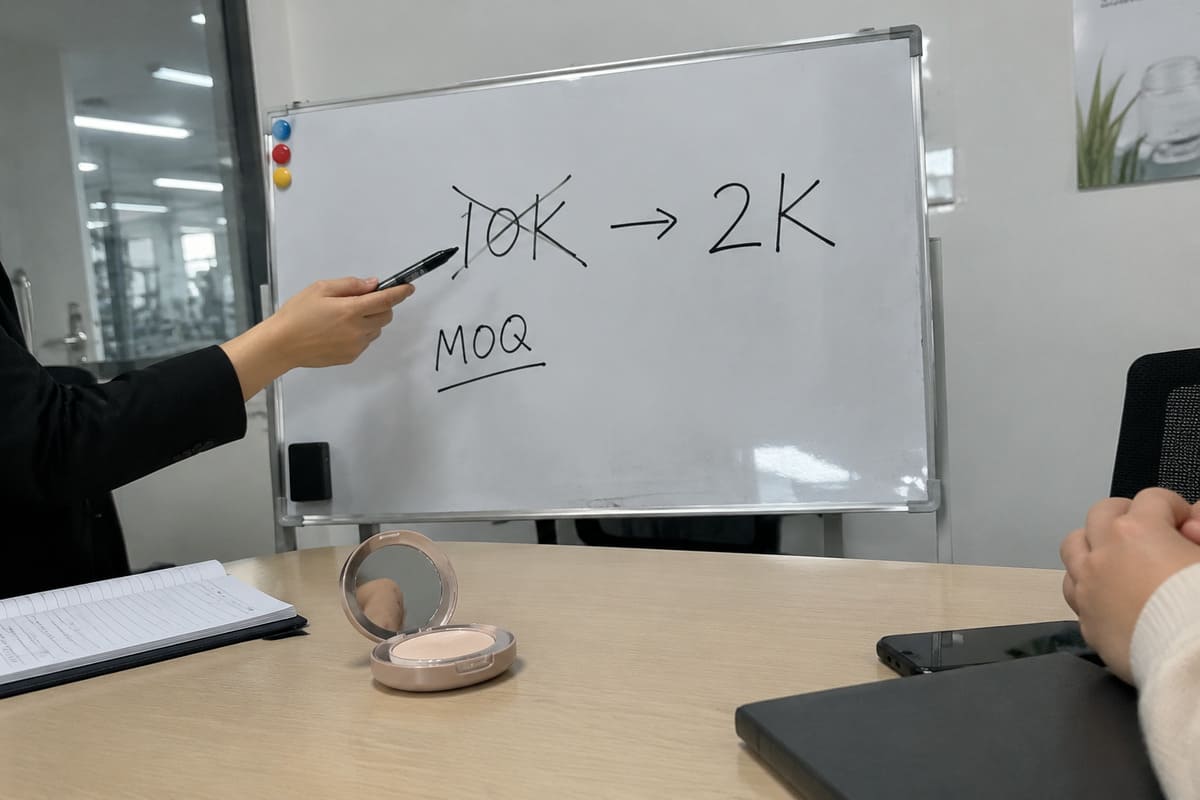
So I gave him the advice I give everyone in his position. I told him: "Don't spend $20,000 on 10,000 units just to test a hunch. Launch with our standard 6-shade palette with your logo at 2,000 units. Test the market. Once you prove the demand, come back and I'll help you build the custom one."
He agreed. We shipped within weeks. That is not just manufacturing. That is risk management for a brand that could easily have died on its first order. I would rather earn a smaller order and a loyal partner than a big order and a founder who never returns because his garage is full of unsold palettes.
A new brand should not start with a huge MOQ. It should start with a smart MOQ.
What MOQ and Customization Realities Should You Know Before Committing?
Founders often get vague promises on minimums and certifications, then feel ambushed later by fine print. I would rather be blunt up front, even when the truth is less exciting than a sales pitch.
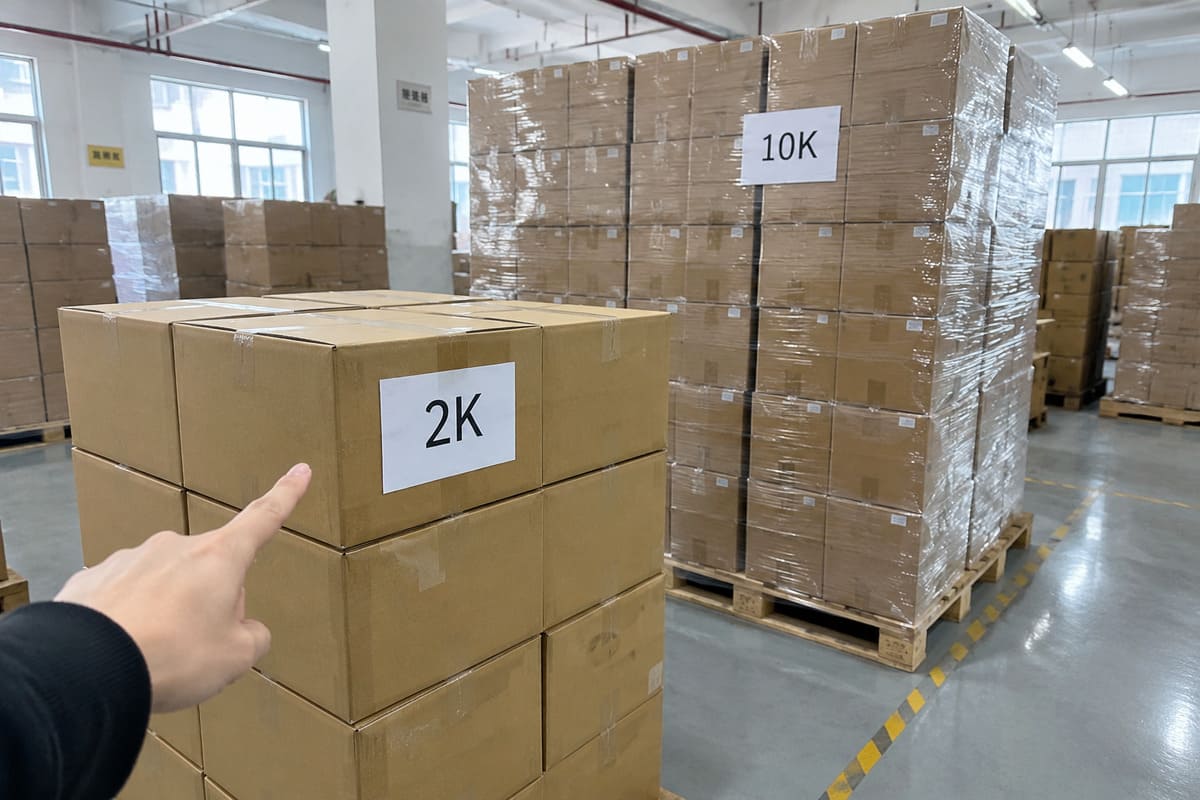
Before committing to a makeup manufacturer, know that MOQ is tiered by customization level and that certifications depend on your target market. Selected standard eyeshadow palettes start at 2,000 units. Most other products require 5,000–10,000 units depending on formulation and packaging. Treat all certifications as documents you must verify for your specific destination market.
The Honest MOQ Breakdown
Here is how minimums actually work in practice. No surprises.
| Product type | Customization | Realistic MOQ |
|---|---|---|
| Standard eyeshadow palette | Logo only (private label) | From 2,000 units |
| Blush, powder, highlighter | Minor tweaks + packaging | 5,000–10,000 units |
| Custom formula or shade | Semi-custom to full ODM | 5,000–10,000+ units |
| Exclusive formula + custom mold | Full OEM/ODM | Higher, quoted per project |
Compliance Is a Document You Must Verify
Export compliance is serious, and I treat it seriously. Requirements differ by market. I cannot wave a single certificate and claim it covers the world. For market-specific rules, you should confirm the current requirements with a qualified compliance professional and the destination authority.
| Target market | Common framework to verify |
|---|---|
| [United States | FDA cosmetic regulations (MoCRA)](https://www.fda.gov/cosmetics/cosmetics-laws-regulations/modernization-cosmetics-regulation-act-2022-mocra)%%%FOOTNOTE_REF_8%%% |
| [European Union | EU Cosmetics Regulation, REACH](https://vertinabeauty.com/eyeshadow-manufacturer-how-can-buyers-find-a-reliable-factory/)%%%FOOTNOTE_REF_9%%% |
| [Saudi Arabia / Gulf | SFDA / GSO registration requirements](https://vertinabeauty.com/how-to-find-a-cosmetics-manufacturer-a-buyers-guide-to-verifying-real-factories/)%%%FOOTNOTE_REF_10%%% |
| [Southeast Asia | ASEAN Cosmetic Directive notifications](https://vertinabeauty.com/what-ingredients-should-i-avoid-in-eye-shadow-a-compliance-guide-for-buyers/)%%%FOOTNOTE_REF_11%%% |
I know the U.S. and EU frameworks well and follow their updates closely. Still, I will always tell you to verify your specific product and market with a professional. That honesty protects both of us.
What I Will and Will Not Promise
- What I do: offer tiered MOQ, transparent lead times, and clear testing processes.
- What I don't do: push a startup to go full custom on day one.
- Realistic boundary: I can guarantee the quality of the supply chain. I cannot guarantee your marketing will work. Those are two different jobs.
How Can You Start with a Low-Risk Trial Order Today?
The scariest part of launching is the first check you write. Many founders freeze here, afraid that one wrong move drains the budget. The fix is a trial order structured to make failure cheap and success repeatable.
You start with a low-risk trial order by choosing a standard private-label product at the lowest tier, adding only your logo, and ordering the minimum validation quantity. With us, that means selected standard eyeshadow palettes from 2,000 units. You test real demand, keep cash free, and scale into customization only after the market confirms your idea.
Your First-Order Checklist
- Pick a proven standard product. Start with a best-selling palette format, not an unproven 12-shade concept.
- Keep customization to your logo. Save formula changes for Stage 2.
- Order the validation minimum. From 2,000 units on selected palettes keeps risk low.
- Set a clear test goal. Decide what sell-through number proves demand before you reorder.
- Plan the scale path. Once validated, move into semi-custom with confidence.
Think of the trial order as buying information, not just product. The 2,000 units teach you whether your audience actually wants what you imagined. That lesson is worth far more than the units themselves.
Frequently Asked Questions
What is the lowest MOQ a makeup manufacturer should offer a new brand?
For a new brand, a smart entry MOQ is low enough to test the market without draining cash. We start selected standard eyeshadow palettes at 2,000 units with your logo. Most other products sit at 5,000–10,000 units, depending on formulation and packaging complexity.
Should I start with private label or full custom manufacturing?
Start with private label. Based on our experience serving global B2B buyers, brands that fail usually make one mistake: they go full OEM before validating the market12. Test standard formulas with your logo first. Once demand is proven, move into semi-custom and then full customization with real sales data behind you.
Is a Chinese makeup manufacturer safe for export markets?
It can be, provided the manufacturer practices strict quality control and understands export compliance. Compliance requirements differ by destination, so treat every certification as a document you must verify with a qualified professional and the local authority for your specific product and market.
How long does a trial order take to produce?
Lead times vary by product and stock levels. Because we keep some standard items ready and sit inside a dense Guangdong supply cluster, we often ship trial private-label orders within weeks. I always confirm an exact timeline in writing before you commit.
Can a makeup manufacturer guarantee my product will sell?
No honest partner can. I guarantee the quality and reliability of the supply chain. I cannot guarantee your marketing results. Those are separate jobs. My role is to make sure production never becomes the reason your launch fails.
Conclusion
Choosing the right makeup manufacturer is a risk-management decision, not just a sourcing task. The founders who win do not chase the cheapest factory or the fanciest custom palette on day one. They move through the three supply chain stages in order: validate the market with low-MOQ private label, differentiate with semi-custom, then build brand assets with full OEM/ODM. Fast response and tiered minimums protect your cash while you learn what sells. Test first, scale later. If you are ready to launch smart, reach out and I will help you design a low-risk trial order that fits your stage.
"Cosmetics & U.S. Law", https://www.fda.gov/cosmetics/cosmetics-laws-regulations/cosmetics-us-law. Regulatory guidance on cosmetic manufacturing describes the activities of formulating, producing, and processing cosmetic products, including arrangements where production is carried out by a party other than the brand owner. Evidence role: definition; source type: government. Supports: That cosmetic manufacturing encompasses formulation, production, and processing of cosmetic products, often performed by third parties for brand owners.. Scope note: Regulatory definitions describe manufacturing activities generally and may not use the specific commercial term 'makeup manufacturer' or the brand-partner framing used in the article. ↩
"Minimum viable product", https://en.wikipedia.org/wiki/Minimum_viable_product. Entrepreneurship and product-development scholarship describes validated learning and minimum-viable-product approaches, in which small-scale testing of demand precedes large commitments as a means of reducing uncertainty and sunk cost. Evidence role: mechanism; source type: paper. Supports: That iterative, small-scale validation of customer demand before full-scale commitment is a recognized approach to reducing early-stage venture risk.. Scope note: This literature addresses venture and product strategy broadly and does not specifically quantify outcomes for cosmetics manufacturing order sizes. ↩
"Inventory Carrying Costs: Analysis, Calculation, and ...", https://intuendi.com/resource-center/inventory-carrying-costs/. Operations and financial-management literature explains that inventory ties up working capital and incurs holding costs, so excess or slow-moving stock reduces available cash and raises financial risk. Evidence role: mechanism; source type: education. Supports: That inventory held but not sold represents committed working capital and carrying costs that constrain a firm's cash flow.. Scope note: The supporting literature addresses inventory economics generally rather than quantifying risk for early-stage cosmetics brands specifically. ↩
"How Can I Create My Own Makeup Brand? (A Startup Founder's ...", https://vertinabeauty.com/how-can-i-create-my-own-makeup-brand-a-startup-founders-guide-to-first-launch/. Reference sources define private label as goods produced to a common specification and marketed under the brand of the seller rather than the manufacturer, enabling brands to launch without original product development. Evidence role: definition; source type: encyclopedia. Supports: That private label refers to products manufactured to a standard specification and sold under a retailer's or brand's own label rather than the manufacturer's.. Scope note: General definitions describe the model across retail sectors and are not specific to cosmetics shade standardization. ↩
"Original design manufacturer", https://en.wikipedia.org/wiki/Original_design_manufacturer. Reference definitions distinguish original equipment manufacturing, in which a producer makes goods to a client's specification, from original design manufacturing, in which the producer also develops the design, which the client markets under its own brand. Evidence role: definition; source type: encyclopedia. Supports: That OEM and ODM denote different manufacturing relationships, with ODM arrangements including design or formulation developed by the manufacturer.. Scope note: Standard definitions apply across manufacturing industries and do not address cosmetics-specific formulation ownership. ↩
"The Value of Fast Fashion: Quick Response, Enhanced ...", https://repository.upenn.edu/bitstreams/beda918a-6166-42f8-9618-d8dc0d9ac40a/download. Supply-chain research on quick-response and responsive manufacturing finds that shorter lead times improve demand matching and lower markdown and obsolescence risk for trend-sensitive goods. Evidence role: mechanism; source type: paper. Supports: That shorter lead times and responsive production improve a firm's ability to match supply to demand and reduce the risk of obsolete or unsold inventory.. Scope note: This research is drawn largely from apparel and fast-moving consumer goods and is applied by analogy to cosmetics rather than measured directly in that sector. ↩
"How to Find a Cosmetics Manufacturer: A Buyer's Guide to Verifying ...", https://vertinabeauty.com/how-to-find-a-cosmetics-manufacturer-a-buyers-guide-to-verifying-real-factories/. Industry and economic-geography analyses identify Guangdong province as a leading center of China's cosmetics production, with a dense concentration of ingredient suppliers, packaging producers, and manufacturers. Evidence role: general_support; source type: research. Supports: That Guangdong province is a major concentration of China's cosmetics manufacturing, supplier, and packaging activity.. Scope note: Cluster descriptions characterize the region in aggregate and do not verify the proximity or capabilities of any individual facility. ↩
"Modernization of Cosmetics Regulation Act of 2022 (MoCRA)", https://www.fda.gov/cosmetics/cosmetics-laws-regulations/modernization-cosmetics-regulation-act-2022-mocra. The U.S. Food and Drug Administration administers the Modernization of Cosmetics Regulation Act of 2022, which establishes requirements such as facility registration and product listing for cosmetics marketed in the United States. Evidence role: general_support; source type: government. Supports: That the United States regulates cosmetics through the FDA under the Modernization of Cosmetics Regulation Act, including facility registration and product listing obligations.. Scope note: The regulatory framework evolves through phased compliance deadlines, so specific obligations should be confirmed against the current FDA guidance for a given product. ↩
"Eyeshadow Manufacturer: How Can Buyers Find a ... - Vertina Beauty", https://vertinabeauty.com/eyeshadow-manufacturer-how-can-buyers-find-a-reliable-factory/. The European Commission's Regulation (EC) No 1223/2009 governs cosmetic products placed on the EU market, while Regulation (EC) No 1907/2006 (REACH) governs the registration and control of chemical substances. Evidence role: general_support; source type: government. Supports: That cosmetic products in the EU are regulated under Regulation (EC) No 1223/2009 and that chemical substances fall under the REACH framework.. Scope note: The two regulations address overlapping but distinct scopes, and their combined application to a specific cosmetic ingredient may require case-specific interpretation. ↩
"How to Find a Cosmetics Manufacturer: A Buyer's Guide to Verifying ...", https://vertinabeauty.com/how-to-find-a-cosmetics-manufacturer-a-buyers-guide-to-verifying-real-factories/. The Saudi Food and Drug Authority and the Gulf Standardization Organization publish registration and conformity requirements applicable to cosmetic products marketed in Saudi Arabia and the Gulf Cooperation Council states. Evidence role: general_support; source type: government. Supports: That cosmetic products in Saudi Arabia and the Gulf states are subject to registration and conformity requirements administered by the Saudi Food and Drug Authority and Gulf standardization bodies.. Scope note: Requirements vary across individual Gulf states and are periodically revised, so the source supports the existence of the frameworks rather than any fixed procedural detail. ↩
"What Ingredients Should I Avoid in Eye Shadow? A Compliance ...", https://vertinabeauty.com/what-ingredients-should-i-avoid-in-eye-shadow-a-compliance-guide-for-buyers/. The ASEAN Cosmetic Directive establishes a harmonized regulatory scheme among member states, including a product notification requirement for cosmetics placed on member-state markets. Evidence role: general_support; source type: institution. Supports: That ASEAN member states operate a harmonized cosmetic regulatory scheme requiring product notification under the ASEAN Cosmetic Directive.. Scope note: Implementation is carried out through national authorities, so notification procedures and timelines differ between individual member states. ↩
"Product Innovation: 95% of new products miss the mark", https://professionalprograms.mit.edu/blog/design/why-95-of-new-products-miss-the-mark-and-how-yours-can-avoid-the-same-fate/. Studies of startup and new-product failure repeatedly identify lack of market need, or scaling ahead of demand validation, as among the most common failure causes. Evidence role: statistic; source type: research. Supports: That a frequently cited cause of startup and new-product failure is building or scaling before confirming genuine market demand.. Scope note: Available research covers startups and new products broadly and does not isolate OEM commitment in cosmetics as a measured failure cause. ↩