You want to start the most profitable beauty business1, but every guide pushes you toward two dead ends. One says learn a service skill. The other says dropship cheap white-label makeup. Both drain your capital and trap you. There is a third path that actually protects your margins and lets you scale.
The most profitable beauty business to start is a differentiated product brand built on a smart manufacturing strategy, not a service business or a generic white-label store. Service income is capped by your working hours.2 50-unit white-label products have zero differentiation and collapse into price wars. Real profit comes from a product with a supply chain moat, validated at around 2,000 units and scaled at 5,000+ units.

So why do most founders pick the wrong model, and how does the right MOQ strategy change your entire financial outcome? Let me break down the real numbers I see every day as a cosmetics manufacturer. The gap between a $2 profit and an $8 profit is smaller than you think.
What Does "Profitable Beauty Business" Really Mean for Founders?
You type "most profitable beauty business" into Google, hoping for a clear answer. Instead you get vague listicles. Meanwhile your startup cash sits idle, losing value, and your competitors move first.
A profitable beauty business, for a founder, means a model that generates high return on investment (ROI)3 without being capped by your time or crushed by price competition. The real question is not "which service pays most per hour," but "which business model delivers scalable, high-margin growth from limited startup capital."
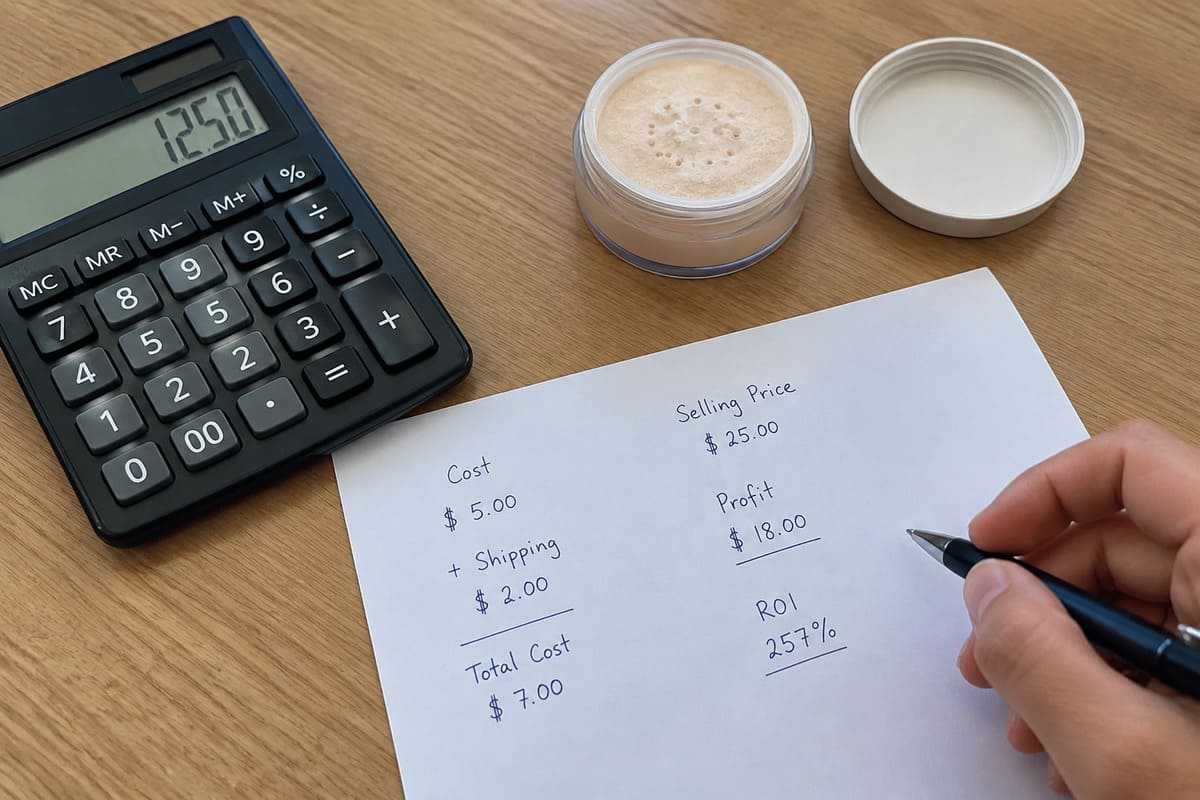
Here is the mindset shift I push every founder to make. You are not asking what skill to learn. You are asking how to protect your capital while building leverage.
The Three Questions Behind the Search
When a buyer asks me "what is the most profitable beauty business," they usually mean three things:
- Scalability: Can this grow without me working 24/7?
- Margin protection: Can I sell at a price that leaves real profit after ads and shipping?
- Capital safety: If this fails, do I lose everything or just a controlled test?
Most advice ignores all three. A service model fails the scalability test. A cheap white-label store fails the margin test. The founders who win treat the business as a financial system, not a hobby.
Think about your startup capital as a limited resource. Every dollar you lock into unsold generic inventory is a dollar you cannot spend on marketing. I have watched brilliant product ideas die not because the product was bad, but because the founder spent 80% of the budget on stock and had nothing left to drive traffic. Profitability is a cash-flow problem before it is a product problem. That truth reframes everything below.
Service vs. Product: The Harsh Truth About Scalability and Profit Margins?
A lash studio looks profitable. You charge $150 for two hours of work. But then you get sick, go on holiday, or hit the ceiling of a 10-hour day. Your income stops the moment you stop.
A service beauty business offers high margin per hour but near-zero scalability, because you sell your time directly. A product beauty business has lower margin per unit but unlimited scalability, because revenue is not tied to your personal labor. For long-term, high-ROI growth, a differentiated product model wins.

So which model actually builds wealth? The answer depends on whether you want a job or an asset.
The Scalability Breakdown
Let me show you the structural difference with real constraints. A service business is bounded by hours in a day. A product business is bounded only by demand and supply chain capacity.
| Factor | Service Model (PMU, Lash) | Generic White-Label | Differentiated Product Brand |
|---|---|---|---|
| Margin per sale | High ($50–$120/hr) | Very low ($1–$2/unit) | Strong ($6–$12/unit) |
| Scalability | None (time-capped) | Low (price-capped) | High (demand-capped) |
| Startup capital | Low | Low–Medium | Medium |
| Differentiation | Your personal skill | Zero | Formula + packaging + brand |
| Can you sell the business? | Rarely | Hard | Yes — it is an asset |
A service business sells your time. The day you stop working, the money stops. I respect PMU artists and lash techs. They earn well per hour. But they cannot clone themselves, and training staff only trades one ceiling for a management headache.
A product business behaves differently. Once you validate a palette that sells, you can order 10x the volume without working 10x the hours. The product becomes an asset that works while you sleep.4 That is the leverage founders are really chasing when they ask about profitability. The question then becomes which product strategy, because not all product models are equal. The next section exposes the trap most beginners fall into.
The "Low MOQ" Profit Illusion: Why 50-Unit White Labels Are a Race to the Bottom?
Fifty-unit minimum orders5 sound like a dream. Low risk, low cost, start today. But that same low barrier is open to everyone else too. You and 5,000 other sellers list the identical palette, and the only lever left is price.
The low-MOQ white-label model is a profit illusion because 50 to 100 unit public formulas carry zero differentiation. Thousands of sellers list the identical product, which forces a price war6. After advertising cost-per-click (CPC) and shipping, net profit per unit approaches zero. Low barrier to entry means low barrier to competition.7
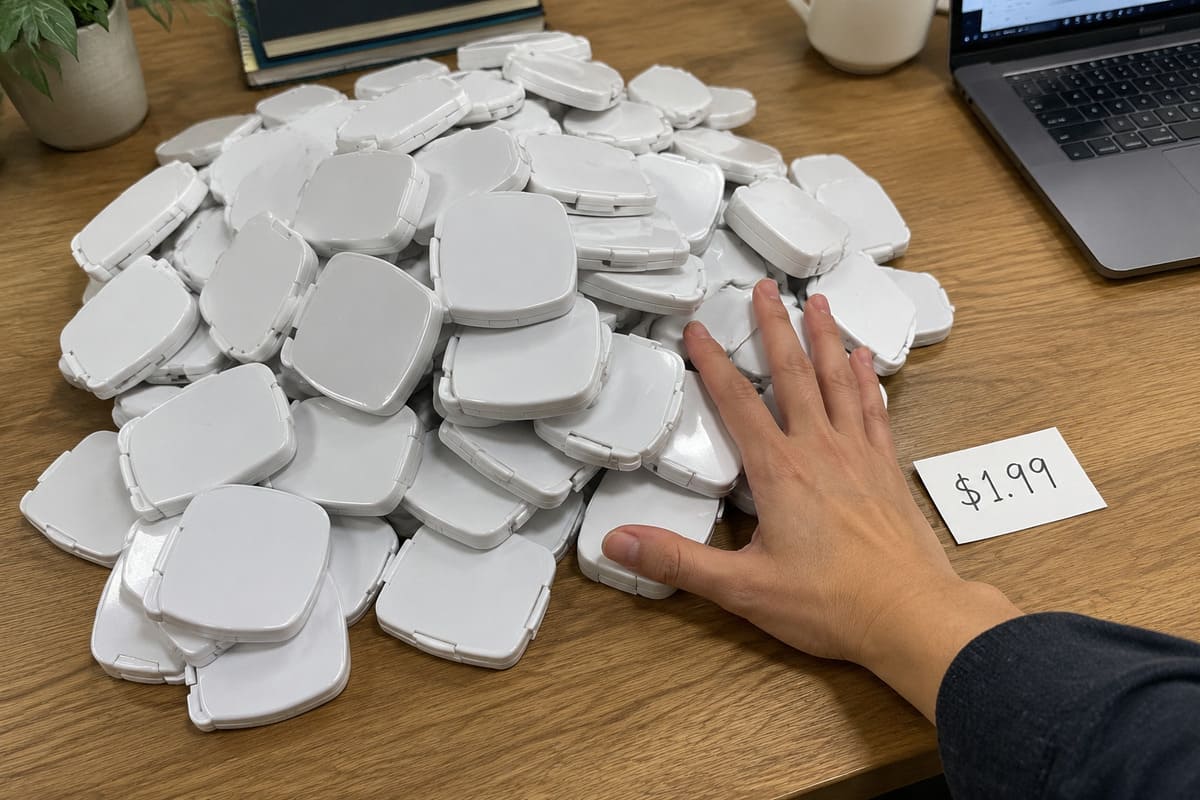
So why does this trap feel so convincing? Because the upfront cost is tiny. The problem is what happens after you buy.
The Math That Kills White-Label Dreams
Let me run the real numbers I showed a client last year. He wanted to buy 300 generic palettes and sell on TikTok. Here is what the economics actually looked like.
| Line item | Generic $9.99 Palette |
|---|---|
| Selling price | $9.99 |
| Product + shipping cost | ~$4.50 |
| TikTok/Meta ad cost per sale (CPC) | ~$3.50 |
| Payment + platform fees | ~$0.80 |
| Net profit per unit | under $2.00 |
When you sell a $9.99 generic palette, you compete against thousands of identical listings. Your only weapon is a lower price or more ad spend. Both destroy your margin. You are not building a brand. You are working for TikTok. The ad platform captures your profit through rising CPC8, and the factory captures the rest through razor-thin wholesale pricing.
I will be blunt here, because this is where honesty matters most. A $500 generic order will not build a high-profit brand. It is a shortcut to failure. The differentiation that commands a higher price does not exist in a public formula that anyone can buy. If your product looks like everyone else's, your customer has no reason to pay more.9 So where does real profit live? It lives in controlled differentiation, which the next section explains in detail.
The Real Profit Model: How 2,000 Units Validates Your Brand, and 5,000+ Builds Your Moat?
You know the white-label path is a trap. But a full custom mold costs tens of thousands and locks your cash for months. That gap terrifies founders. The good news is there is a staged path that balances risk and reward.
The real profit model uses a two-stage MOQ strategy. A 2,000-unit order of a standard palette with a unique shade combination and custom logo validates your brand at low risk. A 5,000 to 10,000 unit order with custom molds and exclusive formulas builds a supply chain moat that commands premium pricing and protects long-term margins.
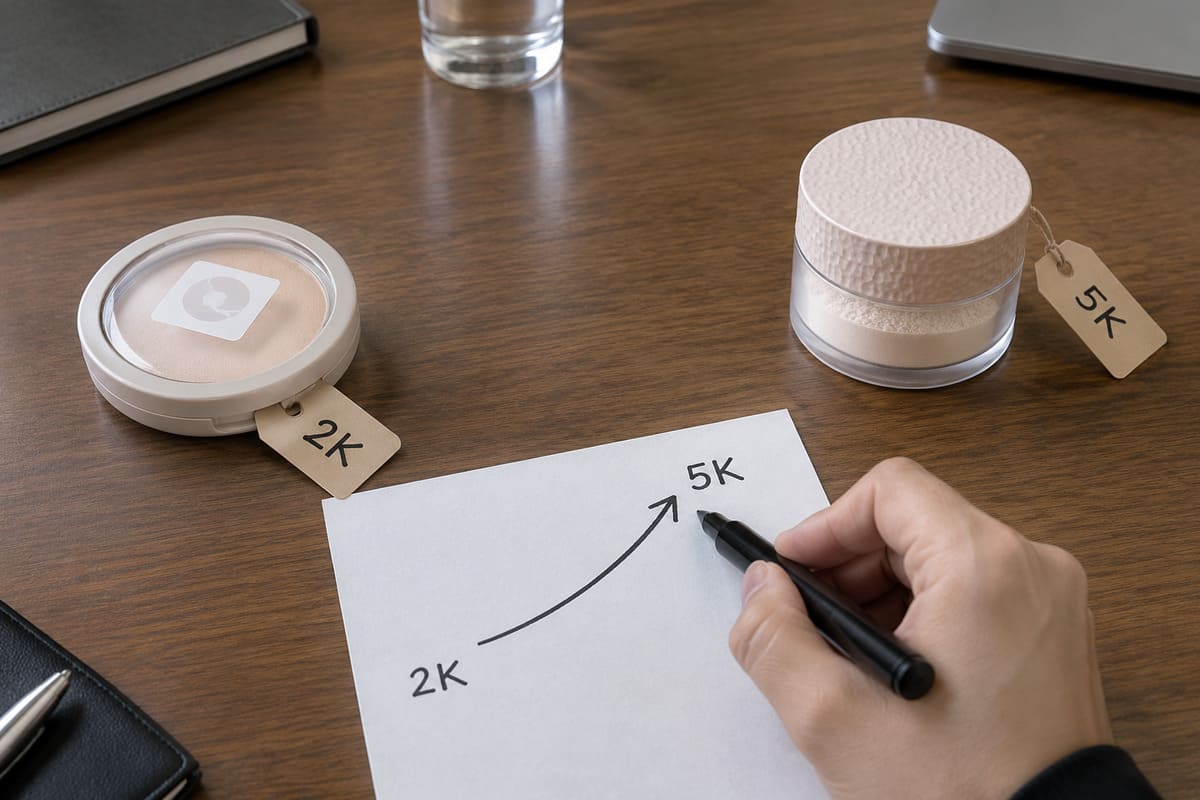
So how do these two stages work together? Each one solves a different financial problem. Stage one protects your cash. Stage two protects your market position.
Stage One: The 2,000-Unit Validation Jump
At 2,000 units, you take a standard, proven palette base and add your own shade combination and logo. This gives you a differentiating factor without the massive cost of a custom mold. The volume is high enough to test real demand, yet low enough to protect your cash flow. You find out whether the market wants your brand before you bet the farm.
Stage Two: The 5,000+ Unit Brand Moat
Once the first batch sells, you reinvest the profit into a 5,000 to 10,000 unit order with a semi-custom or exclusive formula and bespoke packaging. Now competitors cannot copy you by clicking "add to cart" on a public catalog. This exclusivity is your moat.10 It lets you hold premium pricing and build repeat purchases.
| Strategy tier | Volume | Differentiation | Cash risk | Typical margin |
|---|---|---|---|---|
| White-label | 50–300 | None | Low | Near zero |
| Validation | 2,000 | Shade + logo | Controlled | Moderate–High |
| Brand moat | 5,000–10,000 | Formula + mold + packaging | Planned | High |
The logic is simple. Validate cheap, then scale into exclusivity. A real case shows exactly how the numbers move.
A Real Case: How One Founder Tripled His Profit Margin by Changing His MOQ?
Numbers on a table convince no one until they see a real person live them. One founder came to me with a plan I see constantly, and a budget he could not afford to waste. His story is the clearest proof of everything above.
One founder tripled his profit margin by shifting from a 300-unit generic order to a 2,000-unit semi-custom palette. He moved his selling price from $9.99 to $19.99, raised profit per unit from under $2 to $8, then scaled to a 5,000-unit exclusive order funded entirely by first-batch profit.
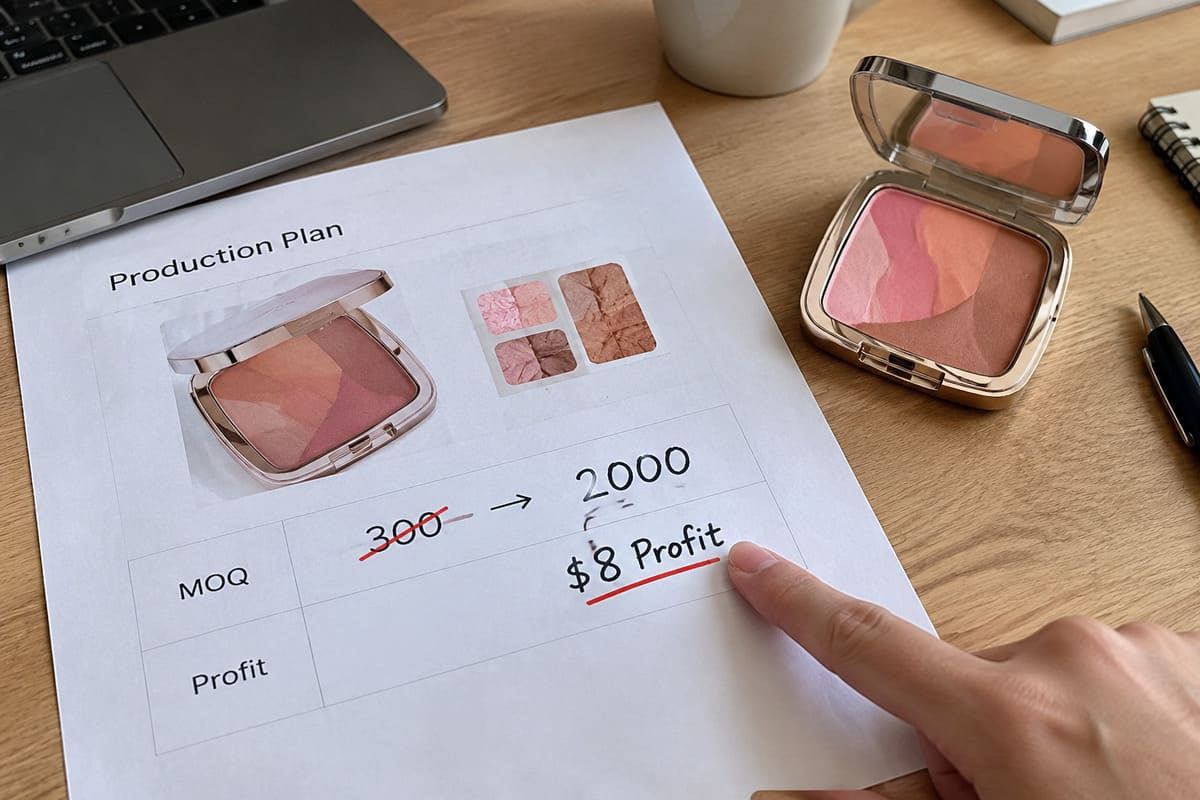
So what exactly changed in his business? Only the strategy. The product category stayed the same.
The Before and After
Here is the comparison I walked him through, and the result he actually achieved. I remember the moment he realized the $9.99 plan was a trap. He went quiet, then said "so I'd basically be working for free." Correct.
| Metric | Original plan (300 generic) | New strategy (2,000 semi-custom) |
|---|---|---|
| Order volume | 300 units | 2,000 units |
| Selling price | $9.99 | $19.99 |
| Differentiation | None | Unique shades + custom logo |
| Profit per unit | under $2 | ~$8 |
| Market outcome | Lost in identical listings | Sold out |
Because the product looked unique, it stood out in the feed and sold out. His margin jumped from under $2 to $8 per unit. He then placed a 5,000-unit order with a semi-custom formula and exclusive packaging, paid for by the profit from batch one. He tripled his margin without raising his startup capital. He simply changed his MOQ strategy. That single decision moved him from a race-to-the-bottom seller to a brand owner. The next question is how you choose the right strategy for your own situation.
How to Choose a Manufacturing Strategy That Protects Your ROI?
You have the models and the proof. But your situation is unique, and the wrong choice still costs real money. Choosing by gut instead of math is how founders overcommit and run out of cash before launch.
You choose a manufacturing strategy by matching your order volume to your current goal: validate or scale. If you are testing a concept, start at 2,000 units to protect cash flow. If you have proven demand, move to 5,000+ units to lock in exclusivity and margin. Never spend more than you can afford to lose on unvalidated inventory, and always reserve budget for marketing.
So how do you apply this to your own capital? Use a simple rule set that protects both inventory risk and marketing budget.
A Decision Framework
Based on serving global B2B buyers from our supply chain cluster in Guangdong, China11, I recommend this sequence:
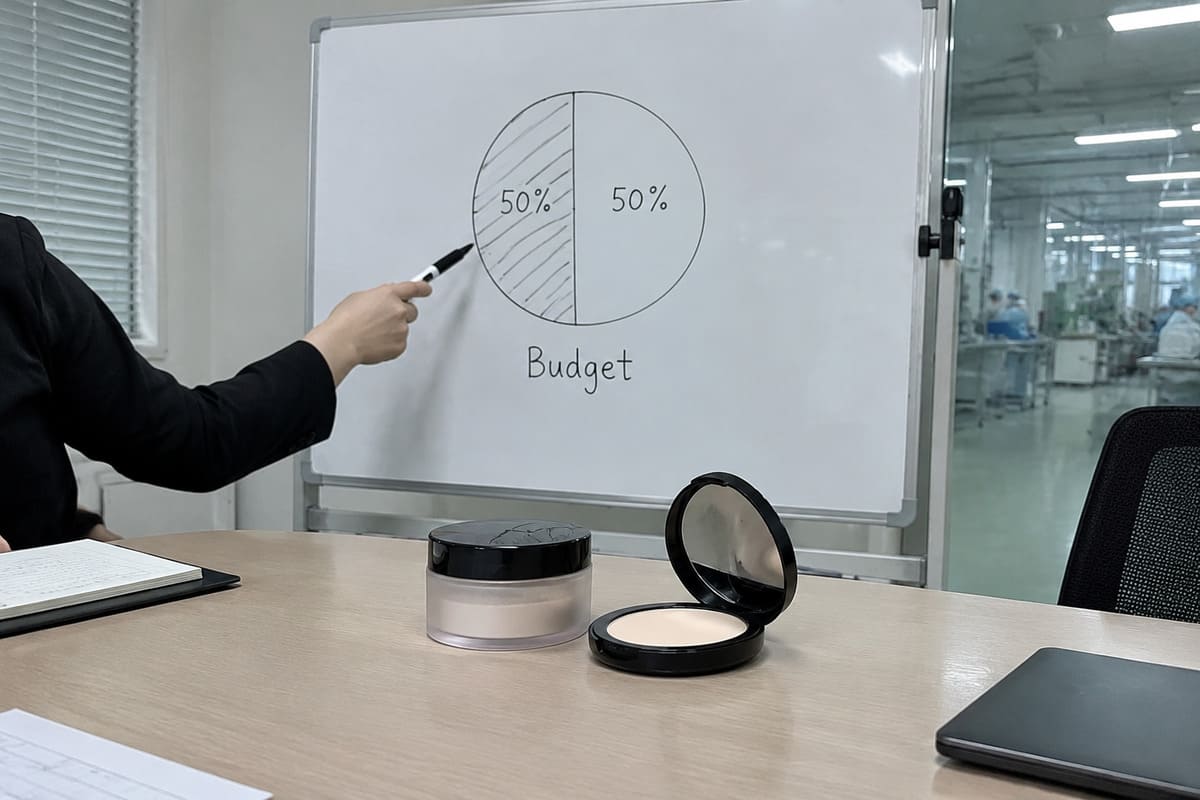
- Split your budget. Never put more than ~50% into first-order inventory. Marketing needs the rest, or the product never sells.
- Validate before you scale. Use the 2,000-unit tier to prove ROI with real sales data, not assumptions.
- Reinvest, don't overextend. Fund your 5,000-unit scale from batch-one profit where possible.
- Build the moat deliberately. Add exclusive formula and packaging only once demand is confirmed.
What I Will and Will Not Promise You
I treat certifications as documents you should verify for your target market, and I recommend qualified regulatory evaluation for application-specific export decisions. Here is my honest position:
What we do: offer a 2,000-unit trial on standard palettes so you can test ROI safely, plus a 5,000–10,000 unit tier for brands ready to build a competitive moat.
What we don't do: tell you a $500 generic order will build a high-profit brand. It won't.
If you want high margins, you must invest in differentiation. I will not push you to overcommit. I will tell you the truth about where the real profit lives.
Frequently Asked Questions
What is the most profitable beauty business to start with low capital?
The most profitable low-capital path is a validated product brand, not a service or generic store. Start with a 2,000-unit semi-custom palette to control risk. This protects cash flow while giving you the differentiation needed to sell above commodity prices and build a real brand asset.
Why is a 50-unit white-label order a bad idea?
A 50-unit white-label order uses a public formula with zero differentiation. Thousands of sellers list the identical product, which triggers a price war. After advertising and shipping costs, net profit per unit approaches zero. Low barrier to entry means low barrier to competition.
How does increasing my MOQ actually increase my profit margin?
A higher, smarter MOQ unlocks differentiation. At 2,000 units you add unique shades and a custom logo, letting you price above generic competitors. At 5,000+ units you add exclusive formulas and packaging, creating a moat that supports premium pricing and higher repeat-purchase margins.
Do I need special certifications to export cosmetics?
Requirements vary by destination market12, so treat all certifications as documents you must verify for your specific country and product. I recommend consulting a qualified regulatory professional for your target market before export. I can match a compliance plan to your market and order timeline once your sales channel is clear.
Is a service business like a lash studio ever worth it?
A lash or PMU studio can earn strong margins per hour, but it is capped by your time and cannot scale without hiring. It works as a job, not a scalable asset. For high ROI and long-term growth, a differentiated product brand offers far more leverage.
Conclusion
The most profitable beauty business to start is a differentiated product brand, not a time-capped service or a generic white-label store. Service income stops when you stop working. A 50-unit white label dies in a price war. The real profit lives in a staged manufacturing strategy: validate at 2,000 units to protect your cash, then scale to 5,000+ units to build a supply chain moat and command premium pricing. One founder tripled his margin doing exactly this. If you are ready to test a smart MOQ strategy that protects your ROI, reach out and I will build a validation plan matched to your market.
"Skincare Industry Statistics 2026 – U.S. Market Overview", https://www.tricociuniversity.edu/beauty-blog/student-life/skincare-industry-statistics-2025-u-s-market-overview/. Market research and industry statistics report substantial size and continued growth in the global cosmetics sector, supporting the premise that the beauty market is a viable field for new product brands. Evidence role: statistic; source type: institution. Supports: The global cosmetics and beauty market is large and has shown sustained growth.. Scope note: Aggregate market size indicates opportunity but does not establish profitability for any individual business model or entrant. ↩
"Assessing the Impact of New Technologies on ...", https://www.bls.gov/bls/congressional-reports/assessing-the-impact-of-new-technologies-on-the-labor-market.htm. Business scalability literature distinguishes labor-bound service models, whose output is tied to provider time, from productized models that can grow output independently of direct labor, supporting the stated constraint on service income. Evidence role: mechanism; source type: education. Supports: Service revenue is constrained by available labor hours, limiting scalability relative to productized models.. Scope note: General management literature describes the mechanism but does not quantify the specific income ceilings cited for beauty service businesses. ↩
"Discover the Importance of ROI for Business Decision-Making", https://onlinedegrees.siu.edu/programs/business/mba/finance/importance-of-roi-in-decision-making/. Standard reference definitions describe return on investment as the ratio of net gain to the cost of investment, supporting its use as a profitability measure in the article. Evidence role: definition; source type: encyclopedia. Supports: Return on investment is a standard financial ratio measuring gain relative to invested capital.. Scope note: A general definition does not validate the specific ROI figures or model comparisons the article presents. ↩
"Building Scalable Business Models", https://sloanreview.mit.edu/article/building-scalable-business-models/. Business model literature on operating leverage explains how product-based firms can scale revenue independently of direct owner labor, supporting the article's distinction between product assets and labor-bound income. Evidence role: mechanism; source type: education. Supports: Productized businesses exhibit operating leverage, allowing revenue to grow without proportional increases in owner labor.. Scope note: The concept describes a general mechanism and does not account for ongoing operational demands such as inventory, logistics, and customer service in a product brand. ↩
"Best Eyeshadow Brand: A Supply Chain Breakdown for Sourcing ...", https://vertinabeauty.com/best-eyeshadow-brand-a-supply-chain-breakdown-for-sourcing-decisions/. Supply chain and operations references define minimum order quantity as the lowest volume a supplier will accept and describe economies of scale in which unit cost falls with higher volume, supporting the article's MOQ framing. Evidence role: definition; source type: education. Supports: Minimum order quantity is the smallest batch a manufacturer will produce, and per-unit cost generally declines as order volume rises.. Scope note: General definitions do not confirm the specific tier thresholds (2,000 and 5,000 units) presented as optimal in the article. ↩
"Open Principles of Microeconomics - 8. Perfect Competition", https://publishing.lib.umn.edu/openmicro/08_perfect_competition.html. Microeconomic theory of competitive markets holds that sellers of homogeneous goods compete primarily on price, pushing prices toward marginal cost, which supports the described price-war dynamic. Evidence role: mechanism; source type: education. Supports: In markets for homogeneous goods, competition tends to converge on price, driving margins toward marginal cost.. Scope note: The idealized model assumes many sellers and full information and does not capture branding or platform effects that modify real marketplace behavior. ↩
"The Five Forces - Institute For Strategy And Competitiveness", https://www.isc.hbs.edu/strategy/business-strategy/Pages/the-five-forces.aspx. Competitive strategy frameworks establish that low barriers to entry raise the threat of new entrants, intensifying rivalry and reducing achievable margins, which grounds the stated relationship between entry and competition. Evidence role: definition; source type: education. Supports: Low barriers to entry increase competitive intensity and tend to erode industry profitability.. Scope note: The framework is a general economic principle and does not specifically model the white-label cosmetics market. ↩
"2026 Marketing Statistics, Trends, & Data", https://www.hubspot.com/marketing-statistics. Industry advertising benchmark reports document upward trends in cost-per-click and customer acquisition costs across major social platforms, consistent with the claim that rising ad costs compress seller margins. Evidence role: statistic; source type: research. Supports: Cost-per-click and customer acquisition costs on major social advertising platforms have trended upward over recent years.. Scope note: Benchmark data reflects aggregate platform averages and may not match the specific CPC figures for beauty products sold via TikTok or Meta. ↩
"A Better Way to Measure Customers' Willingness to Pay", https://insight.kellogg.northwestern.edu/article/better-way-to-measure-customers-willingness-to-pay. Marketing research on willingness to pay finds that perceived product differentiation and branding are associated with price premiums, supporting the claim that undifferentiated products lack pricing power. Evidence role: general_support; source type: paper. Supports: Perceived differentiation and brand distinctiveness are associated with higher consumer willingness to pay.. Scope note: Findings vary by product category and may not generalize directly to palette cosmetics or the specific price points cited. ↩
"Evaluating Competitive Advantage of A New Product for ...", https://web.mst.edu/lib-circ/files/Special%20Collections/INCOSE2010/Evaluating%20Competitive%20Advantage%20of%20a%20New%20Product%20for%20Designing%20Successful%20Product%20Differentiation.pdf. Strategic management research on sustainable competitive advantage holds that resources which are valuable and hard to imitate can protect pricing power, supporting the article's use of a differentiation 'moat'. Evidence role: mechanism; source type: education. Supports: Differentiation that is difficult for competitors to replicate can create a durable competitive advantage supporting premium pricing.. Scope note: The theory addresses competitive advantage generally and does not establish that shade or packaging exclusivity alone constitutes a durable moat. ↩
"How to Find a Cosmetics Manufacturer: A Buyer's Guide to Verifying ...", https://vertinabeauty.com/how-to-find-a-cosmetics-manufacturer-a-buyers-guide-to-verifying-real-factories/. Trade and industry data identify Guangdong province as a major center of cosmetics manufacturing in China, supporting the reference to a regional supply chain cluster. Evidence role: general_support; source type: government. Supports: Guangdong province is a significant concentration point for cosmetics manufacturing in China.. Scope note: Regional industry data confirms manufacturing concentration but does not verify the specific capabilities or practices of the author's own operation. ↩
"Cosmetics & U.S. Law", https://www.fda.gov/cosmetics/cosmetics-laws-regulations/cosmetics-us-law. Official regulatory sources from major jurisdictions set out distinct cosmetics safety and registration requirements, confirming that compliance obligations vary by destination market. Evidence role: general_support; source type: government. Supports: Regulatory requirements for cosmetics differ across jurisdictions such as the EU, US, and others.. Scope note: Regulatory sources describe requirements in force at publication and may change, and do not cover every destination market a founder might target. ↩