Every week I talk to someone trying to buy cosmetics wholesale, and they arrive exhausted. They have been burned by crushed boxes, near-expiry lipsticks, or unbranded powders that nobody recognizes on a shelf. The cheap price felt like a win until the returns piled up. That frustration is exactly the problem I want to solve here.
To buy cosmetics wholesale the smart way, skip liquidation pallets and bare white-label units. Choose branded ready stock instead: finished products with a consistent logo, retail-ready packaging, and quality control already done. You get stable margins, repeat customers, and shelves you can fill today without waiting months for custom production.
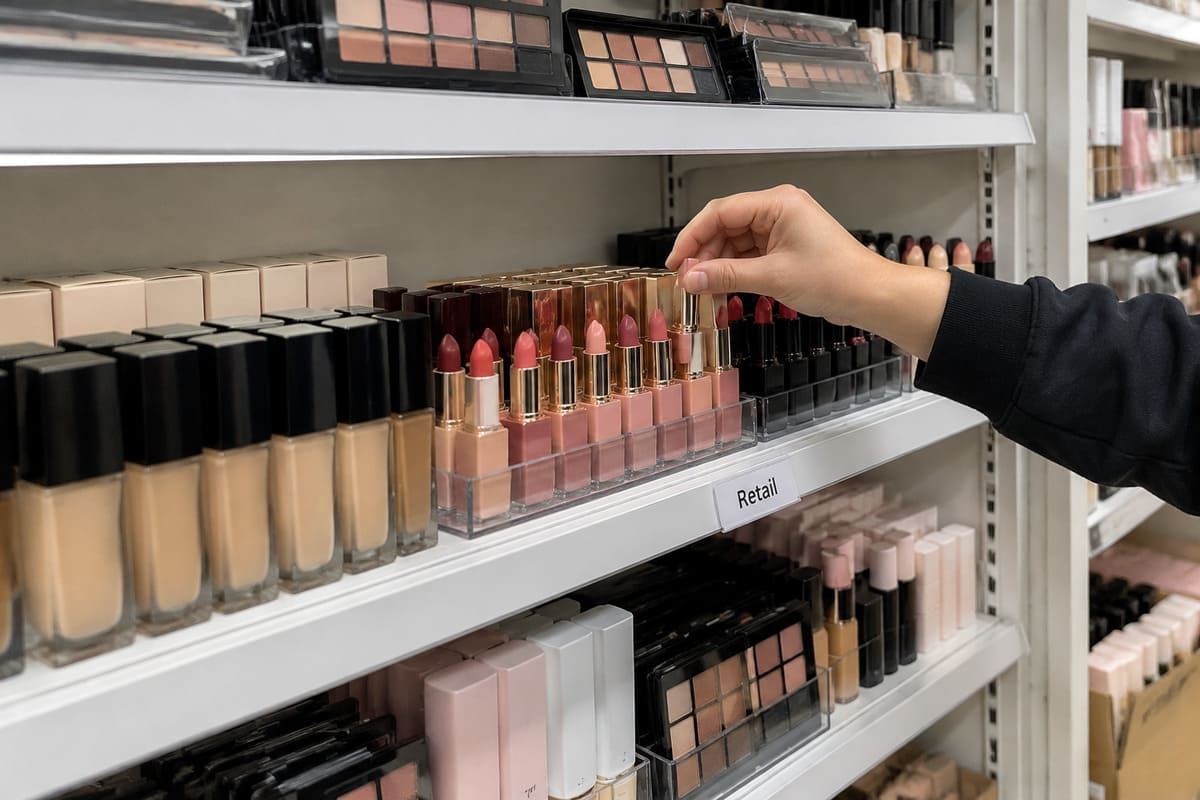
I know that answer raises questions. What counts as "wholesale" really? Why is clearance stock such a trap? And where does branded ready stock fit between dirt-cheap pallets and expensive private label runs? Let me break each one down.
What Does "Wholesale Cosmetics" Really Mean for Retailers and Distributors?
Many buyers use the word "wholesale" to mean "cheap." Then they chase the lowest sticker price, ignore everything else, and wonder why their store never builds a loyal following. The word hides more than it reveals.
For retailers and distributors, wholesale cosmetics means buying finished makeup in bulk at a per-unit price low enough to resell at a profit. The term covers three very different models: liquidation lots, unbranded white-label goods, and branded ready stock. Only one of these supports repeat business and protected margins.
When you buy cosmetics wholesale, you are really choosing a supply model, not just a price. I always ask new buyers one question first: are you trying to make quick cash once, or build a shelf that customers return to? The answer points to different sourcing paths.
The three models behind one word
| Model | Typical unit price | Packaging | Reorder stability | Best for |
|---|---|---|---|---|
| Liquidation lots | $0.65–$2.00 | Mixed, often damaged | None | One-time cash grabs |
| White-label (unbranded) | Low to medium | Plain or blank | Depends on factory | Brands building their own identity |
| Branded ready stock | Medium | Logo + retail-ready | High | Retailers and distributors |
Here is the distinction that matters. Liquidation sells you whatever happens to be left over. White-label sells you a blank product you must dress up yourself. Branded ready stock sells you a finished, recognizable item you can place on a shelf the same day it arrives.
A distributor in a regional market does not have time to repackage thousands of units or chase a factory for a custom run. He needs product that moves. So when he searches for where to buy cosmetics wholesale, the honest answer depends entirely on which of these three realities he walks into. Most buyers never learn the difference until a bad order teaches them. The rest of this article is the shortcut.
The Clearance Trap: Why Buying Liquidation Lots Ruins Your Store's Reputation
The liquidation pallet looks irresistible. Eyeshadow at $0.65 a unit, blush for pennies, a full pallet for the price of a single branded case. You run the math, picture the margins, and click buy. Then the boxes arrive.
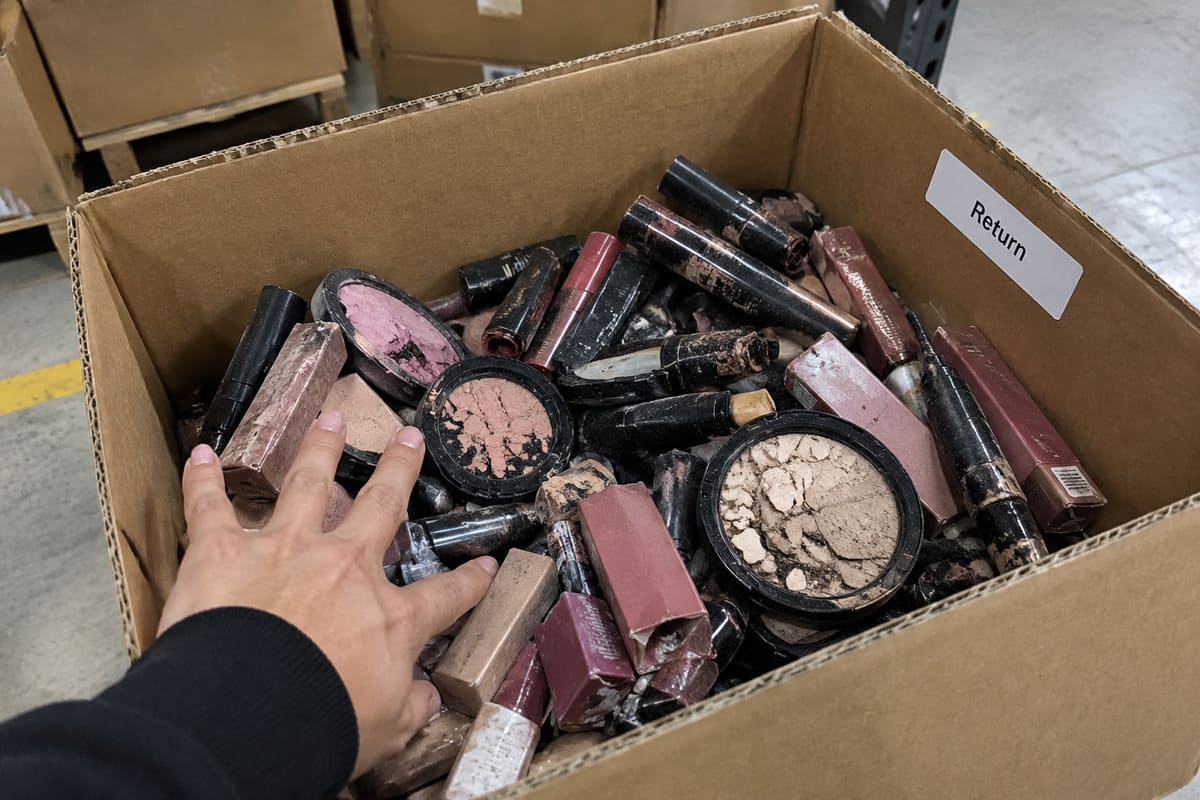
Liquidation lots ruin your reputation because they are built from returned, damaged, discontinued, or near-expiry goods1. The low price hides the real cost: customer complaints, refund demands, and shelf space wasted on products you cannot reorder. A quick cash win becomes a slow reputation loss.
I watched this happen to a vendor at a local wholesale market. He bought discounted liquidation lots from a clearance platform because the price was unbeatable. When the shipment landed, half the boxes were crushed, and several items were set to expire in two months. His customers noticed fast. He faced a wave of returns, and the trust he had built over years took a hit he did not expect.
Why clearance stock quietly destroys value
- No reorder path. Liquidation stock is leftover by definition. When a product sells well, you cannot get more. Your best seller vanishes the moment customers want it again.
- Hidden condition problems. Returns and overstock often include opened, damaged, or defective units.2 You inherit problems other sellers already rejected.
- Expiry pressure. Cosmetics have shelf lives.3 Near-expiry stock forces you to dump inventory fast or eat the loss. Buyers who smell a two-month expiry date walk away.
- Reputation damage compounds. One crushed compact or dried-out mascara does more harm than ten good sales do good.4 Word travels in a local market.5
The math that looks brilliant on a spreadsheet collapses in practice. Say you buy 1,000 units at $0.65. If 30% arrive damaged or expiring, you have already lost 300 units. Add refunds on the units that slip through, and the effective cost per sellable unit climbs well past what branded stock would have cost. You paid less and got less, then paid again in trust.
Quick cash is real. I will not pretend liquidation never moves. But if your goal is a store customers return to, the clearance trap works against you every single day.
The White-Label Dilemma: Why Unbranded Products Have No Margins
So you avoid clearance and go the other direction: clean, unbranded product straight from a factory. No damage, no expiry surprises. It feels safer. Then you try to sell a plain black compact with no logo, and the problem shows up at the counter.
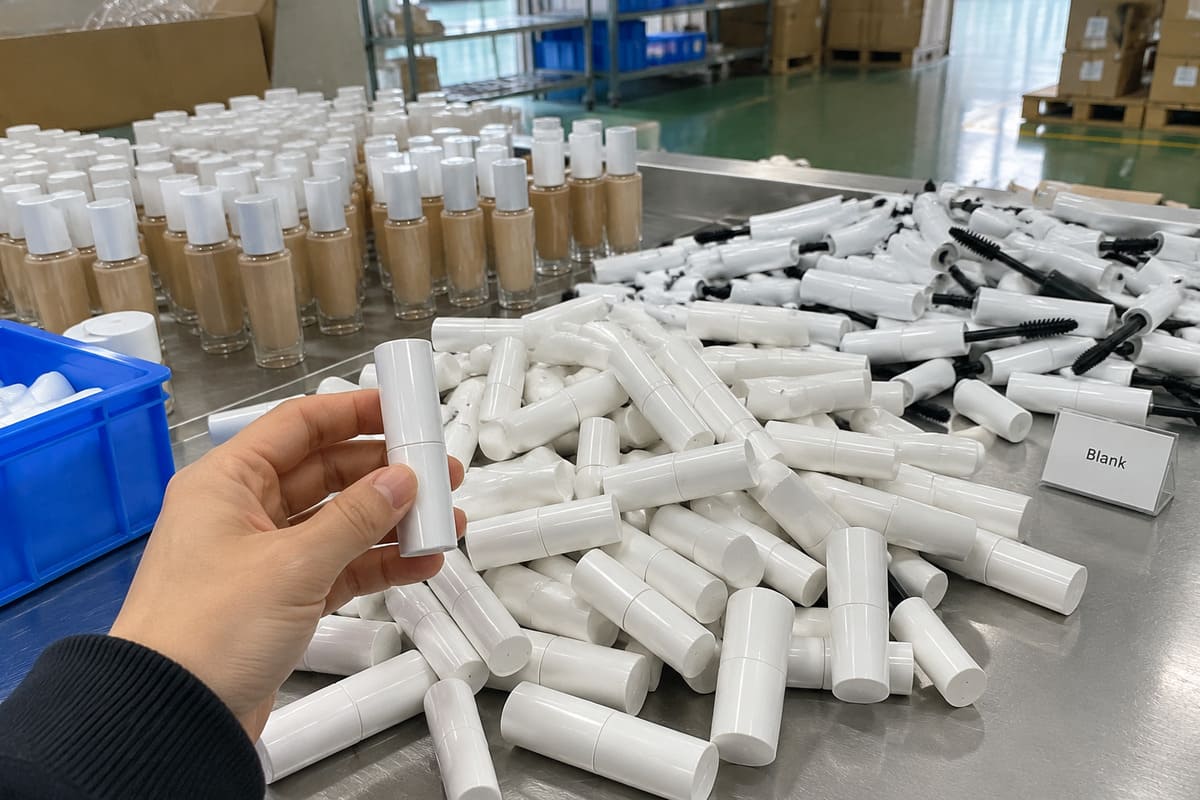
Unbranded white-label products have no margins because they compete on price alone. Without a logo, a name, or retail packaging, customers see a generic item and refuse to pay more than the floor price6. You cannot build loyalty or recognition around a blank box, so every sale becomes a race to the bottom.
White-label makes sense for one specific buyer: a brand owner who plans to add their own logo, design, and story. For a retailer or distributor who just wants product on the shelf, it creates a dilemma. You either invest time and money branding it yourself, or you sell it bare and surrender your margin.
The costs hiding inside "unbranded"
- Packaging and labeling. A blank product still needs a label, a box, and a barcode before it looks sellable. That is design work, print runs, and application labor you now own.
- No price anchor. A branded product gives customers a reason to accept a price.7 A generic one invites them to ask, "Why is yours more expensive than the next stall?"
- Zero loyalty. Customers cannot ask for your product by name if it has no name. Repeat demand never forms around a blank compact.8
- High MOQs for real customization. If you decide to turn white-label into your own brand, you step into OEM/ODM territory: higher minimums and production cycles measured in months9.
I respect the white-label path when a buyer genuinely wants to build a brand. That is a real business model, and at Vertina Beauty we run a full OEM/ODM service for exactly those founders. But a market vendor who needs sellable stock next week is not trying to launch a brand. He is trying to make a margin. Handing him a blank box does not solve his problem. It hands him a second project he never asked for.
The Smart Alternative: Sourcing Branded Ready Stock with Complete Packaging
Caught between damaged clearance and margin-free blanks, most buyers assume those are the only two choices. They are not. There is a middle path that keeps the quality of a real factory and the margin of a real brand.
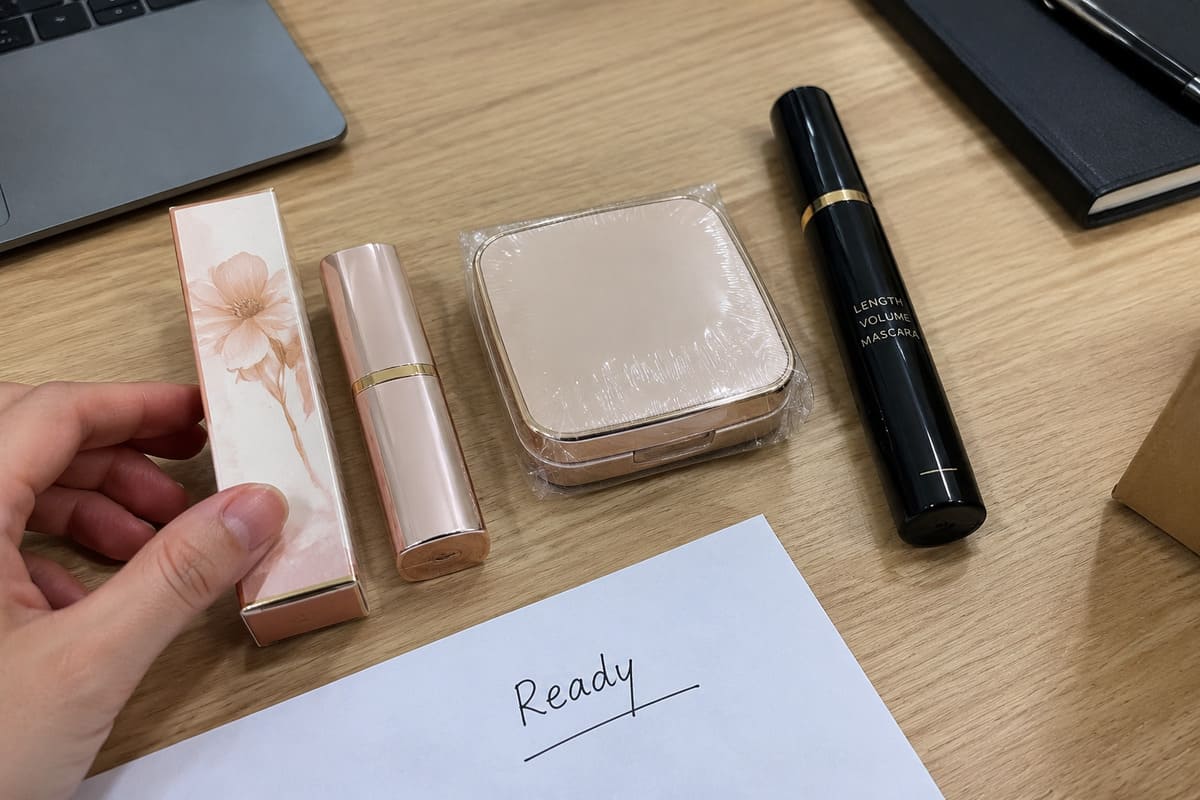
Branded ready stock is finished cosmetics that already carry a logo, complete retail packaging, and factory quality control. You buy the stock, place it on your shelf, and sell it the same day. No manufacturing wait, no repackaging, no expiry gamble. It is the sweet spot between liquidation and private label.
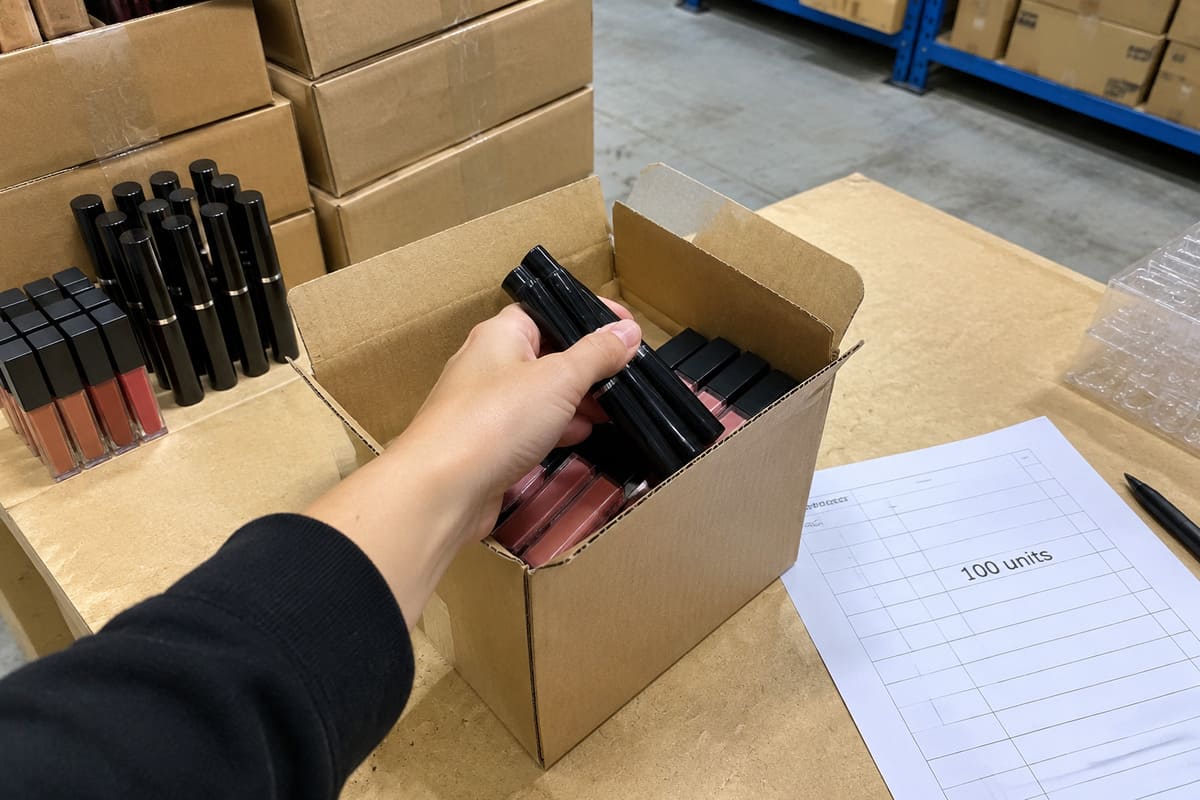
This is the model I built my client relationships around. After the market vendor's liquidation disaster, he contacted us and switched to our branded ready stock: products with our logo and complete retail packaging. Because the quality stayed consistent and the items were sellable on arrival, he stopped firefighting returns. His margins stabilized, and he became a regular customer. Nothing clever happened. The product simply did its job.
Why ready stock protects your business
- It sells itself. A branded eyeshadow palette with proper packaging looks like something worth buying. Customers trust what looks finished.10
- You can reorder. When a shade sells out, you get more. A consistent supply line means your best sellers stay in stock.
- Quality is controlled. These are finished goods from a working factory, not someone else's rejects. No crushed compacts, no two-month expiry.
- No production wait. Private label takes months and high minimums. Ready stock ships now.
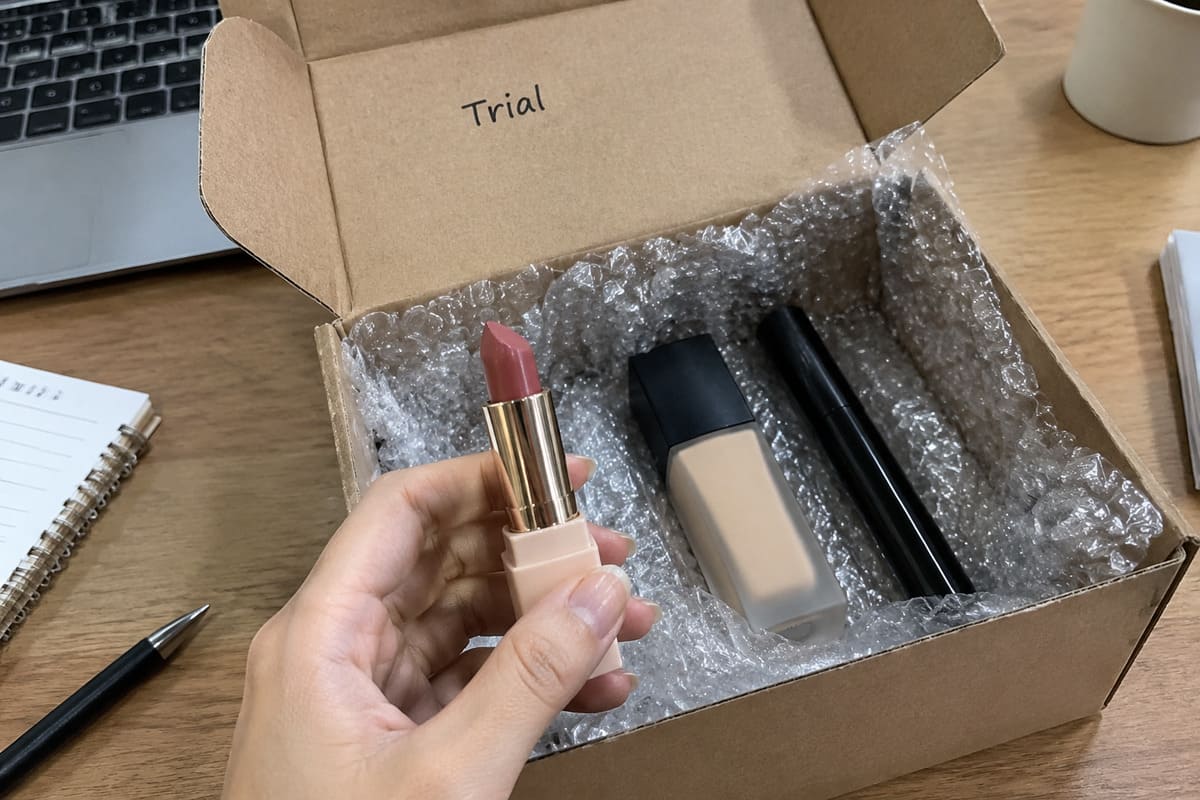
- You can start small. A mixed box or a trial order of 100 to 200 units of assorted best-sellers lets you test your local market before committing.
A quick comparison of the real cost
Consider two paths. Path one: liquidation at $0.65 a unit with 30% loss and a damaged reputation. Path two: branded ready stock at a higher per-unit price, near-zero loss, full reorder ability, and customers who return. Over a few months, the second path almost always wins on total profit, even though the first looked cheaper on day one.
At Vertina Beauty, our strength is "play-with-color" makeup: chameleon eyeshadow, sparkle eyeshadow, powder blush, highlighter, and setting powders that follow the trends people actually see on TikTok and Instagram11. We supply these as branded ready stock to wholesale markets, discount stores, and regional supermarkets. Clients choose us not because we are the cheapest, but because the product is immediately sellable and consistently profitable.
Who This Is For (And Who It's Not For)
I would rather tell you the truth up front than win an order that does not fit. Branded ready stock is a specific solution for a specific buyer. Let me be direct about the edges.
Branded ready stock is for retailers, distributors, and market vendors who need fast-moving, quality-assured, branded cosmetics to fill their shelves right now. It is not for buyers chasing luxury labels, bargain-hunters wanting the absolute lowest clearance price, or founders who want a fully custom brand built from scratch.
What we do
We provide branded ready stock. Our products carry a consistent logo, professional packaging, and are ready to sell in your store or market. You can start small with a mixed box or a 100 to 200 unit trial of assorted best-sellers to see what moves locally.
What we don't do
We are not L'Oréal or Dior. If you want high-end luxury brands, we are not your supplier. We are also not a liquidation platform. We do not sell expired or damaged goods, and I will not pretend otherwise to close a sale.
A realistic boundary
If you want to build your own exclusive brand from scratch through OEM or ODM and you can wait months for custom production, visit our manufacturing page instead. That is a different service with higher minimums and longer timelines. But if you are a retailer who needs quality-assured, branded cosmetics on your shelves this month, ready stock is exactly what you need.
How to Scale Your Wholesale Business with Consistent Supply
Getting one good order is easy. Building a business that grows month after month is the hard part, and it almost never fails on a single shipment. It fails on inconsistency: the stockouts, the quality swings, the supplier who disappears when you need a reorder.
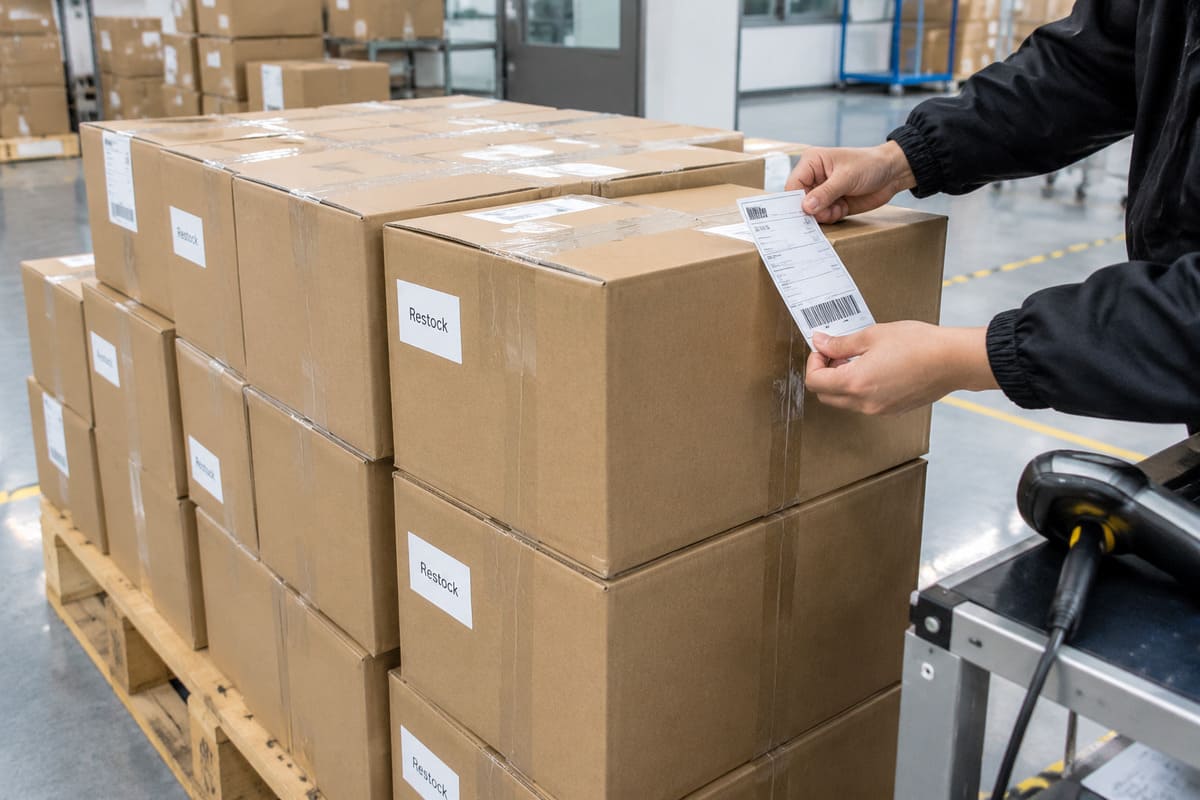
You scale a wholesale cosmetics business by locking in consistent supply, reordering proven best-sellers, and expanding your range only after the market confirms demand. Start with a small branded ready-stock trial, track what sells, reorder fast, and widen your catalog shade by shade instead of gambling on untested volume.
A practical path to growth
- Start with a trial box. Order 100 to 200 units of assorted best-sellers. Keep your risk low while you learn your market.
- Track what moves. Note which shades, finishes, and products sell fastest. Let data, not guesswork, guide you.
- Reorder winners quickly. The moment a product proves itself, reorder it. Consistent supply means your shelf never goes empty on a best-seller.
- Expand deliberately. Add new products once a winner is stable. Build range on proven demand rather than hope.
- Treat your supplier as a partner. Fast communication and reliable restocking matter more than a few cents per unit. I would rather a client call me at any hour than lose a sale to a stockout.
Why consistency beats the lowest price
A distributor who reorders the same ten best-sellers every month builds a predictable business. Customers learn what to expect, demand becomes forecastable12, and margins hold steady. A distributor who chases the cheapest lot each time rebuilds his catalog from zero over and over, and his customers never know what they will find. One compounds. The other resets. Consistent, branded supply is what turns a lucky season into a durable business.
Frequently Asked Questions
Is it cheaper to buy cosmetics wholesale through liquidation pallets?
The sticker price is lower, yes. But liquidation lots often include damaged, returned, or near-expiry goods, so your real cost per sellable unit climbs once losses and refunds are counted. Branded ready stock usually delivers higher total profit because almost every unit is sellable and reorderable.
What is the minimum order to buy cosmetics wholesale as branded ready stock?
You can start small. We offer mixed boxes and trial orders of roughly 100 to 200 units of assorted best-sellers. This lets you test what moves in your local market before committing to larger volumes, which keeps your risk low while you learn demand.
What is the difference between white-label and branded ready stock?
White-label products arrive unbranded, so you must add a logo, packaging, and labeling yourself before selling. Branded ready stock arrives finished, with a consistent logo and retail packaging already applied. You skip the design work and place the product directly on your shelf.
Do you sell luxury brands like L'Oréal or Dior?
No. We are a cosmetics manufacturer and branded supplier, not a reseller of luxury labels. If you need high-end designer brands, we are not your supplier. We provide our own quality-assured, branded ready stock for retailers and distributors who want reliable, sellable products.
Can I order custom private-label cosmetics instead of ready stock?
Yes, through our OEM/ODM manufacturing service. Custom private label involves higher minimums and production cycles of several months. If you want a fully exclusive brand, that path fits. If you need sellable product now, branded ready stock is the faster choice.
Conclusion
When you buy cosmetics wholesale, the real question was never "where is the cheapest makeup?" It was "where can I find a consistent supplier of branded, ready-to-sell cosmetics that protects my margins and keeps customers coming back?" Liquidation pallets offer quick cash and lasting reputation damage. White-label blanks offer clean product with no margin. Branded ready stock gives you finished, quality-controlled, recognizable products you can sell today and reorder tomorrow. That is the model that scales.
Ready to stock your shelves with branded cosmetics that actually sell? Request a trial box of our best-sellers and see what moves in your market.
"Inventory Liquidation: How To Do It Right & Recover Cash", https://greenwaveelectronics.com/blog/inventory-liquidation. Reference definitions of liquidation and closeout inventory describe it as surplus, returned, discontinued, or distressed stock sold below wholesale, supporting the article's characterization. Evidence role: definition; source type: encyclopedia. Supports: Liquidation merchandise is commonly composed of overstock, customer returns, discontinued, and distressed inventory.. Scope note: A general definition does not quantify how often such stock is damaged or near-expiry in the cosmetics segment specifically. ↩
"What Is Reverse Logistics? Improving Efficiency and ...", https://www.amu.apus.edu/area-of-study/business-administration-and-management/resources/what-is-reverse-logistics/. Reverse-logistics research and industry return-rate data document that a notable share of returned goods cannot be resold as new, supporting the claim that returns often include compromised units. Evidence role: statistic; source type: research. Supports: A measurable proportion of returned retail merchandise arrives opened, damaged, or otherwise not resalable as new.. Scope note: Aggregate retail return data may not isolate the cosmetics category or the specific liquidation channels referenced. ↩
"Shelf Life and Expiration Dating of Cosmetics", https://www.fda.gov/cosmetics/cosmetics-labeling/shelf-life-and-expiration-dating-cosmetics. The U.S. Food and Drug Administration notes that cosmetics can deteriorate and that shelf life depends on product type and storage, supporting the claim that cosmetics have limited usable lifespans. Evidence role: general_support; source type: government. Supports: Cosmetic products have finite shelf lives and can degrade or become unsafe over time.. Scope note: Regulatory guidance describes general safety and labeling expectations rather than fixed expiry periods for the specific product categories discussed in the article. ↩
"Temporal Contiguity and Negativity Bias in the Impact of ...", https://marketing.business.uconn.edu/wp-content/uploads/sites/724/2014/08/temporal-contiguity-and-negativity-bias.pdf. Research on negativity bias documents that negative experiences influence judgment more strongly than positive ones, supporting the claim that a single bad unit outweighs several good sales. Evidence role: mechanism; source type: research. Supports: Negative events and experiences carry greater psychological weight than comparable positive ones.. Scope note: The psychological principle is general and does not quantify the specific ten-to-one ratio the article states. ↩
"A Literature Review of Word of Mouth and Electronic ... - PMC", https://pmc.ncbi.nlm.nih.gov/articles/PMC5524892/. Marketing research on word-of-mouth finds it a significant driver of consumer trust and purchase decisions, supporting the claim that reputation spreads quickly among buyers. Evidence role: general_support; source type: research. Supports: Word-of-mouth communication meaningfully shapes consumer decisions and seller reputation.. Scope note: Much word-of-mouth research addresses general or online contexts rather than physical local wholesale markets specifically. ↩
"Potential Clinical and Economic Impact of Switching Branded ...", https://pmc.ncbi.nlm.nih.gov/articles/PMC5417581/. Consumer behavior studies on brand equity find that identifiable brands command measurable price premiums over unbranded equivalents, supporting the claim that generic items compete mainly on price. Evidence role: mechanism; source type: research. Supports: Branding raises consumer willingness to pay, whereas unbranded goods tend to compete closer to a price floor.. Scope note: Findings are typically from controlled or category-general studies and may not transfer directly to local wholesale cosmetics markets. ↩
"Conceptualizing, Measuring, and Managing Customer- ...", https://people.duke.edu/~moorman/Marketing-Strategy-Seminar-2015/Session%203/Keller.pdf. Established brand-equity frameworks in marketing scholarship link brand recognition and perceived quality to pricing power, supporting the claim that branding gives customers a reason to accept a price. Evidence role: expert_consensus; source type: research. Supports: Brand equity increases perceived value and supports a product's ability to sustain higher prices.. Scope note: Theoretical frameworks describe general mechanisms and do not measure the effect size for the article's specific products. ↩
"Brand loyalty not always a benefit, study finds", https://www.psu.edu/news/research/story/brand-loyalty-not-always-benefit-study-finds. Research on brand loyalty indicates that customers rely on identifiable brand names to repeat purchases, supporting the claim that unbranded products struggle to generate repeat demand. Evidence role: mechanism; source type: research. Supports: Brand recognition and recall facilitate repeat purchasing and customer loyalty.. Scope note: Loyalty studies vary by category and may not directly measure unbranded cosmetics at wholesale markets. ↩
"Makeup Manufacturer Australia: The Real Cost of “Local” vs ...", https://vertinabeauty.com/makeup-manufacturer-australia-the-real-cost-of-local-vs-true-customization/. Reference material defining OEM and ODM manufacturing describes contract production with minimum volumes and design-and-development timelines, supporting the article's characterization. Evidence role: definition; source type: encyclopedia. Supports: OEM and ODM manufacturing arrangements involve custom production with minimum order quantities and extended lead times.. Scope note: General definitions do not specify the exact minimums or month-scale timelines for cosmetics, which vary by manufacturer. ↩
"The Impact of Consumer Product Package Quality on ...", https://repository.rit.edu/cgi/viewcontent.cgi?article=1006&context=japr. Studies on packaging design report that visual presentation shapes perceived quality and purchase intent, supporting the claim that customers trust products that look finished. Evidence role: mechanism; source type: paper. Supports: Finished, professional packaging raises perceived product quality and influences purchase decisions.. Scope note: Packaging-perception findings are category-dependent and may not isolate cosmetics at wholesale price points. ↩
"The Impact of TikTok Influencers on Gen Z the Cosmetic Industry", https://digitalcommons.bryant.edu/cgi/viewcontent.cgi?article=1000&context=honors_mathematicseconomics. Studies of social-commerce and influencer marketing report that platforms like TikTok and Instagram affect cosmetics discovery and purchase intent, supporting the article's premise. Evidence role: general_support; source type: paper. Supports: Social media platforms shape beauty and cosmetics trends and influence consumer purchasing.. Scope note: Platform effects evolve quickly and findings may lag current trend dynamics. ↩
"What's the Best Eyeshadow Palette to Buy? A Low-Risk Buying ...", https://vertinabeauty.com/whats-the-best-eyeshadow-palette-to-buy-a-low-risk-buying-guide/. Operations and demand-forecasting literature indicates that consistent assortments and sales history improve forecast accuracy, supporting the claim that reordering the same best-sellers makes demand forecastable. Evidence role: mechanism; source type: research. Supports: Stable, repeated product assortments improve demand predictability and inventory planning.. Scope note: Forecasting research typically addresses larger retail operations and may not directly reflect small wholesale vendors. ↩