You searched for a cosmetic contract manufacturer factory because you want the real source, not another middleman. But the results page is a swamp. Sponsored ads promise impossible MOQs. Global CDMOs look identical to one-person offices. You risk weeks of sampling, only to learn your "factory" was a trader all along.
A cosmetic contract manufacturer factory is a company that physically owns the production lines, R&D labs, and raw material warehouse where your products are made. A trading company does not. It takes your order, marks up the price, and subcontracts the real work to an unknown facility you never get to see or audit.1
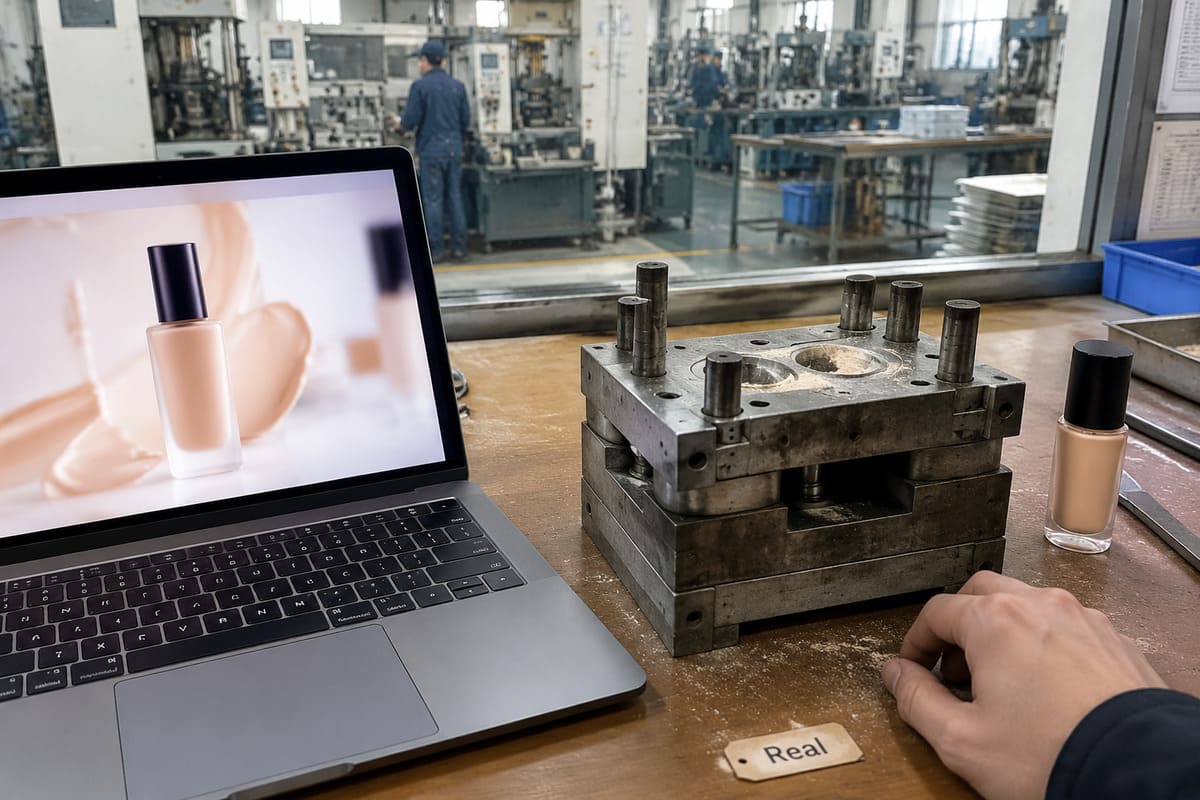
So how do you tell the two apart before you waste a month? The answer is not in their website copy. It is in physical evidence most traders cannot fake. Let me walk you through exactly what to ask and what to look for.
Why Do Trading Companies Outrank Real Factories in the SERP?
You type a simple search and expect to find the people who own the machines. Instead, the top results are slick ads and middlemen. It feels backward. You start wondering if real factories even exist online.
Trading companies outrank real factories because marketing is cheap and manufacturing is expensive. A polished website and a Google Ads budget cost a few thousand dollars.2 A GMP facility with isolated powder and liquid lines costs millions.3 Traders pour money into traffic; factories pour money into machinery.
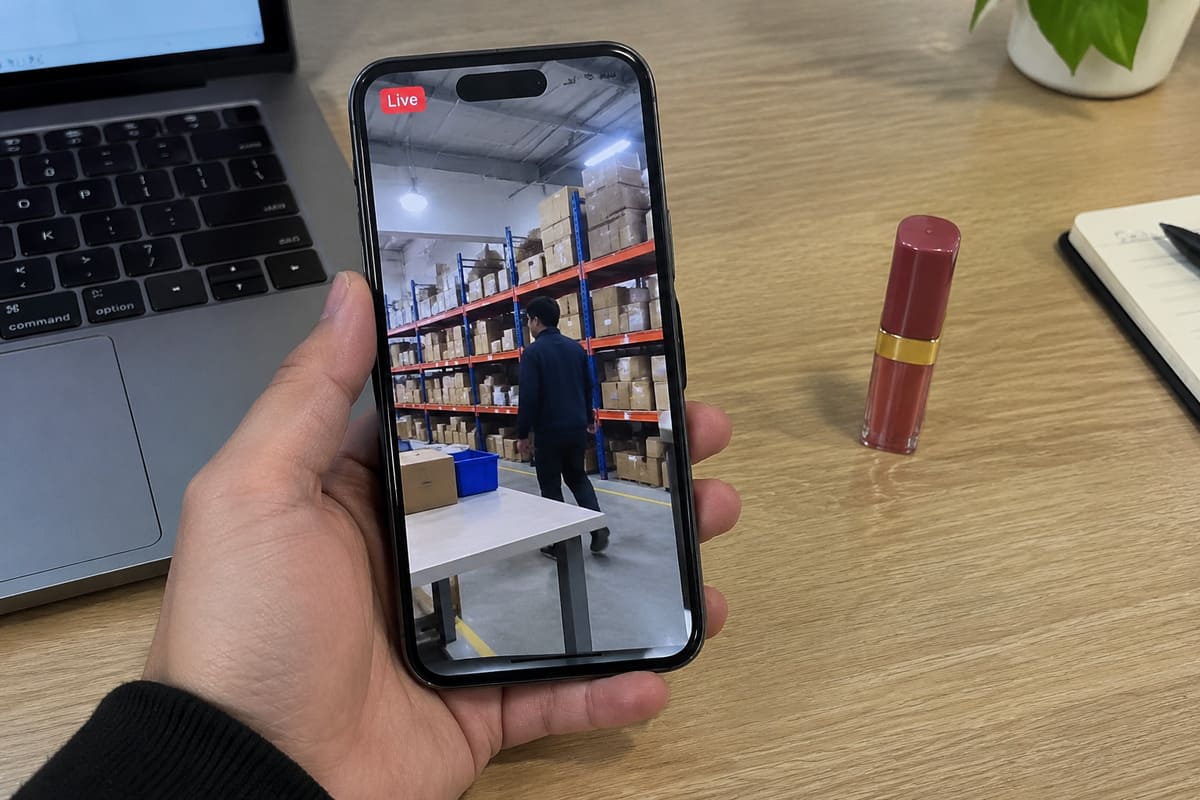
This is the structural reason the market confuses buyers. The economics push the wrong players to the top.
Where the money actually goes
Think about two businesses competing for your click:
- A trading company has no production costs. Every dollar it saves on machines goes straight into SEO, ads, and sales staff.
- A real factory spends on powder mixers, filling lines, lab equipment, cleanrooms, and raw material inventory. Marketing is an afterthought.
The result is predictable. The company that invested nothing in production can afford to shout the loudest. The company that invested everything in production is often quieter online.
Why the "low MOQ" ad is a signal, not a gift
Ultra-low MOQ ads feel generous. They are usually a hook. A real production run has real setup costs: machine cleaning, color matching, batch testing, packaging changeover. When someone offers 50 units of a custom formula with no friction, they are almost always relabeling existing stock or dropshipping from a warehouse they do not control4.
| Spending priority | Trading company | Real factory |
|---|---|---|
| Google Ads budget | High | Low to moderate |
| Production machinery | None | Primary investment |
| On-site R&D lab | None | Yes |
| Raw material warehouse | None | Yes |
| MOQ flexibility claims | Extreme ("50 units!") | Honest thresholds |
Once you understand this logic, the SERP stops being confusing. The loudest voice is rarely the one holding the machines.
How Do You Spot a Trading Company Posing as a Factory?
The website says "manufacturer." The photos show a clean assembly line. The sales rep is fast and friendly. Everything looks right. That is exactly the problem. Traders know what a factory is supposed to look like, and they borrow the imagery.
You spot a trading company by asking for live, unscripted proof. A real factory can show you its working lines on a video call right now. A trader will send a pre-edited commercial, delay, or make excuses. The gap between a polished video and a live walkthrough is where the truth lives.
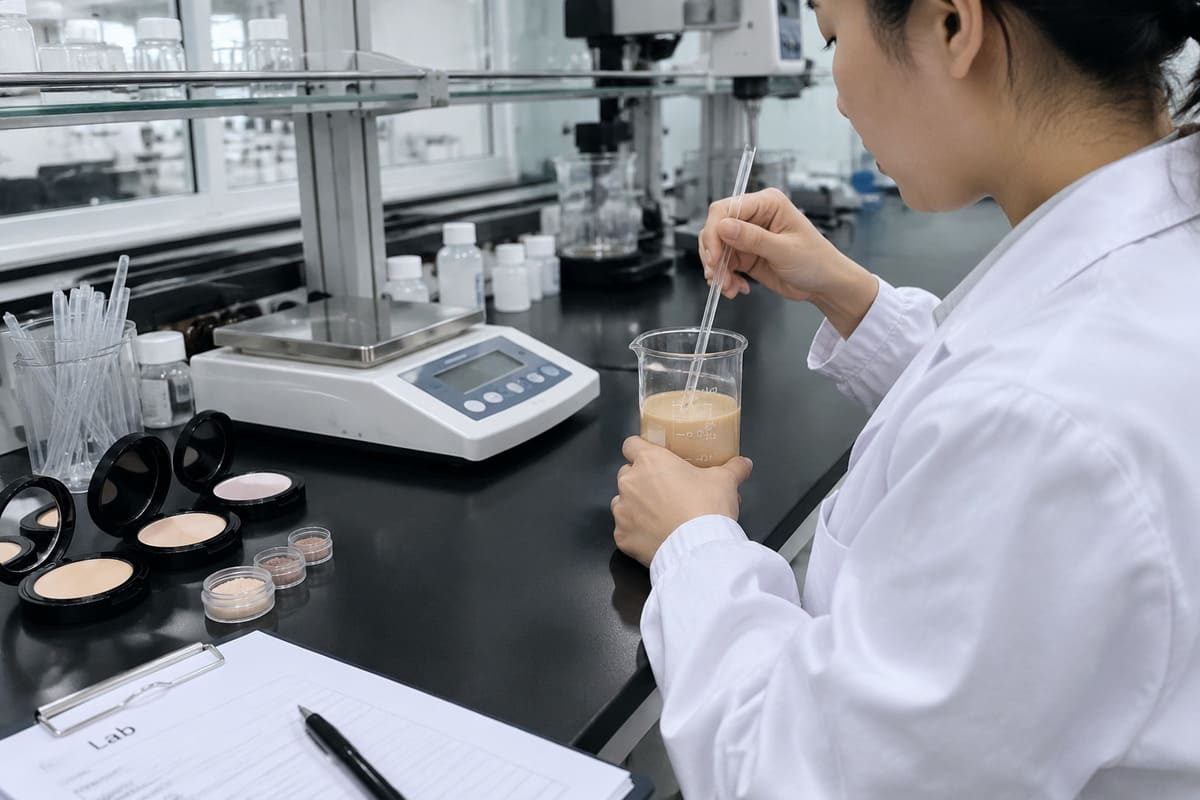
The difference shows up the moment you ask to see reality instead of marketing.
The video tour test
Here is something I see constantly. When a buyer asks for a live video tour, the response splits two groups instantly.
A trading company sends you a beautifully produced brand film. Perfect lighting. Drone shots. Smiling workers in spotless uniforms. It is a commercial, not a tour. When you ask them to walk the floor live, on the spot, they suddenly need to "schedule it" or the "line is not running today."
A real factory just picks up the phone and walks. You will see the powder dust in the air near the mixers. You will see operators mid-task. You will hear the machines running. It is slightly messy because it is real. I once joined a call where our production manager had to step over a pallet of pending orders to reach the filling line. That mess is the proof.
Quick red flags
- The company cannot name a single piece of equipment by model.
- Every photo is stock-quality but no two show the same room.
- They avoid live video and only offer edited content.
- Their address is an office tower, not an industrial zone.
- They dodge questions about who formulates the product.
Polish is easy to buy. A working floor is not.
What Three Physical Questions Expose a Fake Facility?
You can read a website all day and learn nothing. Marketing language is designed to pass inspection. What traders cannot easily fake are the physical realities of making cosmetics. So you stop asking soft questions and start asking hard ones.
Three questions expose a fake facility: Are your powder and liquid lines physically isolated? Are your R&D chemists on-site? Can you show raw material batch traceability from your own warehouse? A real factory answers all three with evidence. A trader stumbles on every one.
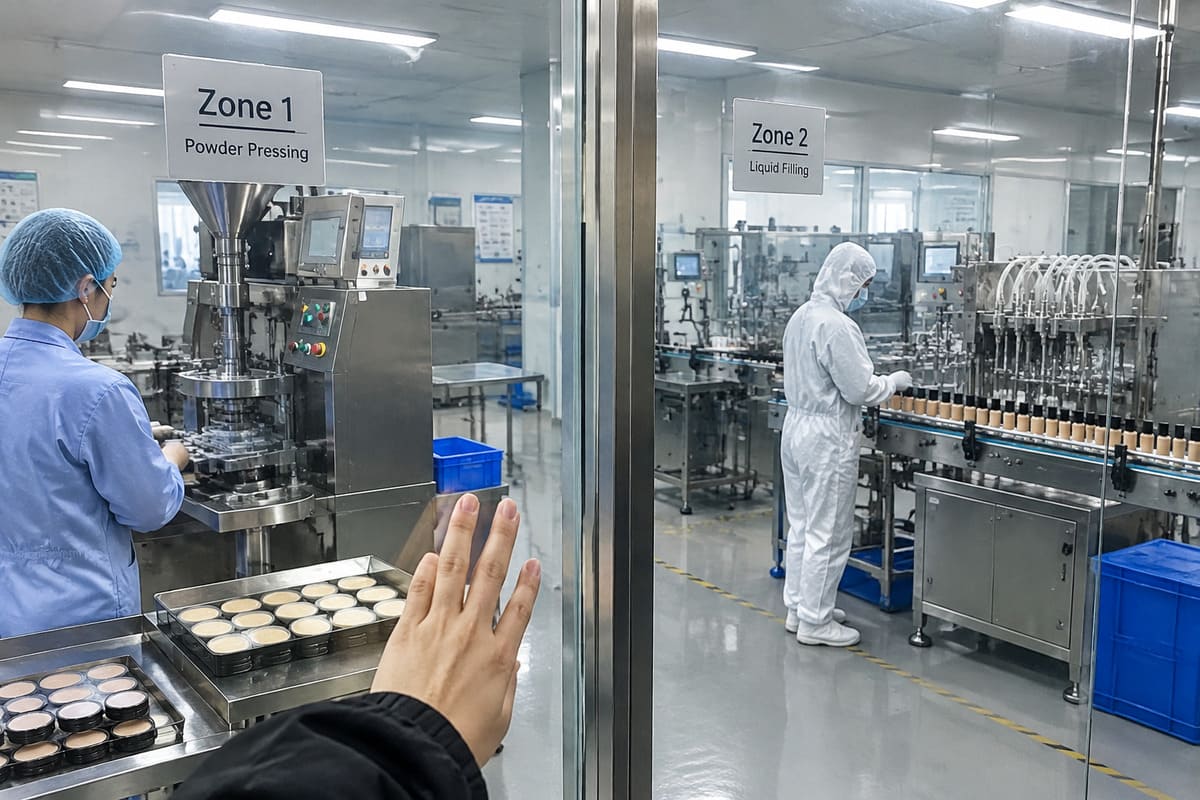
I call these the three lie-detector questions. Here is why each one works.
Question 1: Are your powder and liquid lines physically isolated?
This is the deepest tell. Powder production (eyeshadow, blush, setting powder) creates fine airborne particles.5 Liquid and cream production (foundation, blush sticks) needs a controlled, contaminant-free environment.6 You cannot run both in the same open room7 without cross-contamination. A genuine multi-category factory has separate, isolated areas with their own air handling. A trader has no idea what you are talking about, because they have no lines at all.
Question 2: Are your R&D chemists physically on-site?
A trading company has a sales team, not a lab. Ask to speak with the person who develops your formula. Ask about pigment loading, pressing stability, or how they adjust a shimmer finish.8 A real factory connects you to a chemist who answers in technical detail. A trader says "I will check with the factory" because the real chemists work somewhere they do not control.
Question 3: Can you show raw material batch traceability from your own warehouse?
There is a difference between a supplier's certificate and your own batch records. Any trader can forward a pigment supplier's COA.9 Only a real factory can show you its own incoming inspection logs, its own warehouse batch numbers, and the line linking a specific raw material lot to a specific finished batch10. That traceability lives inside a factory's own systems. A middleman has nothing to trace.
Ask these three questions in your first serious conversation. You will learn more in ten minutes than in ten emails of marketing copy.
What Does a Real Multi-Category Facility Actually Look Like?
The phrase "multi-category factory" gets thrown around loosely. Many claim it. Few can prove it. A buyer building a real brand needs more than one product type, so understanding what a genuine multi-category setup involves protects you from empty claims.
A real multi-category facility has separate, purpose-built zones for each product type, with isolated powder lines, controlled liquid and cream lines, an on-site R&D lab, a raw material warehouse, and its own quality control. It is a layout you can physically walk through, not a line on a brochure.
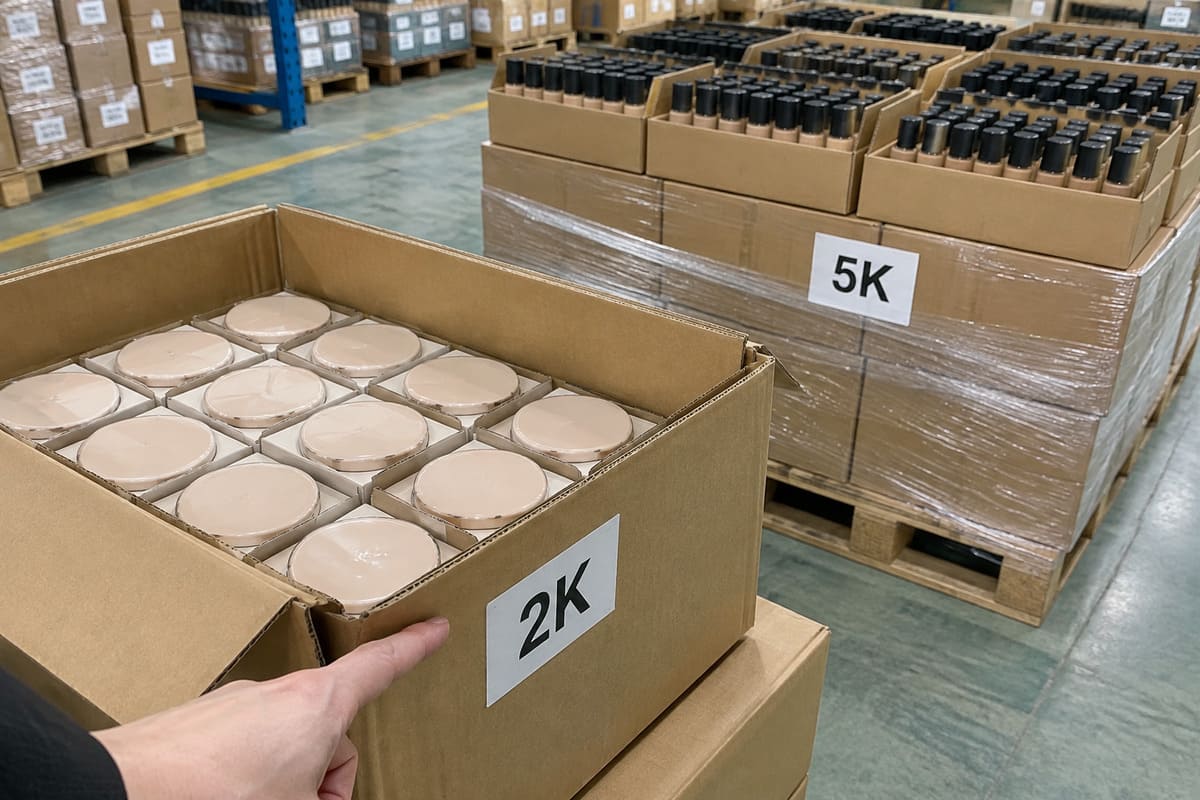
Let me break down what that actually requires on the ground.
The zones a real facility keeps separate
At our own facility in Guangdong, we run distinct areas because the products demand it:
- Powder zone for eyeshadow palettes, chameleon and sparkle shadows, blush, pressed powder, highlighter, and setting powder. This area handles fine pigment dust and pressing.
- Cream and stick zone for blush sticks and cream textures, which need temperature control and a cleaner air environment.
- R&D lab where chemists develop custom shades, test pigment stability, and solve problems like fallout or poor payoff before a batch ever runs.
- Raw material warehouse with incoming inspection and batch logging, so every pigment lot is traceable.
- QC checkpoints that verify color consistency, pressing strength, and packaging integrity.
Why the thresholds exist
Here is the honest part. A multi-category factory has real development thresholds, and anyone who denies them is hiding something. Developing a custom powder product is efficient at roughly 2,000 units.11 Liquid and cream formulas sit higher, around 5,000 units or more, because setup, testing, and cleaning costs are heavier12.
| Product type | Typical development threshold | Why |
|---|---|---|
| Custom powder (eyeshadow, blush) | ~2,000 units | Pressing setup, color matching |
| Liquid / cream (blush stick) | ~5,000+ units | Heavier setup, cleaning, testing |
| Stock relabeling / dropshipping | Not offered | Not a real manufacturing service |
These numbers are not us being difficult. They are the real cost of real production. When a company offers you 50 units of custom formula with zero friction, that is the clearest sign you are not talking to a factory.
What We Openly Invite You to Audit
By now you know the pattern. Traders deflect. Factories invite. Talk is cheap, so the only thing that should earn your trust is verifiable access. We would rather hand you the tools to check us than ask you to take our word.
We invite you to audit our reality directly. Video-call our production lines and watch them run live. Visit our facility in Guangdong in person. Ask our on-site chemists technical questions. Review our raw material batch records. We open the doors because a real factory has nothing to hide behind a marketing wall.

Here is where I am honest about the boundary, because trust works both ways.
Who we are the right fit for
- Brand founders building a real multi-category line of eye and face makeup.
- Distributors and wholesalers who want to deal with the source, not a reseller.
- Creators and new brands who want custom color and packaging with honest MOQs.
Who we are not the right fit for
- Anyone wanting 50 units of stock relabeling. We do not dropship.
- Anyone who needs a custom formula with no minimum. That is not how real production works.
We would rather lose a tiny order than pretend to be something we are not. If you want someone to forward your request to a mystery subcontractor, we cannot help. But if you want to audit the lines, talk to the chemists, and build properly, we are ready.
Frequently Asked Questions
How do I verify a cosmetic contract manufacturer factory is real?
Ask for a live, unscripted video walkthrough of the production floor, request to speak directly with on-site R&D chemists, and ask for raw material batch traceability from their own warehouse. A real factory provides all three on demand. A trading company deflects or sends edited marketing instead.
Why do trading companies rank higher than factories on Google?
Because marketing is cheap and manufacturing is expensive. A website and ad budget cost a few thousand dollars, while a GMP facility costs millions. Traders invest in traffic; factories invest in machinery. This economic gap pushes middlemen to the top of search results.
What is a reasonable MOQ for a real custom cosmetic order?
Custom powder products like eyeshadow and blush are efficient at around 2,000 units. Liquid and cream formulas usually start near 5,000 units due to heavier setup and testing. Offers of 50 custom units with no friction almost always mean stock relabeling, not true manufacturing.
Can a real factory do a video tour on short notice?
Yes. A genuine factory can walk its live production floor on a video call with little notice, showing running machines and real working conditions. If a company only offers polished pre-recorded footage or keeps postponing live tours, treat that as a warning sign.
Do you offer dropshipping or small stock relabeling?
No. We are a real production facility with genuine development thresholds, so we do not offer dropshipping or tiny relabeling runs. We focus on custom and standard production for brands and distributors who want to work directly with the source.
Conclusion
Choosing the right cosmetic contract manufacturer factory comes down to physical evidence, not marketing promises. Traders outrank real factories because ads are cheap and machines are expensive, so you have to look past the SERP noise. Use the three lie-detector questions: isolated powder and liquid lines, on-site chemists, and raw material batch traceability. Honest thresholds signal a real source; impossible MOQs signal a middleman. We are a real factory in Guangdong with open doors. Book a live video tour of our lines or visit in person, and see the reality for yourself.
"How to Find a Cosmetics Manufacturer: A Buyer's Guide to Verifying ...", https://vertinabeauty.com/how-to-find-a-cosmetics-manufacturer-a-buyers-guide-to-verifying-real-factories/. Reference definitions describe a trading company as an intermediary engaged in buying and selling goods, distinct from a manufacturer that owns production capacity. Evidence role: definition; source type: encyclopedia. Supports: That a trading company is an intermediary that buys and resells or arranges production without owning manufacturing capacity.. ↩
"How much should my digital advertising budget be?", https://web.uri.edu/risbdc/how-much-should-my-digital-advertising-budget-be-2/. Market research on small-business digital advertising reports relatively low barriers to entry for search advertising spend compared with capital-intensive operations. Evidence role: statistic; source type: research. Supports: That entry-level search advertising and website costs are modest relative to industrial capital investment.. Scope note: Advertising cost figures vary widely by sector and keyword competition, so they support the general affordability claim rather than a fixed dollar amount. ↩
"GMP Guidelines/Inspection Checklist for Cosmetics", https://www.fda.gov/cosmetics/cosmetics-guidance-documents/good-manufacturing-practice-gmp-guidelinesinspection-checklist-cosmetics. ISO 22716 specifies guidelines for the production, control, storage, and shipment of cosmetic products, defining requirements for premises and equipment that indicate the infrastructure a compliant facility maintains. Evidence role: definition; source type: institution. Supports: That GMP for cosmetics prescribes requirements for premises, equipment, and controlled environments that imply significant physical infrastructure.. Scope note: The standard defines facility requirements but does not quantify capital cost, so it supports the infrastructure claim contextually rather than the stated dollar figure. ↩
"Private label", https://en.wikipedia.org/wiki/Private_label. Descriptions of white-label and private-label cosmetic models indicate that low-minimum offerings typically apply existing stock formulations under the buyer's brand rather than custom development. Evidence role: general_support; source type: other. Supports: That low-MOQ cosmetic offerings commonly rely on pre-existing stock formulations rebranded for the buyer rather than bespoke development.. Scope note: Sources characterize common industry practice and cannot establish that low-MOQ offers are 'almost always' relabeling. ↩
"Quantification of Airborne Dusts From Powders", https://www.cdc.gov/niosh/nmam/pdf/Chapter-AD.pdf. Occupational studies document that dry powder handling and processing release airborne particulate matter, supporting the need for dust-control measures in such operations. Evidence role: mechanism; source type: research. Supports: That handling and processing of fine dry powders generates respirable airborne particulate that requires engineering controls.. Scope note: Most available studies address industrial powders generally rather than cosmetic pigments specifically, so the support is analogical. ↩
"Cosmetics Preservation: A Review on Present Strategies - PMC", https://pmc.ncbi.nlm.nih.gov/articles/PMC6099538/. Microbiological studies of cosmetics report that water-containing emulsions are susceptible to microbial contamination, supporting the need for environmental controls during their manufacture. Evidence role: mechanism; source type: research. Supports: That water-containing liquid and cream cosmetics are prone to microbial contamination and require controlled production environments and preservation.. Scope note: Such studies emphasize microbiological risk and preservation and may not directly address facility air-quality configurations. ↩
"GMP Guidelines/Inspection Checklist for Cosmetics", https://www.fda.gov/cosmetics/cosmetics-guidance-documents/good-manufacturing-practice-gmp-guidelinesinspection-checklist-cosmetics. GMP guidance for cosmetics recommends segregation of production operations and air-handling controls to prevent cross-contamination between product types. Evidence role: mechanism; source type: institution. Supports: That GMP guidance requires measures to prevent cross-contamination between products, including segregation of production areas and controlled air handling.. Scope note: Guidance addresses contamination control broadly and may not specifically mandate separation of powder versus liquid lines, so it supports the principle more than the exact configuration described. ↩
"OEM Makeup Manufacturer: 5 Questions to Verify Real ...", https://vertinabeauty.com/oem-makeup-manufacturer-5-questions-to-verify-real-customization/. Cosmetic science literature on color cosmetics describes pigment loading, binder systems, and pressing conditions as key formulation variables for pressed powder products. Evidence role: definition; source type: education. Supports: That pressed powder cosmetic formulation involves controlled variables such as pigment loading, binders, and pressing conditions studied in cosmetic science.. ↩
"Mineral Makeup Manufacturer: Evidence Chain & Batch Proof", https://vertinabeauty.com/mineral-makeup-manufacturer-evidence-chain-batch-proof/. Quality-management references define a Certificate of Analysis as a document certifying a material's test results against specification, distinct from a receiving facility's own incoming-inspection records. Evidence role: definition; source type: institution. Supports: That a Certificate of Analysis attests to a material's conformance to specification at the supplier and is separate from a manufacturer's internal inspection records.. ↩
"Documentation and Records: Harmonized GMP Requirements", https://pmc.ncbi.nlm.nih.gov/articles/PMC3122044/. ISO 22716 requires record keeping that enables traceability of raw materials and finished products through batch documentation and incoming-material controls. Evidence role: mechanism; source type: institution. Supports: That GMP standards require documentation linking raw material lots to finished batches through inspection and batch records.. ↩
"OEM Makeup Manufacturer: 5 Questions to Verify Real ...", https://vertinabeauty.com/oem-makeup-manufacturer-5-questions-to-verify-real-customization/. Industry overviews of private-label and contract cosmetic manufacturing describe setup-related costs that establish minimum order quantities for custom formulations. Evidence role: statistic; source type: other. Supports: That contract cosmetic manufacturing carries setup-driven minimum order quantities that make small custom runs inefficient.. Scope note: Published sources rarely cite a precise 2,000-unit figure, so they support the existence of MOQ thresholds rather than the exact number. ↩
"Validation of Cleaning Processes (7/93)", https://www.fda.gov/inspections-compliance-enforcement-and-criminal-investigations/inspection-guides/validation-cleaning-processes-793. Process literature on emulsion and liquid product manufacturing notes that equipment cleaning and changeover validation add fixed costs per batch, which raise economical minimum batch sizes. Evidence role: general_support; source type: research. Supports: That liquid and emulsion cosmetic production involves cleaning validation and changeover costs that raise minimum economical batch sizes.. Scope note: Sources address process economics generally and do not confirm the specific 5,000-unit threshold. ↩