Top Cosmetic Contract Manufacturers in USA & Europe [2026 Guide]
Don't let one wrong signature lock you into a formula you don't own. Discover the real Top 15 factories and avoid the Low-MOQ trap.
Choosing between the top cosmetic contract manufacturers feels simple until you realize one wrong signature can lock you into a formula you don't own. I've watched founders celebrate a 200-unit "custom" order, then discover three competitors sell the identical shade. The stakes are real: your margin, your exclusivity, and your brand's survival. This guide fixes that.
The top cosmetic contract manufacturers in the USA and Europe include global giants like Intercos, Cosmax, and Fareva for established brands, agile mid-sized specialists like Lady Burd and Cosmetic Solutions for testing, and true-customization partners like Vertina Beauty for brands ready to own exclusive formulas. The right choice depends on your MOQ, compliance needs, and growth stage.
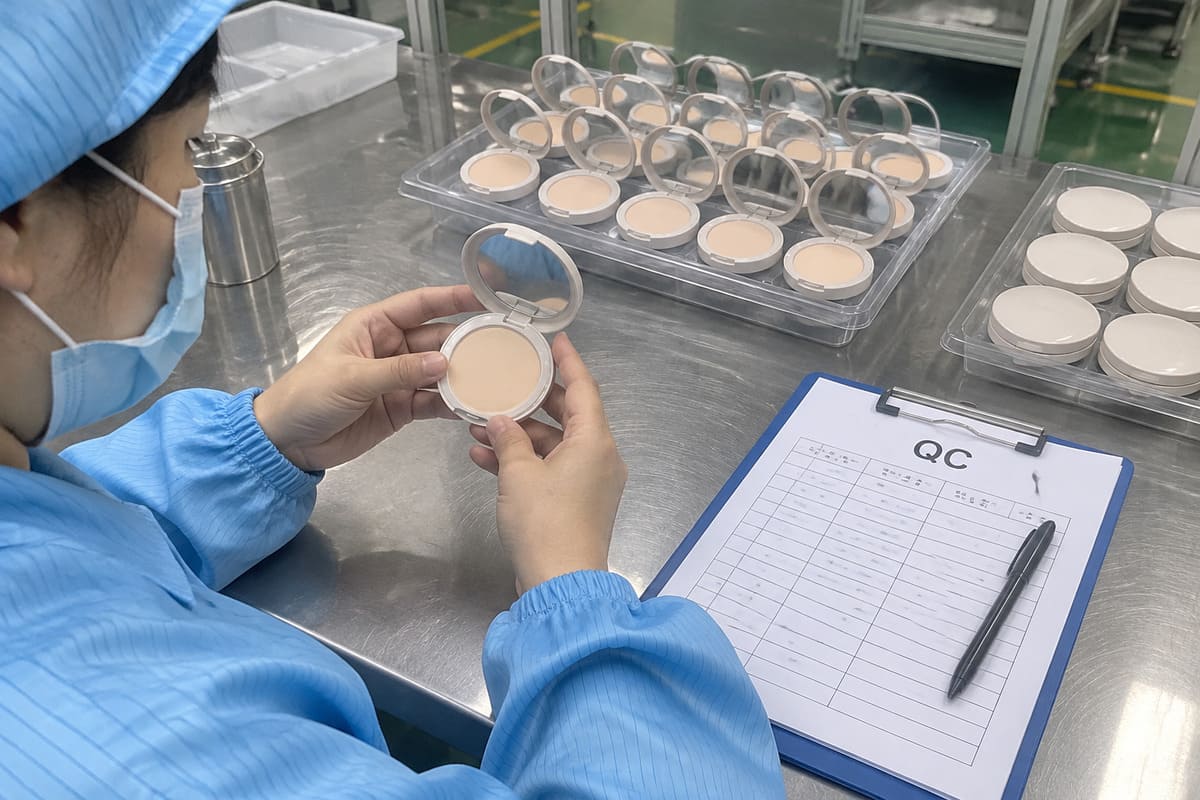
Below I rank 15 factories, expose the "Low-MOQ Trap" that quietly kills new brands, and give you a five-question framework I use before signing any manufacturing agreement. Keep scrolling. The ranking alone will save you weeks of research.
Why Do Leading Beauty Brands Outsource to Contract Manufacturers?
Here's a fact that surprises new founders: MAC, Dior, and Fenty don't make most of their own products. The problem is that building a cosmetics line looks glamorous but hides a brutal capital reality. Agitation? One compliant production line can cost millions before a single palette ships. The solution is outsourcing to contract manufacturers who already carry that burden.
Leading beauty brands outsource to cosmetic contract manufacturers because building in-house production requires enormous capital, regulatory infrastructure, and R&D depth. Outsourcing converts fixed costs into variable ones, shortens time-to-market, and gives brands access to specialized formulation expertise they could never build alone.
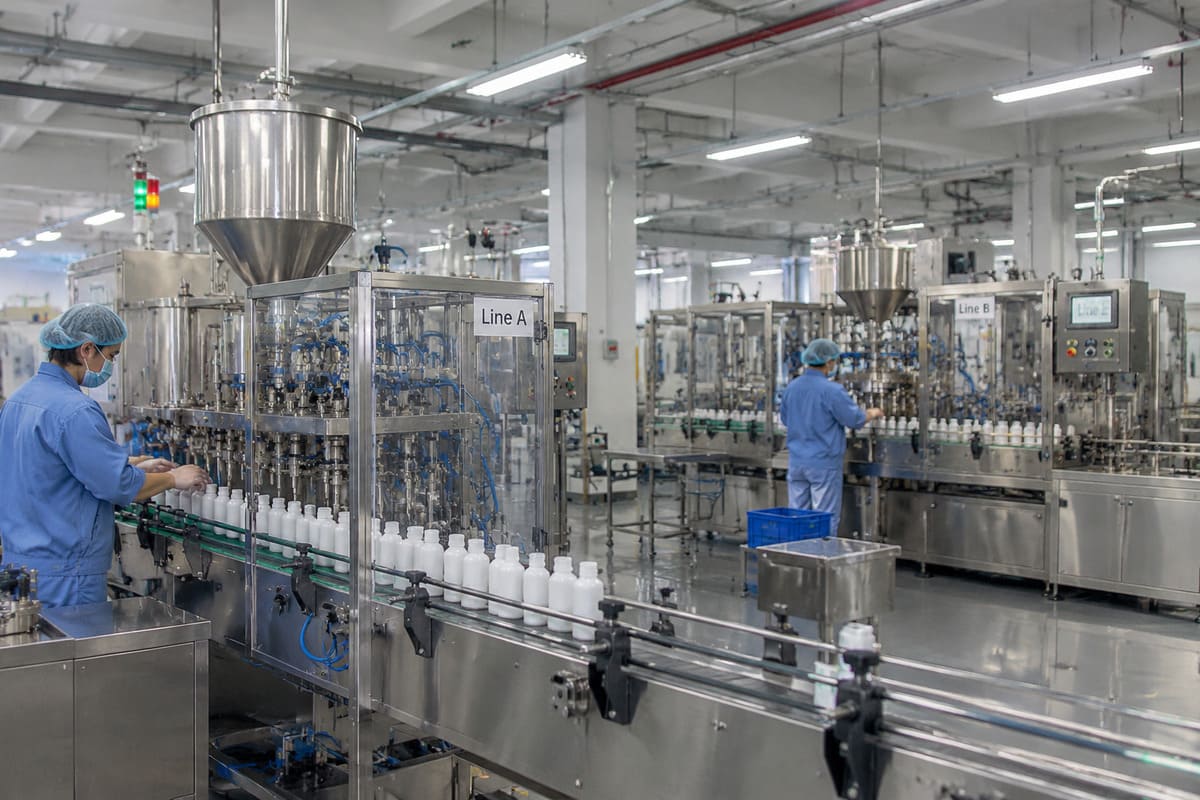
When I talk to brand founders, I explain the math plainly. A dedicated powder-pressing facility needs clean rooms, QC labs, filling equipment, and a compliance team. That easily runs seven figures before you press a single pan. Most brands, even funded ones, cannot justify that spend for an unproven SKU.
Outsourcing solves four problems at once:
- Capital: You pay per unit, not per factory.
- Speed: Established lines ship in weeks, not years.
- Expertise: You borrow decades of formulation knowledge.
- Risk: You test a market before committing to scale.
But I want to be direct about one thing. Choosing a manufacturer is not a procurement task. It is a strategic decision that shapes whether you own your formula, control your exclusivity, and can scale when demand arrives. A cheap factory that saves you $2,000 today can trap your brand in a commodity price war tomorrow. I've seen it happen more than once, and the rest of this guide is built to help you avoid it.
Who Are the 2026 Top 15 Cosmetic Contract Manufacturers?
The problem with most ranking lists is that they treat a 50,000-unit luxury giant and a 200-unit stock house as interchangeable. They are not. I've grouped these cosmetic contract manufacturers into three honest tiers so you can match a partner to your actual stage.
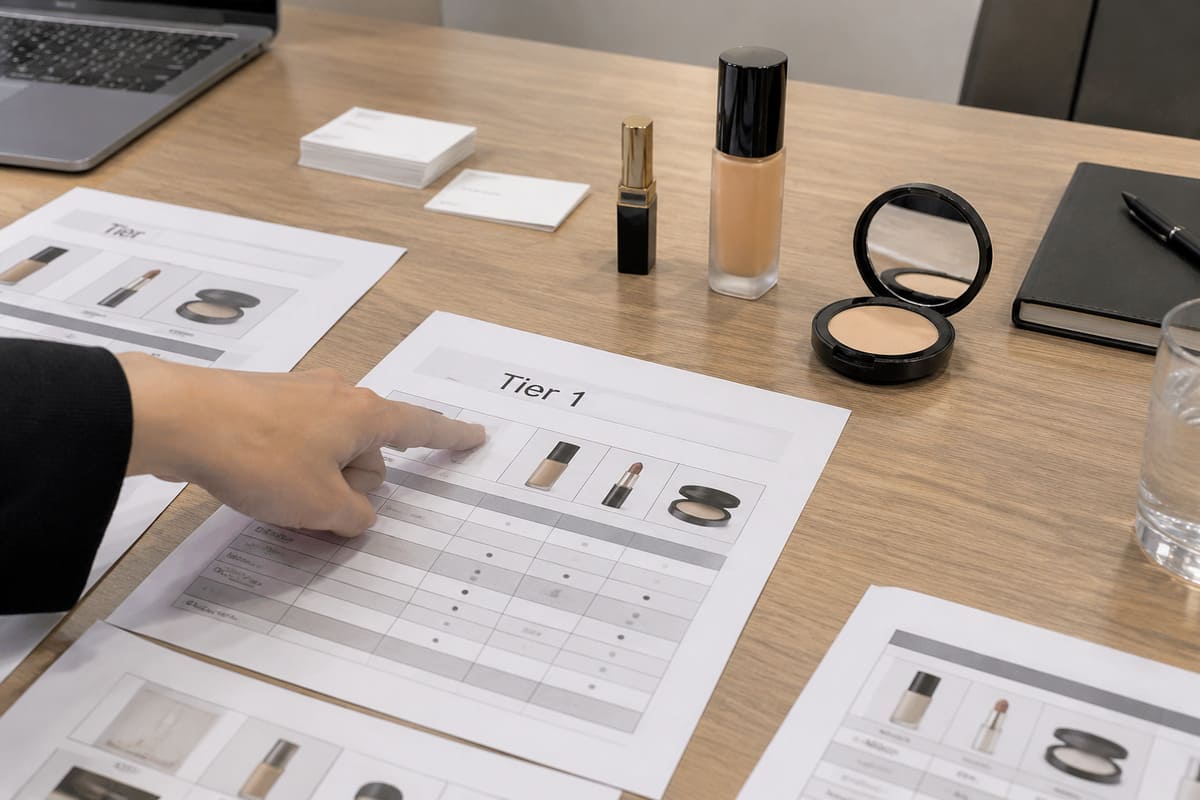
The 2026 top 15 cosmetic contract manufacturers fall into three tiers: Global Giants (Intercos, Cosmax, Fareva, Mana, Kolmar) for established brands with high volumes; Agile Mid-Sized Specialists (Lady Burd, Cosmetic Solutions, HCT and others) for market testing; and True Customization partners (Vertina Beauty) for brands ready to own exclusive formulas at serious scale.
Tier 1: Global Giants (For Established Brands)
These are the names behind prestige counters worldwide. Their quality is exceptional and their MOQs are equally serious.
| Manufacturer | Location | Specialty | MOQ Reality |
|---|---|---|---|
| Intercos | Italy | Color cosmetics, powders | Very high; luxury-tier |
| Cosmax | South Korea | World's largest ODM, K-Beauty R&D | High volume |
| Fareva | France | Skincare, dermo-cosmetics | High; long lead times |
| Mana Products | USA | Prestige color cosmetics | High |
| Kolmar Laboratories | USA | Skincare and powders | High |
My honest take: these giants are superb once you're moving tens of thousands of units. For a new brand, their minimums and lead times are often out of reach.
Tier 2: Agile Mid-Sized Factories & Specialists
This tier is where most growing brands shop. The flexibility is attractive, but read the MOQ reality column carefully.
| Manufacturer | Location | Specialty | MOQ Reality |
|---|---|---|---|
| Lady Burd | USA | Broad color range | Ultra-low (~$150 stock); public molds, stock formulas |
| Cosmetic Solutions | USA | Natural/organic skincare | Small-to-mid batch |
| HCT | USA/Global | Packaging + formulation | Mid; one-stop |
| Oxygen Development | USA | Lipsticks, compact powders | Mid |
| ItIt Cosmetics | Italy | Fashion-trend color | Mid |
| Mascara Plus | Italy | High-end color, mascaras | Mid |
| Cosmetique SA | Switzerland | Skincare, wet wipes | Mid-to-high |
| ColorStrokes | USA | Color cosmetics, brushes | Small batch |
| Temmentec | Switzerland | Emulsions, liquids, waxes | Custom |
Tier 3: True Customization (The Vertina Solution)
For brands that have outgrown public molds: Vertina Beauty (Global/China) offers 2,000-pc true custom formulation across powder, lip, and skincare. They are not a low-MOQ stock house. They are a partner for exclusive shade engineering and full FDA/MoCRA documentation. Custom skincare and fragrance start at 5,000–10,000 pcs. This is the realistic threshold where your formula actually becomes yours.
Contract Manufacturing vs. Private Label: What's the Real Difference?
Founders use these terms interchangeably, and that confusion costs them ownership. The problem is that a factory can call something "custom" when they've simply printed your logo on a stock recipe. The agitation hits six months later when you can't reproduce or defend your bestseller. Let me draw the line clearly.
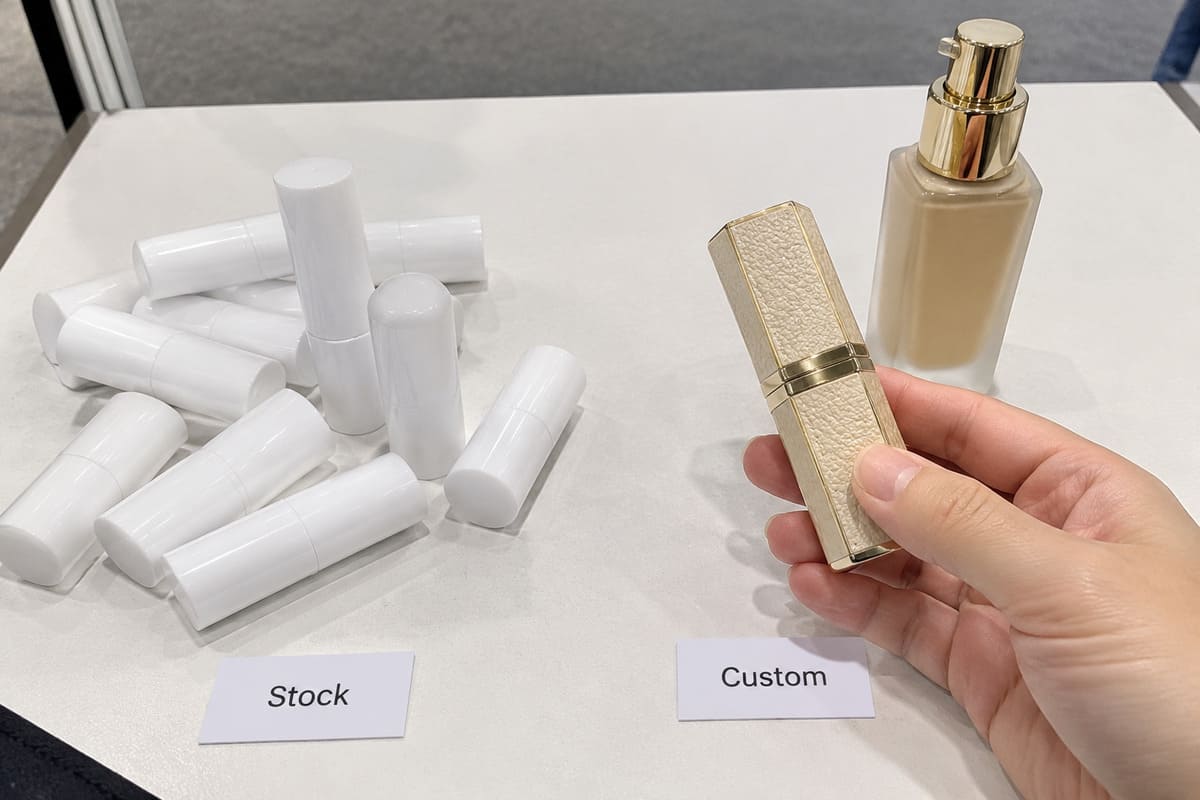
Contract manufacturing means a factory develops a custom formula and packaging that you own exclusively. Private label means you buy an existing stock formula and add your logo. The key difference is ownership: with true contract manufacturing you control the formula; with private label you share it with every other buyer of that stock product.
| Dimension | Contract Manufacturing (OEM/ODM) | Private Label |
|---|---|---|
| Formula | Custom-developed for you | Shared stock formula |
| Ownership | You own it exclusively | Factory owns it |
| Packaging | Custom mold or design | Public mold + your logo |
| Exclusivity | High | None |
| MOQ | Higher (real tooling) | Very low |
| Time-to-market | Weeks to months | Days |
Both models are legitimate. Private label is a smart way to test a market fast and cheap. The danger is blurred language. Many cheap factories market private label as "fully custom." They let you pick from a swatch book, change the compact color, and call it an exclusive product. It is not. The formula underneath is identical to what dozens of other brands sell. I always tell founders to ask one question: "If I leave, can my competitor buy this exact formula tomorrow?" If the answer is yes, it's private label, no matter what the quotation says.
What Is the "Low-MOQ Trap" and Why Do Cheap Factories Cost You More?
A 200-unit minimum sounds like a gift to a cash-strapped founder. The problem is what makes that number possible. Agitation: the only way a factory profits on tiny runs is by spreading one shared mold and one stock formula across hundreds of buyers. You're not getting a deal. You're renting a commodity.
The "Low-MOQ Trap" occurs when factories offer 150–500 unit minimums by using public molds and stock formulas. You do not own the formula, cannot enforce exclusivity, and your product becomes a commodity that competitors sell identically, forcing a price war on Amazon that destroys your margin.
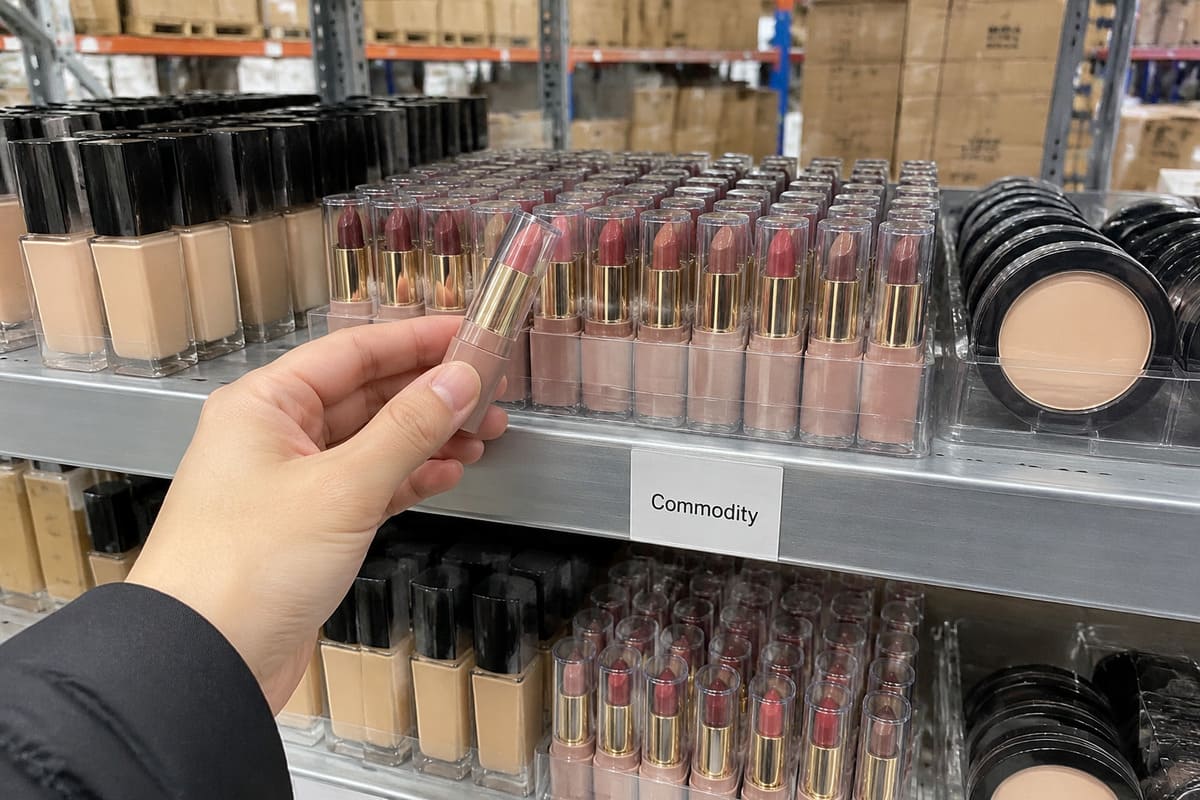
Think through the mechanics honestly:
- No formula ownership: The recipe stays with the factory. You can never move it or protect it.
- Zero exclusivity: The same compact and shade ship to anyone who orders. Your "hero product" is three sellers' hero product too.
- Commodity pricing: Identical products compete only on price. On Amazon or TikTok Shop, that race ends at the bottom.
- No scalability: When demand spikes, you can't re-engineer a formula you never owned.
I'm not attacking low-MOQ factories. They serve a real purpose for sampling and market validation. The trap is mistaking them for a brand-building partner. A founder who builds real marketing momentum on a shared formula has built a sandcastle. The moment a competitor undercuts the identical product, the margin collapses. The cheap entry cost gets repaid many times over in lost pricing power. That's why "cheap" is often the most expensive choice you can make.
What Are the 5 Questions to Ask Before You Sign a Manufacturing Contract?
Before I let any brand commit, I run the factory through five questions. The problem is that founders focus on price and MOQ while ignoring the structural issues that decide whether a brand survives. This framework surfaces them.
Before signing with any cosmetic contract manufacturer, ask five questions: (1) Do I own the formula outright? (2) Is the MOQ for true custom or a public mold? (3) How deep is their compliance, including MoCRA registration, PAO symbols, and barcode Quiet Zones? (4) Can they coordinate color across powder, lip, and skincare? (5) Can they scale from 2,000 to 100,000 units without re-tooling?
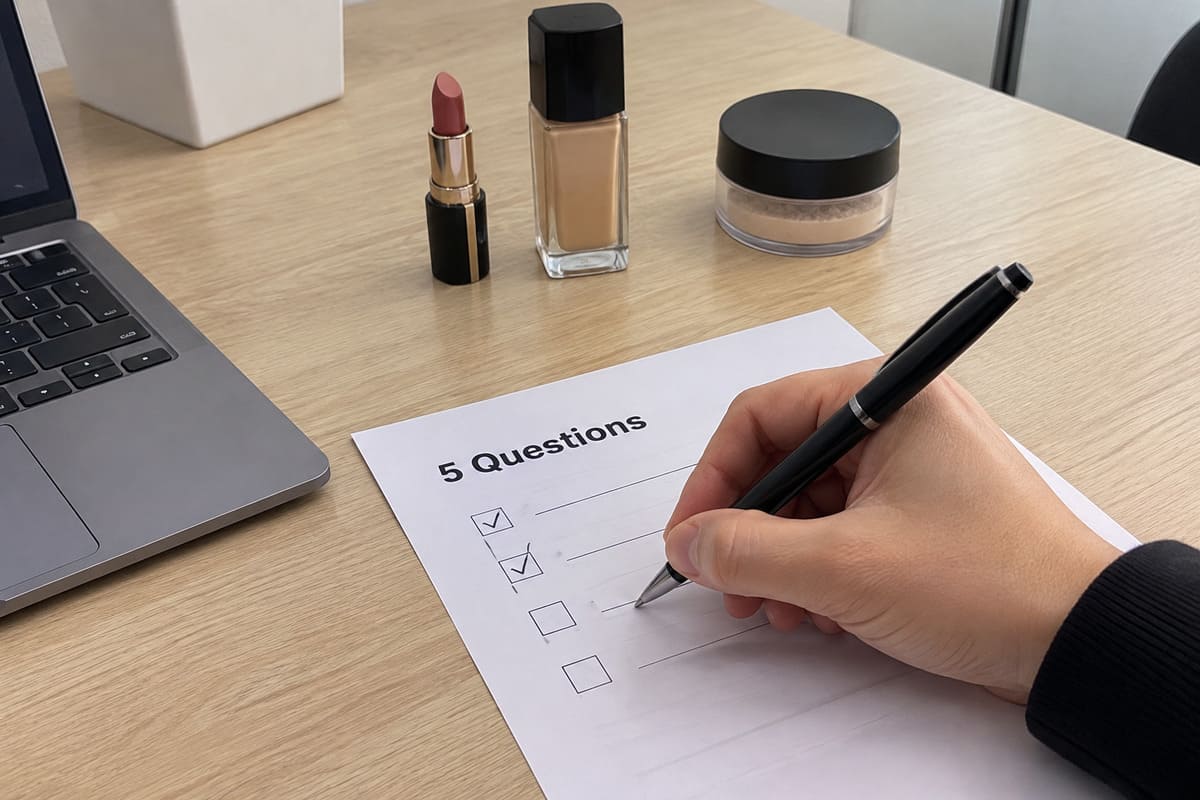
| # | Question | What a Strong Answer Looks Like |
|---|---|---|
| 1 | Formulation ownership | Written exclusivity; formula assigned to you |
| 2 | Real MOQ | True custom tooling, not a swatch-book pick |
| 3 | Compliance depth | Audits MoCRA, FDA, PAO symbols, label Quiet Zones |
| 4 | Category coordination | Matches shades across powder, lip, skincare in one file |
| 5 | Scalability | Grows from 2,000 to 100,000+ without formula changes |
On compliance specifically, I hold a strict standard. For the US market under MoCRA, a serious manufacturer should support facility registration, product listing, responsible-person labeling, and adverse-event documentation. For the EU, that means CPNP notification and a compliant PIF. Export markets add their own layers; Saudi Arabia, for example, requires SFDA cosmetic product notification before customs clearance. I always tell buyers to treat every certificate as a document to verify independently, and to get application-specific regulatory questions reviewed by a qualified compliance professional. A factory that waves away these details is telling you how your border problems will go.
Why Is Vertina Beauty the Partner for Serious Brand Builders?
Most founders reach me after the Low-MOQ Trap has already bitten. The problem is they built momentum on a shared formula and hit a ceiling. Here's how we're built to be the next step, and I'll be frank about where we are not the right fit.
Vertina Beauty is built for brands ready to own exclusive formulas. We offer true custom formulation starting at 2,000 pcs for powder products and 5,000–10,000 pcs for skincare and fragrance, with full-category coordination and complete FDA/MoCRA documentation support. We are the realistic threshold where customization becomes genuine brand equity.
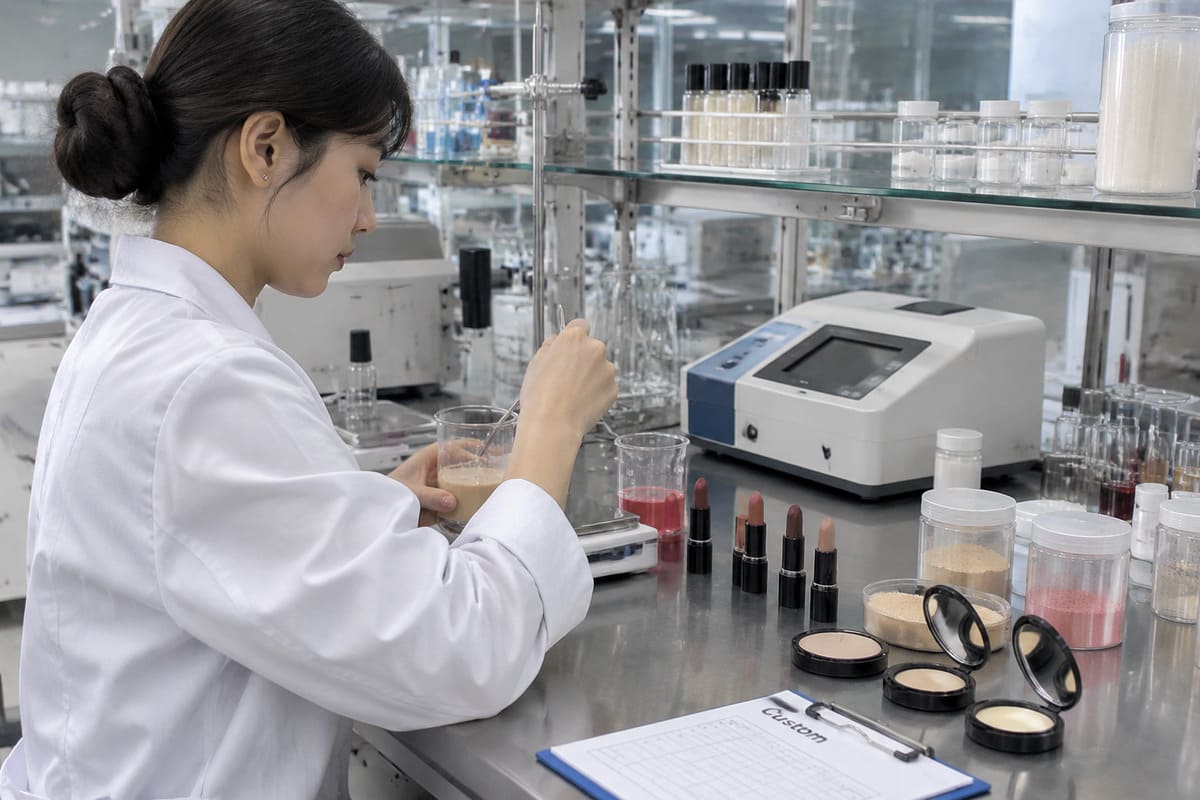
Our differentiation maps directly to the five-question framework:
- Formula ownership: Custom shade engineering developed for you, not pulled from a stock book.
- Honest MOQ: 2,000 pcs (powder) is our real floor for true customization. We don't pretend to be a 50-unit factory.
- Compliance: One FDA/MoCRA documentation package across your whole range.
- Category coordination: We align powder, lip, and skincare color under a single compliance file, so a palette, a lip product, and a complexion item actually look like one brand. Most factories do one category; coordinating across them is where consistency is won or lost.
- Scalability: The same formula grows with you as orders climb.
A real case:
A Middle East brand started with a low-MOQ stock palette from a local trader. The shade range was identical to three competitors, and their margin collapsed. They switched to our 2,000-pc custom shade engineering. The second batch sold out, and they reordered at 2.5x the volume.Now the frank limitation. If you are not yet at 2,000 pcs, we are not your custom partner, and I won't pretend otherwise. For brands at that stage, I recommend our Ready-Stock line, branded, quality-controlled inventory you can sell immediately to test your market before committing to exclusive tooling. Test first, customize when the demand is proven. That's the honest sequence.
Frequently Asked Questions
What is the minimum order quantity for custom cosmetics? ▼
Do I own the formula when I use a contract manufacturer? ▼
What certifications do cosmetic manufacturers need for the US market? ▼
Are low-MOQ cosmetic factories a bad choice? ▼
Can one manufacturer handle powder, lip, and skincare together? ▼
Ready to Build a Brand That Owns Its Category?
Choosing among the top cosmetic contract manufacturers comes down to one decision: do you want a quick, cheap commodity, or a formula you truly own? The giants serve established volumes. Low-MOQ houses serve market tests. For brands ready to build real equity, true customization starts at 2,000 pcs (powder) and 5,000–10,000 pcs (skincare and fragrance). No hidden public molds. Just a formula that's yours.
Grab my Global Cosmetic Manufacturer Due Diligence Checklist, the exact vetting framework I use, in exchange for your email. Let's build a brand that owns its category instead of fighting for the bottom of a price war.
✓ Real Formula Ownership
✓ Honest MOQ (2,000 pcs)
✓ Full FDA & MoCRA Support
Get Your Free Due Diligence Checklist
Enter your details below. We will email you the PDF checklist and a sample shade plan within 24 hours.
View References & Footnotes
[^1]: "Intercos Group | Cosmetic contract manufacturing", https://www.intercos.com/. Company and encyclopedic profiles describe Intercos as an Italian cosmetics manufacturer specializing in color cosmetics, including powders, for brand clients. Evidence role: general_support; source type: encyclopedia. Supports: That Intercos is an Italy-based cosmetics manufacturer known for color cosmetics and powder products.. Scope note: Such profiles confirm the company's focus but do not independently rank its position among 'global giants.'
[^2]: "Who manufactures makeup? (The Real Supply ... - Vertina Beauty", https://vertinabeauty.com/who-manufactures-makeup-the-real-supply-chain-map-for-new-brands/. Industry analyses of the cosmetics supply chain document widespread reliance on third-party contract manufacturers (OEM/ODM) among brand owners, including prestige labels. Evidence role: general_support; source type: research. Supports: That outsourcing to contract manufacturers is standard practice across the cosmetics industry, including prestige brands.. Scope note: General industry sources may not individually confirm the production arrangements of MAC, Dior, or Fenty specifically.
[^3]: "GMP Guidelines/Inspection Checklist for Cosmetics", https://www.fda.gov/cosmetics/cosmetics-guidance-documents/good-manufacturing-practice-gmp-guidelinesinspection-checklist-cosmetics. Industry cost analyses of cosmetic manufacturing facilities report significant capital requirements for clean rooms, quality-control laboratories, and filling and compliance infrastructure. Evidence role: statistic; source type: research. Supports: That building a GMP-compliant cosmetics production facility involves substantial capital investment (clean rooms, QC labs, filling equipment).. Scope note: Reported figures vary widely by scale, product category, and region, so a single 'millions' threshold is indicative rather than precise.
[^4]: "The impact and cost-effectiveness of outsourcing", https://rosap.ntl.bts.gov/view/dot/86538/dot_86538_DS1.pdf. Management and operations literature identifies the conversion of fixed costs into variable costs as a standard economic rationale for outsourcing production. Evidence role: mechanism; source type: education. Supports: That a recognized rationale for outsourcing is converting fixed production costs into variable, per-unit costs.. Scope note: The effect depends on contract terms; minimum-volume commitments can reintroduce fixed-cost characteristics.
[^5]: "Cosmax Official Website", https://www.cosmax.com/en/. Company and encyclopedic profiles describe Cosmax as one of the leading global cosmetics ODM manufacturers by output and client base. Evidence role: general_support; source type: encyclopedia. Supports: That Cosmax is among the largest cosmetics ODM manufacturers globally.. Scope note: Rankings vary by metric (revenue, volume, client count) and year, so 'world's largest' may not hold under every measure.
[^6]: "What is OEM in the Beauty Industry? (And Why It's Not the Right ...", https://vertinabeauty.com/what-is-oem-in-the-beauty-industry-and-why-its-not-the-right-starting-point-for-most-new-brands/. Reference definitions of OEM, ODM, and private label distinguish custom-developed products from the relabeling of existing stock formulations. Evidence role: definition; source type: encyclopedia. Supports: That OEM/ODM contract manufacturing and private label describe distinct arrangements differing in formula development and ownership.. Scope note: Exclusivity of formula ownership ultimately depends on the specific contract rather than the model label alone.
[^7]: "When Your Product Becomes a Commodity - Baker Library", https://www.library.hbs.edu/working-knowledge/when-your-product-becomes-a-commodity. Economic research on commoditization and price transparency finds that undifferentiated products competing in low-search-cost online markets face intensified price competition and margin pressure. Evidence role: mechanism; source type: research. Supports: That undifferentiated (commodity) products tend to compete on price, compressing margins, particularly in transparent online marketplaces.. Scope note: The strength of the effect varies with brand differentiation, platform dynamics, and category.
[^8]: "Period-after-opening symbol", https://en.wikipedia.org/wiki/Period-after-opening_symbol. Reference sources define the Period-After-Opening (PAO) symbol as a labeling mark indicating the number of months a cosmetic remains safe to use after opening, used notably under EU cosmetics rules. Evidence role: definition; source type: encyclopedia. Supports: That the Period-After-Opening (PAO) symbol indicates the recommended usable period of a cosmetic after opening and is a standard labeling element..
[^9]: "General Specifications Change Notification (GSCN)", https://www.gs1.org/docs/barcodes/GSCN_20-323_Clafiry_Add-on.pdf. GS1 barcode specifications define quiet zones as mandatory clear margins adjacent to a symbol that are required for reliable optical scanning. Evidence role: definition; source type: institution. Supports: That barcode specifications require 'quiet zones,' minimum clear margins on either side of a symbol, for reliable scanning..
[^10]: "Registration & Listing of Cosmetic Product Facilities and ...", https://www.fda.gov/cosmetics/registration-listing-cosmetic-product-facilities-and-products. The U.S. FDA's guidance on the Modernization of Cosmetics Regulation Act of 2022 sets out requirements for facility registration, product listing, responsible-person labeling, and adverse-event recordkeeping. Evidence role: definition; source type: government. Supports: That the Modernization of Cosmetics Regulation Act (MoCRA) establishes facility registration, product listing, responsible-person labeling, and adverse-event recordkeeping requirements..
[^11]: "Cosmetic product notification portal", https://single-market-economy.ec.europa.eu/sectors/cosmetics/cosmetic-product-notification-portal_en. Regulation (EC) No 1223/2009 on cosmetic products requires notification through the Cosmetic Products Notification Portal (CPNP) and the keeping of a Product Information File (PIF). Evidence role: definition; source type: government. Supports: That EU Regulation (EC) No 1223/2009 requires notification via the Cosmetic Products Notification Portal and maintenance of a Product Information File..
[^12]: "Makeup Manufacturer Dubai: The Real MOQ of “Local” vs. Agile ...", https://vertinabeauty.com/makeup-manufacturer-dubai-the-real-moq-of-local-vs-agile-supply-chain-validation/. The Saudi Food and Drug Authority (SFDA) publishes cosmetic product notification and registration requirements that apply to products entering the Saudi market. Evidence role: general_support; source type: government. Supports: That the Saudi Food and Drug Authority requires notification/registration of cosmetic products prior to import.. Scope note: The precise sequencing relative to customs clearance may vary by product category and should be confirmed against current SFDA procedures.