Who manufactures makeup is the question I hear most from nervous first-time founders, and the search results terrify them. They see L'Oréal, Estée Lauder, and Coty. They think launching a brand means building a factory or signing with a giant. That fear stops good brands before they start. There is a better map.
Most makeup is not made by the brands on the label. It is made by contract manufacturers. When you ask who manufactures makeup, the honest answer is a three-tier pyramid: in-house giants at the top, mega CDMOs in the middle, and agile contract factories at the bottom—where roughly 90% of new brands actually launch1. You do not need to own a factory to own a brand.

So if the giants are not your starting line, where do you fit? The answer depends less on who makes the product and more on your capital, your stage, and your risk tolerance. Let me break the whole map down, tier by tier, with the numbers I actually quote clients.
What Does "Who Manufactures Makeup" Really Mean for New Brands?
You typed "who manufactures makeup" into Google expecting a factory address. Instead you got a corporate directory of billion-dollar conglomerates. Now you feel locked out, like the industry has a velvet rope and you are on the wrong side of it. That feeling is the first mistake I want to fix.
For a new brand, the question "who manufactures makeup" is not asking for a list of companies. It is really asking "If I don't own a factory, can I still build a beauty brand, and where do I fit?" The answer is yes. The vast majority of brands outsource production to contract manufacturers and focus their own energy on branding and sales.
Here is the gap between the search and the real need. Let me bridge it before we go deeper into the pyramid.
Dive Deeper: The Question Behind the Question
When a founder asks who manufactures makeup, I hear two hidden fears underneath the words. The first fear is the heavy-asset trap: sinking life savings into equipment, permits, and a production line. The second fear is the scam: getting sold generic white-label junk by a middleman who repackages the same product for fifty other "brands."
Both fears are valid. Both come from the same root problem—nobody showed this founder the actual structure of the industry. So let me reframe the question.
The real question is not "who makes the makeup?" The real question is: "What is the smartest, most capital-efficient manufacturing strategy for my brand's current stage?"
That reframing changes everything. A pre-revenue founder and a founder with 10,000 loyal customers need completely different answers. One needs a low-risk validation run. The other needs exclusive formulas and custom molds.
Consider the difference in mindset:
| Question you ask | What it signals | Where it leads you |
|---|---|---|
| "Who manufactures makeup?" | Looking for a factory to own or copy | Heavy-asset trap or confusion |
| "Who makes makeup for brands like mine?" | Looking for a partner | Contract manufacturing |
| "What strategy fits my stage?" | Thinking like a brand owner | Capital-efficient growth |
Once you ask the third question, the giants stop being intimidating. They become irrelevant to your decision. You are not competing with them for a factory. You are building an audience they will one day want to buy. That is the goal.
The Reality Check: Why 90% of New Beauty Brands Don't Own a Factory?
Picture a founder who just spent three months pricing out mixing tanks, filling machines, and a cleanroom. He is exhausted and broke, and he has not sold a single eyeshadow. I have talked dozens of people out of this exact plan. It breaks my heart how close they come to ruin.
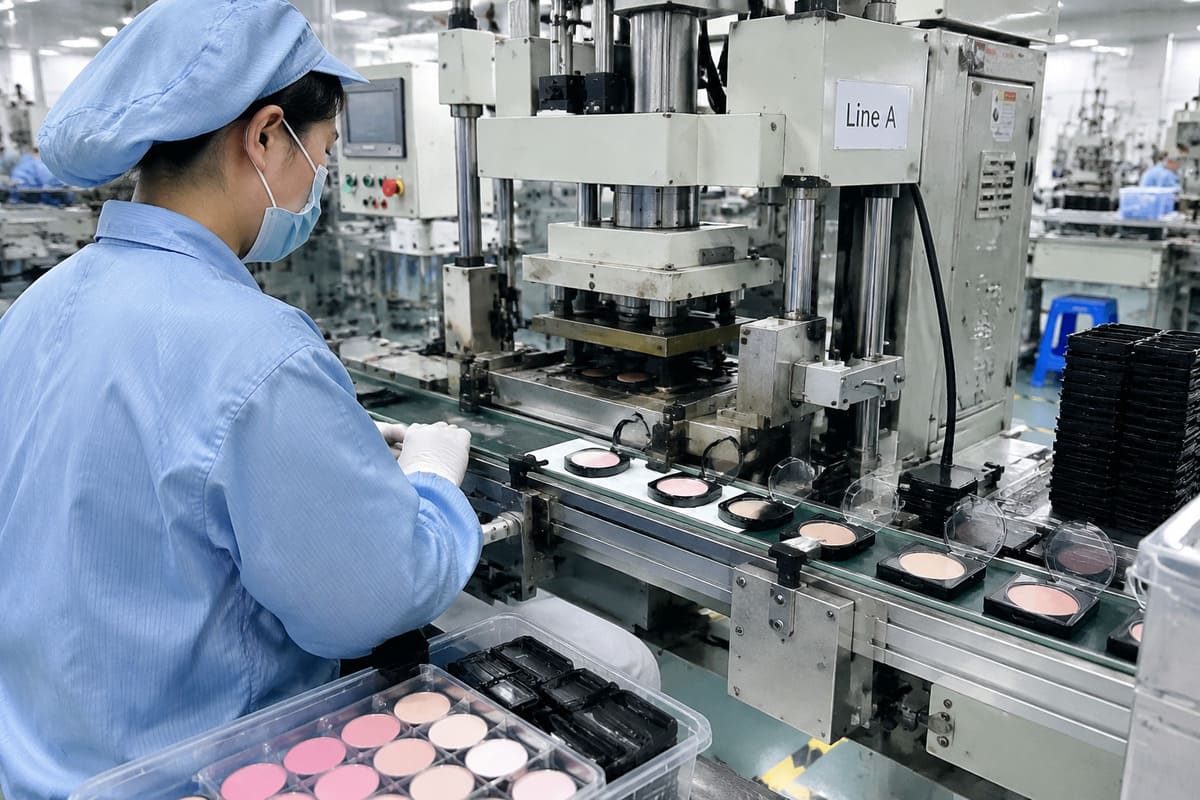
Roughly 90% of successful new beauty brands do not own a factory because the brand owner's job is marketing and distribution, not production. Owning a factory ties up capital, demands permits and maintenance, and forces you to split focus. Contract manufacturing lets you launch faster, cheaper, and with far less risk.
The math on this is brutal and clear. Let me show you exactly why the factory dream fails more often than it succeeds.
Dive Deeper: The Hidden Cost of Owning a Factory
Founders always underestimate the real cost of building a factory. They budget for equipment. They forget everything else. Here is what actually lands on your desk the day you decide to manufacture in-house:
- Environmental permits2 for cosmetic production and waste handling
- Facility registration such as MoCRA registration in the US market3
- Production line maintenance and calibration, which never stops
- Quality control staff and batch testing protocols
- Raw material sourcing at low volume, where you pay the worst prices
- Downtime and spoilage when a line sits idle between orders
Now compare where your time goes. With a factory, I estimate you spend 90% of your energy running the plant and 10% building the brand. For a startup, that ratio is a guaranteed formula for failure. Your customers do not care who owns the tanks. They care about your shades, your story, and your packaging.
Even the biggest influencer launches prove this. Kylie Jenner's early line used a contract manufacturer4. She focused on audience and brand. The factory stayed someone else's problem. That is not a shortcut—that is the industry standard.
| Cost category | Build your own factory | Use a contract manufacturer |
|---|---|---|
| Upfront capital | Tens of thousands+ | Cost of one trial order |
| [Time to first launch | 6–12 months](https://www.sa.gov/Directory/Departments/DSD/Constructing/Business-Commercial/Permit-Process)%%%FOOTNOTE_REF_5%%% | 2–6 weeks |
| Permits & registration | Your responsibility | Shared or handled |
| Focus on marketing | ~10% | ~90% |
| Risk if product flops | Severe (sunk assets) | Limited to order size |
The verdict is simple. For a new brand, outsourcing production is not the cheap option. It is the smart option.
The Three Tiers of Makeup Manufacturing (And Where You Fit In)?
New founders treat makeup manufacturing like one giant locked door. It is not. It is a pyramid with three very different floors, and most people waste months knocking on the wrong one. They email a mega-supplier, get ignored, and conclude the industry rejected them. It did not. They just knocked on the wrong tier.
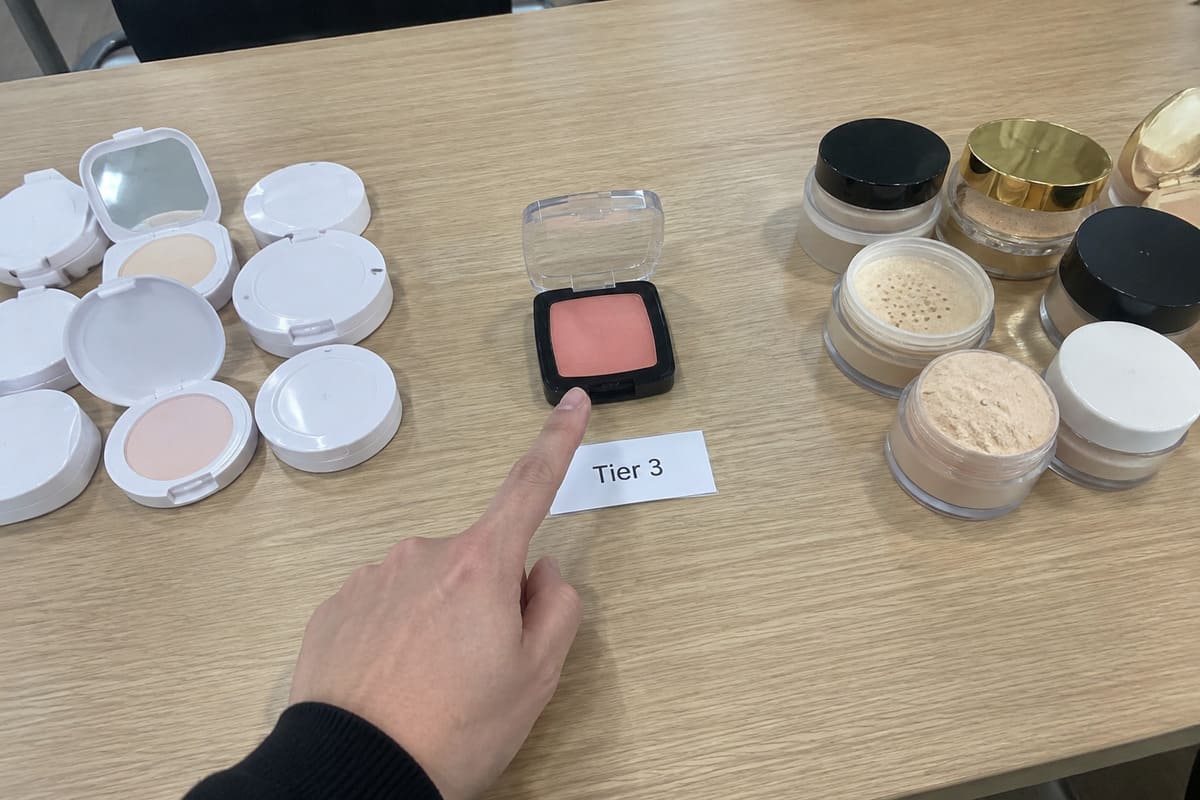
Makeup manufacturing has three tiers. Tier 1 is in-house giants like L'Oréal who own factories and buy brands. Tier 2 is mega CDMOs like Kolmar with 50,000+ unit minimums serving those giants. Tier 3 is agile contract manufacturers who take new brands with low trial runs. New founders belong in Tier 3.
Understanding which tier you belong to saves you months of rejection. Let me map each floor so you knock on the right door the first time.
Dive Deeper: A Breakdown of the Three Tiers
Each tier serves a completely different kind of customer. Knowing the difference tells you exactly where to spend your energy.
Tier 1: In-House Giants. These are the names your search returned—L'Oréal, Estée Lauder, Coty. They own their factories. More importantly, they grow by acquiring successful brands rather than mentoring new ones.6 This tier is not your starting line. It is, if anything, your eventual exit. Your job is to become attractive enough that a Tier 1 giant wants to buy you.
Tier 2: Mega CDMOs. Contract development and manufacturing organizations like Kolmar and Intercos sit here.7 They are brilliant at scale, but they exist to serve Tier 1 and large established brands. Their minimum order quantities often start at 50,000 units per SKU8. If you email them as a startup with no revenue, you will not get a reply. That silence is not personal. You are simply not their customer yet.
Tier 3: Agile True Manufacturers. This is my world, and this is where real brands are born. We are a factory in one of Guangdong's core cosmetics supply-chain clusters9. We take founders seriously at low volume because we remember what it is like to start.
| Tier | Example players | Typical MOQ | Who they serve | Fit for a new brand? |
|---|---|---|---|---|
| Tier 1 | L'Oréal, Estée Lauder, Coty | N/A (own factories) | Themselves; acquire brands | No — this is your exit, not your start |
| Tier 2 | Kolmar, Intercos | 50,000+ units | Giants & large brands | No — they won't reply |
| Tier 3 | Agile contract factories | 2,000–10,000 units | Startups, indies, KOLs | Yes — start here |
The lesson is direct. Stop emailing Tier 2 and waiting for a reply that never comes. Start in Tier 3, validate your product, and climb the pyramid with proof in hand.
The Danger of "Heavy Asset" Thinking: Why You Shouldn't Build a Factory?
I once watched a smart, driven newcomer nearly torch his savings. He had a spreadsheet for mixing equipment, a lease for a small unit, and a plan to be "vertically integrated" from day one. He was proud of it. He was also about to make the most expensive mistake of his career.
You should not build a factory as a new brand because it traps your capital in equipment instead of marketing, forces you to manage permits and maintenance, and splits your focus. Your superpower is branding and audience-building. Production is a solved problem you can outsource. Heavy-asset thinking kills more brands than bad products do.
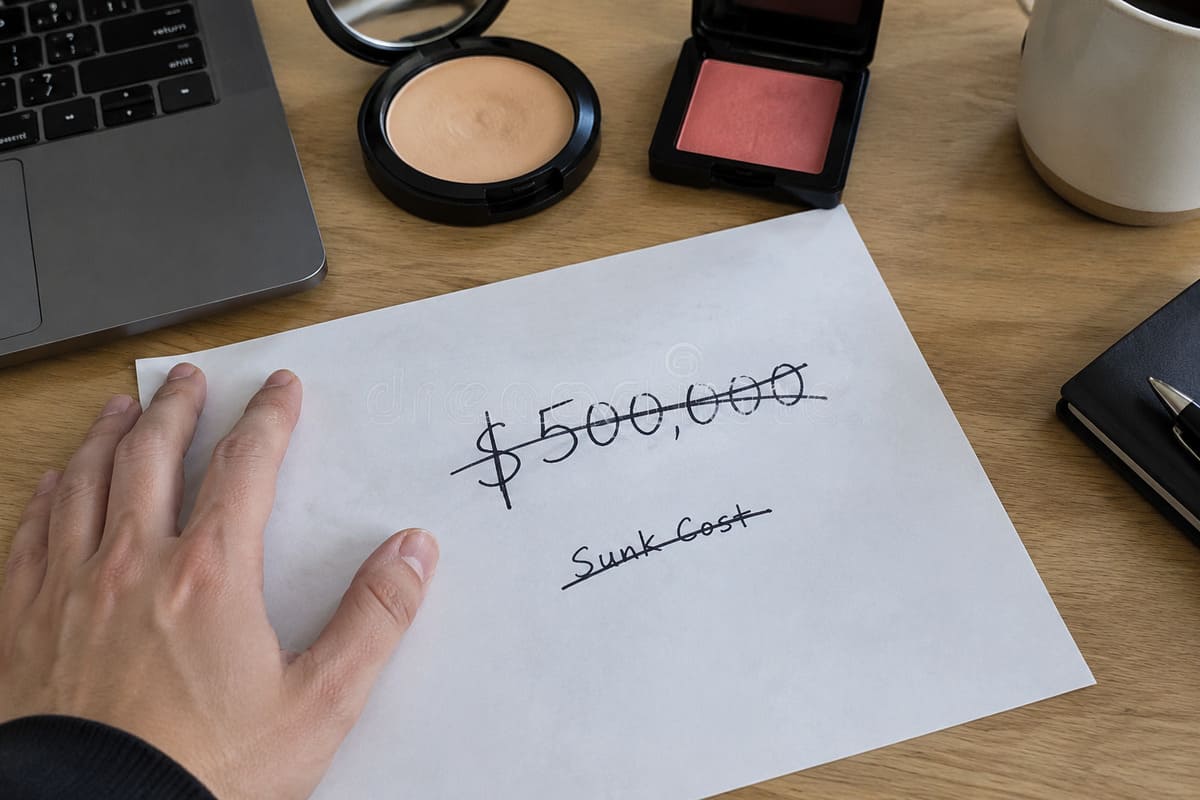
There is a reason the industry splits brand and factory. That split is a feature, not a bug. Let me explain the logic I give every founder tempted by the factory dream.
Dive Deeper: Chef and Waiter, Never Both
Here is the analogy I use. Trying to be both the factory and the brand is like trying to be the chef and the waiter at the same time. You will do neither well. The food gets cold while you take orders. The customers wait while you cook. In cosmetics, the same split applies.
Based on our experience serving global B2B buyers, the industry secret is simple: most "makeup brands" are actually marketing companies that outsource production10. That is not a dirty secret. It is the engine that makes the whole industry efficient.
- The brand owner's job is to build the audience and own the channel.
- The factory's job is to build a safe, beautiful, consistent product.
When those two jobs separate, both get done well. When one person tries to do both, both suffer.
I say this as a factory owner, which should tell you something. I am not trying to sell you a production line. I am telling you not to build one. A new brand that spends its first year buying tanks and chasing environmental permits has no energy left to build the thing that actually creates value—a loyal audience that trusts your name.
Capital is your oxygen when you are starting out. Every dollar locked in a stainless-steel mixing tank is a dollar you cannot spend on content, samples, influencers, or ads. Those are the levers that actually move a new brand. So the rule is blunt: don't buy a factory. Build a brand, and let a Tier 3 partner be your factory.
How to Start with a Low-Risk Manufacturing Strategy (The 2K/5K Rule)?
The fear of being stuck with 50,000 unsold units is real, and it is paralyzing. I have seen founders freeze for a year because every supplier they found demanded volumes that would bankrupt them if the product flopped. That paralysis is unnecessary. There is a staged path that removes almost all of that risk.
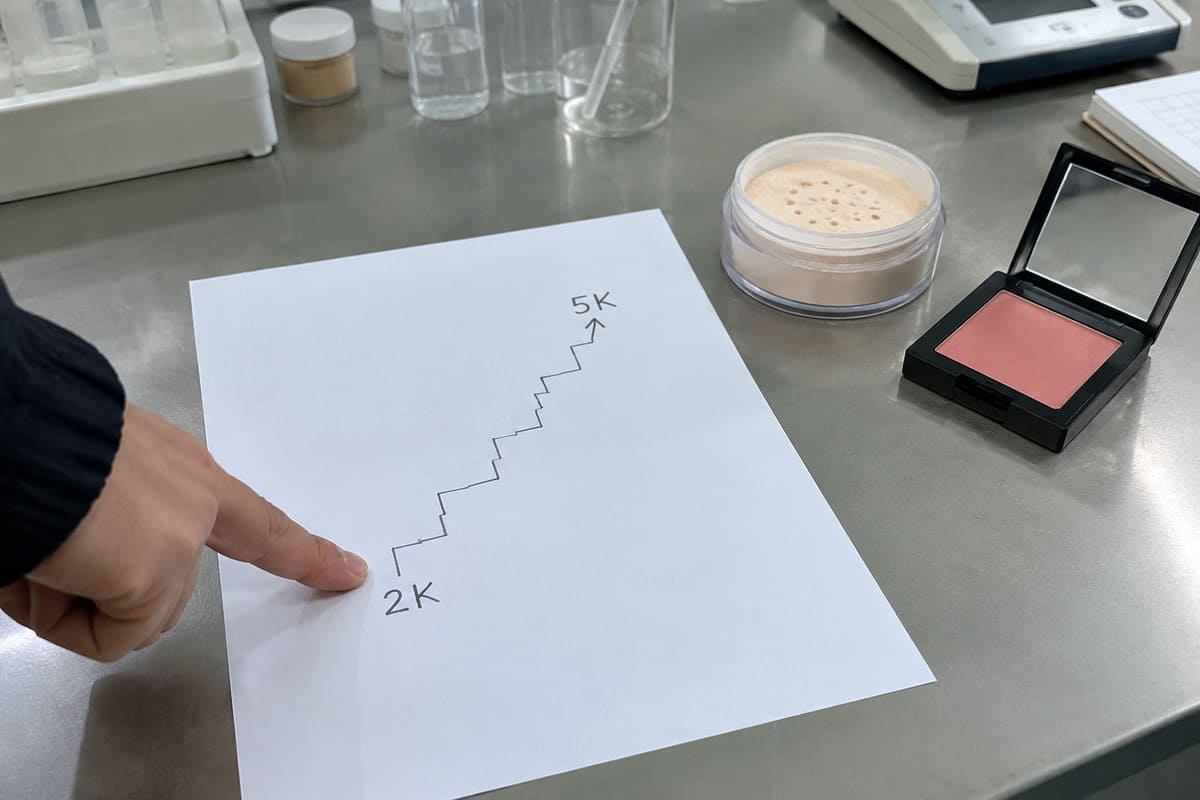
The low-risk path is the 2K/5K Rule. Start with a 2,000-unit trial run of a standard eyeshadow palette to validate the market. Once those sell, reinvest profits into a 5,000–10,000 unit custom order with exclusive packaging and shades. You test cheaply first, then scale into true customization only after demand is proven.
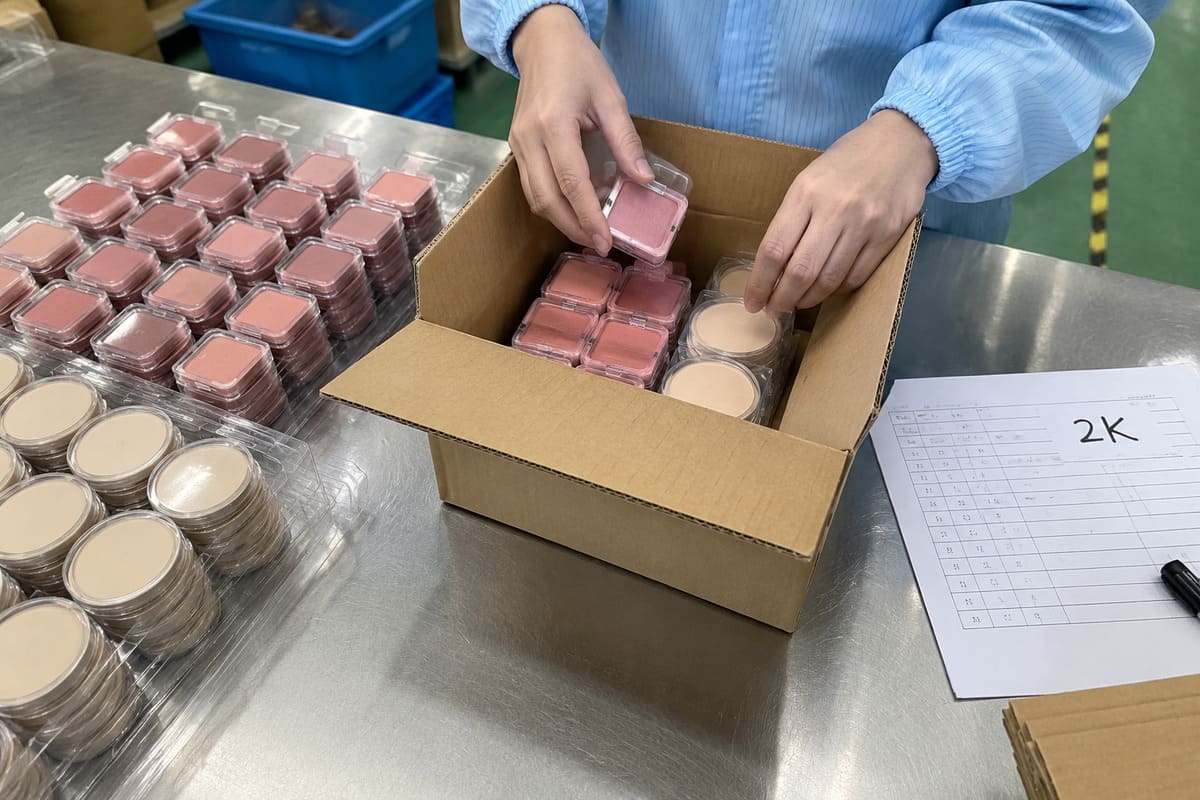
This two-step method is the single most important thing I teach new buyers. Let me show you exactly how the numbers and timeline work in practice.
Dive Deeper: How the 2K/5K Rule Works in Practice
The logic is validation first, customization second. You never gamble big money on an unproven idea. You spend small money to learn, then spend bigger money on what you know works.
Step one: the 2,000-unit validation jump. We offer this on selected standard eyeshadow palettes. You pick from proven formulas and shade layouts, add your branding, and launch. The risk is limited to one small order. If the market loves it, you have real data and real cash flow. If it misses, you lost a controlled amount, not your savings.
Step two: the 5,000–10,000 unit custom order. Once your 2,000 units sell out, you reinvest profits into true customization—custom molds, exclusive formulas, and bespoke packaging. This is where a real brand with a moat is built. Custom work carries a realistic MOQ of 5,000–10,000 units because molds and exclusive formulas have genuine setup costs.11 I will not pretend otherwise.
| Stage | Order size | Product type | Purpose | Capital risk |
|---|---|---|---|---|
| Validation | 2,000 units | Standard palette + your branding | Test the market | Low |
| Scale | 5,000–10,000 units | Custom formula, molds, packaging | Build a moat | Moderate, demand-proven |
Here is my honest boundary, because trust matters more than a sale. I will not sell you 50-unit generic white-label junk and call it a brand—that path has no moat and no future. I will also not tell you to build a factory. The 2K/5K Rule is the middle path: small enough to be safe, real enough to become a genuine brand. You validate, then you commit. That sequence protects your capital at every step.
A Real Case: How One Founder Launched Without a Factory?
Let me tell you about a client who nearly made the heavy-asset mistake. His story is the clearest proof I have that you do not need a factory to launch. I think about his case every time a new founder asks me where to start.
One founder came to me while pricing out his own small cosmetics factory. I showed him the hidden costs and the 2K/5K Rule instead. He launched a 2,000-unit standard eyeshadow palette in weeks, with zero capital tied up in equipment. When it sold out, he reinvested into a 5,000-unit custom order with exclusive packaging.
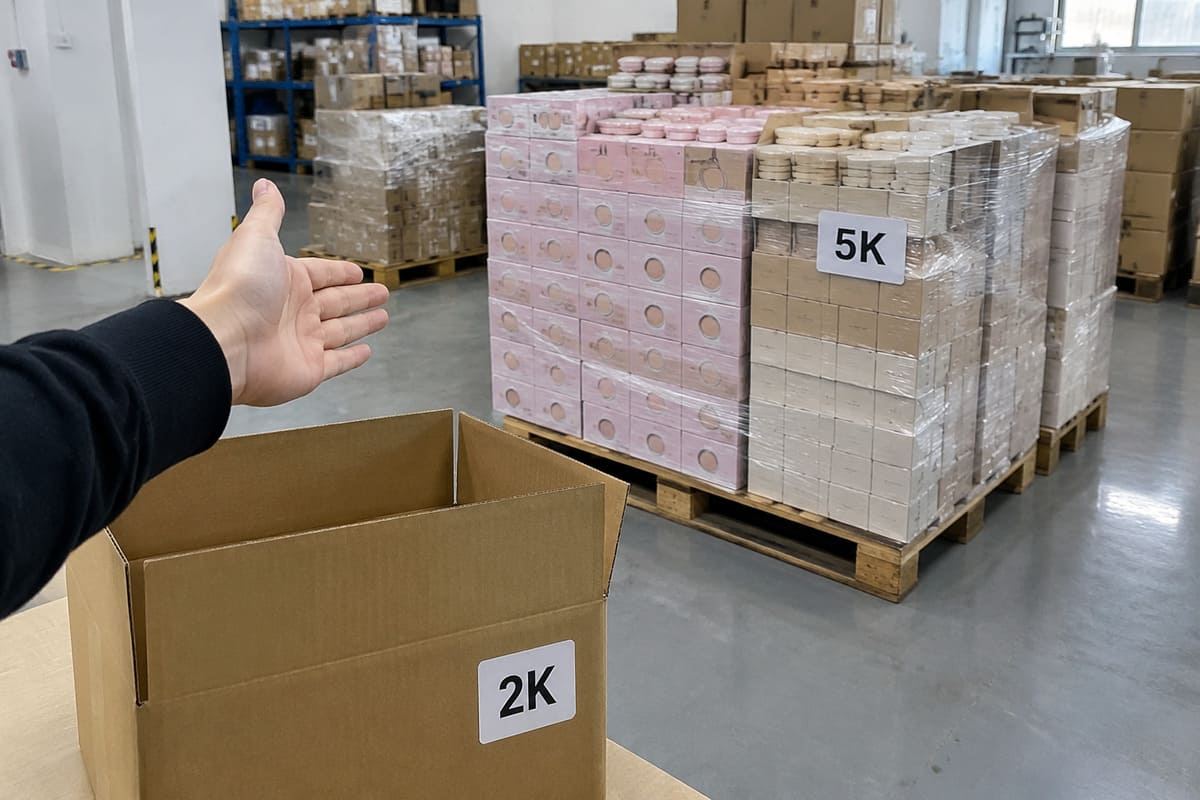
The transformation in his timeline and his bank balance was dramatic. Let me walk through exactly what happened, from the problem to the result.
Dive Deeper: From Factory Dream to Fast Launch
The problem. He arrived convinced he needed to build. He had been researching equipment costs for weeks and was about to spend tens of thousands of dollars plus months of time on machinery and compliance—just to launch a single first product. He did not know that even massive influencer brands used contract manufacturers in their early days. He thought owning the factory was the serious, professional move. It was actually the riskiest move on the board.
The solution. I told him the truth plainly: "You are a brand owner, not a factory owner. Your superpower is marketing and branding, not running a production line." Then I laid out the hidden costs—environmental permits, MoCRA facility registration, endless line maintenance—and the 90/10 time trap. If he built, he would spend 90% of his time managing the factory and 10% marketing his brand. I advised the 2,000-unit trial on a standard eyeshadow palette. We handled manufacturing. He focused entirely on selling.
The result. He launched in weeks instead of months. Zero capital sat trapped in equipment. His money went into content and audience-building, where it belonged. The 2,000 units sold out. Then came the best part: he reinvested his profits into a 5,000-unit custom order with exclusive packaging and custom shades. He climbed from validation to a real differentiated brand—without ever owning a mixing tank.
That is the whole thesis in one story. Build the brand. Let the factory be ours.
Frequently Asked Questions
Who actually manufactures makeup for most brands?
Contract manufacturers make most makeup, not the brands on the label. The industry splits into three tiers: in-house giants, mega CDMOs, and agile contract factories. Roughly 90% of new brands outsource production to Tier 3 contract manufacturers and focus their own time on branding, audience, and sales.
Do I need to build a factory to start a makeup brand?
No. Building a factory traps your capital in equipment and forces you to manage permits and maintenance. A contract manufacturer lets you launch in weeks instead of months. Even large influencer brands used contract manufacturers to launch. Your job is the brand; let a factory handle production.
What is a realistic minimum order quantity for a new brand?
For a standard eyeshadow palette with your branding, a 2,000-unit validation run is realistic and low-risk. For true customization—custom molds, exclusive formulas, bespoke packaging—a realistic MOQ is 5,000–10,000 units. Start with 2,000 to test the market, then scale into custom orders once demand is proven.
Why won't big CDMOs like Kolmar reply to my emails?
Mega CDMOs serve giants and large established brands. Their minimum orders often start at 50,000+ units per SKU, so a pre-revenue startup is not yet their customer. This is not personal. Start with a Tier 3 agile manufacturer, validate your product, then scale as your volumes grow.
What certifications should I verify before exporting cosmetics?
Requirements vary by market. For the US, MoCRA facility registration and product listing apply. For the EU, CPNP notification and a safety assessment are standard12. Treat any certification as a document you should verify yourself, and consult a qualified regulatory professional for your specific product and target market.
Conclusion
When you ask who manufactures makeup, remember the answer is a pyramid, not a locked door. In-house giants and mega CDMOs serve a world you do not need to enter yet. Agile contract manufacturers are where real brands begin. The smartest strategy is not owning a factory—it is validating with a 2,000-unit trial, then scaling into 5,000–10,000 custom units once demand is proven. Protect your capital. Build your audience. Let us handle the supply chain. If you are ready to launch without the heavy-asset trap, reach out and I will map a trial run to your stage.
"Makeup Manufacturer Australia: The Real Cost of “Local” vs ...", https://vertinabeauty.com/makeup-manufacturer/. Industry analyses of the cosmetics contract manufacturing market document that a majority of brands rely on third-party production, though reported proportions vary by segment and methodology. Evidence role: statistic; source type: institution. Supports: A large majority of cosmetic brands outsource production to contract manufacturers rather than operating their own facilities.. Scope note: Published figures rarely isolate 'new brands' specifically, so the exact 90% share is not directly verifiable from standard market reports. ↩
"Perfumes, Cosmetics, and Other Toilet Preparations ...", https://nepis.epa.gov/Exe/ZyPURL.cgi?Dockey=P1000M3N.TXT. Environmental regulatory guidance indicates that manufacturing facilities, including cosmetics producers, generally require permits governing discharge and waste management. Evidence role: general_support; source type: government. Supports: Cosmetic manufacturing facilities are typically subject to environmental permitting covering emissions and waste handling.. Scope note: Specific permit types and thresholds vary widely by jurisdiction, so the requirement is contextual rather than uniform. ↩
"Registration & Listing of Cosmetic Product Facilities and ...", https://www.fda.gov/cosmetics/registration-listing-cosmetic-product-facilities-and-products. The U.S. Food and Drug Administration sets out facility registration and product listing obligations under the Modernization of Cosmetics Regulation Act of 2022. Evidence role: definition; source type: government. Supports: The Modernization of Cosmetics Regulation Act requires facilities that manufacture or process cosmetics for the US market to register and list products with the FDA.. Scope note: Specific registration deadlines and exemptions change over time and should be checked against the current FDA guidance. ↩
"Kylie Cosmetics", https://en.wikipedia.org/wiki/Kylie_Cosmetics. Reporting on Kylie Cosmetics indicates the brand's early products were produced and fulfilled through an external partner, consistent with a contract-manufacturing model. Evidence role: case_reference; source type: encyclopedia. Supports: Kylie Cosmetics launched using a third-party manufacturing and fulfillment partner rather than a brand-owned factory.. Scope note: Public sources describe the partnership arrangement but may not fully detail which production steps were outsourced versus internal. ↩
"Permit Process", https://www.sa.gov/Directory/Departments/DSD/Constructing/Business-Commercial/Permit-Process. Industry guidance on facility setup indicates that standing up a compliant manufacturing line involves a multi-month process spanning construction, validation, and permitting. Evidence role: general_support; source type: institution. Supports: Establishing a compliant cosmetic manufacturing facility typically requires many months for construction, equipment, and regulatory setup.. Scope note: Actual timelines depend heavily on scale, location, and regulatory environment, so the 6–12 month range is indicative rather than precise. ↩
"Coty", https://en.wikipedia.org/wiki/Coty. Corporate histories of leading cosmetics conglomerates document repeated acquisitions of independent beauty brands as part of their portfolio growth. Evidence role: general_support; source type: encyclopedia. Supports: Major cosmetics conglomerates have expanded their portfolios substantially by acquiring established and emerging beauty brands.. Scope note: Acquisition is one of several growth mechanisms and the sources do not quantify its share relative to organic brand development. ↩
"Kolmar Korea - 한국콜마", https://www.kolmar.co.kr/eng/. Company profiles identify Kolmar and Intercos as major original development and contract manufacturers supplying cosmetic brands at scale. Evidence role: case_reference; source type: encyclopedia. Supports: Kolmar and Intercos are established large-scale cosmetic development and manufacturing firms that supply brands rather than selling to consumers directly.. Scope note: Profiles confirm their manufacturing role and scale but may not specify their exact minimum order policies for new clients. ↩
"MOQ in Cosmetic Contract Manufacturing: What to Expect", https://skyatransdermic.com/blogs/news/minimum-order-quantity-moq-in-cosmetic-contract-manufacturing-what-to-expect. Trade and industry sources describe large-scale cosmetic CDMOs as oriented toward high-volume orders, supporting the general claim that their minimums exclude small new brands. Evidence role: statistic; source type: institution. Supports: Large cosmetic contract manufacturers generally require high minimum order quantities that are impractical for pre-revenue startups.. Scope note: The precise 50,000-unit figure varies by manufacturer, product category, and negotiation, so it functions as an illustrative benchmark rather than a fixed standard. ↩
"How to Find a Cosmetics Manufacturer: A Buyer's Guide to Verifying ...", https://vertinabeauty.com/how-to-find-a-cosmetics-manufacturer-a-buyers-guide-to-verifying-real-factories/. Economic and trade analyses identify Guangdong as a leading regional cluster for cosmetics production and supply-chain infrastructure in China. Evidence role: historical_context; source type: research. Supports: Guangdong province is a major concentration of cosmetics manufacturing and related supply-chain activity in China.. Scope note: Sources describe the regional concentration generally and do not attest to any individual factory's capabilities. ↩
"Factory Tour - Real Cosmetic Manufacturing Facility", https://vertinabeauty.com/factory-tour-behind-the-scenes/. Analyses of cosmetics industry structure describe a widespread separation between brand marketing functions and outsourced contract production. Evidence role: mechanism; source type: research. Supports: In the cosmetics sector, brand ownership and physical production are commonly separated, with many brands concentrating on marketing while manufacturing is outsourced.. Scope note: Sources describe this as a common pattern rather than a universal rule, and integrated brand-manufacturers also exist. ↩
"Eyeshadow Manufacturer: How Can Buyers Find a ... - Vertina Beauty", https://vertinabeauty.com/eyeshadow-manufacturer-how-can-buyers-find-a-reliable-factory/. Manufacturing guidance notes that custom tooling and formulation involve upfront fixed costs, which producers generally recover through higher minimum order volumes. Evidence role: mechanism; source type: institution. Supports: Custom molds and bespoke formulations carry fixed development and tooling costs that are typically amortized across higher minimum order quantities.. Scope note: The specific 5,000–10,000 unit range reflects one producer's practice and is not an industry-standardized figure. ↩
"What Ingredients Should I Avoid in Eye Shadow? A ... - Vertina Beauty", https://vertinabeauty.com/what-ingredients-should-i-avoid-in-eye-shadow-a-compliance-guide-for-buyers/. Under EU Regulation (EC) No 1223/2009, cosmetic products must undergo a safety assessment and be notified via the Cosmetic Products Notification Portal prior to being placed on the market. Evidence role: definition; source type: government. Supports: EU cosmetics law requires notification through the Cosmetic Products Notification Portal and a product safety assessment before market placement.. Scope note: Responsibility for notification and assessment depends on the designated Responsible Person, a detail the article does not address. ↩